All blogs

Why Should Performance Budgeting be a Part of your CI/CD?
The automation of any process raises the user satisfaction of that specific project to the next level. However, CI/CD offers more than simply automation to eliminate human error. It helps businesses roll out innovative solutions promptly, effectively, and affordably for users. It is the ultimate cheat code for smoother operations as it enables the delivery of software with fewer risks, frequent deployment of additional features per user demands, and increased developer productivity.
There are various options available now for incorporating performance budgets into Continuous Integration. They ensure that an application does not exceed a specific data cap. Tracking a webpage's performance budget and integrating it with the CI/CD workflow can minimize the performance degradation caused by adding a new code.
What is CI/CD?
Software delivery is a continuous loophole. CI/CD or Continuous Integration and Continuous Deployment are two of its most crucial steps to maintain user satisfaction and operational standards. The entire process is reminiscent of an assembly line with well-defined steps that often need to be done and re-done throughout the software's lifetime.
CI/CD is the process of creating software that allows companies to deploy modifications at any moment in a sustainable manner. With regular code changes, development cycles become more relevant and speedy while maintaining frequency.
Four general steps make up the entire CI/CD process:
- The general architecture for implementing these modifications is known as "continuous delivery."
- The starting step is known as "continuous integration."
- The method of ensuring quality is known as "continuous testing."
- The process of making the finished product available to consumers is known as "continuous deployment."
CI for improved collaboration and quality
Continuous Integration impacts the areas of collaboration and quality control rather significantly. It helps quickly deploy features, allowing the DevOps team to maintain its quality standards. And CI allows it to happen quickly. Here's how:
Easier to spot faults and software quality concerns
Continuous Integration or CI is a development model underpinned by process mechanics and automation. During the CI stage, developers often submit their code to the version control repository. Most teams set a minimum benchmark of committing code at least once daily. The reasoning that prefaces this is that smaller code differentials allow easier detection of faults and other software quality concerns versus bigger codes created over long periods. When teams work on tighter cycles, it is less likely for many developers to modify the same code simultaneously, eliminating a merge when committing the code.
Short and long-term time frames to develop features and improvements
Continuous integration teams frequently commence projects by configuring version control and practice definitions. Although code is checked often, improvements and fixes are introduced in long and short time frames. Continuous Integration development teams use many ways to govern whether features and code are production-ready.
Feature flags for better testing and higher quality software
Many teams employ feature flags, a configuration mechanism that allows them to toggle features and code on and off at the run time. Features still in development are enveloped in code with feature flags, pushed to production alongside the main branch, and left off until their time of use. Feature flags offer improved testing and superior quality. Optimizely Rollouts, CloudBees Rollout, and LaunchDarkly are feature flagging tools that connect with CI/CD platforms and enable feature-level configurations.
Version control branching
Version control branching is another way of managing features. A branching strategy establishes a protocol for integrating new code into standard development, testing, and production branches. Additional branches are generated for features that may need longer development cycles. Once the feature is completed, the developers can merge the modifications from the feature branches into the main development branch. However, an effective strategy can be tough to manage when numerous features are created simultaneously. In such cases, one can automate the build process by packaging the software, databases, and other components.
Achieves complete testing automation
In addition to bundling all application and database components, CI automates the execution of unit tests and other testing. This testing ensures that the developers' code modifications did not break any current unit tests.
Why do you need CI/CD?
CI/CD is a smart integration plan for any DevOps team. But why exactly should it be considered? Given below are a few reasons why.
Quicker software building
Integrating CI and CD results in much quicker builds and faster delivery outputs. With deployments running in a continuous sequence, it enables a project's consistent tracking, provides real-time feedback, and repairs errors as required. Continuous reviews enable product development to remain tuned to end-user expectations.
Better time-to-value proportion
The development pace is tremendous, and the delay between introducing and delivering a new feature is lessened considerably. The team devotes less time and effort to debugging and more time to creating new features. It also results in a shortened feedback loop, and the amount of time separating user participation and updates. As a result of using the CI/CD automated system, the DevOps team produces faster test results for the development and deployment of the application.
Management based on data
The CI/CD approach also requires continuous data monitoring of the development process. Once the procedures and insights become apparent, the team can optimize the existing workflow and remove engineering impediments. This results in a more sophisticated system and a quicker turnaround for the intended software solution.
Effective development
The goal of CI/CD is to improve the integration process by breaking it down into essential and regular development tasks. That helps reduce build costs and discover errors early in the software lifecycle. It increases real-time transparency, allowing developers to work much more efficiently.
Performance budgeting explained
A performance budget is defined as a set of regulations placed on metrics that impact site performance. Performance metrics are a vital part of the user experience. It may include the overall page size, a site's load time on a mobile network, or the total number of HTTP requests sent. Setting a performance budget is the reference point for making design, technical, and feature decisions.
A budget allows designers to consider the impact of high-resolution photos and the number of web fonts they select. It also assists developers in comparing diverse solutions for an issue and evaluating libraries and frameworks based on characteristics, such as size and parsing costs.
Why use performance budget
A budget exists to represent a site's attainable objectives. It is a balance of user experience and other performance measures. It also entails many other advantages mentioned below.
Improves expenditure
A performance budget is essentially a rundown of the amount of data that the development of a website might require to create a well-functioning website. Little similar to allocating funds for a business. It ensures better utilization of resources and cuts down anticipated wastage.
Betters performance
The web continues to grow in size. The size of web pages is also increasing, as are the various resources necessary to display a webpage, such as graphics, scripts, and style sheets. A quick, responsive website is essential for a successful business. The performance budget is a strategy that places performance at the center of development and eliminates needless distractions that cause the site to slow down.
Effective allocation of funds
Performance budgeting plays a rather significant role in the allocation of funds. It explicitly maps out the objectives and uses for allocated funds, increasing visibility with budget planning.
Assists in reviewing the efficiency of programs
Quantity-based metrics do not have a direct relationship to the user experience. However, they provide the critical advantage of providing metrics that are far easier to understand and prepare for than the effect on the user experience.
Combines planning, budgeting, and programming
Performance budgeting allows the integration of three of the most significant aspects of site development. The budgeting enables a better understanding of the site requirements. That results in better programming of the site for its smooth functioning.
Metrics for performance budgeting
Being able to measure something is the only way to improve performance. It is especially true for websites where the metrics influence the overall website performance. Let's consider three primary performance budgeting metrics that track the user-friendliness of a website:
Time-based metrics
The majority of time-based metrics are referred to as "milestone timings." This metric type indicates how quickly specific components of the website load. DOMContentLoaded and load events are two of the most frequent events used to measure page load speed. However, they do not present a complete user experience because the server might send a minimal page to the user while deferring actual content load and display for many seconds.
Some of the essential timing metrics employed in a performance budget are as follows:
- Cumulative Layout Shift (CLS)
- Time to Interactive (TTI)
- Total Blocking Time (TBT)
- First Contentful Paint (FCP)
- First Input Delay (FID)
- Largest Contentful Paint (LCP)
Quantity-based metrics
These metrics are consequential in the early phases of development since they illustrate the implications of including large pictures and scripts. It's much simpler to grasp the effect of one extra script, or another large picture, on a 300kb budget than on a SpeedIndex budget. They are also simple to convey to designers and developers and help their collaboration process. Their primary benefit is that they are considerably easier to envision throughout the design and development process.
Rule-based metrics
Website speed testing tools such as WebPageTest and Lighthouse can generate performance ratings that users can use to define the site's performance budget. One can count on these tools to be generally consistent since they adhere to standard best practice criteria for measuring site performance. DevOps teams receive the best results when they monitor a mix of quantitative and user-centric performance measures. Focusing on asset quantities and tracking FCP and TTI can be beneficial in the early stages of a software development project. Lighthouse also provides tips on improving site performance and creating a performance budget.
Tools for enforcing performance budgeting
WebPageTest: WebPageTest API is one of the most trusted website performance testing tools. It is a free tool that allows users to create an account and retrieve test results for a year. One can also use the WebPageTest API to automate the tests.
Lighthouse LightWallet: LightWallet is a feature integrated with Google Lighthouse that allows users to establish a performance budget. When testing a website with Lighthouse, it will immediately notify the user if any metrics exceed the budget limitations. Users can also use the Lighthouse Bot to define a performance budget and automate the performance testing process.
SpeedCurve: A high-end website speed testing and monitoring application, SpeedCurve also allows users to create performance budgets. If any metric exceeds budget limitations, the tool promptly sends an alert.
Calibre: Similar to SpeedCurve, Calibre is a premium performance tracking tool that allows users to define performance budgets and receive notifications when any metrics exceed the budget limit.
Conclusion
The current scenario requires organizations to go digital in some way or another. Even smaller businesses have a website or are looking to create websites to sell their services. Adopting CI/CD is a need rather than a choice. No matter how small the company is, website maintenance is a mammoth task that invites a lot of monetary investment. That is where performance budgeting tools can prove to be a worthwhile investment.
Performance budgeting can help in the efficient development, update, and integration of software. Performance budgeting tools can assist in focusing on improving site performance even more efficiently.
In addition to helping enhance site performance and speed, some of these tools are also available free of cost. It is a massive boon since it helps eliminate excessive monetary investments while maintaining a functional website.
.avif "Your Business Can Make the Internet More Accessible")
Your Business Can Make the Internet More Accessible
The power of the Web is in its universality. Accessed by everyone regardless of disability is an essential aspect
– Tim Berners-Lee, Inventor of the World Wide Web
Most companies are focused on developing out-of-the-box products - something that gives them an edge and distinguishes them from their competitors. While they do keep the target audience in mind, sometimes the factor of accessibility still skips their consideration.
Now, what good is any product or service if it isn’t easily accessible by the people it is intended for? This audience can include both people with disabilities or neurodivergent individuals, people with a lack of technical understanding where they require additional assistance.
Keeping this in mind every business must ensure that their websites, products, tools, and technologies are equally accessible to everyone. The ease to access, navigate, perceive, and contribute to the Internet represents web accessibility.
In today’s world, providing equal access and opportunity to every disadvantaged person to put them on par with others is the need of the hour. Especially so when one billion people worldwide suffer from some form of disability! From a business point of view, ignoring this market segment would only bear losses and hamper the growth of your company.
Consider the BBC website, one of the first websites to explore and invest in responsive website design. Their digital team is committed to offering people ‘Accessibility Help’ right when you land on their page. From hidden texts that offer extra information to screen reader options further ensuring the site is easy to navigate with a keyboard, the website is loaded with several accessibility enhancements.
Hilton Columbus at Easton is another great example of an accessible website. It's designed keeping in mind people suffering from seizures and epilepsy. Its website allows its users to choose the best accessibility profile that suits their preferences. There are no flashes, no blinking animation, and no loud color combinations, making it a seizure-friendly website!
4 ways to achieve web accessibility
For several years, businesses treated the concept of diversity and inclusion as an additional chore. Yet today, it has become an integral part of most organizations. Similarly, companies are now waking up to the idea of web accessibility having a very real impact on their business.
With accessibility in tow, you allow your business to open up to an entire community of disabled people, thereby growing your potential market base. Moreover, without accessibility, your business risks getting entangled in a web of whacking lawsuits and negative public exposure.
So, choosing web accessibility is an irrefutable win for your business and a step forward in creating an inclusive virtual world. But, how to achieve this state of complete accessibility? How can you transform your business to ensure better inclusivity and a good experience for disadvantaged people?
By training your team
To achieve web accessibility, the first step is to educate your workforce about it. Set a training strategy in place, and enlighten them about how accessibility simply means creating smarter designs for the audience.
This will help you drive up the profits of your business by about 50%. Additionally, it would also allow your workforce to build a new skill set, thereby boosting their productivity and enhancing the workflow in the longer run.
Once your team understands the significance of accessibility, they are more likely to think from the perspective of a user with special needs that they earlier ignored. This would help create accessible websites that comply with the needs of the targeted end consumers.
Offering conscious accessibility training would also that you are open to improving the work culture and creating a more diverse and inclusive workspace. Remember, a happier and satisfied team is likely to be more resilient and stick by you, reducing the chances of employee turnover.
By testing and re-testing
As with any product or service, the more it grows, the harder it becomes to fix its oddities. So, when you aim to design an accessible website, it's essential to continuously test it out. It would allow you to better understand the feasibility and usability of accessible features while still having the room to make adequate changes.
However, most companies fail to take the target market into account when testing, and re-testing. So, do not treat the data about the disabled community as an anomaly, instead, make them an inherent part of your personality profiles.
Remember, they are the people you are designing for; not a bycatch who wouldn't interact with your website. Make sure you invite them to your office and ask for their honest reviews. Ask questions like 'did a certain feature work, or did it create an additional hurdle?'
This is important because understanding how they interact with the software will help you carry out more accurate testing accordingly. You can fast-track the process, straighten out the kinks, and mitigate the number of re-checks eventually.
In the end, your website will reach its targeted audience faster!
By building an in-house accessibility team
The concept of accessibility is still relatively new. It's not practical to expect all your employees to understand the concept intricately. That said, it’s essential to constitute an internal accessibility team.
This team should ensure that the web design coincides with the accessibility objectives. Additionally, the team will become a go-to for everything that concerns accessibility and inclusivity, and will be responsible for training the rest of the members.
Moreover, an internal team will already be aware of the developments and act accordingly, ensuring that every aspect and concern is aptly addressed. This will save time and ensure that accessibility becomes a core part of the everyday work process.
By allocating the budget smartly
When allocating budgets, you cannot simply limit your vision to short-term goals and immediate returns. While accessibility is a money-maker, its results will not be instantaneous. Yet, once the untapped market opens up, you will avoid great legal setbacks that would have come without accessibility. This is when you'll see the true returns.
Inclusivity reflects thoughtfulness, and that is something your consumers will fall in love with, in due time. So, it's crucial to fix an accessibility budget after considering the purchase of specialized tools, the cost of educating your team, and the time spent in formulating testing strategies.
Do not become part of the herd that skips over accessibility conversations, ignores an action plan, and keeps aside no budget for crafting an accessible website experience. Otherwise, you would be left scampering, trying to fix the issues later at greater costs and in little time.
ROI of Web Accessibility
"Outer beauty turns the head, but inner beauty turns the heart."
This phrase is relevant to both our physical and virtual lives. It's not enough to simply be beautiful and eye-catchy; the inner beauty in website designs counts just as much.
This brings us to one of the indisputable core considerations when designing a website: accessibility. Ensuring that those with special needs do not have a negative experience when consuming web content is a pressing priority!
But, what’s in it for you? Implementing web accessibility brings about several benefits that you cannot refute. Let’s take a look!
Prevents discrimination lawsuits
The Internet is a significant part of every person’s life. There is hardly anyone who might be bereft of the magic of Google. No wonder web accessibility is now a civil right for disabled people. They have the same right to enjoy, explore and make the best use of digital technologies as any other.
The Americans with Disabilities Act (ADA) ensures equal access and enjoyment of public places for people with disabilities. While ADA does not explicitly include web accessibility, the legislation encompasses digital spheres.
Additionally, if you look at the numbers, you will see that web accessibility lawsuits are growing every year. In 2021, there were 2,352 lawsuits against U.S. businesses, which is 14.3% more than in 2020!
So, if you do not want a discrimination lawsuit in your hands, then working towards web accessibility is a need, not a choice.
Reach a wider range of audience
A billion people live their lives with disability of some form. Ignoring this potential market segment will simply cause negative repercussions and losses. So, while it's impossible to create an accessible website that meets the requirements of every single person, a couple of modifications can surely go a long way.
Features like closed captions, transcripts, clear and simple design, and easy mobile accessibility would be useful for everyone, not just disabled people! Hence, you must tap the unexplored potential market and allow your business to flourish!
Creates better public image
This is the era of digital activism. People are growing more conscious of the businesses that they choose to support. They are sticking to their ideals, beliefs, and values, and any business that does not meet the same standards is out of the race in no time. Corporate social responsibility is not an afterthought anymore.
70% of American consumers are inclined to positively interact and purchase from a business that’s making a genuine effort to make the world a better place. Another 55% of American consumers believe that companies must take a vital stand on social, political, and environmental issues.
Today, web accessibility has become an important cause for not only the disabled community but also people who have disabled loved ones in their lives. So, taking a righteous stand on the web accessibility cause and working for it will allow you to build an excellent brand image for your business.
People with disabilities, and their friends and family, are more likely to recommend your business if you create positive interactions. So, create an accessibility statement for your business. State your commitment to creating an accessible website and mention the steps you undertook to accommodate disabled people.
Enhances search engine optimization
Improving the usability of your website is one aspect of web accessibility. But there's something more that it does – it improves search engine optimization (SEO), thus making your site easier to find. With better SEO, your content will witness higher traffic, and your website rank will increase.
The clean interface of the website and its easy navigation by disabled people will improve the bounce rate as well. Keep in mind that search engines are mostly text-based. They cannot search through your videos and audio content unless there are transcripts and closed captions.
It helps Google to easily discover texts which are then indexed appropriately. Hence, it inadvertently helps redirect more users to your website and ultimately not only helps people with disabilities but everyone else, too.
Increases usability
The concept of web accessibility and usability overlap each other. The goal is to create websites, services, and products usable by every person, especially disabled people. You need to ensure that your website is entirely navigable through the keyboard, making it easier for people unable to use a computer mouse.
Keyboard accessibility ensures that all the elements of a website are organized in a proper hierarchy to help locate the content effortlessly. Using alternative texts for objects and images allows people with visual impairment to understand the visual content better. It also helps those struggling with slow internet since they can see the written content before the visuals pop up.
Last but not the least, creating a glossary of rare words, acronyms, jargon, etc., also makes your website accessible to people with cognitive disabilities. Not to forget, it serves as an aid to people who may not understand English very well or have linguistic barriers.
The cost of web accessibility
Before you can understand the cost of web accessibility, it’s essential to understand what ROI means. In mathematical terms, ROI = (Net Profit/Cost of Investment) x 100.
In simple terms, good ROI increases revenue and improves the net profit. But the ROI on web accessibility is not limited to just good revenue. This investment also helps you steer clear of possible future expenses.
Now, to gain positive ROI from web accessibility, there are two ways: Firstly, you can upgrade the customer's lifetime value and ensure your business's customer retention rate is top-notch or secondly, you can infer the total sum of money you spend on acquiring new customers and invest accordingly.
So, gain an ROI from web accessibility by ensuring that your net profit is more than the amount you spend on it. You could either do so by acquiring new business or ensuring that you create a base of loyal customers. As a simple rule of thumb, strive to maximize the ratio of loyal customers to the action of acquiring new customers.
Ideally, this ratio should be 3:1 (retaining loyal customers: acquiring new customers) for your ROI to be dubbed a success. In terms of accessibility, your goal must be to attain 300% from web accessibility instead of the cost you spend in making your systems accessible.
Remember there is a risk of enduring losses if you do not strive to achieve accessibility. You can calculate this possibility of loss as well – (Probability of negative event to occur/total number of businesses in your industry who dealt with a loss) x 100
While it's hard to gauge the probability of an event that may or may not happen, it will allow you to gain some insights. Lastly, calculate the amount you spend on accessibility. It includes the money spent for consultations, audits, tools, and training.
It also includes the time spent, materials utilized, and the number of employees involved. If your investment cost is lesser than your ROI, i.e., increment of customer base and retention of loyal consumers, then you are golden!
Consequences of inaccessible websites
Want to know something intriguing?
In 2020, a WebAIM study found that not even 2% of top websites offer web accessibility. Another Forbes article stated that 71% of people with disabilities bounce off a website due to inaccessibility. What's even more baffling is that the global population of disabled people holds the spending power of over $1.2 trillion!
Yet, little to no companies are catering to their needs, leaving this market unexplored. Ultimately, it's a huge monetary and goodwill loss for businesses not capitalizing on this under-the-radar section of the market. In today's day and age, you cannot disregard the consequences of an inaccessible website.
Otherwise, your business runs the risk of:
Legal threats
With more stringent rules in place, websites that do not follow the WCAG accessibility guidelines are sued. Any lawsuit about web accessibility will have you spending big bucks on an attorney or outside counsel, fees on filing, and discovery costs.
Moreover, if you do not find a permanent solution, it would result in a never-ending tailspin. More lawsuits will continue coming in, and it will drain both your money and time, and weaken your organization completely.
Destruction of brand image
The demographic of disabled people is on a continuous rise. If you do not listen to their voice, needs, and demands, you risk gaining a bad reputation. Given that the general customer base is getting more inclined towards being ethical and morally correct, your corporate identity is likely to suffer.
Lack of competitive edge
Web accessibility can serve as a market differentiator between you and your competitors. If you don’t create a barrier-free, easily accessible website and environment, and your competitor does, then you will lose a significant market segment to them. Ultimately, this would result in a grave loss for your business revenue.
All about laws related to web accessibility
The U.S. has certain web accessibility laws set in place. Its violation could reflect adversely on your business. The Americans with Disabilities Act (ADA) is the primary law that exists in this regard.
Title III of the ADA states that any discrimination “based on disability in the activities of public accommodations” is prohibited.
Sure, this law was instituted keeping the hurdles present at physical locations in mind, but it is now also applicable to the virtual world. Keeping this in mind, let’s take a look at some prominent web accessibility laws:
Web Content Accessibility Guidelines 2.0 (WCAG)
WCAG is a globally recognized standard of accessibility formulated by the World Wide Web Consortium. Its sole aim was to construct the Web, which is more accessible for disabled people.
Although WCGA talks about a comprehensive range of issues, it cannot address the specific needs of every disabled person. But it aims to make the Web usable by all, including older individuals who struggle with aging and physical limitations.
Thus, with its goals clearly outlined, the first WCAG came out in 1999 and the 2.0 version was published in 2008, which has become the definitive standard across the world.
These guidelines provide 4 overarching design principles to develop accessible websites. It also offers guidance to developers and designers to help make accessible designs. Lastly, it stipulates a certain standard of technical requirements that every website must meet.
The Americans with Disabilities Act (ADA)
This law was enacted in 1990 to ensure there was no discrimination against people with disabilities. The Act does not talk of web accessibility explicitly. Yet, it ensures that if businesses offer services and products on their websites, they must be easily and equally accessible even to disabled people.
The Rehabilitation Act
The Rehabilitation Act 1973 was the first U.S. law that prohibited discrimination against people with disabilities. Section 508 of this Act dictates that Federal agencies must ensure that their information and electronic technology are easily accessible by disabled people.
In 2018, this section was updated to include WCAG, thus harmonizing the accessibility requirements as per universal laws. Do note that this section does not apply to private organizations unless they receive federal funds or are employed by a federal agency.
Twenty-first Century Communication and Video Accessibility Act
This Act updated the accessibility laws that ran through the 80s and 90s to bring it up to speed with 21st-century technologies. So, it allows for increased access for people with disabilities to utilize modern communications like mobile, broadband, and digital innovations like any other person.
These web accessibility laws are crafted for people who suffer from any kind of disabilities – mobility, hearing, vision, speech, independent living, cognitive, self-care, neurological, language, and learning incapacity.
Additionally, ADA, the primary law regulation in regards to web accessibility, applies to the following business categories:
- Lodging
- Exercise or recreation
- Business concerning foods and drinks
- Social services
- Entertainment and exhibition
- Education
- Public gathering
- Public display
- Rental or sales business
- Public transportation
- Service establishments
- State and local governments
Main pillars of accessibility
Moreover, these ADA laws are enforceable by the federal government through the motions of the Department of Justice. The federal government can demand civil penalties and seek changes. Usually, the class action suits under this law target big businesses, forcing them to change their inaccessible practices.
So, to save yourself from the trouble of being sued under any of these legislations, ensure that you comply with accessibility standards- the four main pillars of accessibility that are elucidated in WCGA:
Perceivable
Your website must be easily readable and discernable by all users, especially those suffering from impaired vision.
Look at the Condor Hotel website, for instance. Their website has a clean interface and font that is effortlessly intelligible, and the text expands aptly to accommodate the changing screen orientations as per the user's device.
This allows it to be more adaptable to people suffering from visual disabilities like cataracts, tunnel vision, glaucoma, etc.
Operable
A responsive and easily navigable website design is a must. Moreover, it should be such that users can easily access it over any device and browser.
If you look at Shopify’s website, you will get an ideal sense of how responsive websites should be. The user experience on their website is consistent across all mediums of devices.
Additionally, the illustrations and CTA change as per the device used, making it easy to observe and access. Shopify's menu also changes to a hamburger icon when you use it on handheld devices, thus making it easy to navigate.
What’s most impressive is their loading speed which is under 5 seconds despite the image carousels!
Understandable
Organize your website effortlessly, allowing your users to quickly spot important features and content. The more self-explanatory your website is, the easier it becomes to comprehend for the user.
Remember, minimalism is the key! Also, using a common language that most of your audience would understand will increase the website's relevance.
If you hop on Ginza’s website, you will find a very concise and clear web design. Their content is divided into easy-to-understand short copies, and the images further drive the point.
Moreover, the overall design is subtle and creates a sophisticated look, and allows a user to glide through the site without any difficulty.
Robust
Integrate your website with assistive technologies that help people with disabilities easily surf across your site.
You must be familiar with Netflix which uses several accessibility features and assistive technologies to provide the same entertaining experience to one and all.
Additionally, assistive listening systems, audio descriptions, keyboard shortcuts, compatibility with common screen readers, subtitles, and voice commands are some of its prime accessibility features.
Wrapping up
No two people are ever the same– their needs differ, and so does their ability to comprehend, access, and use most things, including websites.
Since the number of people with disabilities is quite considerable and ever-growing, it's only fair to cater to their specific needs and requirements. Not to forget, offering equal access and providing them with a similar experience as you would to any other person is a must in this era.
Moreover, web accessibility brings with it a lot of positives too– from great brand image to reduced litigation affairs. On the other hand, if you ignore it, you run the risk of losing what could potentially be your biggest customer base.
So, the bottom line is when most of your consumer base is waking up to the idea of greater morality, ethics, and inclusivity, why shouldn't you?

Craft a Distinctive Differentiating Strategy for your Brand
Your brand is the sum total of your business’ efforts to create, position, and market the products and services you offer. Your brand positioning is the Unique Selling Proposition (USP) or Unique Value Proposition (UVP) of your brand that makes it stand out from the crowd.
Differentiation is the word to describe a brand strategy and positioning. It is essential if you want your brand to achieve a competitive edge over other businesses in the market. How you portray your brand today will determine its future success. A well-designed brand strategy will help you stay relevant today and in the future.
A brand strategy is more than just copywriting to read or a CTA to click. It is the journey of your company from where you are today to where you want to go next generation. It's about planning today how your business will succeed tomorrow. Your brand positioning should be carefully thought out and planned prior to development, ensuring it reflects the business vision and mission.
Differentiating your brand among competitors
In many B2B industries, enterprises offer the same product with marginal differences. What will differentiate them is their brand positioning. For example, consider Slack. It was initially intended for internal communication but not created for public use. The founders saw the potential in Slack and launched it to the public in 2012. Today, it has grown to be one of the top communication tools in the market.
Slack’s brand positioning statement is, “Making work-life simpler, more pleasant and more productive.” The statement says nothing about Slack but describes how you would feel if you use Slack. The tool also focuses on a few key features that make its positioning statement a guarantee.
Slack can integrate with more than 2400 apps, thus making work-life productive and simple. It also keeps updating with evolving technologies to upgrade its features and functionalities, making work-life easy and pleasant. And, that’s why Slack is popular among its competitors and is called one of the first “new-age communication tools.” If you want your brand to stand out, you need to position it differently in an ocean of me-too competitors.
Make your brand appealing to the right audience
While brand positioning is crucial for both B2B (business-to-business) and B2C (business-to-consumer), the B2B strategy comes with unique considerations. At its core, a B2B brand strategy should define who you are, what you value, and who you serve. It also should include your business goals (present and future) and how you plan to reach those goals.
To understand the brand strategy for B2B better, let’s consider some aspects of why B2B and B2C strategies should be different.

B2B brand strategies should target the interests, needs, and challenges of people who purchase on the behalf of their organization. The organization is the customer. Here, the buyer’s journey plays an important role while planning brand positioning and strategy. Consider different stages of a buyer’s journey to understand how to position your brand effectively.

Now, let’s dive into the various brand positioning strategies you can execute to appeal to your specific business audience.
5 steps to develop a unique B2B brand positioning strategy

Identify your target audience
Your target audience would be specific stakeholders of organizations who either make the decision or impact the decision-making process. Identify the stakeholders, their role in the organization, the pain points of the organization, and the solutions that would help. It helps to make your brand appealing to your audience.
Identify your competitors
Conduct competitor research to understand and analyze your competition. Research the market, social media, and customer feedback to understand your competitors' brand positioning and marketing strategies. It helps to differentiate your brand from competitor brands.
Identify your USP
Identify what makes your brand or offerings unique from what the competitors are offering. Compare your offerings to identify at least one aspect where you are better than your competition and make that your USP. It helps to specifically state what you are offering that others are not.
Create your positioning statement
Create a 1-2 sentence statement that defines your brand’s unique value for your customers. Your positioning statement should include the greatest benefit of your product that appeals to your audience.
Connect emotionally with prospects and customers
Use the results of the first two steps to connect emotionally with your audience. Make your audience understand that your product will help them overcome a challenge or solve a problem that their organization is facing.
B2B brand positioning stories that created an impact
IBM, launched in 1911, has stood for technological innovation with the power to change the world. Despite 3 major positioning changes until now, its recent change positioned itself as a “Cognitive Business” emphasizing its focus on big data and AI. Its brand positioning with its tagline, “Let’s Put Smart to Work”, emphasizes that IBM not only has the expertise but also knows how to apply it in building solutions for its clients’ benefit.
Intel, for many years, has positioned its brand uniquely by targeting its end-users in its communications. Its slogan “Intel inside” is the quality stamp for many products even though its technology is mainly invisible and expensive. Recently, the brand has positioned itself as “powering the future of computing and communications”, and now has transformed from being seen as a PC component to an enabler of amazing experiences.
Position your brand for growth amidst competition
A powerful brand positioning makes all the difference when your business is entering or competing in any market. You need to work to find a differentiation that already exists in your business and frame the positioning strategy around it. If you want to connect emotionally with your audience or showcase your brand as unique in the market, a distinctive differentiating brand strategy is a must for your business.

What is a Brand Strategy and Why Does it Matter?
When it comes to building a great brand, just a logo or a tagline won’t work. Consumers need to see how you differentiate yourself from other competitors in your niche. That is brand positioning. Your positioning determines how your customers connect with your brand and informs them why they need to pick you over other companies.
And, that’s why brand positioning requires a strategy. You need to establish that your brand is something worth thinking about. It’s more about how you do it rather than what you do. You need to define your positioning so that your brand is distinct from other brands. Only the right methodology will enable you to create and present your distinctive position.
What methodology works? Humanity is the heart of distinctiveness! You can make your customers view your brand as unique by associating feelings, emotions, sentiments, and traits with it. Giving it a human touch by appealing to human qualities.
Why distinctive positioning is needed
Your distinctive positioning creates a bond between your brand and your customer. It will be that friend of your customer who stays in their subconscious mind to remind them of the uniqueness of your brand and how emotionally connected they are to your brand.
Adobe

Adobe, the multinational B2B company that specializes in software, positions its brand around digital experiences. During the COVID-19 pandemic, in its mission to inspire and move the world forward with the next generation of storytelling, Adobe launched the #HonorHeroes campaign. The campaign video featured stunning digital portraits of front-line heroes who were individually picked by the community members to honor them. This campaign had a powerful emotional impact at a crucial time when the whole world needed compassion and empathy.
Adobe also backed its campaign with practical impact by granting access to Adobe Creative Cloud for remote students, launching its Diverse Voices platform to amplify the voices of all underrepresented voices in the world, and promoting women creators through Women Create Wednesday. Adobe’s tagline, “Creativity for all” was not just its marketing strategy but also its guiding principle. Its brand positioning as a creative company rooted deeply in innovation, compassion, and empathy is powerful enough to resonate into the post-pandemic future.
Disney World

When it comes to B2C organizations, consider Disney World. Its brand positioning is around happiness as it is a fun, magical experience for children and families. And, people associate it with happiness as they are happy at Disney World. Even consumers who experienced Disney in their childhood have a nostalgic attachment to it. They fondly remember their happy experience and return to Disney to be reminded of it. They don’t want a new Disney or something similar, they want the Disney that they loved as a child. They are emotionally, mentally, and socially attached to Disney. And, that is the power of brand positioning.
With innovation evolving at light speed, not all companies are the “firsts” or “only” in their niche. While some companies are truly pioneers, most are entering an existing market with an improved product or developing a product based on a future vision. That’s where distinctive positioning plays an important role. You need to make your brand more appealing to your audience.
Branding is more than a logo
A logo helps to identify a brand. It makes it easy to distinguish between countless brands that we come across every day. A logo in itself does not connect with us, but the experience we had with the brand in question does. Over a period of time, we get to associate the logo with the perceptions and experiences of that brand. As we live with these brands, the logo takes a deeper meaning that is unique to us. That deeper meaning is branding and its impact on us.
Branding is the entire ecosystem of your business that creates a place in the hearts and minds of your customers. Disney’s brand impact comes from its customers’ experiences with amusement parks, interactive games, theatrical performances, and animations for years. Disney is true to its mission of entertaining, informing, and inspiring people around the globe. The brand is dedicated and consistent in fulfilling its mission for decades. A logo or a tagline cannot achieve that.
Craft a meaningful brand narrative
The elements that make up your brand are countless, not just the logo. Color and typography lend a visual touch. Voice and tone define the mission and vision. Customer experience defines whether your brand has a distinctive impact on the audience. Say, if we close our eyes and imagine walking into Disney World, the logo is not what we imagine but the experience.
Similarly, all elements of your brand need to work in harmony like an orchestra. Your customers can hear or sense that harmony and embrace how your brand makes them feel. Every business has a brand. What defines it is whether it is by default or by design. When you intentionally and carefully curate and deliver it, that's a brand at work.
So, carefully evaluate your customers to craft a strategy that makes your brand appealing and distinctive to the audience. Only then you can position your brand uniquely in the market.

The ROI of Digital Experience Platforms (DXP)
Customer Experience (CX), the backbone of every business matters more in a digital business than in a traditional business. Since by definition “digital” is remote and inhuman, a human touch is required which is a challenge in a digital business.
Forrester reports that prioritizing CX helps 66% of businesses see increased retention, and 60% of businesses see increased customer lifetime value. Hence, CX or Digital Experience (DX) makes all the difference between a business that succeeds and one that doesn’t.
Evolving technologies have enabled businesses to enhance CX and deliver it via multiple touchpoints. In the ever-augmenting MarTech suite, Digital Experience Platforms (DXPs) play a central and significant role. A recent CX survey by Emplifi states that brand CX and speed of delivery/availability are the top two criteria of modern customers.
A DXP empowers businesses to achieve those criteria. DXPs combine personalization, integration, content management, navigation, collaboration, analytics, workflow, and omnichannel support capabilities to deliver enhanced digital experiences effortlessly.
Let’s consider some game-changing benefits of DXPs.
Transformative advantages of DXPs
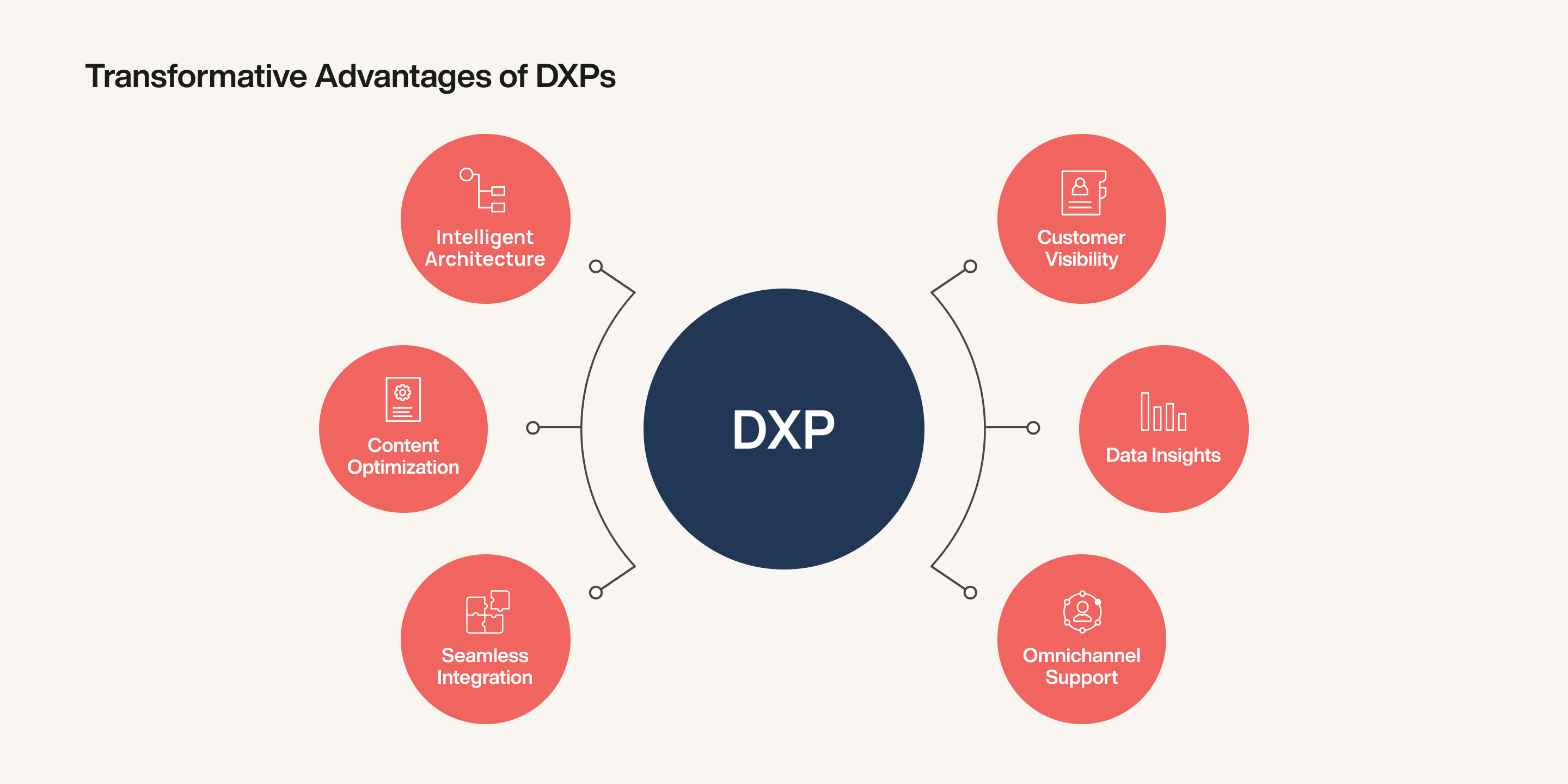
Intelligent architecture
An Open DXP utilizes microservices and Application Program Interfaces (APIs) to connect with internal and external systems. Businesses can easily make changes in the front-end and back-end simultaneously, improving administrative efficiency and enabling continuous app development.
Content optimization
Modern hybrid DXPs use Headless CMS with advanced AI and ML capabilities to optimize and deliver content across multiple channels. Businesses can create personalized content for each channel and track what works for whom to optimize content further.
Seamless integration
Pre-built APIs of a modern DXP connect with all existing systems, platforms, and third-party databases for seamless integration. Businesses can connect and manage all their apps, channels, and services on one platform.
Customer visibility
As DXPs integrate with other software and platforms in the ecosystem, they enable a 360-degree view of each customer. Businesses can easily access all information about a customer, their buying history, preferences, and behavior on a single dashboard.
Data insights
DXPs combine advanced analytics, customer data, and content management to generate actionable and predictive insights. Businesses can work on these insights to deliver personalized recommendations and experiences.
Omnichannel support
DXPs enable businesses to deliver personalized digital experiences and content over the web, mobile, eCommerce, voice, social, portals, and chatbots. Brands can custom-create experiences for each customer via their preferred device at any time.
DXP ROI - Factors that contribute
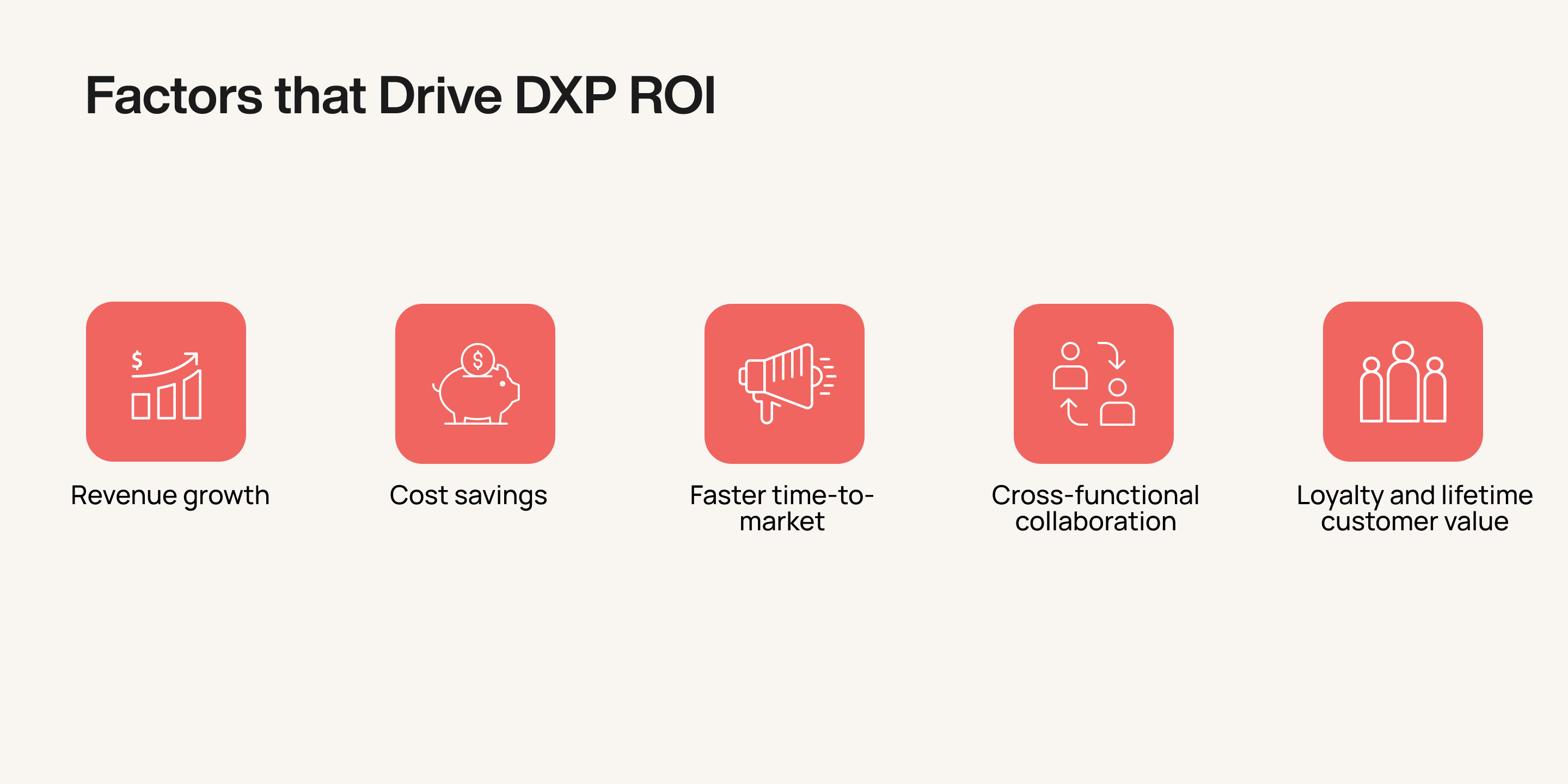
The exact Return on Investment (ROI) for DXP will vary for each business based on several factors, such as business requirements, investments, integration, implementation, and progress. But in general, when businesses adopt a DXP, they can expect quantitative benefits in five major areas.
Revenue growth
Businesses see an increase in revenue when they deliver personalized digital experiences via a DXP.
Forbes states that businesses that offer enhanced and personalized CX outperform their competitors by 80%. According to a Deloitte survey, consumer spending increases up to 140% with a positive experience. Also, 80% of customers are more likely to purchase when offered or recommended personalized experiences.
Cost savings
DXPs help businesses to reduce operational costs by automating processes and workflows.
Businesses can access and manage core business components on one platform via a DXP. They can reduce misplaced assets, remove MarTech redundancies, and efficiently incorporate changes and advanced capabilities that reduce development and integration costs. Deloitte reports that enhanced CX lowers business costs by 33%.
Faster time-to-market
DXPs accelerate time-to-market by distributing content seamlessly across multiple channels and streamlining business processes.
PwC states that 80% of customers expect speed, convenience, and knowledge from businesses. A DXP empowers businesses to deliver personalized content, products, and services at the right time via the right channel for each customer.
Cross-functional collaboration
DXPs enable cross-functional collaboration across an entire business to accelerate innovation and digital transformation.
Accenture reports that companies prioritizing cross-functional collaboration with digital platforms saw a 4X increase in revenue gains. DXP enables businesses to reduce siloed solutions and drive IT-OT (Information and Operating Technology) collaboration with ML-driven insights, KPIs, and intuitive dashboards.
Loyalty and lifetime customer value
Businesses that deliver personalized experiences via a DXP transform average customers and prospects into loyal brand ambassadors.
Forbes states that 74% of customers are likely to become long-term customers or return to a brand for purchasing based on excellent CX. Gartner reports that 66% of customer loyalty comes from outstanding CX.
DXPs - Vital for current and future growth
Businesses that do not deliver personalized CX cannot remain competitive in the digital business landscape. Though some companies have adopted a CMS, it is not an adequate digital tool in this dynamic environment. As technologies and customer expectations evolve, a DXP is an ideal tool to deliver enhanced CX.
Businesses that may not require a DXP right now would definitely need it sometime sooner than expected. DXPs accelerate the pace of digital transformation in organizations by giving complete control over its implementation. Businesses can adopt a methodical approach via a DXP to shift to agile workflows, upgrade the MarTech stack, connect silos, and evaluate customer data.
Businesses can future-proof themselves with an Open DXP as the platform evolves and integrates with advancing technology. It becomes convenient and effortless to upgrade tools via a DXP to adapt to the ever-changing demands of the target audience. A DXP is essential for the current and future growth of any business across any industry.
DXPs - To lead in the CX Era
In the CX era, only businesses that adopt a DXP to deliver personalized digital experiences will lead the way and thrive in the competitive landscape. The advantages and ROI of DXPs make a compelling foundation to adopt one and reap quantitative benefits.
If you are looking to deliver personalization across all digital touchpoints and curate an optimized customer journey for your business, a composable DXP is the ideal solution.

All about Building an Open DXP with Headless Drupal
Scalability is the key when determining which digital properties work best for your business. It helps you keep pace with the rapidly changing landscape of digital experiences. In today's digital landscape, it is essential to deliver the right experience via the right touchpoints at the right time. Here’s where DXPs play an essential role.
A Digital Experience Platform (DXP) is the platform that powers the unique capabilities of a digital experience. The platform enables businesses to build, deploy, run, and scale digital products. DXPs have become the core of most modern organizations because it centrally manages all aspects of delivering digital experiences via multiple touchpoints. A DXP can be used to build portals, websites, intranets, integration platforms, and more.
DXPs come in various types:
- Monolithic DXPs
- Composable DXPs
- Hybrid DXPs
All versions aim to empower businesses to deliver exceptional Customer Experience (CX) across all digital touchpoints.
What is a Closed DXP & Open DXP?
A closed DXP is a full-stack platform consisting of all key components and is maintained by a single provider. It facilitates the supply of one vendor’s product and services. Adobe Experience Cloud is an example of a closed DXP.
An Open DXP is a composable platform that combines several components from different sources to make them function as one. The open architecture is API-first making it easy to integrate with existing and third-party systems, unlike a traditional closed DXP.
Open DXPs are backed by open-source CMS like Drupal where organizations have complete control over the direction of their digital transformation. Businesses can also upgrade tools and features wherever and whenever necessary without waiting for one provider to update the platform. Open DXPs enable low-code solutions, enterprise functionalities, and easy-to-use reusable components that empower businesses to create digital experiences as required.
The main components of a DXP

DXPs pack a lot of components and functionalities in one system for omnichannel content delivery and management. Check out some common components that make up a typical DXP. The application and inclusion of these components may differ based on the product, use case, and industry.
- Content management system (CMS)
- Customer Relationship Management (CRM)
- Customer Data Platform (CDP)
- Customer Experience Management (CEM)
- Business Intelligence (BI) Tools
- eCommerce
- Conversion Rate Optimization (CRO)
- Digital Asset Management (DAM)
- Artificial Intelligence (AI)
- Search Engines
Monolithic DXP vs. Composable DXP vs. Hybrid DXP

Monolithic DXP
A monolithic DXP is an all-in-one platform with a legacy CMS as the core to deliver and manage content. Such DXPs contain more features that a business might need. The tools that integrate with the CMS are not usually best-in-class, making monolithic DXPs cumbersome to developers and organizations.
Composable DXP
A composable DXP contains several microservices or components for integration via advanced technologies. The CMS is headless and leverages best-in-class APIs to integrate with other microservices. Businesses and developers can use a composable DXP to custom create a modular tech stack suiting their business needs.
Hybrid DXP
A hybrid DXP is one step above a composable DXP with pre-built integration services. A headless CMS is the core of a hybrid DXP which provides a user-friendly interface of a traditional CMS and the architectural flexibility of a headless CMS. Businesses can choose the technologies they want to integrate with and also get to choose from a catalog of pre-built integrations that suits their needs.
CMS - The core of DXPs
The CMS is the core of a DXP since it provides the required content for other microservices within a DXP to work together. A CMS like Drupal empowers businesses to communicate effectively with their customers by providing the right context and content. Even when a DXP offers advanced services such as omnichannel initiatives and automation, it relies on Drupal for the content.
The digital era, especially the post-pandemic market, has highlighted the increasing demand for personalized content on all digital touchpoints in a customer’s journey. This shift in digital experience has resulted in the creation of headless Drupal to keep up with customer expectations.
What is a Headless CMS?
In Drupal, the head is the presentation layer (front-end website templates, views, & pages), and the body is the back-end content repository. The traditional Drupal or Coupled Drupal enabled non-technical users to create and edit the content on the back-end and displayed that content on a pre-built front-end presentation layer.

Headless Drupal decouples or separates the back-end and front-end content management. The back-end serves as the center responsible for content creation and storage, while the front-end is responsible for content delivery via an interface.
Decoupled Drupal offers the flexibility to developers to choose the desired front-end technologies for each project and design experiences for multiple new devices and channels. Developers are not limited by the front-end possibilities offered by Drupal as decoupled Drupal empowers them to select the right tools they require. Businesses are empowered to deliver content on websites, mobile apps, IoT devices, chat portals, wearables, and CRM systems.
Is the future of content management headless?
Headless CMS (Drupal) works best for content creation and management that can be delivered to any given channel via APIs. It also allows customizing content integration with better security and improved performance. As customers continue to demand personalized content, headless Drupal enables organizations to customize content creation, management, and delivery to enhance CX.
Businesses focusing on omnichannel marketing, seamless integration, hyper-personalization, and high security would find an Open DXP with headless Drupal as the ideal solution. As DXPs evolve with advancing technologies, organizations can also future-proof their sites and create interactive experiences with new-age technologies. The future of content management would be DXPs with headless CMS as they allow companies to create solutions and experiences on multiple channels effectively.
Benefits of headless Drupal
Omnichannel content
Editors get more control over content management for consistent and seamless delivery, and content is reusable over multiple interfaces.
Enhanced front-end experience
Developers and marketers can create amazing interactions and experiences for mobiles with PWA and front-end app development.
Out-of-the-box performance
Businesses can scale front-end and back-end independently with isolated templating and development for complete control without limitations.
API-first approach
Developers can use APIs for data consumption and transfer content across multiple channels, devices, interfaces, and platforms.
Cost-effective marketing
With faster updates, rollouts, and easy-to-access and reuse marketing content, businesses can enjoy increased productivity with reduced costs.
Content future-proofing
Businesses can get the maximum value of the created content without having to recreate or revise content pieces every time technology or innovation is updated.
Headless Drupal & Open DXPs: The way forward for digital experiences!
A modern Open DXP enhances the way businesses deliver digital experiences. It empowers companies to utilize customer data, buying patterns, and evolving technologies to craft personalized experiences for each customer. DXPs enable better collaboration between internal teams, like marketing, IT, sales, operation, and management.

A headless approach is a perfect solution to deliver excellent content and digital experiences across multiple touchpoints. Headless Drupal helps businesses manage an omnichannel digital ecosystem efficiently and adapt seamlessly to changing technologies and customer demands. An Open DXP with a headless Drupal would be the ideal marketing strategy for companies to future-proof themselves.

How Do You Optimize the Cost of Your Cloud Services?
Renowned companies like Netflix, Kroger, and Coca-cola have one common aspect. All these organizations leverage cloud storage to manage their information. Today, more than 60% of all corporate data is stored in the cloud.
However, with rising dependence on cloud storage, companies need to be aware of significant challenges like growing costs. This is because inadequate knowledge of cloud service features often leads to an increase in unnecessary investments.
So, companies need to implement IT cost optimization to reduce these finances. Techniques like evaluation, right-sizing, and balancing subscriptions are some ways to optimize cloud services.
This article explains cloud cost optimization and relevant techniques to help companies develop a sound storage strategy.
Cloud cost optimization: A pivotal part of cloud strategy
Companies need to evaluate their cloud management strategy constantly. For this purpose, IT cost optimization proves to be a thorough process that involves continuous configuration and assessment of a company’s cloud resources.
Given the significance of savings in cloud services has now become a paramount factor, businesses today must implement cost optimization.
To do so, there are many strategies that they can administer. Some of these include:
- Lock-in period for cloud solutions
- Embedding backup and recovery solutions
- Distributing cloud workload
- Using multi-cloud or hybrid cloud strategies
Furthermore, most businesses today already have a multi or hybrid-cloud strategy in place. Flexera reports that enterprises today have both multi (93%) and hybrid cloud strategies (87%), respectively.
But, before we delve deep into these strategies, it is essential to understand cloud adoption and its practical challenges. So, let’s begin by understanding the same.
Stages of cloud adoption
Ideally, businesses adopt cloud services by following these stages:
- Assessment: Companies analyze the apps, modules, and data for a potential migration to the cloud. Hence, there is more clarity on the expertise, type, and effort required for moving on to cloud resources.
- Preparation: In this stage, businesses rebuild their existing applications for cloud compatibility. As a result, the preparation phase provides a clear idea of the maintenance, adaptability, and scalability of existing resources.
- Management: This stage includes continuous verification of applications on the cloud network. The dedicated IT team displays performance data and takes appropriate action for fluent cloud service adoption.
- Improvement: Finally, organizations look to gain maximum returns on investment. Hence, the technical team reengineers relevant processes to leverage cloud resources.
Challenges in the cloud cost optimization journey
Cloud adoption and its cost optimization has several practical challenges which companies need to identify at their earliest.
Some of these challenges include:
1. Lack of visibility
Without a concise dashboard, monitoring and optimizing cloud activities becomes tough. Hence, organizations cannot analyze crucial metrics related to these digital platforms.
Consequently, these drawbacks have many cost implications, and the lack of visibility affects the cloud cost optimization process.
2. Improper provisioning
Cloud providers allocate resources to their clients. But in some cases, providers fail to manage the required amount of cloud resources.
This failure leads to incorrect provisioning, which in turn increases the costs to tackle such inefficiencies.
Mainly, these provisioning flaws can be categorized into two sets:
- Under-provisioning: Low performance leads to poor user experience.
- Over-provisioning: Most resources remain idle, which leads to unnecessary costs for unused features.
3. Ease of use and lack of governance model
The simple provisioning of cloud services can lead to cost overruns. Hence, the flexibility and scalability give rise to a resource sprawl.
At the same time, a lack of governance over these aspects hampers cost optimization. Not to forget, the lack of automation, too, goes on to pose challenges in this journey.
4. Siloed decision making
Some companies do not follow a holistic approach to choosing cloud applications. As a result, such businesses have siloed apps that lead to inefficiency.
This is another vital challenge that creates overhead for IT processes. Hence, cloud apps should work in conjunction to achieve organizational goals.
Why is cost optimization important?
The benefits of cloud adoption are immense in today’s world. Hence, most businesses follow the four ideal steps for migrating to cloud platforms.
However, amidst all the information, practical challenges lead to the issue of overspending. In simple words, most companies pay more than they require.
This can have many ramifications, such as:
- Underutilization of cloud computing resources
- Insufficient exploration of automation features
- And incompatible storage selection
Thus, it is crucial to perform IT cost optimization to avoid unnecessary expenditure.
The benefits of cloud cost optimization
Apart from reducing costs, the optimization process can provide other significant benefits. This includes:
1. Facilitates efficient cloud analysis
Cloud cost optimization improves the analysis of cloud services. The strategies used to optimize put the visibility of resources at the forefront. This equips the business adequately to analyze which features are underutilized.
Such an analysis helps the IT team to improve cloud service utilization.
2. Decrease in unnecessary cloud costs
A Flexera survey reveals that 59% of organizations feel the need to optimize existing cloud usage. This indicates that cost savings are the topmost initiative to implement cloud optimization strategies.
Through IT cost optimization, companies can relate costs to the output in a better manner. This way, businesses can reduce excess money spent on using incompatible features.
3. Boosts cloud utilization
Cloud storage and service providers offer numerous features to their clients. A suitable example is AWS (Amazon Web Services) which offers more than 100 products.
However, companies do not use all of these services. So, buying the whole package can often lead to the underutilization of some tools.
Luckily, cloud cost optimization considers this aspect. Organizations can thus choose the bare minimum necessary products as per requirement. This leads to optimum utilization of the cloud.
4. Improvement in productivity of engineers
Consider cloud cost optimization as a means to streamline the storage. This way, the developer team has limited resources to analyze. This benefit enhances the engineering team’ which in turn helps in making accurate assessments.
Best strategies for cloud optimization
After understanding the benefits of cloud optimization, overcoming the challenges is vital.
These strategies can prove effective in improving cloud services.
1. Analyzing resources
The first step to optimizing cloud costs is evaluating all the available resources. This is important because consolidating idle or unattached resources saves extra costs for enterprises.
Hence, it is vital to identify such aspects and remove them to initiate cloud cost optimization.
2. Proactive right-sizing
Right-sizing involves analyzing performance to match the current usage requirements. This way, companies can turn off overprovisioned instances and reduce cloud costs.
However, right-sizing needs to be an ongoing strategy to optimize cloud services. But it is beneficial since committing to one or three-year contracts leads to long-term savings.
3. Choosing the required storage type
Organizations today can utilize one or more of the four cloud storage types:
- Public cloud storage: Common cloud service for file sharing, app development, and other non-critical tasks. It is suitable for small-scale companies.
- Community cloud: Cost-efficient cloud service that is suitable for multiple firms operating in the same community.
- Private cloud: Tailor-made storage for a specific company. It is appropriate for large companies with sensitive information.
- Hybrid cloud storage: This type merges private and public cloud storage. Sensitive data gets stored in a private cloud, whereas non-critical data is stored in the public cloud.
Companies must hence understand the suitability of a cloud storage type. To do so, they should analyze critical aspects such as space, maintenance, uptime, and server speed.
4. Make cloud-native applications
In simple terms, cloud-native applications are specifically developed to suit cloud scalability, services, and elasticity.
Google Maps is an excellent example of API, which allows other software to use its functionality. These apps optimize cost in several ways.
Due to the use of cloud services, such apps reduce development costs. In addition, this strategy saves operation costs as companies only have to pay for time cloud services. Lastly, implementing a cloud-native outlook speeds the development of compatible apps.
All of these together lead to effective cloud cost optimization.
5. Consider a single cloud server
Businesses relying on a single cloud server avail services of one provider. On the other hand, organizations dealing with more than one cloud provider use multi-cloud platforms.
So, which strategy is best?
Consider this hypothetical example:
Consider ABC Enterprises spending USD 20,000, USD 50,000, and USD 20,000 for three different cloud provider services. This decision eliminates any possibility of considerable vendor discounts. If the same company spends USD 90,000 to buy cloud services of a single provider, it is in for a massive overall discount.
In addition, companies can also end up saving on switching costs.
While migrating from one cloud to the other at a low price can seem lucrative, businesses can save up to 70% by leveraging reserve instances in a single cloud model.
6. Implementing automation and selecting pricing models
Autoscaling and IaC are some beneficial options to spin up resources. These techniques enable companies to shut resources after their utility. Hence, automation solutions have the potential to reduce costs.
In addition, a pay-as-you-go model is a profitable option for companies. Cloud providers offer such pricing structures to build their brand reputation. As a result, businesses can benefit from paying only for the cloud resources required at a particular instant.
7. Utilization of heat maps
Heat maps display parameters like peaks and valleys in computing.
Proper analysis of this data can help establish start and stop times. This method also enables developers to manage servers efficiently. In fact, smart IT professionals can also automate the server times using information from the heat map.
Additionally, they show vital data to help businesses make crucial decisions. This hence helps optimize cloud storage and reduce unnecessary costs.
8. Using backup and recovery solutions
One of the most important aspects of cloud cost optimization is establishing a sound cloud management strategy. This activity focuses on keeping a company’s data safe in the digital arena.
However, businesses should use auxiliary techniques like using backup and recovery solutions. This way, managers can access critical information at any stage from any location.
In simple words, the IT infrastructure of a business should be robust to make it easy to optimize cloud services and environments.
9. Distributing cloud workloads dynamically
Using modern application traffic steering systems, companies can enhance cloud operations efficiently. Generally, teams using this strategy distribute cloud workloads based on cost factors and performance.
However, clarity in the cloud resource utility is vital to perform this type of optimization. A specialized IT team is well-equipped for this purpose.
Based on this strategy, enterprises can reduce the need for additional cloud resources. As a result, there will be an improvement in cloud services and management.
10. Other tweaks for cloud cost optimization
There are many technical tweaks that IT experts can perform to optimize cloud services. Hence, apart from the prominent strategies, businesses can implement the following tasks:
- Complementing data management strategies
- Identifying and maximizing software license expenditure
- Migrating in stages
- Releasing idle IP addresses
- Automating cloud cost management
In short, the possibilities to save costs on cloud services are high. What companies must do is identify which tasks are practically feasible for their team.
Utilize the cloud adoption framework for building the perfect strategy
Cloud Adoption Framework (CAF) is a comprehensive guide that helps companies develop an apt optimization strategy.
Businesses should study the different stages of cloud adoption framework before migrating to cloud services. Here’s a brief look at the six stages:
- Strategy: First, companies need to identify the requirements, objectives, and existing resources of their business.
- Plan: At this stage, organizations should plan the adoption strategy. For this purpose, it is vital to inform, brainstorm, and discuss with the team.
- Finalization: Companies should thereafter implement and prepare the cloud environment for end utility.
- Adoption: This stage includes fluent migration of existing data and resources to the cloud. Also, the IT team can innovate as per cloud requirements.
- Govern: After adoption, it is time to monitor the activities to keep track of the benefits of cloud migration.
- Manage: This is the maintenance and management stage that includes continuous data assessment.
Presently, Microsoft, Google, and AWS offer detailed cloud adoption frameworks as they make one of the best guides to follow during migration.
Why?
This is because they come with several benefits. Some of these include:
- These frameworks are reliable and secure
- The provider equips them with regular updates
- Cloud adoption frameworks aim at improving efficiency and performance
- They have new features to support hassle-free cloud adoption
So, following the guidance of the cloud adoption framework helps reduce the efforts for cost optimization, which allows companies to focus more on management and data analysis activities.
Also, businesses can concentrate on choosing effective cloud cost optimization tools that minimize the efforts to improve cloud service integration.
Cloud cost optimization tools
Technology allows different vendors to develop software for IT cost optimization. Here are some well-known tools that organizations can consider exploring.
CloudZero
This tool focuses on organizing cloud spending for businesses. CloudZero enables organizations to detect waste and cost anomalies and presents an in-depth analysis and breakdown of costs to understand cloud spending. Additionally, it also alerts organizations in case of cost spikes, thereby preventing high expenditures.
Not to forget, this tool is also customized for engineering, finance, and FinOps. So, companies can utilize this software for specific analytical use.
Densify
Densify is a cloud resource optimization tool. This tool analyzes patterns in business demand and generates analytics for sound evaluation. It hence allows businesses to study cost-saving opportunities on the platform.
Additionally, it also has a dynamic instance alert feature to manage resources optimally. Companies can as such reap benefits from controlled spending, high-performing applications, and recommendations.
Harness
Companies can track important aspects like idle resources through the Harness tool. The platform claims a cost reduction of up to 75% in cloud management.
Additionally, with Harness, organizations do not need manual tagging to analyze relevant information. In addition, the software also performs root cost analysis that correlates with deployment changes.
Moreover, businesses can benefit from the cost reporting features of this tool, such as cost anomaly detection, which proves extremely useful.
Wrapping up
Cloud storage and services have become highly essential for modern businesses. The ease of use, quick synchronization, and security are crucial reasons for their importance. Companies hence must purchase cloud solutions to store data and manage their applications.
However, overlooking certain aspects can lead to unnecessary expenses. But by using the strategies listed above, they can optimize cloud costs and thereby reduce their overall expenditure.
Importantly, businesses must evaluate their organizational requirements. This prior assessment, too, can reduce many activities for cloud cost optimization.
Lastly, it is beneficial to use tailor-made tools to analyze crucial parameters, and CAF during cloud adoption for migrating your business data.

Time To Evolve Your Higher Ed Business Model?
Covid-19 has altered our lives forever and in the light of this 'new normal,' specific shifts in the societal and technological front have impacted our education sector, too.
Before the pandemic, the higher ed industry was slowly inching toward a digitalized structure. The pandemic simply accelerated these technical advancements.
But it is just not the technological landscape that is changing the face of higher education. There are several other factors influencing higher education like financial challenges, academic institution competition, the unconventional age of college-goers, and the changing societal needs.
Clearly, it is the hour of evolution for the higher education business model.
Cultural and technological changes that impacted the higher ed business model
We are two decades into the 21st century, so why should our higher education model remain the same as that of the 20th century?
And rightfully so, today, society has made immense strides in both cultural and technological advancements.
These changes have inevitably contributed to the changing structural transformation of the higher education model. So, let’s look at the 4 primary developments that have posed a challenge for the existing higher ed business model:
1. The requirement for life-long learning
In the given time and age, the need to constantly upskill yourself and stay in touch with relevant concepts is a must.
We exist in a digital economy, where disruptive and ever-evolving technological advancements guide most jobs. Additionally, there is also an excellent level of flexibility in employment and the presence of automation in labor.
This has invariably pushed out the industrial-age mindset where education was required in the primary stages of life. Instead, education today requires consistent upscaling that most undergo throughout their entire lives.
In fact, it's the only way to survive in the non-linear world and the modern careers it offers.
2. Changing needs of students
Much like any other business sector, the field of education is also guided by the ever-changing expectations and needs of its consumers, i.e., the students in this case.
The student demographic is witnessing a significant shift and normalizing its non-traditional needs. Thanks to the varying lifestyles, preferences, and circumstances, the young generation has significantly moved away from that of the previous generation.
They don’t want the stringent fixed courses taught in the same classroom style format.
Hence, the one-size-fits-all education path is no more celebrated as it once was. Instead, the need for a seamless, flexible, and personalized educational experience grows popular in demand.
3. Emerging AI technologies
Gen Z has grown up with technology intricately woven into the very fabric of their being, so they expect the same digital experience in their education.
This digital transformation has actively contributed to how the higher education business models are reinventing themselves. The innovators present in the education industry are down to challenge the status quo of the model structure.
No wonder even major tech giants like Amazon and Google are partaking in the alternative approach of an AI-driven, personalized educational system.
Additionally, the ‘Netflix for Education' teaching scheme allows for higher flexibility and more effortless adaptability. And not to forget, it makes the process of education much more enjoyable.
4. Skills more critical than a degree
The idea of a degree being the most vital sign of an educated person has existed for far too long. Today, employers value skills over degrees, thus transferring the focus from a piece of paper to actual talent.
While it’s true that holding a higher-education degree significantly improves the chances of employment and better income, its value is dramatically falling.
Students now wonder whether the traditional education system that creates lasting student debt is worth it. After all, the job markets have become extremely unpredictable, so the only thing that would help compete is a skillset.
Degrees are simply a signal that vouches for a potential employee's capability. At the end of the day, it does not honestly assure excellent job performance.
Innovation is more essential than tradition
For any business sector to last long, innovation and creativity are intensely crucial. Adjusting to accommodate the needs of the consumers and also staying up-to-date with the ongoing societal and technological advancements is a must!
Education today is not simply the means to the end– it's not perceived as the only way to secure a good job. The current generation and its educational needs have modernized. They want education for its experience, ease, and to satiate their hunger for knowledge.
This is precisely why the sector observes the regular implementation of disruptive and innovative ideas.
To understand this better, consider the example of mega-online educational universities or online educational platforms like Coursera.
With over 92 million learners registered, the platform offers an active learning and dynamic environment. Additionally, it facilitates a more effortless learning experience, given the wide range of courses available.
Hence, this approach was uber-successful, especially during a pandemic, when people were locked in isolation. It helped upskill people and ensured more equitable job opportunities around the world.
As such, this innovative learning approach is perhaps the biggest reason to do away with traditional learning structures.
4 trends shaping the higher ed-post-pandemic business models
Innovation is not the only trend that is invading the high-ed business model. Here are 4 more trends that are actively shaping how higher education business models will look post-pandemic. These are:
1. Changing the higher education business model
Most business leaders are not interested in maintaining things as they were. They do not however want to make some sudden radical changes that would be hard for the consumers to accept, either.
So, their idea is to recalibrate and revise the higher-education model post the downfall of Covid-19. Hence, they are keen to invest in information technology, remote working, shared services, automation, etc.
2. The core competency of technology expansion
There was a time when technological advancements were solely looked at as expensive and needless add-ons. Today, it has become a core competency in every institutional strategy.
Business leaders are aware that the technology in the educational sector will blow up and strengthen the revenues. For example, universities are not noticing the need to use 3D hotspots to stimulate galleries and labs. Some are keen on including stimulations and gamification in online courses to make them more collaborative even if there is physical distance.
It will thus allow for the expansion of online enrollment and better engagement during the courses.
This trend will have the business leaders balancing the existing technical systems with future investment in new technology.
3. Less investment in residential amenities
It will come as no surprise if the universities and business leaders begin to downsize their investment in infrastructure. Since the educational model is shifting to an online or hybrid structure, it makes absolute sense to minimize expenditure on on-campus amenities.
As such, it is expected that the residential education demand will considerably change. That said, there is also the awareness that the experience offered in in-person classes and interaction cannot be replaced.
So, while the institutions will continue to integrate virtual systems, there will always be space for the involvement of one-on-one education. So, the focus might be shifting to better accommodate distance learning but it’s not changing altogether.
4. Changing financial strategies in the face of the monetary crisis brought by Covid-19
Unsurprisingly, higher education has also faced a huge financial brunt posed by the pandemic. The cash flow suddenly stopped as the physical universities shut down, thus putting an end to all the auxiliary revenues, parking fees, dinner sales, etc.
It’s no wonder that business leaders will aim to change their financial strategies to accommodate their limited means, too. This will mainly focus on three things:
- Knowing how to accommodate students’ requests about enrollment and preparing accordingly is the first step. This will essentially require modification in enrollment goals, to at least meet the minimum net tuition revenue.
- The second step is to keep the focus on the core competencies of the institutions. So, if some institute is focused on traditional learners, now would not be the time to shift focus to adult learners. Sticking to the ongoing program will save resources immensely.
- Lastly, knowing how to create flexible financial aid packages is of the essence. One cannot simply offer the same aid to every student, given the financial crunch. Knowing how to help a student bridge the gap between their finances and helping accordingly is the key!
8 areas higher education institutes should explore for future-proof business models
Redefining our future in the face of a global pandemic is tough. Yet, it's also time to reimagine the new state of the educational sector. So, when thinking about the restructuring of the educational field, one cannot ignore these 8 essential areas. These are:
Personalized educational content
When no two people are the same, why should their educational graph charter the same course? Every learner comes armed with a host of strengths and weaknesses, coupled with differing skill sets, interests, and needs.
Considering this difference in each individual, it makes complete sense to create an educational approach that is customizable for each learner. This would enhance understanding and engagement, ensure better retention power, and pump the learner with apt motivation.
Hence, investing in the creation of personalized education content is a must for a successful educational experience.
Investing in revenue-driven partnerships
This trend might spring up in the private educational sector, where higher educational business models are always looking for partnerships.
It is important as finding the right investor and alliance can surely infuse the institution with the necessary resources and expertise. It would also eventually lead to the renovation of educational institutions.
Additionally, not only does this ensure cost reduction but also provides easy scalability of courses, which is appreciated in this pandemic scenario! This trend is slowly gaining momentum as several institutions partner up together to offer joint online programs.
Adaptive institutional pricing
If you look at the healthcare sector, you will notice the gradual shift of the fee-for-service payment model to the value-based system.
Similarly, thanks to the change in learners' demographics and education delivery format, the educational system is undergoing adaptive institutional pricing, too. This idea is worth exploring as it attaches the educational costs to the possible learner outcomes.
For example, if an institution adopts differential tuition fees, it can tie the cost to the learner’s earning potential or the course’s internal costs. It’s a ‘pay for what you receive’ kind of educational structure. Here, the pricing is specific to the kind of program the student chooses.
Imagine it like a subscription plan but for educational services!
SaaS solutions for cost reduction and better control
The benefits of cloud computing are unparalleled. If deployed effectively, these services can free up the current resources, thereby allowing the institutes to scale themselves as per the demand. This means that they would only pay for the resources truly used.
Consequently, this would eliminate all the expenses of getting in-house hardware and software. Additionally, SaaS solutions allow for better security, control, and reliability.
To make the best use of cloud computing technology, institutions must hence create a cohesive usage of cloud services across every department.
Developing technology-enhanced post-pandemic vision proposition
While there were traces of remote learning before the pandemic, the process only got amplified once Covid-19 struck. Today, the institutes can reach out to their students who live in any region or country.
Hence, business leaders are ready to expand this opportunity further and allow for a higher level of access to the students. In fact, it's about time we leveraged technology to help realize the inspiration ambitions of students quickly and inexpensively.
Moreover, the aim is not only to offer equitable access to devices and connectivity to the students but also to create a conducive learning space!
Adopting a blended campus system
The suddenness of the pandemic had indeed left the educational institutes and all its staff recuperating from the consequences. But, now the reopening of university doors has allowed the business leaders to reimagine the campus structure.
More essentially, the question that arises is whether there is any need for a physical campus or not?
Many institutes have noticed a decline in student enrolment, which might become a steady trend, considering the ongoing pandemic and demographic changes. Living on campus or commuting daily no more fits the bill for most learners as they struggle to balance family and career commitments.
Administratively speaking, institutional staff has also gained massive productivity in the hybrid model.
Thus, it makes complete sense to redesign the concept of campus to aid a hybrid learning system, mitigate space crunches, and lower campus costs.
Student-centric technology systems
The pandemic made it painfully clear that most educational universities are unprepared to offer digital connectivity to their students, especially in rural and indigenous communities.
In fact, digital inaccessibility is not even about the excellent connectivity level as much as it is about accessibility in itself. Hence, it's a genuine requirement for leaders to invest in the equitable access to software, tools, and devices required by each student.
Digital faculty
When students enroll in a higher education institute, they expect digital sophistication in their learning modes and methods. For most millennial and Gen Z learners, the digital medium is their home– a default way of carrying out interactions.
To match up to this student demographic, it becomes an inherent requirement to ensure that there exists a technologically-equipped faculty. However, it requires a lot of encouragement and helps to reach the state of digital fluency.
As such, business leaders must now invest in excellent instructional design support and faculty training. Additionally, the staff must be encouraged to experiment with innovative digital teaching technologies.
Final words
As the demographic of students changes, the face of higher education also witnesses subtle conversions. The disastrous pandemic roughly pushed this change in the business model a few steps further.
The higher education business model awaits thoughtful deliberation and investments of business leaders to change the way it functions. These areas expand from the need to create personalized educational content to the use of SaaS technology and the honing of digital faculty.
With the right areas getting explored and invested in, it would be no surprise to see the renovated higher education landscape soon!

Intranet 2.0: Making a Big Company Feel More Connected
One of the unloved parts of an organization’s tech stack is the intranet. While the traditional intranet was present in most Fortune 500 companies, it was never used or liked much. But COVID-19 changed everything, including the way companies engage with their employees. The Intranet 2.0 promises to connect the distributed workforce efficiently and transform the traditional corporate intranet into a social communication tool.
Intranet 2.0 is an evolved version of traditional communication methods and has the potential to build a close-knit network in a company to increase employee engagement. This article will give you in-depth knowledge of the benefits of using a social intranet in organizations.
What is Intranet 2.0?

Simply put, intranet 2.0 is a term used in organizations and industries for an intranet using social features present in apps, such as Pinterest, Facebook, Twitter, etc. Intranet 2.0 is often referred to as ‘social intranet’ as it contains the same features as a social networking app. Social features are added to a company’s intranet to drive employee interaction and engagement.
A corporate social intranet can be a complete social platform or a third-party app like Yammer or Microsoft Teams. The key difference between a social networking platform and a social intranet is that the latter enables employees to connect with co-workers across multiple regions instead of connecting with millions of users around the world.
Along with allowing employee interaction, intranet 2.0 also allows an easy flow of knowledge-sharing for members of different teams across the globe to collaborate over shared goals.
Advantages of Intranet 2.0
- Social intranet tools are compatible with most mobile apps and provide employees the flexibility to communicate, collaborate, and connect remotely.
- Employees can connect more efficiently with team members across the globe to collaborate on projects and share documents.
- Colleagues can follow social profiles and comment or react to blog posts, leadership updates, and news items shared by co-workers.
What does the new generation of potential employees expect?
Modern employees want seamless two-way communication with teams and employers. Communication plays a vital role in a distributed workforce, a significant part of a digital workplace. Employees also want a personalized engagement channel that helps them with work communication and provides a platform for freedom of expression.
Employees expect the corporate intranet to help them connect better with their work-family and make them feel part of a large corporate culture. They want access to secure resources and documentation whenever they need them. With the intranet being the main channel of work interactions, the modern workforce wants organizational news and events, such as company initiatives, new job openings, work events, company social events, and more, to be shared with them first via an intranet.
These expectations highlight the need for an employee-friendly intranet with a streamlined and easily accessible content portal. An intranet must motivate the employees and fulfill their desire to contribute to society positively with their organization. To do that, the modern intranet must contain social features.
5 pillars of Intranet 2.0
The success of any software is based on pillars that ensure smooth and effective functioning. A social intranet has five core needs: content, communication, collaboration, business process, and people.
Content
Content repositories in intranets should be more flexible and dynamic than static. Intranets should capitalize on content (knowledge from company databases) and share it to enable social learning.
Communication
The intranet should allow employees to express themselves in various ways, such as comments, status updates, and content sharing. Information and communication must flow seamlessly, both horizontally and vertically.
Collaboration
Intranets must empower online collaborative workspaces. It should be a platform for social games, socialized project management solutions, and the exchange of ideas and solutions.
Business process
Including business apps and processes in the corporate intranet helps to rally all employees to engage. The intranet should enable the workforce to create, collect, analyze, and publish data.
People
Corporate social networks work better when companies stimulate and moderate employee communities. Sharing equally in the community and inspiring the employees is a must for organizations to connect with the workforce and inspire them.
Main features of Intranet 2.0

Some of the best social intranets incorporate features that make it easy for team members to collaborate toward shared goals. Let's consider some of these features.
Employee interaction
Social intranets enable employees to comment, react, and follow user profiles, news updates, blogs, articles, or shared goals of colleagues that they find inspiring or motivating.
Appreciation & recognition
Social intranets allow users to thank their colleagues for a job well done. Participating in an employee recognition scheme for good contribution helps the company to maintain and encourage employee motivation and effective functioning.
Analytics
Users can measure success and learn what employees care about with the help of real-time analytics reporting. Companies can look at the insights and make corresponding changes to evolve the intranet into an enhanced platform.
Employee directories
Intranets allow users to connect with people and enable knowledge-sharing. A people directory makes it easier and more convenient for users to collaborate with their co-workers and find internal experts.
User-generated content
Users can publish their stories, upload videos, and share images with several blogging features and front-end creation on an intranet. Employees can stay updated with instructions and information related to work.
Third-party integration
Third-party integrations with platforms like Yammer, Slack, Teams, etc., make the everyday interaction among workers even more exciting. The digital workplace becomes a fun place where employees share interesting news and insights that may help them.
Ideas and feedback sharing
Social intranets enable employees to discuss and brainstorm ideas for upcoming or ongoing projects. Employees can share feedback on related projects or tasks fostering an interactive collaboration.
Topic discussion channels
Intranets enable users or employees to create discussion channels specific to certain topics. It creates an organized flow of discussions and knowledge-sharing.
Employee wikis
Employees can collaboratively add, manage, and edit employee wikis or content that are highly relevant to a company. It streamlines processes and reduces time spent searching for information.
Do you need a social Intranet? 5 questions to ask
If you are simply curious whether an intranet might work for your business or seriously considering upgrading your internal communications strategy, here are a few questions you need to ask as an organization.
Are our employees engaged and satisfied with the organization?
Measuring employee engagement is a critical tool for overall business success. Find out how your employees are feeling through employee surveys, pulse surveys, or just plain feedback suggestions. An efficient intranet will build an engaged workforce by giving them a voice and connecting them with their peers.
Can our employees access accurate information at all times?
Information management is crucial to a company. Employees require access to the right information regardless of location, time, and devices. A centralized intranet with cloud-based storage and a mobile app provides secure access to information anytime.
Does our current internal communication tool meet employees' needs?
There are many communication tools available, but the question is whether they meet the engagement needs of your organization. Analyze engagement patterns and insights to find out. An intranet satisfies the need for business-wide communication and builds a virtual culture that enhances the digital employee experience.
Does our organization have a strong employer brand?
Employee advocacy communicates to the outside world what your company is like to work for. It is a powerful differentiator, essential to attract and retain top talent. An intranet will help you establish your brand as an employer by communicating values, purpose, success, recognition, and development opportunities.
Are our employees as efficient and productive as they should be?
Employees need centralized access to all information, processes, and workflows to be productive and efficient. Without it, they will waste time and resources on manual tasks or searching for information. An intranet can be the focal point of your organization supporting your employees to be productive.
Significant benefits of Intranet 2.0

Since 2020, many organizations have given modern social intranets a chance and have observed significant benefits in the functioning and performance of the workforce and the organization.
Let's look at some prominent benefits of a modern intranet.
Employee collaboration
Intranets enable employee collaboration whether they work in the same region or on a different continent. Organizations can create dedicated channels for projects or teams to update everyone in real-time. Employees can find support and help from colleagues and internal experts on time.
Social connection
Gallup reports that one in every five employees working remotely is struggling with loneliness. With the post-pandemic workforce being disconnected and siloed, an intranet helps to overcome work isolation by helping create communities with shared interests. It reintroduces social connection digitally and aids employees in building stronger connections with their peers.
Enhanced productivity
McKinsey reports that using modern intranet tools can boost employee productivity by 25%.
A social intranet allows teams to check in on one another, reach for assistance, find quick updates, and progress together with the organization. Enhanced engagement improves efficiency and productivity.
Better retention
A survey of Cisco of C-suite executives states that 85% believe that attracting and retaining talent is critical to a digital workplace. Employers can utilize a social intranet to help their employees feel heard, recognized, and valued. Employees can also appreciate and thank the contributions of other employees. A strong and appreciated employee community will remain loyal to the organization.
4 tips to ensure a great social intranet
Integrate collaboration tools
Ensuring that users or employees can seamlessly share content and documents across channels and platforms is one of the most critical measures any organization needs to be mindful of while launching its social intranet. Third-party social collaboration tools like Slack, Donut, or Teams can significantly help employees reach out to one another whenever needed. It also supports knowledge-sharing and social learning. Employees can seamlessly share content that they find helpful.
Add channels for shared interests
Every organization must ensure that its social intranet platforms have channels for employees to discuss their passions and interests. Bringing people together to share their hobbies and social life is a great start. Creating dedicated channels for such activities keeps interaction better organized. Employees can dedicate time towards starting a conversation with co-workers or posting something publicly.
Include training and development
Including channels that encourage or provide training and development will hugely benefit employees. They can improve their skill sets through various training and development programs organized on corporate intranet platforms. Training sources, such as explainer pieces, will help users understand the workflow better. They can also like, comment, and share valuable information on these channels.
Encourage engagement
Encourage your employees to contribute to the overall social experience by introducing gamification features like leaderboards, gauges, and badges. Such features help keep the employees engaged and motivated. You can also tag colleagues who might be interested in relevant content and encourage activities that help highlight employee achievements regularly.
Make it accessible
Given the diversity and vastness of digital spaces, mobile functionality is essential for members working remotely. You can ensure that your social intranet is mobile-friendly and accessible. Push notifications can help employees stay updated, especially when they are on the move.
Social Intranet 2.0 - A collaboration ecosystem
Remote work is driving demand for connected global workforces. Evolving technologies can facilitate collaboration in the digital workplace with a distributed workforce. Intranets are also evolving to incorporate advanced capabilities and features with seamless integrations, AI, and other innovations.
Including the social in the digital employee experience is essential for organizations, especially as we move into a hybrid future of work. If you are looking to drive more value from your corporate social tools or implement a social intranet in your organization, strategize on how to engage your employees efficiently.

Digital Transformation in BFSI: Implementing a Self-Service Portal
Digital disruption has rocked the BFSI (Banking, Financial Services, & Insurance) industry and it continues to impact the entire globe. The BFSI sector is assessing the value of digital service solutions (platforms & self-service portals) and many organizations have realized that their customers' expectations have changed. In the post-pandemic world, they implemented a new customer service strategy based on what they learned in 2020.
That implementation has changed the very nature of BFSI services. Organizations are trying to provide their customers with access to information from any location as the customers have successfully adapted themselves to digital service. The top priority now is Customer Experience (CX). The apparent solution is progressive self-service tools to help customers with timely information and provide a seamless and connected experience.
Preparing for the post-pandemic financial customers
McKinsey & Co reported that BFSI institutions could see an increase of 40% when they successfully use digital technologies. The increase would come from a combination of increased revenues and low operational costs. And, many organizations are demonstrating newfound confidence in digital services.
Mobile and remote access have changed from conveniences to necessities for millions of customers. Digital proficiency (remote transactions, self-service portals, digitization, automation, and advanced analytics) in BFSI institutions leads to significant value creation for the entire industry.
A top priority is a deep engagement with customers. When organizations lose the conversation with their customers, they miss out on trust and the likelihood of becoming the primary financial or insurance institution for that customer. As more technology is introduced in the industry, more questions arise for customers. Questions, such as “How do I transfer funds?”, “How do I enroll for online bill payment?”, “How can I reset my password?”, How can I renew my policy online?”, and etc.
Surprisingly, the solution comes from an unusual source. The streaming giant, Netflix, has trained its customers to demand answers to questions on their own devices, and on their own terms. A similar self-service approach for the BFSI industry is the raging demand now.
BFSI: What is Self-Service for Customers?

Self-service in banking and insurance broadly refers to the means by which a customer can find the content and information they require. There is no need to call customer service and wait in queues to get the answer to a simple but essential question. Today’s modern customers prefer to interact with a financial or insurance organization in this way.
A combination of digital self-service options (portal or platform) and personalized customer service from a human agent is the recipe for success. Immediate benefits include an increase in savings and productivity due to the reduction of calls to customer support. Long-term benefits include maintaining and growing a loyal customer base, maximizing revenue, and a future-proof digital self-service strategy.
Top 3 strategies for a successful self-service portal
The modern banking and insurance portals are a critical tool in the organization’s resources to deliver an engaging customer experience. Adding self-service to that portal adds more value. Most BFSI institutions have the services and knowledge to support self-service, they just need a dedicated strategy to make the portal an effective customer-facing solution.
Understanding the organization’s technology infrastructure
Evaluating the current technology infrastructure is the first step. Organizations that have a disjointed technology stack need to restructure it or in some cases, retire it. To do this, organizations need to have a deep understanding of their current infrastructure and technology.

Understanding customers’ expectations
Self-service in a customer portal can take many forms. Organizations should ensure that their CX and IT teams understand their customer's expectations thoroughly, and then include self-service functionalities that fulfill those expectations.

Understanding when to offer self-service
While self-service is an important digital tool, it may not be effective in every situation. Financial and insurance organizations should not view self-service as a one-size-fits-all solution, instead, consider carefully the situations that would require self-service to deliver a personalized experience.

Delivering the best self-service portal in BFSI
While Netflix and consumer banking or insurance seem so apart, organizations can learn from the media giant to deliver a stellar self-service experience.
World-class support center
Netflix streams to around 221.6 million subscribers in over 190 countries. There are so many questions asked (How can I turn on the subtitles? How can I find a particular movie? How to set parental controls? How to change billing information) that are answered via a self-service help center on the app instead of a live customer support team.
Banks and insurers can set up a world-class support center with clear, searchable, and categorized content. Customers can resolve their doubts or troubleshoot to a quick and easy resolution on their own with excellent support content.
Speed bumps ahead of live support
Netflix offers the chat option but puts a speed bump before initiation by presenting the common support questions and answers so that the customer can quickly browse through to see if the answer they require is already present.
Similarly, BFSI organizations can enable the support content option when a customer requests a live chat or conversation empowering the customer to find the answer by themselves.
Support content at the front and center
Netflix places its support link right at the main navigation of its apps so that it’s hard to miss. Similarly, financial institutions and insurance companies can provide support content links right at the front and center of their digital channels to make the self-service obvious and within reach for all devices.
Remove contact number from plain sight
While it seems counter-intuitive, removing the contact number for customer support will encourage customers to self-serve. Pointing customers to the support center or FAQs section first and offering the contact number as the last step will ensure the success of a self-service portal.
Benefits of self-service strategy in BFSI
Enhanced customer experience as people prefer to answer their questions without having to contact support.
Improved sales as customers continue with the transaction only when they get a quick answer.
Reduced support costs as customers will call less into customer support.
Better support availability as self-service enables support all day, every day, and on all devices.
Staff productivity as support staff can work on complex issues instead of repetitive questions.
Good self-service vs. Bad self-service

Best practices for continued self-service success
Onboarding CX and IT teams
Organizations should devise a self-service strategy along with the CX and IT teams. That way, technology can be designed to provide the best customer experience possible. Training and educating the teams on a regular basis helps to improve the services based on customer expectations.
Onboarding the customers
Customers need some guidance to adopt a self-service portal. Organizations should educate customers on the functionalities and benefits of the portal with accessible information on their digital channels. They should showcase the value of self-service and inspire confidence in customers about it.
Realizing the value of self-service
Financial organizations and insurers should realize that self-service is meant to enhance the existing CX and not replace it. Self-service should be considered an option to arm the customers with needed information. Customer support teams should continue to work on their CX strategies and engagements to boost customer relationships.
Dos and Don’ts of implementing self-service in financial services

Moving ahead in the BFSI landscape
J.D. Power reports that a record 67% of US retail bank customers used their bank’s mobile app in 2021, marking an increase of 7% points from 2020. It also stated that around 41% of bank customers are now classified as digital-only.
These stats highlight the progression of the financial customers towards a fully connected world enabled by cutting-edge technology. All BFSI customers expect simplicity, connectivity, and immediacy from their financial institutions and insurance companies in every interaction. A self-service portal with an experienced support team fulfills that need successfully. Self-service also creates personalized experiences for banking and insurance customers.
BFSI organizations should invest and commit to a mature digital customer service strategy with self-service to optimize business efficiencies. Such a strategy leads to scalability, agility, and the ultimate goal; excellent customer experiences.
A Comprehensive Guide to Codeless Automation: Basics, Benefits, and Approaches
Conducting traditional test automation is a key aspect of product analysis and increasing deployment speed. But the traditional approach of hand-coded automation requires programming expertise. Hence, companies face challenges in preparing robust test code.
As the programmer-centric approach creates a shortage of skilled human resources, companies want a modern solution. This gave birth to the codeless automation approach that enables developers to execute test scripts without writing code.
It allowed all team members to contribute to the test automation process. As such, more companies are planning to shift to codeless automation from traditional testing. It is hence not surprising that its demand is projected to grow at a 15.5% CAGR from 2021 to 2031!
Moreover, the approach allows testers to execute tests faster, resulting in quicker product delivery and release rates. Given these trendsetting benefits, this article will take a closer look at the crucial details of the codeless automation process.
What is codeless test automation?
Codeless test automation is a modern process where the tester can develop test scripts without writing code. It allows professionals to automate test script creation without being technically proficient.
Even if a tester doesn’t know a programming language, he can automate the scripts. A professional can also maintain test scripts conveniently through this approach without any coding. Thus, professionals, including the managers, software developers, and even release managers, can contribute to the testing process.
Moreover, unlike legacy testing tools, codeless testing offerings are equipped with artificial intelligence and machine learning which allows testers to create and modify test steps manually.
Additionally, codeless automation facilitates the creation of test flow diagrams, making the process even more convenient.
Hence, to sum up, codeless test automation is an excellent approach that frees up the testers’ and developers’ time so that they can utilize these working hours to focus on enhancing product strategies and improving testing activities.
How codeless testing works
For conducting codeless testing, testers do not necessarily need to know the exact code to move forward and hence they utilize codeless testing tools for developing the scripts.
The idea behind the process is to make executing, maintaining, and integrating test scripts convenient via a simple UI. This is done generally through two test automation approaches-
1. Record and play approach
In this process, the tester performs the test manually, while the automation tool records any action that helps develop the test script.
As per product requirements, the testers can be modified and can edit this script which the company and professionals can execute later on. As such, this approach is highly prevalent among web-based product developers.
For instance, Katalon Studio, a very popular codeless automation platform, offers this feature.
2. Test flow diagram
In this approach, software testers develop a test flow diagram that consists of structured test blocks. Here, the test script will run automatically depending upon the actions present in the test flow diagram.
Low-code vs. no-code vs. codeless automation
In this rapidly expanding market, organizations are always aiming to gain a competitive edge over other firms. Hence, product testing and developing test scripts need to be faster than before.
That’s why development teams try to implement multiple strategies for automation testing. They use technologies like no-code, low-code, and codeless tools interchangeably. However, these tools have specific characteristics that separate them.
Low code test automation
Low code test automation tools allow developers of different technical skills to begin application development without manual coding. These tools offer built-in visual code blocks that the testers can drag and drop to develop applications.
With these tools, testers can avoid learning the latest programming frameworks or executing multiple tests for their application code. However, some amount of coding knowledge is still required for operating these tools.
That's why professionals with programming knowledge utilize these tools to enhance the speed of their development process. Although non-technical professionals might be able to work with low-code technologies, the projects will require coding at some point.
Lastly, low-code tools allow developers to conveniently build apps for several platforms and share them with stakeholders.
No-code test automation
These tools are targeted at IT professionals who do not have actual programming knowledge or experience. They provide visual development along with drag and drop features. As such, both technical and non-technical professionals can collaborate on a single project to speed up its development.
Additionally, they are similar to low-code automation tools, but no-code technologies don't require programming expertise. Not to forget, the tools comprise of all the elements required for application development. As such, they are quite popular and used in Bubble and Makerpad.
Furthermore, these platforms are ideal if testers want a simple application for a specific business purpose. Instead of waiting for your software development team to deliver it, you can assemble a team and develop an application in a quick time.
Codeless automation
No-code and codeless automation are the same as they don’t involve extensive coding during app development. In addition, codeless automation platforms can also consist of NLP and self-healing features which allow the tool to modify the tests according to the changes in the user interface.
Code-based vs. codeless selenium testing
A skilled programmer might need to automate a web script and have sufficient time to go ahead with it. In such a situation, Selenium is the best automation testing tool for the project.
The tool is open-source software that supports most browsers and is preferred for web applications. Additionally, to enhance the test automation process, codeless Selenium has emerged in recent times.
1. Code-based Selenium testing
Selenium automation testing requires superior programming expertise and app developmental abilities. The tools support major programming languages like Python, Java, Ruby, and PHP. Moreover, it offers a suite of tools such as Selenium WebDriver, Selenium IDE, and Selenium Grid.
Due to these features, developers accustomed to low-code or no-code platforms might face difficulties operating this platform.
Moreover, the test scenarios are complex and very structured and hence tales sufficient time to set up the testing process and maintain the scripts. In addition, testers might require third-party integrations to execute some tests. As such, developers with strict project deadlines might not prefer code-based Selenium.
2. Codeless Selenium testing
As the name suggests, codeless Selenium testing is all about executing test scripts faster with less code involved. This approach enables testers of various skills and expertise to start working on an application. So, it reduces the complexity of the automation testing process.
Additionally, it has less complicated test scripts which aren’t heavily structured which allows testers and developers to create test scripts and execute test cases faster than code-based Selenium.
So, each codeless test usually takes approximately an hour.
For instance, Selenium IDE is a useful tool that makes codeless testing convenient. Testers can record interactions in the browser and playback them easily. This automatically reduces the time and complexity of executing the tests.
Moreover, another excellent feature of codeless Selenium automation is test case reusability which allows testers and other team members to reuse already created test cases.
So, they save a substantial amount of time by avoiding developing test scripts for multiple scenarios. Not to forget, cross-browser testing is also much faster and more convenient in the codeless approach.
Besides, professionals can lessen the complexities of maintaining these test scripts. As a result, they can spend more time enhancing the product, innovation, and deployment.
Which tests are best for codeless automated testing?
To implement codeless automated testing, it is crucial to identify the tests that need automation to help the testers and the company enhance their testing processes.
These variations include:
1. Manual tests
Organizations can consider manual tests which make for the most common testing strategy across the globe. This is evident in a recent survey that showed that companies execute manual and automated testing with a ratio of 75:25.
Here, 9% of the survey respondents stated that they carry out only manual testing, but 73% would like to achieve a ratio of 50:50. However, 14% of these firms want to discontinue manual testing and shift to codeless automation.
The primary reason behind this change is the significant amount of time manual testing entails and its complexity.
2. Inconsistent tests
Testers would also prefer to automate inconsistent or flaky test scripts that often provide undesirable results.
These tests might lead to returning false negatives or return failures and passes without any code modifications. But, handling these inconsistent tests gets difficult with time, as application development becomes complex and the amount of code increases.
So, along with these tests, companies must also consider automating tests needing substantial expertise.
As every company may not be able to manage the necessary resources or hire new employees, automation will be a boon for them.
How to get started with codeless automation?
Before starting with codeless automation, you need to identify the tests you wish to automate.
These can be the time-consuming and flaky tests that complicate your testing processes. Furthermore, it is important to determine the tests that create instability within your testing pipeline. To do so, you must follow the listed steps:
1. Begin with automating repeatable tests
If the company doesn't have an automation suite for implementation, starting with repeatable yet simple tests is a commendable strategy. Regression tests and smoke tests are the most recommended test strategies here.
Testers can start by applying codeless automation for a small number of tests to evaluate the process’s efficiency. However, they have to be careful to ensure that these tests are absolutely atomic and independent from other tests. This is important because it will allow them to execute these tests efficiently without affecting other test scripts.
Additionally, in case the organization has a scripted test automation suite, they must regularly replace scripted tests with codeless tests.
2. Preparing the test team
The next most important step is to identify the professionals who will be handling the entire testing procedure.
It's important to gather the required professionals, including testers, developers, product engineers, and release managers, for moving forward with the process.
This will be a structured approach that will stabilize the codeless automation processes. Moreover, these professionals will be able to track the testing progress and analyze the outcomes.
3. Modularize the tests
As codeless automation offers many reusable components, testers can utilize modular blocks of tests that might be already in place. So, if they want to test the specific functionality of an application, they can use the associated test block rather than prepare an end-to-end test script.
This will allow teams to also evaluate these small test cases separately to increase the testing efficiency.
In addition, testis can also utilize some repeatable test steps, which can work as prerequisites for other cases.
Codeless test automation tools and approaches
Developers and testers are looking for codeless automation tools that will offer maximum usability, reliability, and flexibility during testing. Hence, companies must select the appropriate codeless testing tools for their business operations.
Being a cost-effective and less time-consuming method, codeless automation tools allow testers to enhance application quality.
To understand this better, let’s look at some of the best codeless automation tools currently used in the industry:
Katalon Studio
Katalon Studio is one of the most popular codeless testing platforms supporting testers of a variety of skill levels. It is ideal for developing desktop, mobile, APIs, and web solutions. Plus, it offers a solid automation framework for added convenience.
Moreover, it provides a record and playback feature to capture test movements and a BDD Cucumber feature for conveying test scenarios to facilitate team collaboration. Furthermore, the Katalon TestOps functionality enhances the workflow along with DevOps and test orchestration.
Leapwork
This is a user-friendly cloud-based automation tool that supports applications for Windows, SAP Testing, and the Web. It allows professionals to combine and reuse test flows and perform cross-browser testing efficiently. Moreover, testers can conveniently integrate it with their existing DevOps toolset.
Additionally, testers get notified through an SMS alert if there are performance errors and they can view reports on the live dashboards for performing modifications.
Perfecto Scriptless
This is another cloud-based web and mobile application that is powered by a record and playback functionality. It doesn't require extra plugins but supports parallel execution for multiple data sets.
Its smart binding feature captures application changes and attributes like position, size, or text value. Additionally, the platform offers numerous built-in integrations such as Issue Management, Communication, Notifications, and Test Management.
Not to forget, the analysis and reports of every test step also help testers evaluate the automation test’s efficiency.
Ranorex Studio
Ranorex Studio is a multipurpose codeless automation tool that is suitable for mobile, desktop, web, and cross-platform testing. Preferred by experienced and beginner testers, it comes with drag and drop objects and regression testing code modules.
Hence, professionals can easily integrate this platform with Android, iOS, Java, HTML5, and Silverlight. Furthermore, the flexible automation interface makes integration and test execution convenient and testers can utilize the Ranorex Spy and RanoreXPath features for identifying GUI elements during testing.
Codeless Automation Approaches
Organizations must ensure that all selected codeless automation tool is suitable for professionals with varied technical skills and experiences. Hence, they must follow the listed approaches for selecting these tools:
- The tools must reduce programming complexity and enable testers to use common constructs like loops, arrays, and conditional blocks.
- It must provide reusability and modularity in automation testing
- The tool must maintain the business process flow and consistency
- The testing platform must-have functionalities to handle the dynamics of UI changes
Benefits of codeless automation
One of the most important benefits of codeless automation is it allows companies to free up resources and improve the testing processes. As professionals take lesser time for automation testing, they can spend more time on exploratory application testing.
The approach hence helps them understand the nuances of the application and suggest areas for improvement. Furthermore, with parallel test execution, companies can execute more tests in a variety of environments. All of this helps reduce their expenses and increase the efficiency of their organizational strategies.
Better automation scope
As codeless automation testing tools are equipped to handle multiple applications such as desktop and mobile apps, the automation scope is huge.
These tests involve several interfaces and offer maximum flexibility. So, it becomes easier to scale the automation of several applications and support project integration.
Moreover, it also allows testers to evaluate possible risks and issues in the application.
User-friendliness
The codeless automation tools have excellent functionalities to make the testing process convenient and simple. They offer a user-friendly interface and features that non-technical professionals too can learn.
Moreover, having a shallow learning curve, codeless automation allows professionals to start testing right after they register for the tool. Not to forget, most tools offer product tours and simple configurations to make the testing process smooth.
High scalability
Upgrading standard automation testing platforms is a difficult task for most professionals. But in codeless automation, companies receive excellent scalability as most of the tools are cloud-based.
This makes it much more convenient to scale up the tools according to the project and product requirements. In addition, it provides greater security and is less expensive than scaling a traditional automation system.
As such, companies can utilize saved costs to increase the application’s functionalities.
Reusability
Codeless testing tools facilitate the reusability of test steps of cross projects, applications, and even operating systems.
The tools might also prioritize a particular test case's reusability and automatically update the test cases. These practical features thus help in saving time and expenses.
The bottom line
It is expected that by 2026, the automation testing market might be worth $49.9 billion. This is because more companies are adopting codeless automation to free up their resources, enhance collaboration and elevate product standards. It proves beneficial as they won’t have to hire more testers. So, codeless automation can be considered the future of modern testing. With artificial intelligence, analytics, and IoT becoming popular in codeless tools, professionals will have more flexibility to execute tests.

Merging Low-Code & No-Code with Design Systems
Companies have been using low code and no code tools for software development. These technologies have become popular as they help modern development teams build applications faster and require little or no coding. Although these tools offer great flexibility, utilizing them for enhancing user experience design is not straightforward. UX designers struggle to maintain a consistent UI across devices and face limited layout facilities and customization issues. To overcome these issues, merging standardized design and development practices might be the answer. So, modern design platforms are trying to accommodate design systems and testing tools to reduce LCNC issues.
To understand this better, let’s dive into the challenges of LCNC tools with UX design and the possible developments of the same in the future.
What is low-code and no-code development?
Low code and no-code development tools emerged when organizations required faster app deployment.
These tools facilitate the development of applications with less supervision and programming. Hence, the companies enjoyed better productivity and deployment rates. But, both platforms have limitations when it comes to UX.
Low-code development
Using low code development tools, teams have become more efficient in building visual tools without substantial coding. Being a visual development approach allows a UX designer to automate steps of the application lifecycle.
Although very useful, low code tools have a few issues. Applications designed using these tools aren't scalable. This is because the apps are limited to the low code platform's functionalities.
Nevertheless, it is expected that by 2025, 70% of modern applications will utilize low code tools. This might lead to more low-code full-time and part-time developers. Additionally, these low-code developers might be proficient in building the best UIs. This means that UX designs will seem restricted and of low quality.
No-code development
Similar to low code, no code platforms require no coding. So, these platforms enable even non-technical professionals to develop software without writing a single line of code.
As such, they are extremely user-friendly and provide drag and drop tools, making the implementation process convenient. Furthermore, these tools reduce development costs and improve the company's productivity.
They also enable professionals to focus more on the application's functionality instead of understanding complicated programming constructs. However, some complications may arise while using them.
This can be because while developing UI designs, professionals might work independently with no-code tools. The situation reduces the opportunity for design experts to supervise the projects.
So, the apps developed by non-technical professionals might have security, data storage, and scalability issues.
Measuring the value of user experience design
Customers expect apps with UIs to simplify their lives and help them fulfill their objectives. Designers keep these points in mind during development. However, an app that satisfies a user might not impress another. Analyzing or measuring an app’s UI becomes vital here. As UX design will not necessarily depend upon the opinions of a particular user, KPIs become crucial for measuring the app’s success. Additionally, not every UX project will be feasible for a company.
To elaborate, the next section will focus on two KPIs– revenue generation and reduced development costs.
Reduced cost
If you're a UX developer, you must first consider if the project requires end-user training. So, focus on the amount of customer support associated with the app or UX project.
Secondly, you need to evaluate the bugs, code modifications, and associated expenses. Whether the project is based on low code or not, it's essential to focus on the code's functionality.
Lastly, you have to analyze the costs and time it will require to market the project (app). If the cumulative expenses of all these considerations seem feasible for your company, you can consider starting the project.
Higher revenue
The next vital metric to consider for the project is the expected revenue. Revenue will depend upon multiple factors related to the project. These include usability, credibility, customer satisfaction, and conversions.
Additionally, analyze the application to answer these questions:
- Is the application practical and fulfills its objective, like messaging or file sharing?
- Does the application deliver what it promises and builds among the users?
- How well do you think the app will rank in customer satisfaction?
Remember, obtaining the answers to these questions will offer you clarity on whether you can move ahead with the project. In addition, you will also gauge the number of conversions the app might receive.
Challenges of low-code and no-code development approaches
Low code and no-code development tools shorten the path from ideation to app launch. But designers face multiple issues like limited layout, limited UX processes, and scalability.
Limited layout and design process
Most low-code tools have limited functionality and might follow a template-driven approach for creating apps. Additionally, these limitations make enhancing the application difficult.
So, if you want to develop a responsive application with a consistent UX, low code tools might hinder the process.
Minimal custom integrations with design tools
If you are a first-time developer on these platforms, integration is a challenge you might come across. While connecting the UX application with third-party services, you'll require a connector for the API.
Additionally, you need to ensure that the low code tool has inbuilt integrations to support the third-party software. As most low-code platforms lack proper integrations, the development process might become difficult for your team.
Limited or no UX process
Due to restrictions on functionality and templates, low code tools suffer from a lack of UX processes. In addition, there are limited functionalities for app customization and screen design.
This creates problems while developing mobile apps, as most applications aim to deliver a seamless experience across all devices. So, developers might not receive the best assistance from low code. It also hampers a brand’s image and intended customer experience.
Inadequate theming and branding capability
These platforms do not have much flexibility to change themes according to your brand requirements. Low code tools usually have pre-built themes and designs, making it difficult for customization.
As developers don't receive many themes to experiment with, these tools might not be useful in modifying an app frequently. For example, if you want to modify the app according to the special occasion using the theme, it wouldn’t be easy.
Poor scalability
These tools don’t produce scalable apps. And it isn’t easy to include them in a private cloud. Since there are limited layouts available, it is difficult for organizations and businesses to scale digital experiences for their users.
This leads to stagnation in terms of layout options and eventually, the websites of different organizations appear the same. Scalability is a top priority for vendors and users alike.
Security and risks
Applications containing sensitive customer information might not be secure when developed using low code tools. Even if these tools have some security functionalities, they might not pass corporate security standards.
Moreover, this might lead to risks to your internal systems and company data. So, given that you need to depend on the low code providers for security, addressing security issues might prove to be challenging.
The future of low-code & no-code
The future of low code depends upon the platform's capabilities to provide better customization and flexibility. However, the multiple design challenges remain a concern.
To that account, a new technological platform has emerged to overcome the various challenges of low code tools. These are called digital product design platforms, which aim to improve customer experience and low code capabilities by merging standardized development practices with standard design strategies.
What is a digital product design platform?
A digital product design platform strives to combine practices like UI kits and design tooling with code generation and developer IDE. So, it will provide digital teams with a unified platform to utilize all functions needed for app development.
These functionalities or steps include user testing, prototyping, and code generation. However, these steps are divided into two teams- design and development.
Additionally, the platform provides maximum integration and convenience to make the development process smooth. You can utilize HTML, TypeScript, and CSS or the code according to your requirements.
Elements of a digital product design platform
Design systems are the core of any digital product design platform. It provides an inventory of multiple UX patterns and styles. You can utilize them for building and refining your applications. However, any design platform has other vital components. These are:
Screen design
Screen design is the layout or graphical design of any app's UI. In this process, the developers focus on enhancing user experience and usability. So, the screen design needs to be attractive and seamless. Some digital product design platforms improve app development by integrating user interface designs from other platforms like Adobe.
User flows
These are diagrams depicting the path any user takes while using an application or a product. They map out every user interaction, from the beginning to the exit.
Prototyping
Prototyping allows developers to create a mock-up of the application. It will consist of the entire view and interactions they want to offer to their end-user. So, designers and developers understand what the application will look like after deployment.
User testing
After developing the prototype, you need to test the applications. This is where user testing becomes important as they allow you to test your designs and prototypes in front of real customers. The process provides you with valuable insights into user experience and usability. You can also modify your application based on these insights or testing results.
Collaboration and co-editing
This is the process where developers, designers, and product managers collaborate to analyze the application or UX project. It is a real-time process where these professionals will upgrade and co-edit the app's functionalities to satisfy the user. It might occur during various stages of the design phase to understand the final UX.
App building
App building is probably the most critical process when the application is built. Developers prepare their testable code for the app with the help of low code tools. They also utilize other components, including a convenient IDE, UI kits, configuration editor panels, themes, and hierarchical views of master pages.
Code generation
This is the process or stage where developers convert the prototypes and screen designs into executable code. You can consider this the final stage of the application development process. So, the developers will prepare the presentation layer code for deployment.
The bottom line
Although low-code and no-code have specific challenges, digital product design platforms can help tackle them. These platforms will enable designers to speed up the development process and focus on user satisfaction. Moreover, developers can save time and money tackling low code issues.
So, organizations can utilize the time to enhance their application functionalities. It will ultimately elevate the company's image and enable it to expand its customer base. But, always keep in mind that collaboration is important to develop better applications.

The Power of Storytelling: Making Brands Come to Life
Stories are powerful. They fire people up and get them to care about the message in the story. Stories connect to how we think, how we decide what's true, and how we make sense of the world around us.
And we all have a story to tell. Whether we are marketing our business, our products, or our life's purpose, we have to connect with people & you do that by telling your story.
Take, for example, Patek Philippe. A Swiss clockmaker known for luxury watches and some of the world's most expensive timepieces has royal and noble patrons, such as Queen Victoria, Leo Tolstoy, Albert Einstein, Nelson Mandela, John F Kennedy, and Pablo Picasso. Their 'Generation' advertisements focus on the bond between a father and son using timeless black and white imagery.
Their slogan, "You never actually own a Patek Philippe. You merely take care of it for the next generation." is brought to life with this type of brand storytelling. The below video captures a tender moment between a father and son exploring a bookstore with the invitation, "Begin your own tradition with Patek Philippe."
Business stories are powerful tools for marketing and sales. There is more to business storytelling than simply creating a great character or an intriguing plot. The idea behind Brand Storytelling is to bring about a culture that encourages the narrative style of communication both internally and externally. A strong brand story, if told rightly, can help you build a strong customer and employee base.
Business storytelling is one of the most powerful tools to grow your business. This blog looks at the different aspects of this powerful tool that can turn your information into an engaging narrative that your audience can relate to and remember.
Business storytelling attracts and grows your audience

Business Storytelling means communicating with your existing and potential customers through a powerful story.
When businesses stand out with a meaningful story that connects emotionally with the audience, it makes the brand more personable and urges the customers to choose that brand. Let's check multiple ways how brand storytelling can grow your audience.
Engaging with customers & employees
Through stories, you can share your brand's values and mission to connect with your audience. It will help create an emotional connection with your brand and inspire loyalty and advocacy among your customers and employees.
Creating a memory
Stories will make your audience think about your brand and product. When stories resonate with people, they create a lasting memory for your audience. That memory attracts more buyers and maintains a powerful impression on your customers long after the purchase.
Connecting through emotions and feelings
Emotions trigger purchase decisions, not logic. Evoking the right kind of emotions and feelings through a story will connect with your audience on a deeper level and prompt action rather than passive appreciation.
Increasing customer loyalty
Stories make your customers feel like they are a part of your brand, history, and reputation. It makes your customers happy as they can connect on a personal level and helps them to develop a strong sense of loyalty which is essential for any brand.
Giving a competitive edge
When you create a compelling narrative around your business conveying who you are, what you stand for, and what makes you unique, it gives your business a competitive edge. It makes your brand more memorable, relatable, and trustworthy among the competitors.
Aligning storytelling with the customer journey to drive action
Intrigue for awareness: Build intrigue by focusing on shared values and interests to make the audience aware of your brand. Connect people with your message through relatable experiences, passions, market gaps, and common problems.
Educate for consideration: Share more about your brand and perspective by explaining how you built your business and why you did so. Inform your audience how you are helping others reach a goal or solve a problem.
Influence for conversion: Influence a purchase by clearly specifying how your brand or product helps solve a problem or create an advantage in the market. Use customer reviews and testimonials as social proof to increase credibility and trust.
Engage for Retention: Continue to engage your customers with community stories and memorable experiences. Build meaningful relationships and maximize your reach by connecting with your customers personally.
What makes a good story?
A few aspects can transform your story into an inspiring experience for you and your audience.
A Good Brand Story will be:
Entertaining to keep your audience interested and engaged in what's coming next
Educational to add to your audience's knowledge and spark curiosity
Organized to convey your brand's core message helping your audience understand better
Universal to tap into your audience's emotions and experiences making it relatable
Memorable through engaging and delightful content incorporating humor and inspiration
3 Main components for a good story

Character: If your audience can put themselves in a character's shoes, they are more likely to take action to purchase your brand. Feature at least one strong character that will connect your audience with your story. Ensure this character remains the bridge between you, your story, and your audience.
Challenge: The challenge is the conflict your main character faces in your story. Conflict elicits emotions and makes your audience eager to know how your character combats the challenge. Use relatable experiences to create riveting conflicts in your story.
Resolution: The resolution is the closing of your story. By now, you need to provide the key for the challenge through your central character and wrap up the story with a good ending. The closing should contain a call to action for your audience to react to the story.
Top techniques to create a compelling story for your business
Business storytelling can transform your business into a brand and your one-time shoppers into loyal customers. But, how can you craft a business story to inspire your audience and convert them into your brand advocates and loyal customers?
Simple
Keep your story simple and straightforward to quickly capture your audience's attention. A complex plot, though interesting to many, may not reach a larger audience. First, talk about the challenge you aim to solve, show how you solved it, and then showcase the success. Let your story closing create a sense of continuation and mark a new beginning rather than a closed-end.
Real
Go in-depth with your story about your journey but do not focus much on the corporate or business aspect. Make your story real and sustainable so that people can relate to it. You need not have a perfect story, as sometimes imperfect stories are more real and cause a better emotional impact on your audience.
Personal
Tell your story through the eyes of a person rather than the company. Using a loyal customer or a faithful employee to narrate your story will connect with your audience better than using your company. Anchor your story with real people so that your audience can see themselves as a part of your story and brand.
Big picture
Include a social cause component in your story to advocate the bigger picture. Today's customers make choices based on the social issues they care deeply about and engage better with brands that care about such issues. Tell a story about your business mission and how it helps make society better to attract more customers.
Sell the story, not the product
If you have a great product, you don't have to do much to sell it if your story can connect emotionally with your customers. Always back your product with a captivating story and sell the story instead to make your customers feel that when they buy your product, they are buying your story as well.
Captivate your audience with your brand story

Business stories require vision, creativity, and skill to captivate your audience. The storytelling process plays a vital role while planning your content strategy. Let's consider the crucial steps of this process below.
Know your audience
Research your target market and define your buyer's person before planning your story. Know which audience will benefit most from your product and who would respond quickly to take action. Acquaint yourself with those who will listen, read, or view your story to know what type of story to create.
Include a core message
Establish a core message before starting your story. Define the point of your story with a message that spans your entire brand. Start by summarizing your story in less than ten words to create your brand's core message.
Determine the kind of story
All stories have a purpose. Determine the purpose and objective you want to pursue through your story. Is it to tell others about your brand, incite to action, impart knowledge, foster collaboration, or convey your values? Choose an objective and curate your story around it.
Choose a story medium
You can narrate your story in multiple forms. Stories can be written in blogs, books, and articles or spoken through a recorded format like audio stories and podcasts. You can tell your story in person through Ted talks, presentations, and panel discussions or share it in digital format via video ads, games, interactive narratives, and animation. Choose the medium that works best for your story.
Initiate a call-to-action
Establish the action you want your audience to take after consuming your story. Do you want people to buy your product, contact you, subscribe to your newsletter, or partner with you? Align your CTA with your objective to ensure action based on your story.
Share your story
Promote your story by sharing it on various mediums. Use social media, emails, guest posts, YouTube, and other digital mediums to share. Spoken stories like panel discussions, webinars, and talks work better when you record them to promote on your website and others.
Leverage a powerful narrative for your content strategy
The Accenture Global Pulse Research results highlight the aspects of a brand that attract more customers. Check some outstanding stats below about the brand audience.

These stats identify the causes why people opt for specific brands and remain loyal. You can use stories to highlight how your brand is faring in these categories. Leverage a strong narrative by using storytelling in all aspects of your business rather than just on the "About Us" page on your website.
- Connect emotionally with your customers across all content, from native ads to social posts.
- Review your content, website, marketing resources, and strategy to enhance them.
- Tell your audience that you are aware of their pain points and empathize with them.
- Allow your customers to narrate their personal stories and the community's stories.
- Engage regularly with your current and prospective customers on a personal level.
Powerful stories that made an impact
Manchester City

Manchester City, the English football club, showcased a story of their players and fans all over the globe to celebrate wins together. Their profile story of Georgia Stanway, top women's goalscorer, focused on her journey from an ordinary young girl to a global star. This emotional story hooked the audience and helped many relate to Stanway's struggle to the top, inspiring young girls to take up sports.
Doctors without Borders

The global medical charity, Doctors without Borders (MSF), always describes its activities via a compelling and emotional story. It summed up 2021 in the form of 54 photographs of both patients and staff taken around the world. The full-screen photos were powerful to make the viewers imagine the magnitude of the global charity work and immerse themselves in this humanitarian act.
Honda & Monster Energy

Honda motorcycles and Monster Energy drinks collaborated to narrate a story about the Dakar Rally off-road race. They included a behind-the-scenes story with photographs, multimedia, and quotes from racers, engineers, and technicians. The story also featured sections of 'a day' in the life of the race team. This powerful story made the readers imagine themselves in the driving seat to feel the thrilling experience of the race.
Powerful storytelling for the best brand recognition
So, let's recap. As we've considered, storytelling is a great way to promote your brand and reach a wider audience. You can connect with your audience and show them who you are as a company and what your mission is!
You can tell a story about the brand and products you are selling based on your audience's wants and needs and how your brand can fill that void. People will remember your product or brand more than a faceless name or logo. They will buy on emotion, but they will return for the brand.
We hope you've found this blog helpful, and if you have any questions about planning or executing a story, we'd love to hear from you! Leave your comments below.

How to Connect your Business Ecosystem with a DXP
Maxim Ivanov, Co-Founder, and CEO of Aimprosoft compares the modern digital business ecosystem to that of a biological one. He emphasizes the need for constant collaborative efforts between different business departments, starting from production to sales.
He believes a digitally-backed business ecosystem influences and is impacted by all its components, resulting in an evolving collaborative effort where every unit has to pull its weight by displaying adaptability for the business to function effectively.
This is where a Digital Experience Platform comes in.
A DXP is implemented to encourage an optimum collaborative atmosphere. According to IBM research, enterprises who have prioritized the digital transformation of their customer experience have generated thrice the revenue of those that haven’t. These companies were often termed "Experience Leaders."
According to that same report, business leaders attributed a 22% revenue growth to DXP investments. DXP transformation itself contributed to another 23%. Moreover, 20% of that growth came from customer personalization changes using DXP.
The new generation of entrepreneurs and company owners believe in the potential of collaboration. DXP intends to harness this interconnectivity and collaboration to power a business to maximize profitability, scale quickly, and gain significant differentiation.
Why build a connective ecosystem?
Every company has several internal and external stakeholders. This poses a challenge when engaging and integrating all parties, each with their own set of goals and interests.
Having a solid ecosystem enables firms to adjust and grow in an increasingly complex digital environment. It also helps avoid communication problems with these stakeholders. Collaboration becomes far less complicated, too.
Not having a connective ecosystem can also be a cause for fragmentation of information exchange within globally spread out businesses.
The information gap can be addressed with a portal that delivers a sophisticated and collaborative environment. The portal would allow all company partners to share and view relevant information at the right time, execute their responsibilities, and subsequently meet their goals.
A brief introduction to DXP
A digital experience ecosystem is a comprehensive collection of business software solutions necessary to satisfy the whole digital journey of a customer. To explain it in simple terms, a DXP is what forms the core of any DX ecosystem, thereby providing a company with a wealth of advantages. These include:
- Content management for building websites, mobile apps, and forms
- Digital asset management
- Marketing campaign management
- Marketing automation
- Marketing workflow management
- Marketing analytics
- Marketing targeting
- Data management to create audiences and export segments
- Creating customer data platforms
Hence, the DXP is essentially a collection of software tools that allow for the design, distribution, and optimization of a unique digital experience that would encourage customers to perform the desired action, therefore driving a company's revenues.
Components of a DXP
The DXP consists of three primary elements and an additional extension that helps create the DXP ecosystem.
- WCM (Web Content Management) or CMS (Content Management System)- A content management system (CMS) is a software application that allows numerous users in a networked environment to create and manage digital material. WCM, on the other hand, is often used to refer to a CMS that has the ability to manage content across web pages, including pictures, photographs, video, audio, and more.
- An AI-powered content personalization engine- Personalization engines tailor the user experience for micro-segments of users based on behavioral, contextual, and user-specific data.
- Omnichannel content delivery- Omnichannel is a cross-channel content strategy in which channels and associated customer interactions are handled to provide a unified customer experience. It helps provide a cohesive consumer experience allowing a company to create a seamless consumer experience.
Aside from these three essential components that comprise the primary DXP, there are a variety of technological packages and platforms that enhance the DXP. A company can choose from a range of these based on their requirements. These include:
- A Digital Asset Management (DAM) platform
- An e-commerce engine
- Analytics
- Customer Relationship Management (CRM) software
- Data management platforms
- Marketing automation tools
- Social media platforms and tools
- Translation and localization software
- Video management solutions
Connecting your organization to a Digital Experience Platform
As mentioned earlier, a DXP helps improve the ease of business and creates a space where the customer, partners, and business owners can seek refuge. As a multichannel, multipurpose, customizable, expandable software, the DXP can be made fit to serve any business regardless of their business domain.
These characteristics help firms with designing digital solutions for users across the company. In particular, customers, partners, and company staff who work from different locations benefit greatly from these solutions.
Examples include websites, mobile applications, intranets, and portals like customer self-service.
Furthermore, it is an excellent way to create and deliver content to the customer base while only requiring minor one-time investments. In addition, its flexibility and expandability allow for a unified experience for all.
Advantages of connecting a DXP to a business
DXP offer completely tailor-made solutions that help in the following:
- Accelerates time to market
- Boosts consumer loyalty
- Enhances the consumer experience through personalization and high-value content delivery
- Increases company efficiency
- Increases revenue
- Maximizes profit
- Obtains a competitive advantage
- Reduces expenses
- Refocuses staff on core competencies
- Scales quickly using add-on tools suited to the business
To understand its perks better, let’s look into some of these in detail:
Enhances the consumer experience across all digital touchpoints
With the emergence of the different types of content sharing and digital platforms, it is becoming even more critical to ensure unification across the board.
The Digital Experience Platform assists businesses in maintaining strong brand consistency across all digital touchpoints such as video, audio, social media, etc. Additionally, it enables businesses to use personalization features to increase client engagement.
Not to forget, the DXP systems have built-in data, and trend analytics features to assist businesses with consumer behavior tracking.
A unified system for companies
For years, companies have needed to build and deploy various software to manage varied business processes. Not only is it inconvenient, but it requires significant investments.
This is where the Digital Experience Platform proves helpful.
It facilitates the integration of many software and applications into a single platform and lets businesses have constant access to the complete data across all systems, thereby simplifying and streamlining all the digital processes.
AI that can reduce time-to-market
Organizations must understand their consumers' mindsets to match their evolving expectations. In order to gain insight into the clients' demands, businesses must examine relevant data. Monitoring social media engagements, interests, past purchases, browsing data, and other information provides businesses with practical insights that bring tremendous value to their operations.
Businesses can execute this analysis more effectively by incorporating Artificial Intelligence into the DXP. This aids in the identification of critical client information from a vast volume of customer-related data more quickly and accurately.
Increases business productivity
Businesses hope to generate income. This can only be accomplished by expanding their clientele and retaining them thereafter. When it comes to producing captivating consumer experiences, the Digital Experience Platform is critical. Furthermore, DXP is a versatile solution that enables businesses to link their current enterprise systems and third-party apps via APIs.
Thus, when businesses hope to integrate new services in the future, combining them into the platform becomes easier, therefore, simplifying business operations. Moreover, brands can enhance conversion rate, increase revenues, and decrease operating costs by leveraging the Digital Experience Platform's content, commerce, and integration capabilities. All of this together adds to an increase in the overall productivity of the business.
Successfully addresses all of the customer's key concerns
Creating a successful marketing plan requires organizations to monitor client interactions across all sales and marketing channels throughout the various stages. DXP gives businesses total control over the monitoring of the channels through which target audiences engage with the brand. This assists firms in understanding the requirements and challenges of their consumers.
Moreover, it delivers quantitative data that businesses may use to develop a more effective marketing plan. Furthermore, companies can recommend suitable items and services depending on these pain points.
Connects all business components
Although DXP is a highly advanced technology, it has some inevitable shortcomings as a standalone. Hence, it necessitates using additional programs relevant to certain activities. E.g., an eCommerce solution to monitor transactions and inventories and customer support solutions to provide immediate assistance to current customers.
This is where the additional packages and platforms come in to provide a truly centralized solution to a business.
Organizations can integrate DXP with any number of business solutions. It uses APIs to organize and aggregate data to define and offer the best possible experience to customers when they connect with a brand.
Drupal DXP
Drupal is an open-source platform for developing Digital Experience Platforms for e-commerce businesses. Thanks to its API-first strategy and modular architecture, Drupal has emerged as a credible option for an e-commerce DXP.
Since Drupal is open source, it is far less expensive than other DXPs on the market.
To personalize the DXP, users can choose from a variety of modules. Given its API-first architecture, it also connects effortlessly and seamlessly integrates everything to provide an effective DXP for an e-commerce platform.
Stanford Graduate School of Business: Redefining the Digital Experience
The Stanford Graduate School of Business is a premier business school in the world. However, they were holding on to an outdated Drupal 7 website that served them adversely. The shortcomings included:
- A complex content authoring experience
- A scattered ecosystem with no central hub for the creation and management of experiences and assets
- An out-of-sync design

Why Drupal
The Stanford Graduate School of Business's website was built on Drupal 7. They decided to migrate to Drupal 8 because of its content moderation and authoring features.
Furthermore, they wanted to use a component-based architecture that would allow site admins to easily build content pages. Drupal's component-based UI, a set of configurable components, could be used to swiftly create pages using drag and drop.
Outcomes
Using Drupal contributed to the following:
- Digitally enhanced experiences for GSB's prospective and present students, lifelong learners, graduates, and staff.
- With updated platforms, students' course selection journey was elevated and streamlined.
- A new information architecture redefined the mobile experience for learners and educators.
- GSB's non-technical workforce was able to independently build, deploy, and maintain pages and content.
Barriers to DXP implementation and how Drupal DXP overcomes them
While a DXP is probably only one component of an organization's digital transformation, it is undeniably an essential technological tool that performs many critical functions to improve customer experience.
However, like any other tool, there may be barriers to implementing the system. Drupal DXP aims to eliminate these barriers for a less complicated, and comprehensive implementation of DXP.
Data barriers
When it comes to improving their DXPs, enterprises struggle due to the predominance of unusable data formats. Not to forget, apprehensions regarding regulatory constraints on collecting data and usage are also massive concerns.
Hence, organizations seek solutions that increase data accessibility, make sense of unorganized siloed data, and turn data into useful information that they can harness to propel real-time AI-enabled interactions so as to remove data barriers.
With fully customizable forms, Drupal DXP can accommodate an infinite number of content categories, including text and audiovisual information. This helps to declutter data and make it usable.
Further, system and process integration is imperative here. Drupal facilitates extended functionality and complete control over the design due to a collection of add-ons in the form of themes and modules.
Implementation barriers
According to IBM, most executives list integration as one of their top implementation issues, with more than half citing integration with other cloud-based apps as a barrier.
Ironically, it is the integration of platforms throughout the company and the data from old infrastructure that enables better insights and enhanced procedures that boost customer interaction.
Drupal DXP Modules provide all administrative and end-user-facing functionality. These include basic capabilities like logging in or generating content to dynamic image galleries and intricate voting systems.
Moreover, it utilizes the latest and best web technologies making it that much more reliable.
Organization barriers
Conflicting goals, branding, and a lack of openness and sharing within business divisions are typically the root causes of integration, data, and workflow problems. Often, depending on their involvement with a business, these organizational conflicts may prove to be tougher to solve than technological issues.
Not to forget, business units with varying platform requirements tend to have the most complex organizational problem. Additionally, platform solutions designed to meet the needs and requirements of specific business units might cause significant integration challenges and hinder data exchange.
These are hindrances to productivity that Drupal DXP’s open-source initiative can easily solve.
It comes with all of the most frequently used modules for building a site. Additionally, there is a vast array of contributed modules accessible for free on Drupal.org as well, which is made available by other developers.
Workflow barriers
The most significant workflow obstacles are caused by AI bottlenecks and segregated divisions, which can sap productivity and cause data accessibility concerns.
Artificial intelligence constraints develop for several causes, such as a lack of defined use cases or an inability to get the correct data in the correct format.
Drupal uses sophisticated but simple features to dynamically extract, filter, and present content.
Additional features of Drupal DXP
Drupal DXP is easy on the pockets of the organization that chooses to employ it to build their DXP. It possesses several other advantages contributing to its utility as a reliable DXP. These include:
- Easy-to-use Interface: Drupal is an exceptional CMS that provides an easy-to-use user interface for content generation and distribution.
- A wide array of content creation tools: Not just that, It includes simple content creation tools and robust in-place editing tools that help to create and customize content.
- Ensures security by restricting access: Drupal's complex permission system and user role classification restrict access to its content and features, ensuring security.
- Website development: Drupal is also a sophisticated website development platform.
The future of digitization
As the world embraces digitization, DXP can be an excellent investment. Not only is it a great customer retention tool, but it also helps streamline and unify work procedures and contributes to increasing productivity and revenue.
Suppose a company has already integrated certain aspects of digitization. In that case, it is time for them to invest in software that can simplify life by unifying all the different company divisions.
Furthermore, using an open-source DXP like Drupal is a cost-free investment that will streamline all your business processes. They make operations a lot easier and assist in developing effective strategies. Not to forget, they also prove highly effective in triggering business expansion.
However, hindrances arise in the effective implementation of DXP, given its sensitivity to data, organizational hindrances, and workflow. Nevertheless, organizations can resolve these minor setbacks by integrating relevant modules to have a seamless work process.
So go on and find the perfect DXP solution for your business today!

Why Design Systems are a Necessity for Universities
The brand is the story of every product. That’s why high-growth enterprises invest in a design system to develop a unique and memorable brand to attract consumers. Design systems help create a consistent user experience across their products and streamline their product development process.
Product-focused companies like Google, Salesforce, and Spotify use customized design systems to deliver exceptional digital experiences. Similarly, we have custom-built design systems for multiple businesses in retail, e-commerce, legal, technology, and other industries, to create or reinvent their branding and provide consistent customer experiences across all digital touchpoints.
What about higher education? Do universities need a brand? After all, education is their story. Right? Wrong! Universities are a complex system of students, educators, and administrators with individual departments, schools, and leadership. To present themselves as an integrated front, universities need to deliver unique experiences that satisfy the demands of the varied audience and align those experiences to the overall institution.
Branding is essential for universities to create a distinct identity among competition while delivering a consistent experience for their audience. We have crafted design systems for universities as well. Our live case studies prove that universities can benefit greatly from design systems in building a unique brand to tell their story. Let’s first understand what is a design system and then learn why it is a necessity for universities.
Design Systems - Brand in Action
A design system is a collection of reusable components and guidelines for designing and building digital products. Businesses use design systems to create consistent, scalable, and cohesive user interfaces.
A design system helps reduce the time and cost of design and development by providing a library of components that can be reused and customized. They can also improve the quality of products by ensuring that they are consistent and meet user needs.
Why Universities face Brand Inconsistency
Brand consistency is one of the biggest challenges facing universities today. Inconsistent branding impacts the university's reputation negatively and brings down credibility. Let's consider three significant reasons for brand inconsistency at universities.
Complex Institutions
With multiple campuses and a statewide university system, it can be demanding to keep track of all the different branding elements and ensure they are consistent across the university. It can lead to confusion and frustration for students, faculty, staff, and potential students trying to learn more about the university.
Decentralized Decisions
Different departments and schools within the university may have varying goals and objectives, making it hard to maintain a consistent brand identity. Additionally, the ever-changing landscape of education and the constantly evolving needs of students can make it tough to keep the brand relevant and consistent over time.
Dislike towards Marketing
University administrators and faculty think that marketing their brand is wasteful in terms of financial resources. Many universities feel that they are not getting a return on their investment in marketing and that the resources should be spent on other priorities. Moreover, university self-promotion often fails to reach its target audience and is often ineffective in persuading students to enroll in a university.
How Design Systems Build Brand for Universities
Create a Memorable Brand
Design systems can provide universities with a memorable brand identity. By creating a set of guidelines that cover all aspects of the university's visual communications, from the logo and color palette to the typography and photography style, a design system ensures that the university's brand is consistent and recognizable across all channels.
It can be a valuable asset in today's competitive marketplace, where potential students have a wide range of options when choosing a university. Building a recognizable brand can help a university stand out from the crowd and attract the attention of the best and brightest students.
Deliver Structure and Freedom of Expression
Design systems provide a framework for universities to create cohesive and expressive visual identities. These systems offer both structure and freedom of expression, allowing universities to build unique and differentiated branding that can be applied across a wide range of applications.
Design systems can help streamline the process of creating and maintaining a visual identity and provide a valuable resource for university marketing and communications teams.
Promote Brand Consistency
By establishing a set of design standards, universities can ensure that their branding is applied consistently across their websites. It helps create a powerful brand identity that is easily recognized by students, staff, and the general public.
By using pre-approved design elements, universities can create communications quickly and easily, ensuring brand consistency across multiple channels.
Focus on Long-Term Goals
A design system is a valuable tool for achieving long-term goals. By centralizing design resources and establishing clear guidelines, a design system enables universities to focus on solving problems rather than spending more time on design and branding.
Design systems also connect internal apps, such as an intranet, mobile applications, and course research. Every department can access a centralized resource center to set the design and functionality of new digital initiatives or solutions instead of trying to secure additional time and resources.
Align Everyone on the Same Page
Design systems in universities provide a shared source of truth for designers and stakeholders, which help to collaborate efficiently and make decisions faster. This methodology enables quicker updates of UI and components across the digital ecosystem.
Multiple content editors can access the latest versions and stay on the same page by having a central repository for design assets and guidelines. It speeds up the design process and helps university departments to work together more effectively.
Rollout Experiences Faster
Design systems improve digital assets’ (websites, webpages, portals & mobile apps) development speed and efficiency. By documenting and standardizing design elements, design systems provide a roadmap for universities to follow, which can help them move faster and avoid making mistakes.
Additionally, design systems help protect universities' valuable resources, such as time and money, by reducing the need for custom designs and ensuring that new features are developed consistently and reliably.
Enable Better Collaboration
Design systems provide a shared language and set of standards for teams to use when collaborating on digital experiences. By establishing a common foundation, design systems can help streamline communication and improve efficiencies between dev and business teams and within dev teams.
Design systems are not a panacea, but when used correctly, they can be a powerful tool for teams to collaborate easily and avoid duplication of effort.
Promote Blended Learning
Design systems are an essential part of blended learning at universities. By incorporating design thinking into the curriculum, universities can better prepare students for the workforce. Design systems help students to think critically and creatively, as well as to collaborate effectively. In addition, design systems can promote a more personal and engaging learning experience.
Universities that Realized the Potential of Design Systems
Stanford Graduate School of Business

The Stanford Graduate School of Business uses a design system built by QED42. Based on users’ preferences and usage patterns across all its applications, including its mobile app, GSB provides a consistent and personalized experience to all students. GSB also uses interconnected platforms to help students navigate through different courses, build a course schedule, and register for selected courses effortlessly.
University of Edinburgh

The University of Edinburgh has implemented a university-wide design system so that prospective students can navigate easily between the main website, school website pages, degree finder page, and accommodation services page. The university website offers a consistent and coordinated digital experience for all those who navigate its website.
West Virginia University

West Virginia University adopted a design system to remove the inconsistencies across the WVU websites. The system was created with input from designers across its campus meeting their needs and providing a robust pattern library with ample flexibility to build branding with new style elements.
Why University Branding is Essential
University branding helps communicate the values of higher education to students and their families. The unique and branded visual identity sets the expectation of the university experience for students and prospects.
- Brand consistency builds trust and recognition in universities
- Branding creates value for universities
- Branding boosts enrollment
A design system helps standardize the look and feel of university websites and applications, making it easier for students and staff to use them. It also speeds up the development process, as designers and developers can reuse components from the system instead of having to start from scratch each time. In short, a design system can save universities time and money and create a more consistent and user-friendly experience for students and staff.

Why a Mobile Strategy is Essential for Increasing Employee Engagement?
Imagine the current workplace scenario. The COVID-19 pandemic has changed everything. Most employees work remotely, distributed across different cities and even time zones. But some employees are required to be on-site (office staff), and some have to move around daily (drivers of logistics companies). Communicating with the entire workforce at all times, and sharing expectations to be implemented evenly, can be difficult.
Most companies use an intranet to communicate with employees. But a desktop intranet is not entirely efficient when you have remote and on-the-move employees. Legacy intranets have many limitations like outdated or unusable features and do not work effectively.
With more than 90% of employers considering a hybrid workplace in 2022, how can companies connect, align, and engage with their distributed workforce? An updated intranet with a mobile app is the answer. While an updated desktop intranet makes sense in the digital workplace, is a mobile intranet app necessary? Absolutely!
Let’s consider various factors why companies should include a mobile strategy for their intranet.
Top Trends Influencing Use of Mobile Apps in 2022
Distributed Workforce
The modern workplace consists of office and remote staff distributed across the globe. Employees now can work from different cities or countries. Around 35% of the current workforce consists of millennials who prefer remote work with a mobile-friendly intranet for effective communication.
Shift in Workplace Location
Many employees are not tethered to the desktop anymore. 80% of the workforce is mobile and prefers an intranet app to connect with employees and co-workers from wherever they are working.
Preference for Content Consumption on Mobiles
The modern workforce is focused on mobile apps and finds the mobile a better medium to access important information.
Check some stats about modern mobile usage below.
- 90% = Time spent on mobile apps
- 80 = Average number of apps installed on a mobile phone
- 50% = Time spent on social and communication apps
Your New Digital HQ - Mobile Intranet App
Let's consider a few tools or apps used for work communication by most companies. The below graphic specifies the feedback for each of these tools.

You can notice the necessity for work tools or apps across an organization to communicate and engage with employees. However, these tools are not as efficient as they should be since some are not available to all employees, difficult to access, or not effective in fulfilling the purpose.
MIT states that having an engaged and productive workforce will help a company outperform its competitors by at least 20%. The one business mistake around 47% of companies make is not having an efficient internal communications strategy to engage with a distributed workforce. This mistake can cost a company millions of dollars each year.
Here are some of the outcomes that companies face without an effective internal communications tool or app.
- Slow Productivity
- A disconnect between Management & Employees
- Miscommunication with High Losses
- Low Retention Rates
- High Costs to Replace & Retain Employees
- Loss of Customer Experience
As already considered, distributed workforce and preference for mobile apps highlight the necessity of a mobile intranet app to combat the negative outcomes mentioned above. A mobile intranet app perfectly fits the requirement of today's digital workplace like a cherry on the cake.
To make the mobile intranet app more engaging, companies can incorporate social features into the apps. Social apps, such as Facebook, Instagram, & Whatsapp, are heavily used to share current events and other up-to-date content. Users check social apps multiple times a day as the apps keep refreshing with the latest social news/updates.
Including such social features in a mobile intranet app will help employees check work communications in real-time and also engage with co-workers about what's happening around them.
Formal and informal communications are effortless on a mobile intranet app. It will help companies engage better with their employees by providing social elements of personal life in work life.
So, what exactly should a mobile intranet do? It should:
- Provide up-to-date news about the company
- Share critical updates
- Reach all employees in real-time
- Enable social features like sharing world news, memes, and fun content
Top Features of a Mobile Intranet App
Engaging: An intuitive interface enables the employees to use the app without training.
Intelligent: An intelligent search option helps employees find critical information personalized to their work.
Integrated: Seamless integration to work apps, such as Office 365, DropBox, Google Drive, or any cloud-based management system, assists employees to work efficiently.
Effortless: An easy-to-use app enables employees to connect easily from anywhere.
Does a Mobile-Only Intranet Work
Since a mobile intranet app can connect better with the workforce, would a mobile-only work? No! Why? Because one size does not fit all.
A mobile-only intranet may work for small organizations without desk employees but would not work for large companies with a diverse workforce. The desktop workforce would prefer a desktop intranet to connect and communicate quickly. Also, the majority of content is created on desktops, and it is easy to share the work via the desktop intranet.
When one communication channel is available in two mediums, it is easy for employees to choose the convenient one at any particular time. Hence, a corporate intranet accessible on desktops and mobiles is the perfect solution.
Top Advantages of a Mobile Strategy in Corporate Intranet
Organizations are becoming more connected and mobile, so providing access to information on the go is important. Your employees should access the dedicated intranet app on the move while simultaneously benefitting from the functionality of accessing the intranet site.
Accessing the company intranet from mobile devices is much easier than firing up a computer and logging into the intranet. Companies also can save money without the need for additional hardware.
Employees can:
- Consume content anywhere and from any device (desktop, laptop, tablet, smartphone).
- Use the same app, and view and read the information in the same manner across the company.
- Stay connected with corporate apps even on the move.
- Get access to company data securely, quickly, and conveniently at all times.
- Update additional features to the mobile app easily.
- Connect with co-workers, supervisors, and company experts quickly.
Tips to Reinvent Your Mobile Intranet App
While mobile intranet is engaging, always find ways to improve so that your employees continue to use the app. A few tips are:
- Include social and fun elements to keep the employees engaged.
- Include the company directory to connect quickly with a distributed workplace.
- Enable push notifications to notify any critical situation in real-time.
- Encourage network building to boost collaboration and teamwork.
QED42 – Build Personalized Mobile Apps
A mobile app integrated into the corporate intranet makes it easy to connect and engage with all employees. Deloitte reports that the organizations that implemented social intranets realized an 87% increase in employee retention and a 20% increase in employee satisfaction.
Incorporate a mobile strategy for your corporate intranet. Make it intuitive and integrate it with work apps to make it engaging for your employees. Leverage end-to-end mobile app development services that include design planning, development, and testing, to suit your needs and preferences perfectly.

Human Customer Experiences: The Next Big Thing in e-Commerce
The COVID-19 crisis has accelerated the adoption of digital solutions in multiple industries. While the e-commerce industry has existed for quite some time, the pandemic highlighted the need for embracing advanced solutions to maintain business.
Consumers who suddenly had to shift to online channels found digital journeys more convenient than traditional shopping methods. Now, e-commerce customers demand online purchasing services and prefer an excellent customer experience at all times.
With the increasing demands for digital experiences, e-commerce needs to adapt the customer experience to the expectations. While in-person engagement is replaced with digital engagement, consumers prefer a 'Human' experience over a Computer experience. Customers expect the digital journey to be similar to an in-store journey whether it is before, during, or after a purchase. Their expectations include multiple aspects, such as brand visibility, products, navigation, first impressions, customer service, and promotions.
Adding 'Human' to the Experience Forges Emotional Connections
Online retailers now need to personalize the customer experience to retain existing customers and attract new customers. As numerous e-commerce brands have cropped up in the last two years, businesses cannot operate without personalizing their products and services. Small brands may achieve this feat easily, but it is a challenge for big brands.
Digital Experience Platforms (DXP) empower e-commerce brands to personalize products and services, thereby enhancing customer experiences. DXPs also elevate the brand experience in multiple ways.
While personalization enriches customer experience greatly, there is another aspect required to complement personalization. What is it?
Providing a consistent and excellent digital experience for multiple products and services requires a human touch. Why? To form rich touching connections! Businesses need to consider who their customers would best connect with. Who would that be? Other humans!
Humanizing e-commerce customer journeys helps online retailers to connect emotionally with their customers, and meet their expectations successfully. Adding 'human' to the experience empowers e-commerce brands to establish a personal connection with the consumers.
Strategies to Add Human to your E-commerce Experience
Businesses should consider the cognitive, behavioral, and emotional responses of consumers during the entire journey. When the digital journey is positive and relatable, people will return for more. Below are some strategies that will embrace the human in customer experience.
(Add icons for each strategy)
Personalize Communication
Since customer experience connects with multiple communication touchpoints, it is essential to let the customers know that they are dealing with a trusted and reputable brand that respects them. Handwritten notes, small gifts, welcome emails, and humanized brand voice, all help to humanize communication.
Abercrombie & Fitch, a popular American retailer of casual clothing, became more popular after it launched its plus-size jeans range called Curve Love. The brand understood the preferences and expectations of modern customers and proved that humans worked behind the brand to deliver what the customers wanted. Now the brand offers plus-sizes in many garments other than jeans.
Enhance Social Media Presence
Interacting with customers on social media helps online retailers introduce their brands in a familiar, fun, and comfortable space. Engaging with customers in the comments section or on their personal accounts gives a direct human touch. Fun and playful content, happy customer testimonials, and encouraging customers to post photos with hashtags give out the feel of real people using the products and services.
Brands also establish a personal connection through a trusted face (celebrity or influencer) on social media. Under Armour, a popular sports apparel and accessories brand collaborated with Dwayne Johnson, who has 302 million Instagram followers to promote the band. The promotion was successful where the Project 1 Sneaker sold out within 24 hours, and the collaboration hashtag #ProjectRock has been used 262,000 times on Instagram.
Include Entertaining Stories and Experiences
Integrating entertainment with e-commerce customer experience helps to connect with customers easily. Useful information (how to use it, how it is made, where it is made, and the idea behind a product) helps people to become involved with the brand. Entertaining content, such as trivia, fun facts, and quizzes, makes the brand more attractive to people. An excellent example is LOL Surprise, a collectible dolls website that provides games for kids to play as well as shop.
Leverage Emotive Storytelling through Videos
Video is an ideal medium to create an emotional connection with customers. Snapchat reports that Millennials and Gen Z spend almost more than an hour watching videos on social media apps every day. In e-commerce, using emotive storytelling through video will help to increase sales and click-throughs. Also, when consumers watch how to use, install or assemble a product, they will understand it better.
Establish Relationships through Customer Issues
Customer responses, especially complaints, are essential to establishing relationships. Empathizing with the customers, supporting their requests, and asking for feedback, enables customers to see the human behind the brand. Working on feedback quickly and improving products and services based on the feedback helps to form tight-knit communities.
Excellent Customer Experiences - Success Stories
Many e-commerce brands have added a human touch to their digital journeys and found success in enhancing customer engagement.
Walmart - Making customers part of their family

A Walmart associate turned 101 years old, and the chain shared the news on Facebook, inviting all customers to celebrate the occasion. Publishing a feel-good story on how they view their associates and the birthday celebration made their customers feel connected as a part of the Walmart family.
Trader Joe's - Helping out those in need

An 89-year-old man got stuck at home during a snowstorm, and his granddaughter could not reach him with sufficient provisions. When other grocery chains could not help, Trader's Joe, which does not deliver normally, made an exception and delivered a large order for free within 30 minutes. Caring for a person in need showcased the company's focus on valuing people.
Zappos – Personalizing replies to every email

Zappos replies to every mail they receive, including ones sent to the CEO. A woman emailed a request to the CEO, and though the CEO was unavailable, a representative replied with an engaging and humorous email. Personalized replies to emails showed the retailer's care and interest in customers' needs.
Sephora - Virtual skincare consultations

Sephora introduced virtual skincare consultations for customers to identify what they require to care for their skin. The virtual consultations were convenient for customers to know what type of facial would suit them before visiting the outlet. Ideal product recommendations and personalized guides highlighted the retailer's focus on providing the best experience.
Ralph Lauren – Virtual shopping experiences

Ralph Lauren is providing the RL Virtual Experience, where customers can virtually step into the famous RL outlets. The apparel company also has introduced the first-to-market virtual scan feature partnering with Snapchat, where customers can scan the logo on any medium to unlock AR (Augmented Reality) experiences. The digital solution enables the customer to shop and enjoy the in-store experience right from home.
Top Three Tips to Consistently Humanize Digital Experiences
While incorporating the advanced solutions mentioned above is not possible for all e-commerce brands, below are a few tips that can help you consistently humanize your digital experiences.
Reach out to the customers via social media
Instead of using social media for only customer service or post-purchase interactions, businesses can engage with customers for recommendations, feedback, surveys, and ideas. Even posting a question on social media about what people expect from a particular product will help companies understand the needs and respond with personalized improvements.
Provide high-class online customer service
Customers do not prefer online chat for mainly one reason, it is robotic. E-commerce stores also treat chat as a minor aspect of customer service. Instead, the online presence must be the same as the in-store presence by skillful and passionate staff manning the digital channels. It is a significant opportunity for companies to interact with customers in real-time with meaningful engagement and support.
Understand the customer's needs and preferences
Creating a conversational and hospitable environment is essential to retaining customers. It includes training the staff to answer all questions promptly either through chat or email. Addressing complaints, suggestions, and ideas, also helps brands keep the customers engaged. Noting customers' history and using that knowledge with future interactions makes the customer trust the brand more.
Key Advantages of Humanizing Customer Experiences
Enhanced Customer Engagement
Good customer engagement leads to increased interactions and better relationships mutually beneficial to the customer and the company. Through meaningful engagement in social media, emails, and chats, companies can provide improved and personalized products and services based on interactions.
Elevated Customer Loyalty
Exceptional customer engagement and experience increase the trust and loyalty of customers. Though customers seek high-quality products at the optimal price, they are ready to pay more for the same product if the brand provides additional value through engagement. Such customers also loyally stay with a brand for the long term.
Increased Customer Acquisitions
A Nielsen study reports that in 56 countries, 92% of customers rely on family and friend recommendations for e-commerce products. Long-term customers and their testimonials help to attract new customers and retain them. Businesses can leverage digital mediums and social media for customer acquisitions.
Multiplied Customer Conversions
When companies prioritize relationships and create a life-cycle of feedback and offerings, existing customers are more willing to purchase a new product. Providing additional value through campaigns and promotions enables brands to increase their conversion rates.
Optimized Crisis Management
When it comes to complaints, satisfied customers are more likely to contact the company to resolve the issue rather than publicly exposing the complaint and harming the brand's reputation. Offering a wholesome experience for customers helps manage a crisis without damaging the brand name. Companies that honor customers grow in the long term though facing any short-term setbacks.
Humanizing e-commerce customer experiences lead to personalized digital journeys. Businesses can successfully meet demands despite a dynamic environment when paying attention to customers' needs and preferences. Building emotional connections with consumers empowers e-commerce companies to profit, grow and expand.
To sum it up
E-commerce brands need to emotionally connect with their consumers to deliver a ‘human’ customer experience. DXPs help brands to achieve that goal. A Digital Experience Platform will enable your business to deliver excellent customer experiences across all digital touchpoints.

Assemble the Right Digital Experience for your Customers with a DXP
Various factors have led companies across the globe to move their business practices around and become more customer-oriented. There’s a growing need to make their resources available on channels beyond physical stores and websites.
This shift in orientation directly reflects the adoption of Digital Experience Platforms (DXPs) — a harmonious blend of architecture, user experience, and platform management. Desjardins, a Canadian insurance company, is leveraging a Digital Experience Platform (DXP) to enhance customer and agent engagement.
Desjardins is one of the many companies that believe that a DXP might be the way forward. As a result, the DXP market, which stood at $10.1 billion back in 2020, is expected to more than double by 2031 at a CAGR of 19.6%.
What Is A Digital Experience Platform?
DXP, a primary tool for marketers, is an integrated set of core technologies that helps in delivering context-based, optimized digital experiences. The latest generation content management system (CMS) helps track customer journeys, including their behaviors across touchpoints. On many fronts, a DXP offers an architectural foundation for business developers to orchestrate digital journeys at scale and in a modular fashion.
At large, organizations use DXPs to build, deploy, and optimize their digital experiences on their websites, mobile apps, and other channels. And it is one of the first platforms to offer complete integration of multi-channel marketing experiences, allowing organizations to deliver content to every possible touchpoint.
How A DXP Solves The Problem of Hyper-personalization
According to Cision PR NewsWire, 84% of companies that invest in improving their customer experiences report an uptick in revenue.
There's a torrent of information thrown at your users every day — only personalizing their experiences can get you their attention. With that said, here are some of the tangible benefits a DXP has to offer.
Increased Control Over Business
The core idea driving the development of DXPs has always been integrating a brand's marketing efforts with customer support and commerce. With the flexibility of using APIs at its disposal, a DXP can collect and deploy all the relevant data coming in its direction. Consequently, brands have more say in how they interact with their customers.
Harness The Power of AI
AI is one of the key technologies that give DXPs the much-needed lift for creating a powerful digital experience. Immersive applications using AR/VR or IoT interfaces need content specific to the format and in a manner that's relevant to the user. AI can assess and organize the content's depth and devise how to make the best possible presentation. Again, a DXP leverages natural language processing (NLP) to make searches more intuitive by going beyond keyword searches and determining user intent through semantic vector search.
Improved Touchpoints
Brands that deploy a DXP have access to more and better touchpoints with consistent branding. It lets you expand your present business activities into more streamlined channels where your customers live and beyond online ads and websites. It empowers you to distribute content across these touchpoints and increase engagement.
Friendlier And Personalized Experiences for Customers
In today's cut-throat environment, all competitive brands expect to deliver tailored experiences to their customers at scale, and it's something a DXP is designed to deliver. Using it, you can define your audience segments with dependable rules based on cookies, URLs, devices, etc., for personalizing their experiences at the granular level.
Smarter And Agile Architecture
DXPs function effectively, and to a great extent, the credit goes to the usage of microservices. It's a cloud-native architectural approach that's agile and lets businesses scale their application easily since they function independently and are low on maintenance.
Industries Adopting DXPs
Industries across the globe are adopting DXPs to deliver a cleverly integrated and optimized experience to their end-users. Here are some of them:
Healthcare
The healthcare sector is adopting DXPs to extend digital satisfaction to its customers and healthcare professionals. To that end, we are now looking at multiple modules like intranets for employees, provider portals that deliver exemplary care to the patients, and self-service patient portals that manage omnichannel digital experiences.
The Vitality Group is using a DXP for insurance providers, employers, brokers, and consultants to boost healthy changes in their users.
Similarly, Bayer is using a DXP to create a centralized online platform for caregivers, healthcare professionals, and customers alike. The platform also helps consumers to find specialty pharmacies and local care centers.
E-Commerce
With DXPs, modern businesses can customize all facets of their users’ e-commerce experiences. It helps in delivering a richer, more unique experience to every customer by enabling better touchpoints. This kind of personalized experience delivered at scale is bound to drive customer loyalty over time.

The Hewlett Packard Enterprise is using a DXP to create a portal that would revolutionize partner experiences across the globe through flexibility and fast data communication.
NPOs
A DXP for non-profits can refine content authoring, develop site navigation, and hence lead to greater engagement with donors, members, and communities. As a result, the organizations can expect a considerable increase in new donors and improved retention.

Epilepsy Foundation witnessed a 31% increase in organic traffic and 24% increase in new users by delivering personalized content to its users.
Higher Education
Institutes that offer higher education use DXPs to deliver content across numerous digital channels and share data with other systems around campus. On top of this, the platform includes multi-language support, workflow management, an in-built CRM system, marketing automation tools, and analytics to get a holistic view of the students or prospects.
Trinity University leveraged DXP to reimagine its website.
Food & Beverage
All global F&B companies strive to provide an excellent user experience and launch their products and updates as quickly as possible. A DXP helps them keep up with the latest digital trends and improve their presence on several touchpoints.
Burger King is using DXP to dominate website and mobile app engagements.
Financial Services
The banking and financial services industry is using DXP to keep up with the rising consumer demand and to introduce an array of customer-oriented solutions into the norm.
CNP Assurances is using a DXP to overhaul online customer experiences by leveraging page builder capabilities along with the autonomy of creating content quickly.
Does A DXP Fit The Needs of Your Business?
If you are still uncertain whether your business needs a DXP, here are a few questions you need to ask yourself:
- Do you think delivering personalized experiences to your customers can improve your business?
- Do you feel the need to react to your evolving customer demands?
- Are your customers engaging with you through social media?
- Is your legacy tech infrastructure holding you back from evolving?
- Is it necessary for you to update product data regularly? Do you think automating this process can help you become more efficient?
- Do you think selling directly to your customers through a digital channel is the way forward?
If you answered ‘Yes’ to any of the above questions, it’s time to take a step forward and adopt the new norm of DXPs.
Digital experience platforms are being adopted across industries, and the benefits of deploying one are obvious. It delivers personalized, responsive content in real-time by integrating customer interaction data. A DXP can serve the needs of all teams across an organization as it enables them to combine customer data and analytics with omnichannel content management.
As established above, a great customer experience leads to increased revenues. Forrester found that improving CX by a single point in a survey for auto manufacturers can add up to $1bn in extra revenue.
It's important to note that an architecturally strong DXP can integrate with solutions across an organization, allowing businesses to combine customer data with analytics. It’s safe to say that we are on the brink of adopting a new technological solution that is the new generation of delivering omnichannel customer experience.
What Can You Build With A DXP?
A DXP is a one-stop solution for several enterprise pain points. Here's a list of what it can be used to build:
Ecommerce Portals
Ecommerce portals are automated sales machines that are live 24x7 and offer boundless possibilities in terms of the customers you can expect. A DXP unifies customer touchpoints and refines the self-service functionality of an e-commerce platform. It fills the gaps in your customer journeys by offering personalized recommendations to your customers using behavioral analysis to harvest accurate data, thus leading to intuitive shopping experiences.
Furthermore, a DXP offers native knowledge base management for self-service portals that reduce dependency on live agents. It also offers publishing workflows and approvals for your knowledge base. Again, a DXP helps unify all your existing customer service touchpoints to create a more connected experience for your consumers.
Websites
A DXP ensures brand consistency by offering features such as forms, adaptive media, localization, customized workflows, inline editing, audience targeting, user management, etc., to create highly responsive and dynamic websites. More importantly, DXPs empower marketing teams to launch and manage webpage content without further support from the development team.
Intranets
DXPs can also help develop comprehensive intranets for workplaces to meet the needs of an evolving workforce. It can be built to offer a tailored experience to every company with features ranging from business-friendly tools, user profiles, web analytics, secure access to the business's intellectual property, and an integrated CMS to drive enterprise-wide consistency through communication.
Integration Platforms
Most organizations struggle to manage multiple disconnected systems and a unified system that saves them time. A DXP can solve this problem through integration platforms that eliminate silos and connect all databases, thus bridging various disparate processes.
Customer Data Platforms
A customer data platform (CDP) collects customer data, integrates customer profiles, maintains cross-device attribution, and segments customers. While a DXP is used to deliver personalization and manage content, customer relationships, and digital assets, we can build a functional CDP with a DXP.
Analytics
Organizations depend on analytics to understand the performance of their digital products and to measure their growth over a period. And since DXPs carry the heritage of CMS platforms, they deliver web-based analytics that doesn’t take long to set up or process.
Cloud
A DXP Cloud serves as a medium to deliver development tools and application metrics to the IT team, among other features, so that it helps them get more real-time insight into the health of their systems.
Partner Portals
A company’s distributors, service providers, and other stakeholders have special requirements about their access to your marketing resources and sales information. A DXP is a perfect solution for building tailored partner portals that cater to their individual needs. It does so with features such as multitenancy, user management, social collaboration, user management, and role-based content delivery.
How To Develop Your DXP Strategy
Selecting a DXP is a tough decision, given the limited solutions available in the market. With that in mind, here’s a step-by-step guide to developing your DXP strategy:
- Assess whether your organization is ready to adopt the change and whether you have board-level sponsorship for the revamp.
- Determine your end goal and ensure this goal aligns with your customers' needs.
- Select the technologies based on how your customers interact with your brand across touchpoints to cater to different use cases.
- Develop a roadmap with realistic expectations over the next few years and ensure it coincides with the pre-established user journey.
The Road Ahead
If DXP has piqued your interest, and as an organization, you believe that you can benefit from a digital transformation, you should first work on building an e-commerce website. This website will serve as one of your most active customers’ touchpoints, thus laying the foundation for your DXP and whatever you need it to be.
We live in a world where digital user experiences are as mature as the product itself. It’s high time the mainstream adopts this mindset as it’s one of the most functional strategies. It will help you redefine your internal processes and help you customize your digital solutions to the standards the times are dictating.