All blogs

What is it Like to Work Remotely at QED42?
As jarring as the transition to remote work was during the coronavirus pandemic for most of us. Ever wonder what will it be like to work remotely... permanently?
Thomas Edison once said - “Time is really the only capital that any human being has, and the only thing he can’t afford to lose.”
True isn’t it? At QED42 we believe there is a time for everything. A time to relax and a time to be busy, a time to frolic with family & friends, and a time to work.
And hence, remote work has never been a perk or benefit at QED42, but a way of life.
Pre-pandemic our employees had the flexibility to choose a model of work that best suited their needs. We had folks working from the comfort of their homes, from our offices spread across the country, and some oscillating between the two! When the pandemic struck, we hopped from going 100% remote to virtual hybrid working models.
Organizations thrive through a sense of belonging and shared purpose that can easily get lost when two cultures emerge. Luckily that did not happen to us!
This being the third year into the pandemic we all have come across a lot of ideas and misconceptions about remote workers: people sitting in their PJs, not having showered for days, increasingly losing their ability to communicate with humans 😄

credits - the oatmeal
Let me be honest with you: that is not at all what remote work at QED42 is like!
There are certainly pajama days and days when we crave more human connection, but the beauty of remote work is that you get to design your ideal work schedule, environment, and life really. That means everything is in your control.
For 12+ years we’ve worked harmoniously with geographically distributed teams and we’d like to bust some remote working myths by sharing a glimpse of - what is it like to work remotely at QED42.
Creating your space for work
The very first step to remote work is providing all the necessary infrastructure one needs to create their space of work. Be it an internet connection, a desk, or an office chair. We make sure that all our existing employees and our new additions to the team have everything they require to set up their working corner. We also have a bunch of really cool co-working spaces in different cities where our people can choose to work from.
Remote work - a threat to social ties?
Scary as it may sound, hybrid virtual models or remote work models have a bad reputation for cutting the ties that bind a company’s people.
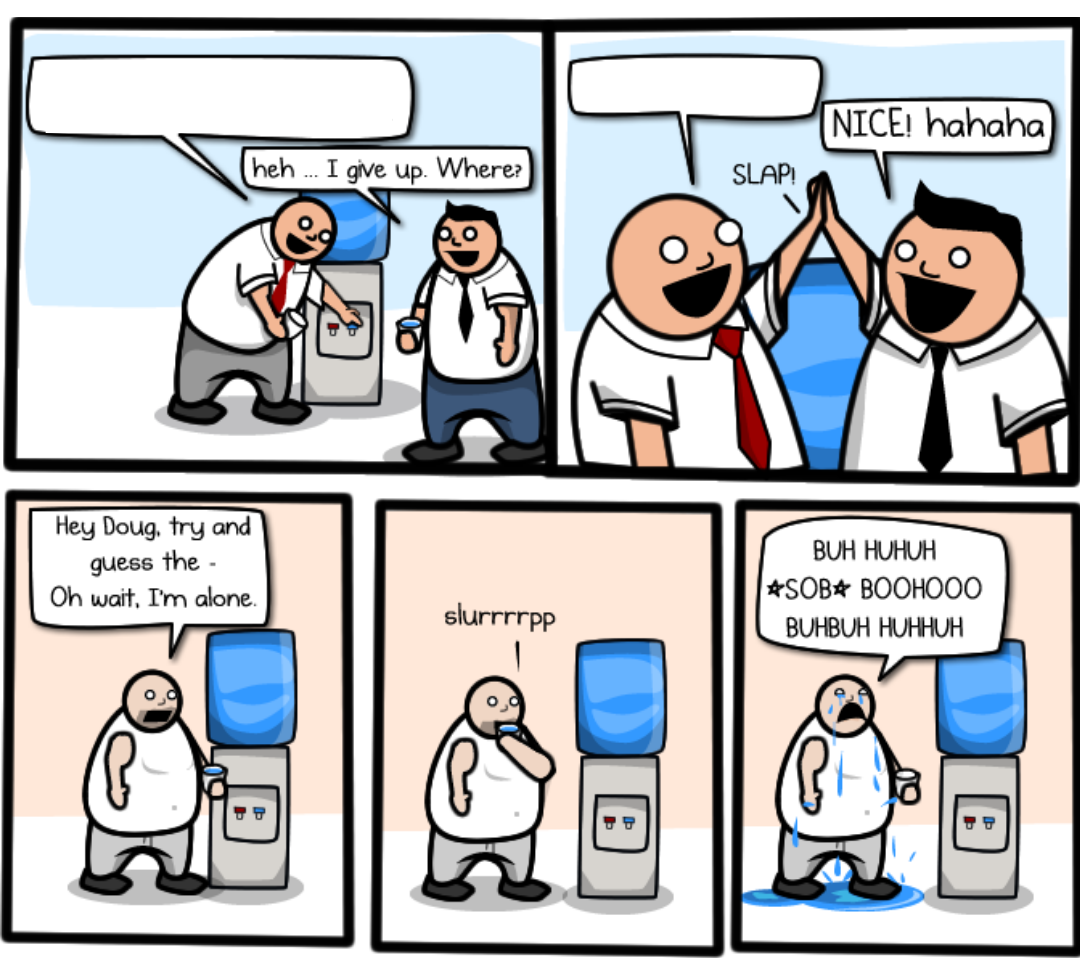
credits - the oatmeal
At QED42 we dedicatedly make efforts to fill in the void of ad-hoc team meals, discussions around new tech, movies, books, birthday celebrations, festivities, and more. While each team devises its own way/style of staying connected with its team members through daily zoom calls, slack channels, organizing fun activities & workshops, we also ensure that they do not do so in isolation. We foster communication across different team members through virtual meetups, slack channels themed as per our employee's interests, mixing members from random teams to connect over a casual video call, just to get to know each other, virtual birthday celebrations, and more.
Productivity and speed
We believe it is very important to go beyond the impulse of monitoring outputs and activities as a proxy for employee productivity.
Inputs or volume of activity has always been a poor substitute and so we channelize our efforts toward improving the real productivity that boosts outcomes and results. Our teams have been thriving with the help of techniques and programs that are empowering and less controlling. For instance our Professional Development Ladder, we call it the PDL. Wondering what it is?
PDL is a program that will allow our employees to have career growth discussions, skill enhancement feedback/follow-ups, and a way for us to be in regular touch with team members. This is a sincere effort toward the holistic growth of our employees.
Apart from this we also have regular check-ins and informal discussions to ensure that all blockers or issues at work are addressed.
Moreover, our buddy system is a hit among the new team members who have joined our remote culture. We have turbocharged decision making and with compassionate leadership, we ensure that no form of disconnect arises which could hamper the productivity and speed of our teams.
Awards & Recognitions
“When working remotely, it isn’t as easy to say a quick ‘thanks’ or ‘good job’ to a teammate,” says Google.
At QED42 we love celebrating our people and their achievements would it be towards their own learning & development, project work, a new initiative, a successfully delivered workshop, work anniversaries, birthdays, and the list goes on. We also appreciate our people by sharing kudos in team meetings, company meetings and even have a Slack channel dedicated to it.
Making well-being a priority
In the midst of a pandemic, mental & physical well-being are more important than ever. Apart from helping set up comfortable office space and organizing various activities to foster communication. We strongly believe in the need for ‘buffer time’. Our flexible work hours enable employees to block time in their schedules for a quick walk, run, meditation session, or do anything else that helps them decompress. We also schedule mental well-being sessions and provide free access to healthcare apps.
We surely know how to unwind
One thing we QEDians know is how to unwind. We have virtual meetups to chat after a long day of work, game nights, in-person getaways when we can, celebrations for different festivals, and more. Basically, we find ways to have fun would it be virtually or in person!
Picture this: You have a productive morning, energizing meetings with your team at the office or on Zoom, grab lunch with your coworkers or family, head out for a walk, finish up your day, spend time with your loved ones, volunteer in your community, or indulge in a favorite pastime! This is what remote working at QED42 is like.
If you like what you read, then you’d absolutely love to be a part of our team. Go ahead and check out our job opportunities here.

Perks and Benefits of Working with QED42
At QED42, we believe in the pursuit of excellence while prioritizing the personal and professional success of our team members. We deliver digital solutions by being rooted in our values and principles, including taking charge, cohesion, coherence, kindness, boldness, and creativity.
We are focused on creating an inclusive, diverse culture where QEDians feel like they belong, as we grow and change. Our perks and benefits are carefully shaped keeping the professional growth and personal well being of our employees.
Work with ambitious mandates
We build partnerships with big brands across diverse industries, fostering inter-practice collaborations, and earning the trust of our valued clients.
Our partners are enterprises and purpose-driven organizations like, United Nations, Stanford GSB, Nestle, American Diabetes Association, Dr Reddy's Laboratories, nVent, Sony, HERE Technologies, National Stock Exchange, Illinois Legal Aid Online, Kotak Securities, SABMiller, National Kidney Foundation, Canon, HP, Ashoka, Scholastic, and Warner Music Group among others.
Working with big brands can significantly boost your career growth and exposure. The projects you work on and the connections you make can be a valuable learning experience. Whether it's honing your communication skills, mastering project management, or understanding the intricacies of their culture, there's much to gain from working with industry giants.
Collaborating with big brands exposes you to a vast network of professionals within the organization and its industry ecosystem. These connections can lead to valuable partnerships and mentorships.
Learning with collaboration
Here at QED42, collaboration between different teams is an integral part of our work culture. Cross-team collaborations allow our employees from different departments or functions to share their unique expertise, experiences, and perspectives.
This exchange of knowledge fosters a culture of continuous learning and enables individuals to gain insights into areas outside their immediate scope of work.
By working together to overcome obstacles and achieve common goals, employees have a wealth of benefits, including knowledge sharing, improved problem-solving abilities, enhanced communication skills, increased efficiency, professional development opportunities, networking, adaptability, and resilience.
Opensource
QED42 is a product of the open-source movement, our belief in contributing back to open source is firm and is one of our guiding values to pursue. Our contributions to open-source communities like Drupal and React are based not only on our ethos of giving back but also on a desire to collaborate with some of the best minds across the world.
We encourage and mentor all our team members to contribute and help build the open-source community.

Professional Development Ladder (PDL) program
We sponsor employees for upskilling and other educational opportunities for their growth within the company and otherwise. The PDL is a program wherein a mentee gets guided career-wise and with motivational, & emotional support by a mentor to show growth, develop skills, and set goals.
This program is designed to benefit both mentor and mentee, wherein the former gets to brush up on their leadership skills and the latter gets to practice and demonstrate all that has been taught.
Events and conferences
We want to help our team to have various experiences and exposures. So we encourage and motivate our employees to participate in events and exhibitions both on a national as well as global stage to present their work. This provides employees with the benefit of interacting with like-minded colleagues, showcasing their work globally, and also growing professionally.
Competitive salaries
We keep a close watch on industry standards and competitive salaries are paid based on your skills and experience.
Flexible work hours
We encourage our employees to structure their day as per their convenience with a required overlap with their team members. Flexible work hours allow our employees to go biking in the mountains, cook their favorite meals, spend time with family, or run to grocery stores among others without worrying about being stuck in a 9-5 job.
Health insurance
We value your physical and mental well-being and make no compromises there. After all, health is wealth, so we ensure it is well taken care of, for you and your family! All QEDians are entitled to term life, accident, and health insurance. The family medical insurance includes spouse, and up to 2 children.
We believe in protecting not just our teammates but also the people they love.
Our leave structure
Everyone needs their ‘me’ time and we value that immensely. Whether you’re looking for a vacation leave, a sabbatical, a celebration, or a loss, we’ve got your back. All QEDians are eligible for 21 days of consolidated leave from their date of joining.
We have 26 weeks of maternity leave for the first two children and 12 weeks for the third child, in compliance with the Maternity Benefit Act, India. We also offer 30 days of Paternity leave and 12 weeks of adoption leave to help make a smooth transition into a beautiful phase of life that awaits.
We offer 45 days in case of a miscarriage and 10 days in case of the loss of a close family member. We believe that these are difficult times and look to extend our support during such times.
You can also take a sabbatical, this is our way of pampering the employees who’ve been with us for a long duration. We offer 30 days of paid leave upon the completion of 5 years with the company.

Conclusion
We uphold the idea of equality for all, irrespective of their position, race, and gender. While work needs to get done, one shouldn’t have to compromise on their commitments to family and friends. A healthy work-life balance is of prime importance to us because it helps in attaining job satisfaction.
We value the idea of ‘maximizing joy and minimizing fear’ with empathetic leadership and an equal-opportunity work culture.
Along with doing good work, we value every opinion, we try to ensure each member feels at home when they’re a part of the QED42 family. We focus on spreading kindness and believe that a little affirmation at work does make one feel good.
Here are some numbers that might affirm your faith in wanting to be a part of our team.
- A 4.7 rating on Glassdoor
- A 4.8 rating for customer satisfaction on Clutch
- A 99% rating of being recommended to a friend
- A 94% approval rating of the CEO
If you like what you read, then be part of an organization where everyone’s got your back and your growth is given equal importance to the growth of the company. Explore our open positions here.

My internship as an AI marketer at QED42 taught me things no course ever did
I saw the opening for an AI-enabled Marketing Intern at QED42 and applied after reading the description because the role matched my interest in marketing, AI, and content. Even after I got accepted, I was still a little unsure about what the role would actually involve.
I was about to find out what it meant the hard way: by doing it.
I want to be honest with you about something.
Before this internship, I thought AI tools would make me faster. I thought the skill was in knowing which tools to use. I took courses on prompt engineering, watched YouTube videos about ChatGPT and Claude workflows, and genuinely believed I had a head start.
I was wrong about almost all of it.
Not because AI tools aren't powerful, they are…. But because everything I had learned was about the tools. Nothing had taught me how to think around them. And that gap between tool knowledge and systems thinking is exactly where most AI-assisted work falls apart.
Here is what my internship actually taught me that I could not have learned in any course.
Understanding the audience comes before touching any tool
Every course I had taken started with the tool. Here is the interface. Here is the prompt. Here are the results.
My internship started differently. Before I was allowed anywhere near a live project, I spent time reading QED42's entire website, studying its AI platform Aeldris, attending onboarding calls, and documenting my understanding of brand voice and positioning. Not because I was told to. Because I quickly realised that a well-structured prompt built on a misunderstanding of the audience produces confident, polished, completely useless output.
From where I saw it, AI did not know the brand; it only knows the buyer.
Building an AI tool is a judgmental task, not a technical task
I built three AI-powered tools during my internship, all using Aeldris:
- AI Blog Guardrail and Brand Compliance Tool — reviews content drafts and flags anything that violates QED42's tone, style, and brand guidelines before a human editor sees it
- AI Generated Content Reviewer — flags writing that reads robotic or tonally inconsistent with human editorial standards
- Content Repurposing Tool — takes a single blog post and generates multiple LinkedIn posts calibrated for different audiences. Keeps the same tone, messaging, and style across different content pieces.
The AI was the engine. I was the architect. And being the architect required marketing thinking, not engineering thinking.
Prompt engineering is not one skill
Every course treats prompt engineering as a single discipline. Write clear instructions. Give examples. Be specific.
That advice is correct and almost entirely insufficient.
Through building the enterprise intelligence system at QED42, researching 30+ companies across Healthcare, BFSI, and other sectors using a master Claude Project. I discovered that effective prompting at scale actually requires two separate skills that most people collapse into one:
Instruction design: The clarity of what I was asking for. This is what most courses teach. It is necessary but not sufficient.
Architecture design: For the enterprise system, I built a master Claude Project with three file layers: a research template, raw company research notes, and a strict style and register ruleset. The quality of the output depended as much on what I put into the project as what I put into the prompt.
The most impressive output is worthless if nobody uses It
The Content Repurposing Workflow got more adoption than any other tool I built. It is not the most sophisticated. It does not do anything technically complex. It takes a blog post and turns it into LinkedIn variants for different audiences.
But it solved a real, daily frustration that every member of the marketing team felt. And I recorded a walkthrough. And I shared it in the internal Everyday AI channel. And I followed up when people tried it.
The real skill is building systems, not tools
A tool solves one problem once. A system solves a category of problems repeatedly.
The enterprise intelligence system I built at QED42 is the clearest example of this distinction in my own work. The task was to produce research reports on 30+ enterprise companies across Healthcare, BFSI, and other sectors, the kind of intelligence that helps QED42 approach a potential client not with "we help enterprises modernise platforms" but with "we noticed your team has been posting simultaneously for a Drupal architect and a headless migration lead, which usually signals a platform decision already in motion."
A tool approach would have been: write a research prompt, run it for each company, compile the outputs.
A systems approach was: build a master Claude Project with a consistent 11-section research template, a raw signals layer for each company, and an editorial register ruleset enforced in a separate prompt pass, so the output quality was consistent across all 30+ companies, regardless of how different their sectors, structures, and platform contexts were.
The system took longer to build. But it scaled. And it produced reports that were specific enough to be genuinely useful rather than generic enough to be safely ignored.
Documentation is not the last step. It is half the work
I was not taught this in any course. I learned it the hard way when I realised that a workflow only I understood was not a workflow, it was a personal habit.
Every process I have built now exists in two forms: as a working system and as a written document that a team member could follow without any explanation from me. This is not just good practice for knowledge sharing. It is a discipline that forces clarity. If I cannot write down what the system does and why each step exists, I do not fully understand it yet. And if I do not fully understand it, I cannot improve it reliably.
The most important document I produced was a skill file for the enterprise research system, a set of explicit rules for how reports should be researched, structured, and written. Every new company research run now starts from that file. The output quality is consistent. The process is transferable. The system works without me.
.png)
.png)
Some colleagues and I after a very cool session on AI Observability
The honest takeaway
Six weeks ago, I had never built an AI tool. I had ideas, curiosity, a tech background, and a title I didn't fully understand.
Today, I've built three tools, designed and run an enterprise intelligence system across 30+ companies in four sectors, written more prompt iterations than I can count, and shipped things that actually got used by real people. All from a marketing bent of mind, as they say it here. I am still building that mindset. Writing this blog was one of the exercises to get there.
That's what AI marketing looks like from the inside. It's not magic. It's not prompt engineering as a party trick. Its methodology was built slowly, tested honestly, and improved every single week.
I came in thinking AI tools would make me faster.
They did eventually. But not in the way I expected. The speed came not from the tools themselves but from understanding deeply enough what I was trying to produce that I could give the tools precise, useful instructions.
That understanding came from working on real problems with real stakes for a real audience. Not from a course. Not from a certification.
Today, because of this internship, I am more curious, AI tools are my playground, and marketing is becoming a way of thinking.
The title still sounds made up. But now I know what it means. And I'm just getting started.

Inside Drupal Trivandrum’s 25th anniversary meetup
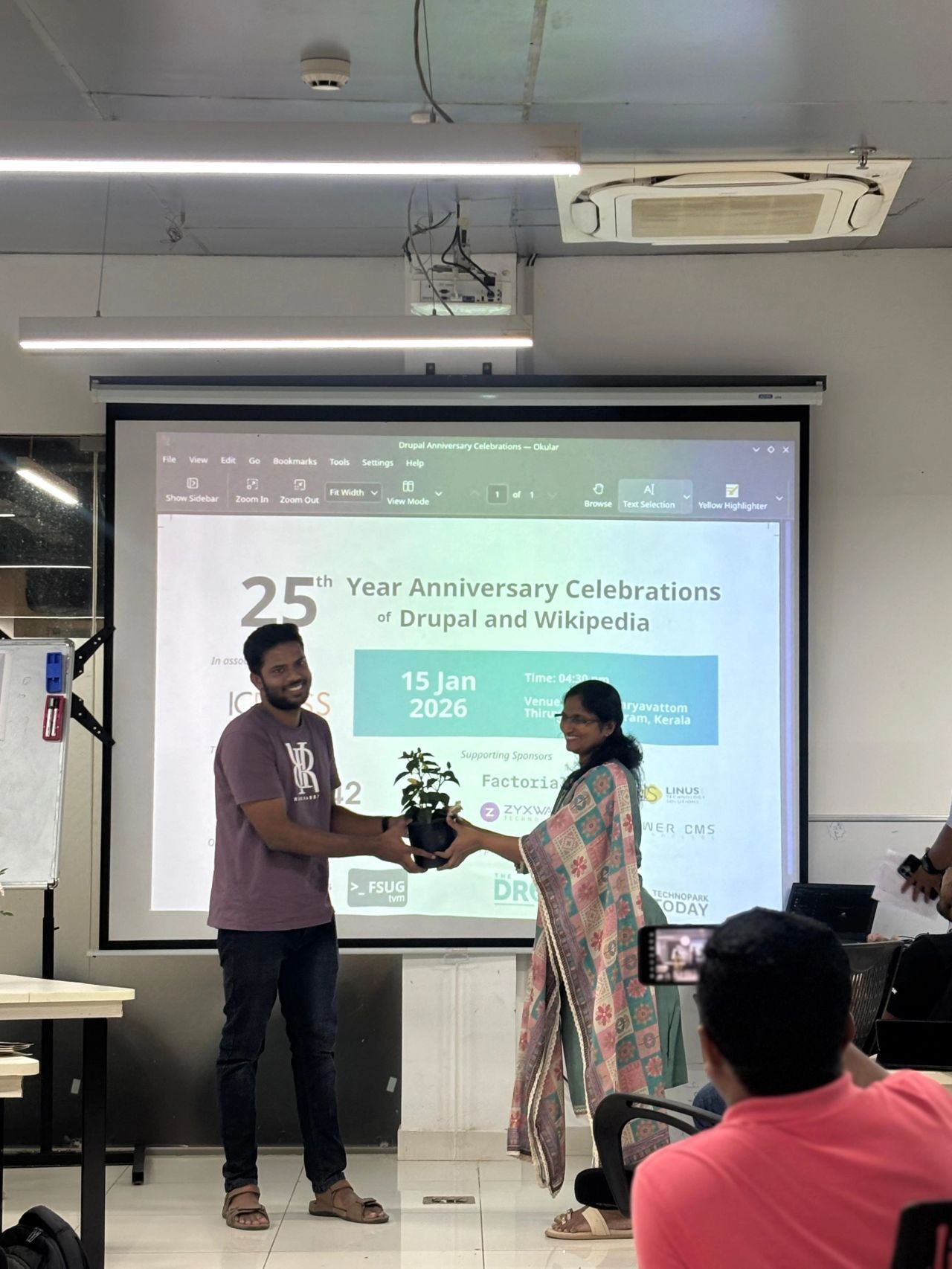
Drupal Trivandrum celebrated the 25th anniversary of both Drupal and Wikipedia on 15th January. I attended the meetup in person, and it was a good experience. Our involvement started with a simple conversation between Piyuesh and The Drop Times, which led to us being part of the event, and in turn, I got to be there as well. Destiny!
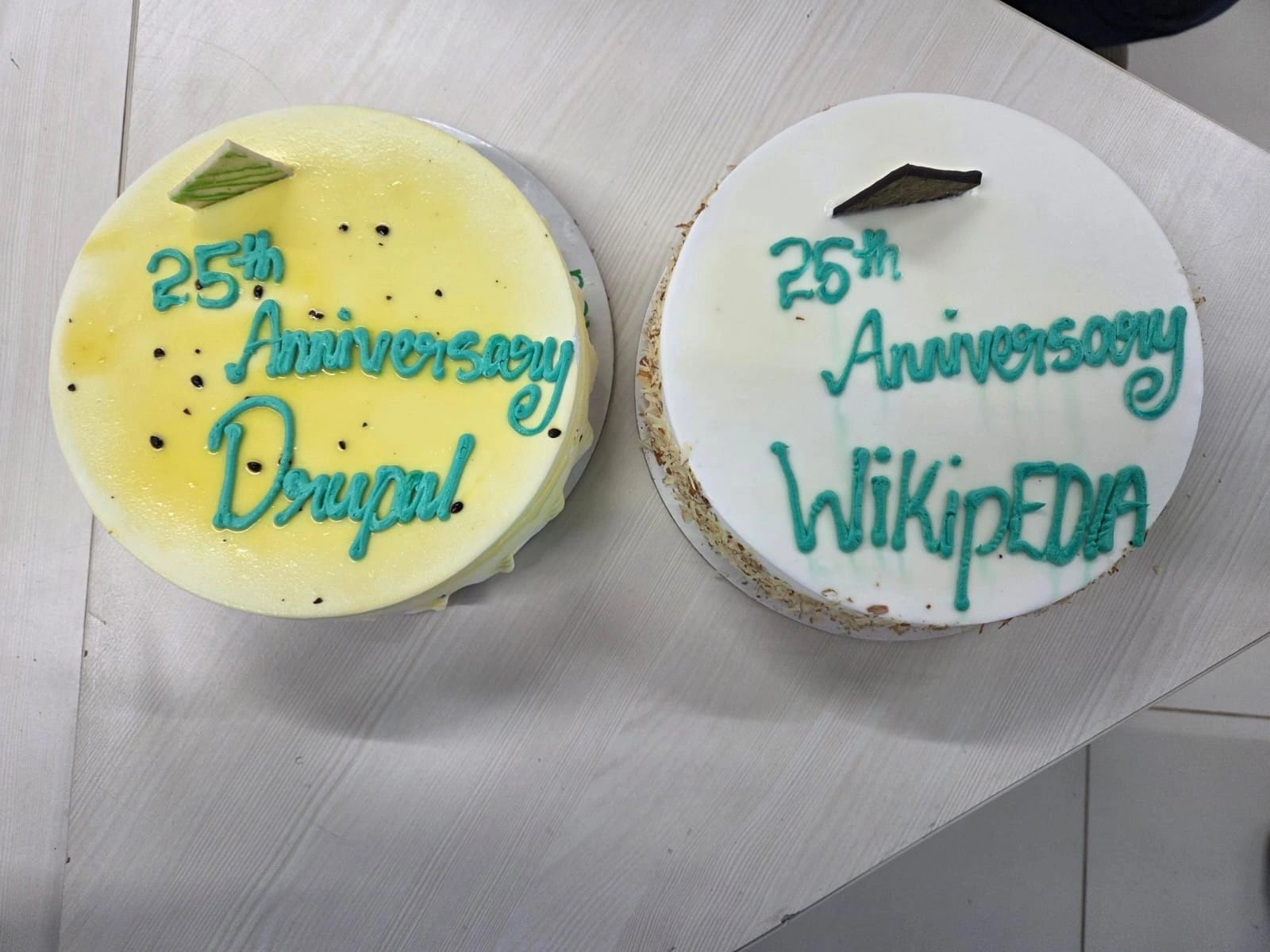
The event was held at the International Centre for Free and Open Source Solutions (ICFOSS), Trivandrum, and the turnout was impressive. There were many college students and fresh graduates attending, asking thoughtful questions, and engaging deeply with how Drupal is evolving. At a time when Free and Open Source communities are actively thinking about how to stay relevant for the next generation, seeing this level of curiosity and participation felt like a strong sign that the ecosystem is moving in the right direction.
The program opened with the Presidential Address by Sunil TT, Director of ICFOSS, followed by a session titled ‘Drupal: Past, Present, and Future’ by Sebin A. Jacob, Editor-in-Chief of The Drop Times. The session traced Drupal’s journey over the years and gave a clear picture of how the platform has grown and changed.
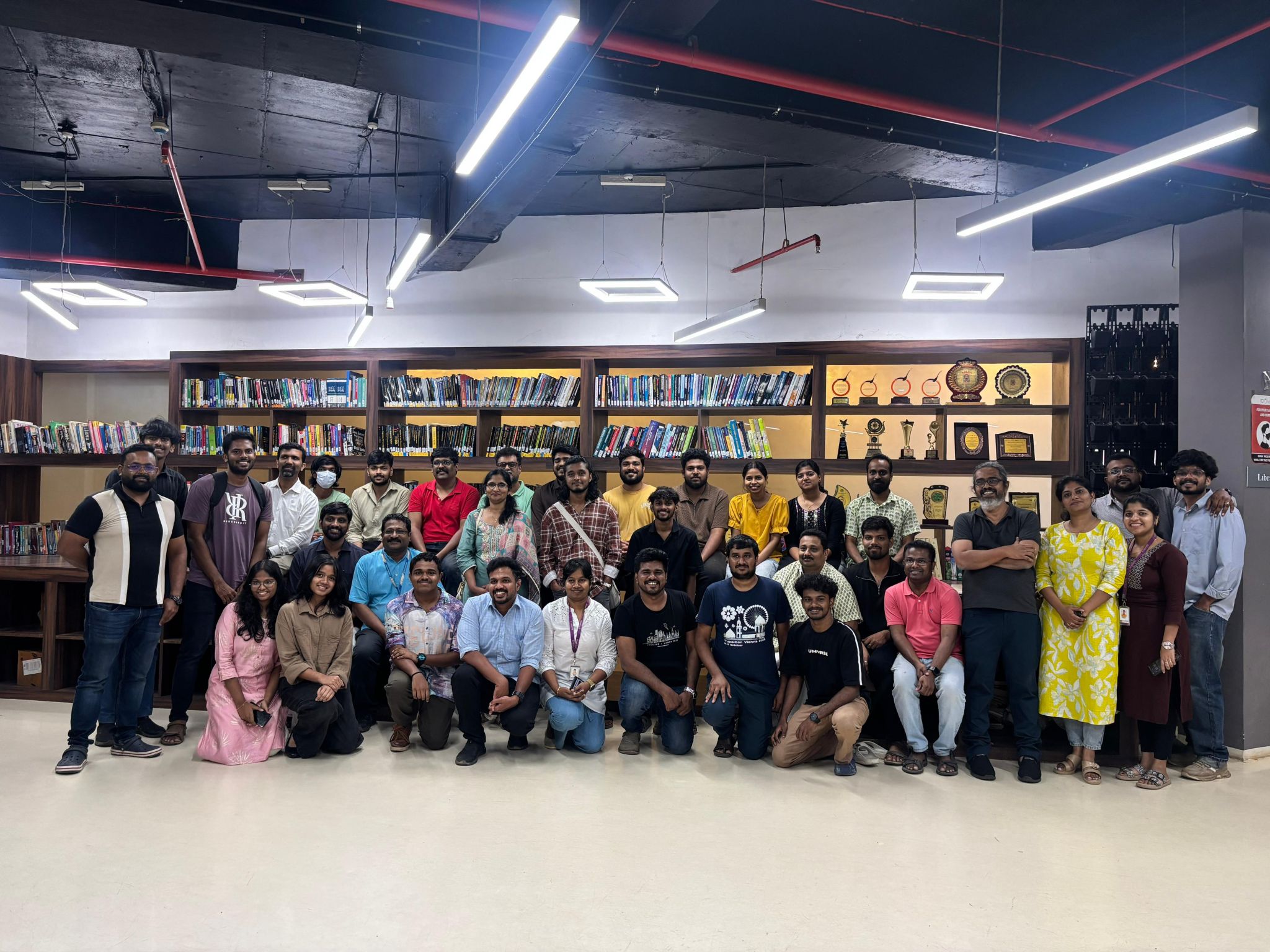
One of the most inspiring parts of the meetup was hearing people share their personal Drupal journeys. They spoke about how they discovered it, how they learned it, and how it ended up changing their lives.
What struck me deeply was how, in a time when the internet was not widely accessible and knowledge was not available at everyone’s fingertips, people still built communities and shared learning. They laid the foundation of an ecosystem that today creates jobs for so many of us and quite literally puts food on our plates. I spoke about the Drupal AI initiative and Drupal Canvas, which I am always happy to talk about.
As part of the celebration of 25 years of Wikipedia, Mujeeb Rahman from Wikimedians of Kerala presented the history of Wikipedia and explained how thousands of contributors collaborate every minute to make knowledge freely available and accessible to the world. He also introduced us to a fascinating site called Listen to Wikipedia(http://listen.hatnote.com/), which plays a sound whenever a Wikipedia page is edited or updated in real time. It felt like a powerful symbol of community spirit and collaboration.
To make sure Drupal and Wikipedia continue to stay relevant for the younger generation, two thoughtful initiatives were announced during the meetup:
- Drupal in a day, announced by Anish A from the Drupal TVM group, focused on introducing Drupal to college students in a simple, hands-on, and approachable way.
- Wiki Loves Drupal, announced by Kala Jayan from the Drupal TVM group, focused on improving the quality, depth, and accuracy of Drupal-related content on Wikipedia.
The second initiative felt particularly timely, as Wikipedia remains one of the most trusted and widely referenced sources of information, including by many AI systems and search tools. Strengthening Drupal’s presence there makes the information more reliable, more accessible, and easier for people to discover.
Dinner followed, supported by the event sponsors, and it gave everyone a relaxed space to talk, connect, and spend time together over good food. It was a simple but nice way to wind down after a packed day.
Meetups like this leave me feeling refreshed. They create room for real conversations, new ideas, and stronger community ties, and they remind me why being part of the Drupal and the wider open-source ecosystem matters.
Thanks to QED42 (that’s where I work), which supported the event as the Title Sponsor, along with several other sponsors who helped make the gathering possible.

Drupal Turns 25: Highlights from the January 2026 Pune Meetup
Just like people, technology grows, adapts, and figures itself out over time. And after 25 years, Drupal has done all of that and more.
On January 10, 2026, the Drupal Pune community came together to celebrate this milestone at a special Drupal Birthday Edition meetup, marking 25 years of Drupal. Hosted by QED42 at their Pune, India office, the event brought together Drupal enthusiasts, professionals, and long-time community members for a morning filled with learning, reflection, and good conversations.
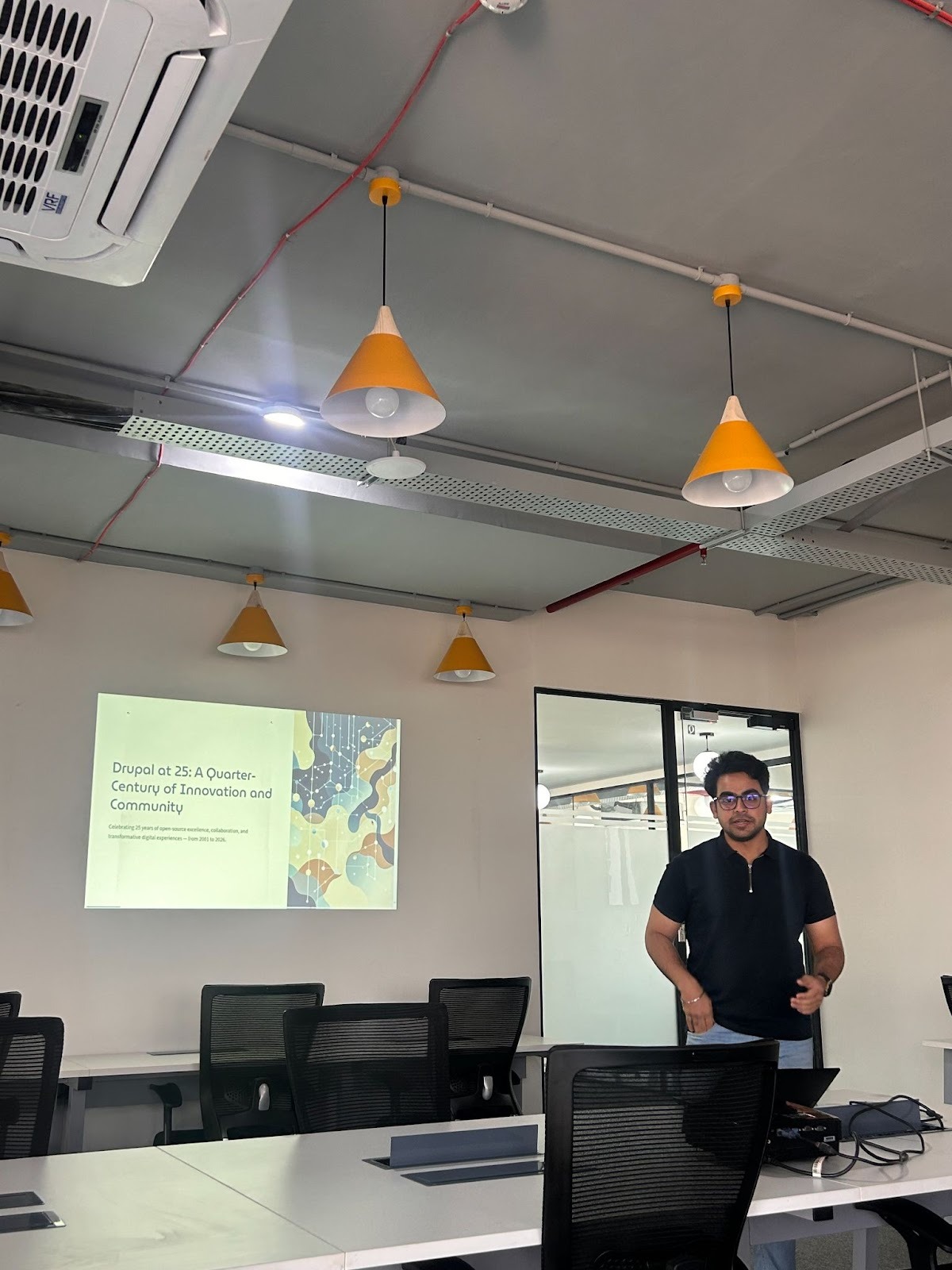
The day kicked off with a relaxed meet-and-greet, setting the tone for what felt less like a formal event and more like a community reunion. That was followed by an insightful session titled “Drupal at 25: A Quarter-Century of Innovation and Community” by me.
I took everyone on a journey through Drupal’s story, one that mirrors human growth in many ways. It started back in 2001 as this simple dorm-room experiment, just people trying to solve a problem, no big master plan. And over time, through a lot of trial, learning, and collaboration, it turned into something real and dependable.
Today, that same idea has grown into a powerful, enterprise-grade content management system trusted by governments, universities, media houses, and global brands. That evolution is kind of crazy when you think about it. I talked about the key milestones that shaped Drupal and how it wasn’t about sudden breakthroughs, but steady progress.
Consistent innovation, a strong open-source community, and a commitment to flexibility are what helped it grow without losing what made it special in the first place.
One of the most engaging parts of the meetup was the discussion between members around Drupal’s future in the age of AI. The conversation focused on how Drupal is becoming increasingly AI-ready, thanks to its flexible architecture and API-first approach.
From content generation and personalisation to smarter workflows, participants shared how Drupal is well-positionedwell positioned to support modern, intelligent digital experiences without compromising on security or scalability.
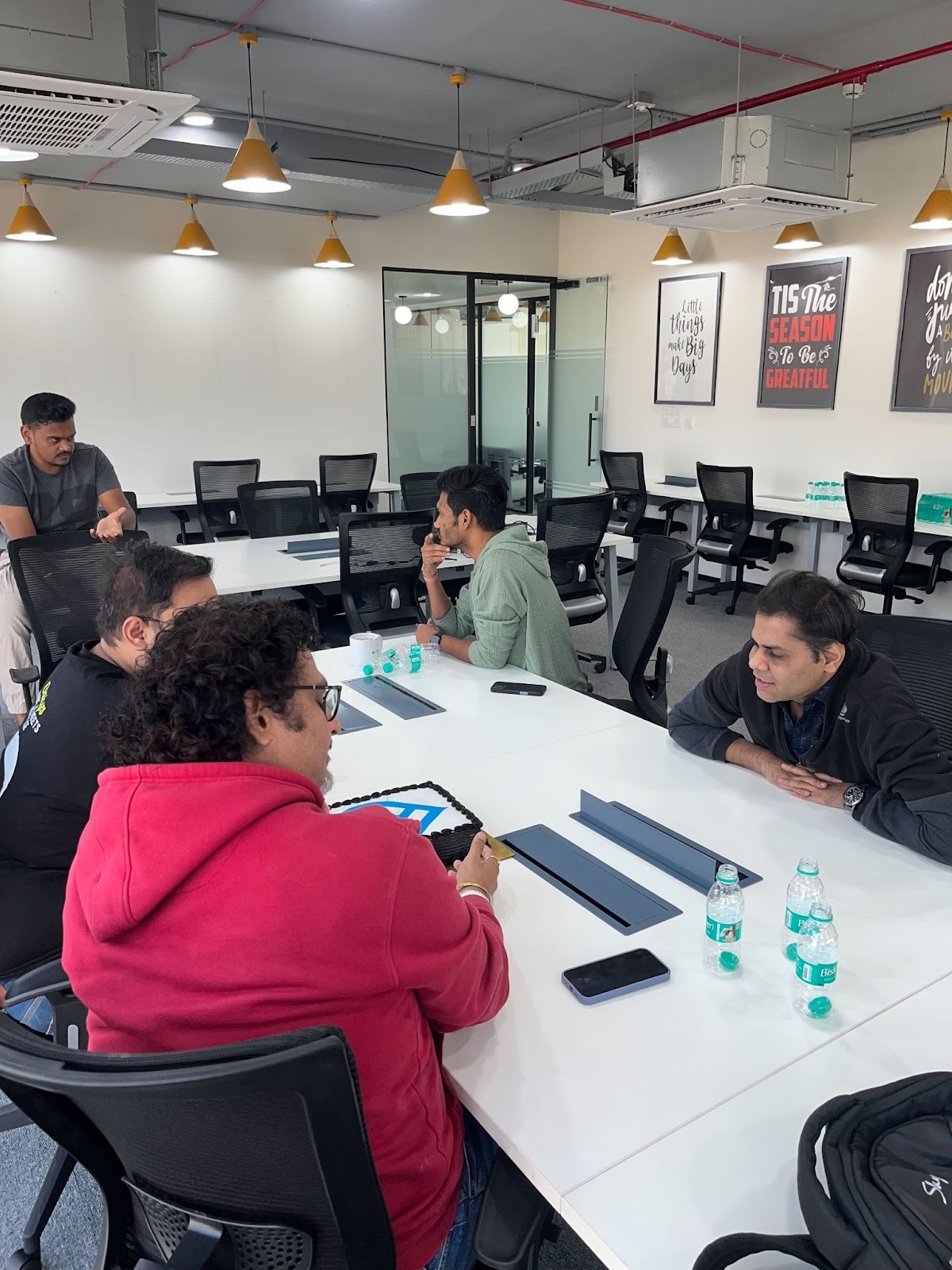
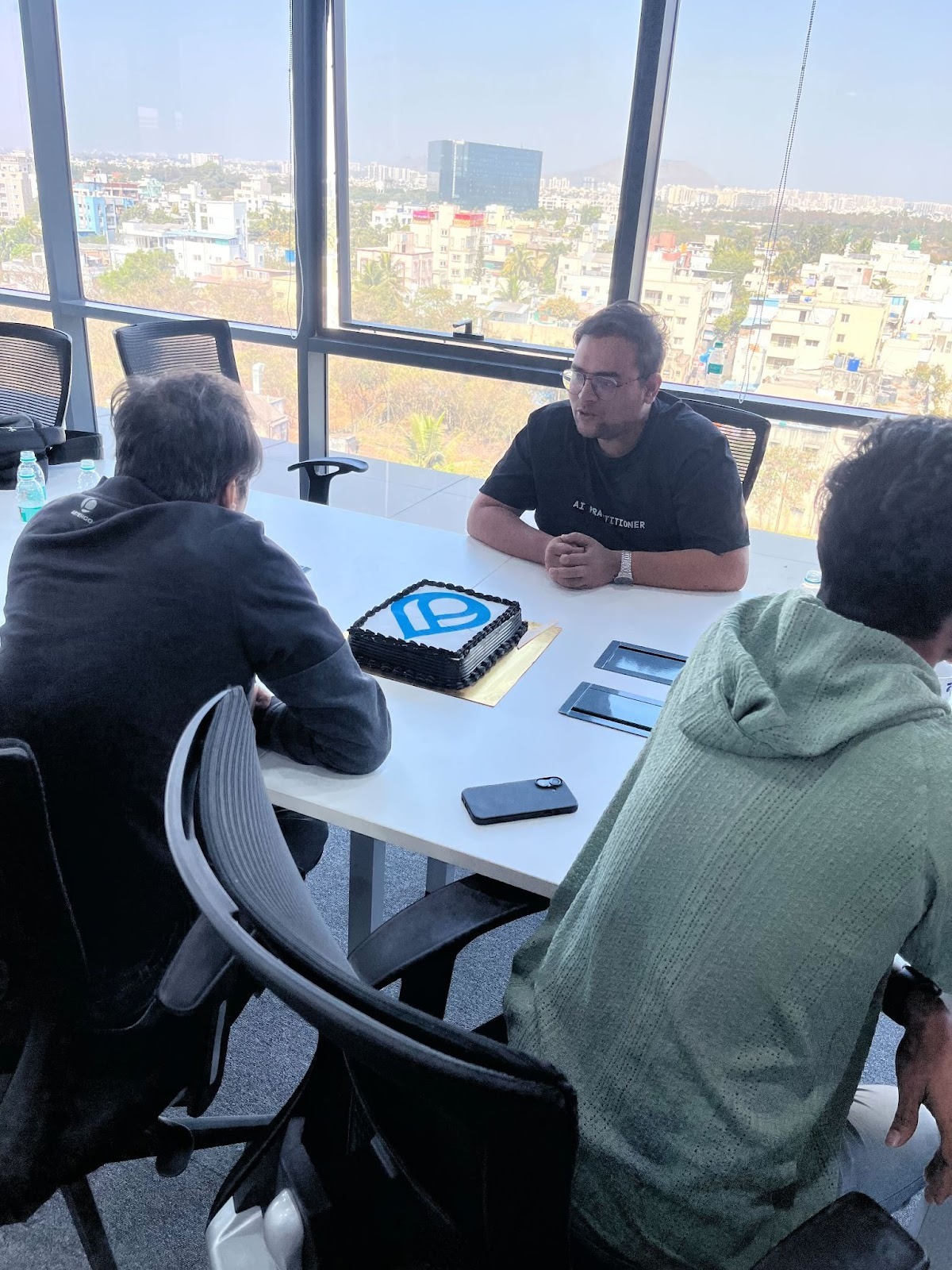
The meetup ended over lunch, with people breaking into small groups (that’s honestly where the deeper conversations always happen at any event).
Conversations flowed easily, ideas were exchanged, and there was a shared sense of excitement about what lies ahead.
More than anything, the event was a reminder that Drupal’s real strength isn’t just technology. It’s the community that continues to build, support, and evolve it together.
Here’s to the next chapter of Drupal!

Oaisys 2025: a space for humans who learn by doing
Oaisys 2025 is a two-day gathering built around one idea: progress through practice, bringing together people who design, build, and apply AI in ways that make systems more useful, open, and human.
On 29–30 November in Pune, engineers, designers, and researchers will meet for talks, sprints, and sessions shaped by real projects and shared learning It’s a space to exchange ideas, test methods, and explore how collaboration can make technology more meaningful in everyday use.
Oaisys is built on community — people who learn and create together.
It’s a place for thoughtful discussion, practical exploration, and collective effort that turns ideas into working systems. It also reflects how open-source and AI communities in Asia are growing — sharing knowledge, building together, and shaping technology with intent and purpose.
And, why would this matter?
AI is now part of how we build, design, and decide. The question is, how do we apply it with clarity and purpose?
Progress happens when knowledge is shared. It needs spaces where experimentation meets community — where builders learn from one another in the open.
Oaisys was created to be that space: grounded, collaborative, and shaped by practitioners who care about how things are created.
Keynote
Marcus Johansson and James (Jamie) Abrahams from FreelyGive will lead the Drupal AI Code Sprint and keynote sessions at Oaisys 2025.
Both have been deeply involved in Drupal’s work with AI, shaping how open systems evolve through shared experimentation. Their sessions will focus on what’s being created, how it’s coming together, and how the Drupal community can participate in this progress.
The Code Sprint is a hands-on space for contributors and developers to explore Drupal AI — setting up tools, writing code, and learning through real implementations. It’s an opportunity to collaborate, share ideas, and move forward together.
Workshops and sprints
The sessions at Oaisys are made for people who learn by building.
Across two days, participants will join talks, sprints, and collaborative sessions centred on applied AI in practice. Each activity invites open participation — seeing how ideas are tested, refined, and translated into working systems.
From focused builds to informal discussions, every part of the event encourages practical exploration and shared thinking. It’s a place to connect with peers solving similar challenges and to gain a grounded view of how applied AI is taking shape.
Conversations and collaboration
Beyond the structured sessions, Oaisys makes room for open dialogue and exchange.
Panel discussions, show-and-tell sessions, and Birds of a Feather meetups bring together people from different disciplines to reflect on what’s real, what’s changing, and what’s next. The format is fluid — participants shape the conversations they want to have.
Whether it’s a discussion around Drupal AI, an exploration of open architectures, or an impromptu breakout, these moments often spark new ideas and collaborations that extend beyond the event.
A growing community
Oaisys marks the beginning of a broader effort to connect people working with applied AI across Asia. It’s a space to stay in touch, share what’s being learned, and keep building together long after the event ends.
The goal is simple: to strengthen a community where progress is shared and every experiment, no matter the scale, contributes to how AI evolves next.

Why CTOs can’t afford to ignore offshoring
For digital organisations, building fast, staying lean, and delivering reliably are now non-negotiable. Yet with engineering talent in short supply and delivery windows shrinking, traditional hiring approaches can no longer keep pace.
That’s why more CTOs are turning to offshore partnerships. Not as a fallback, but as a way to extend their in-house team and keep delivery on track.
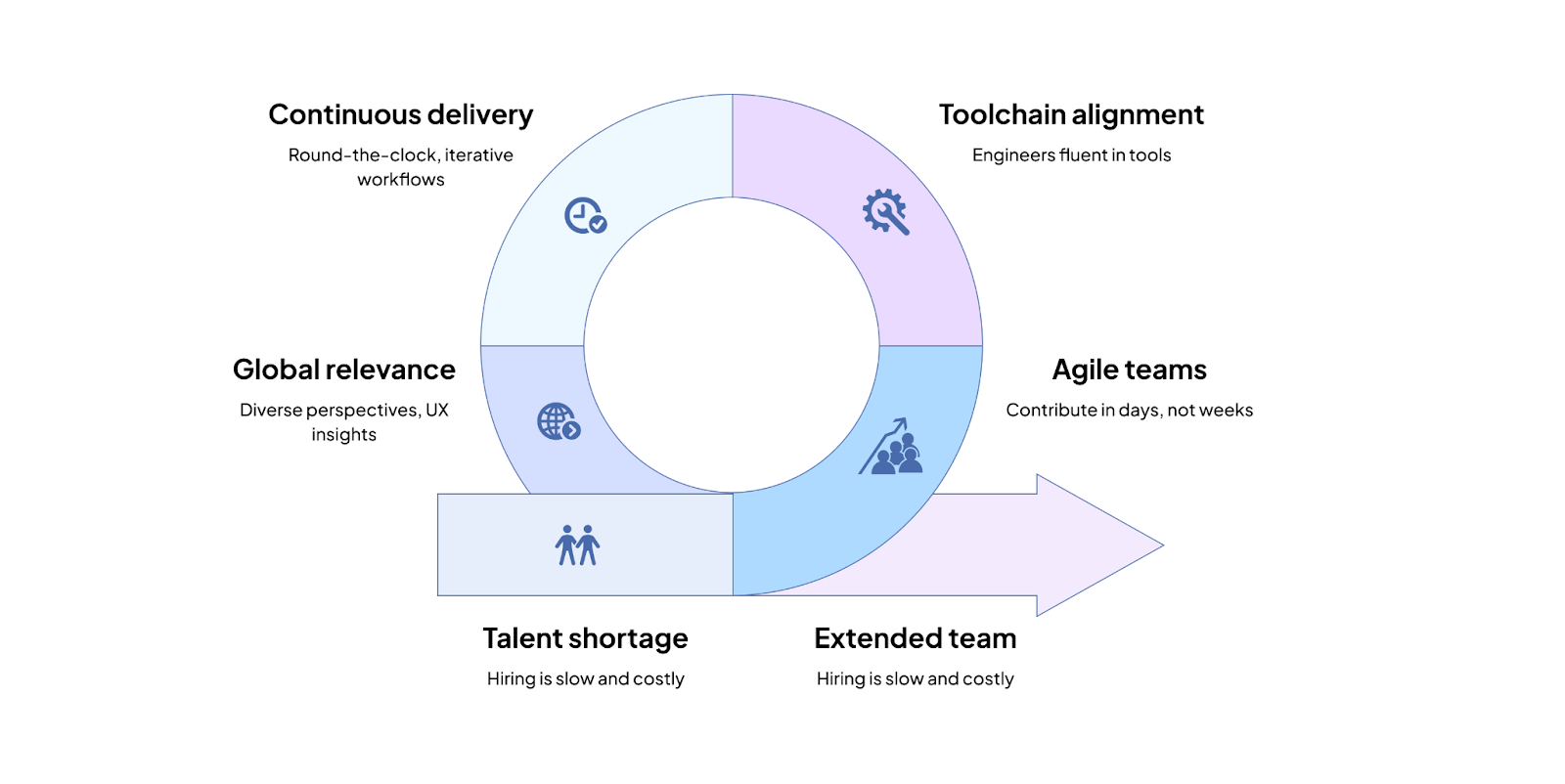
Offshore teams with agile maturity, cloud fluency, and toolchain alignment contribute in days, not weeks, along with taking accountability and being coachable.
What is the value beyond cost
Local hiring cycles are lengthy, and onboarding adds further delays. Offshore delivery reduces that ramp-up by providing engineers already fluent in the tools, workflows, and delivery practices in use.
Whether you're rolling out a headless CMS, improving frontend performance, or adding LLM-powered features, offshore teams make it possible to plug in just the expertise you need, when you need it.
The real value is not in lower rates but in aligning capability to need, while time zone coverage enables continuous delivery.
Round-the-clock, iterative workflows help teams hit tight deadlines while enabling knowledge transfer that strengthens internal teams over time.
What makes integration the difference?
The difference between transactional outsourcing and meaningful offshoring lies in integration. Teams that are aligned with your systems, delivery goals, and culture deliver stronger outcomes. Shared purpose builds trust, collaboration, and ownership.
Offshoring also unlocks relevance in a global marketplace.
Diverse perspectives reveal language, UX, and regional insights that strengthen product-market fit. Forcing one side to over-accommodate the other rarely works.
Balanced teams learn from each other and evolve together, bringing together the most relevant people across geographies, skill sets, and perspectives to engineer systems that serve a global marketplace.
Conclusion
Offshoring is no longer just about cost efficiency. It’s a way for CTOs to bring in the right skills at the right time, keep projects moving across time zones, and reduce delivery risks. When offshore teams are fully integrated into systems and goals, they accelerate execution and strengthen in-house capabilities.
In my view, the biggest shift is that offshoring has become a business advantage. It gives organisations a way to deliver faster, adapt to demand, and stay competitive without being limited by local hiring cycles.

Takeaways from React Nexus 2025
Are we moving towards a future where we write less code or where we write code more intelligently?
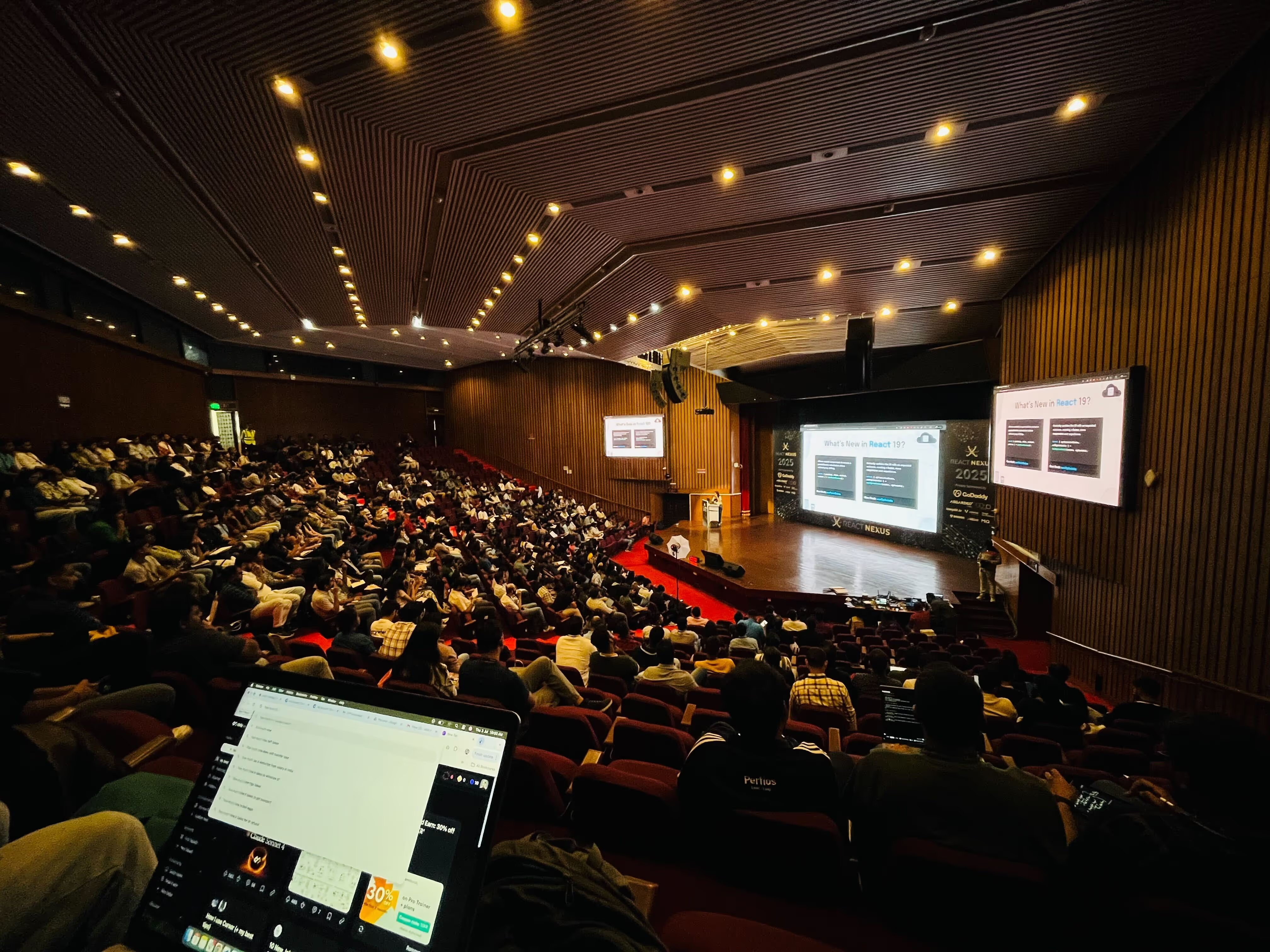
At this year's React Nexus, held at IISc Bengaluru, felt like a bit of both. The sessions and conversations portrayed that React 19 and AI are transforming our development processes, and the way we build software is evolving fast.
By automating repetitive tasks and minimising boilerplate code, these tools allow us to concentrate on what really matters, creating performance-driven architectures, enabling inclusive user experiences, and building systems that endure over time.
For the 700 attendees, this was more than just another tech event. With 29 brilliantly sharp speakers sharing their insights, it became a space to really pause and think about where React is going, and where our whole industry might be headed.
Personally? It was unforgettable. My first-ever tech conference, and oddly enough, it didn’t feel like a formal event at all. It felt more like a reunion.
For the past 3 years, I’ve been working remotely at QED42, bonding with my team through Slack threads, Google Meet calls, and GitHub pull requests. Getting to meet my teammates from the Pune office again was something else entirely.
Day 1: performance, architecture, and understanding the core
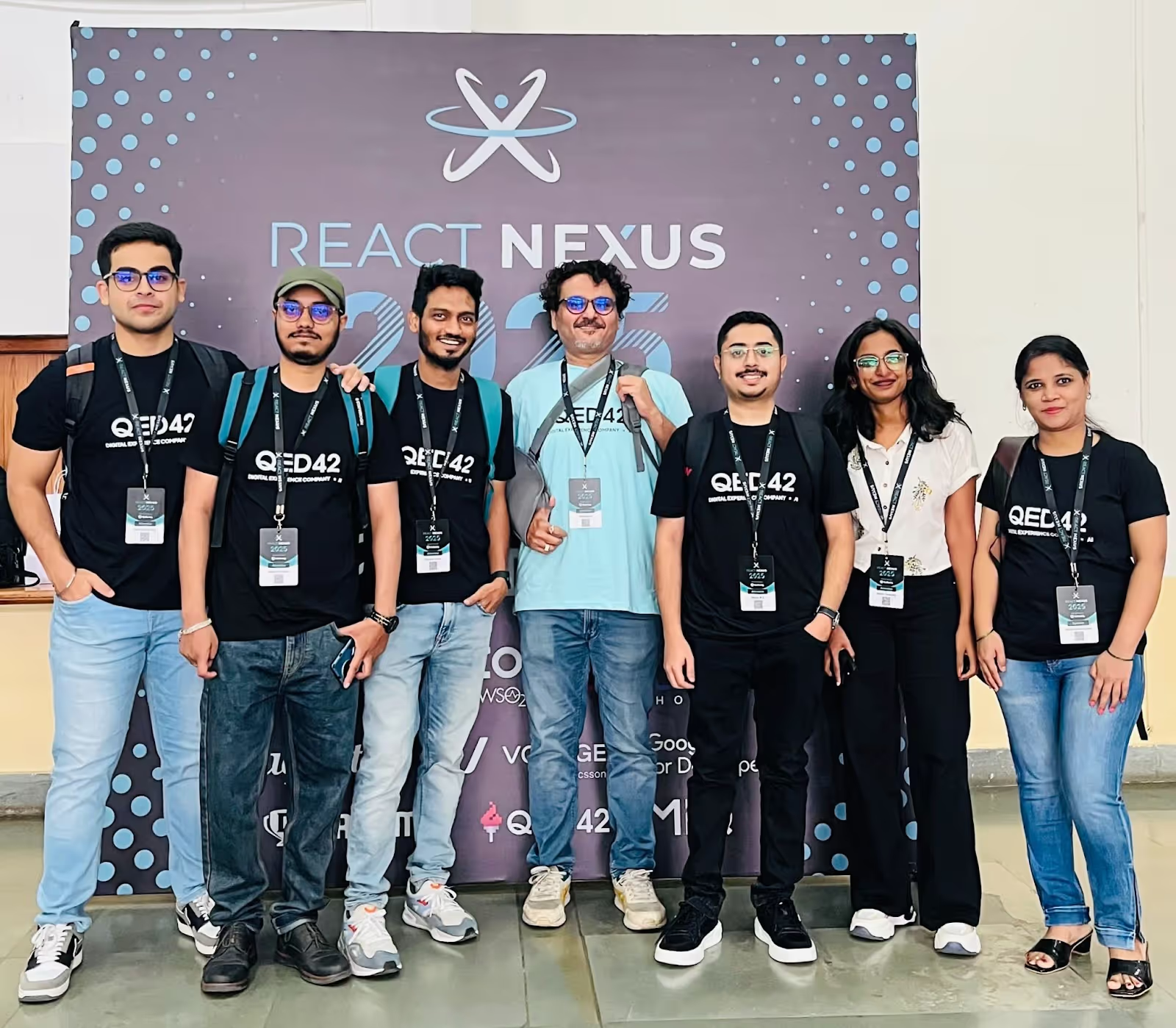
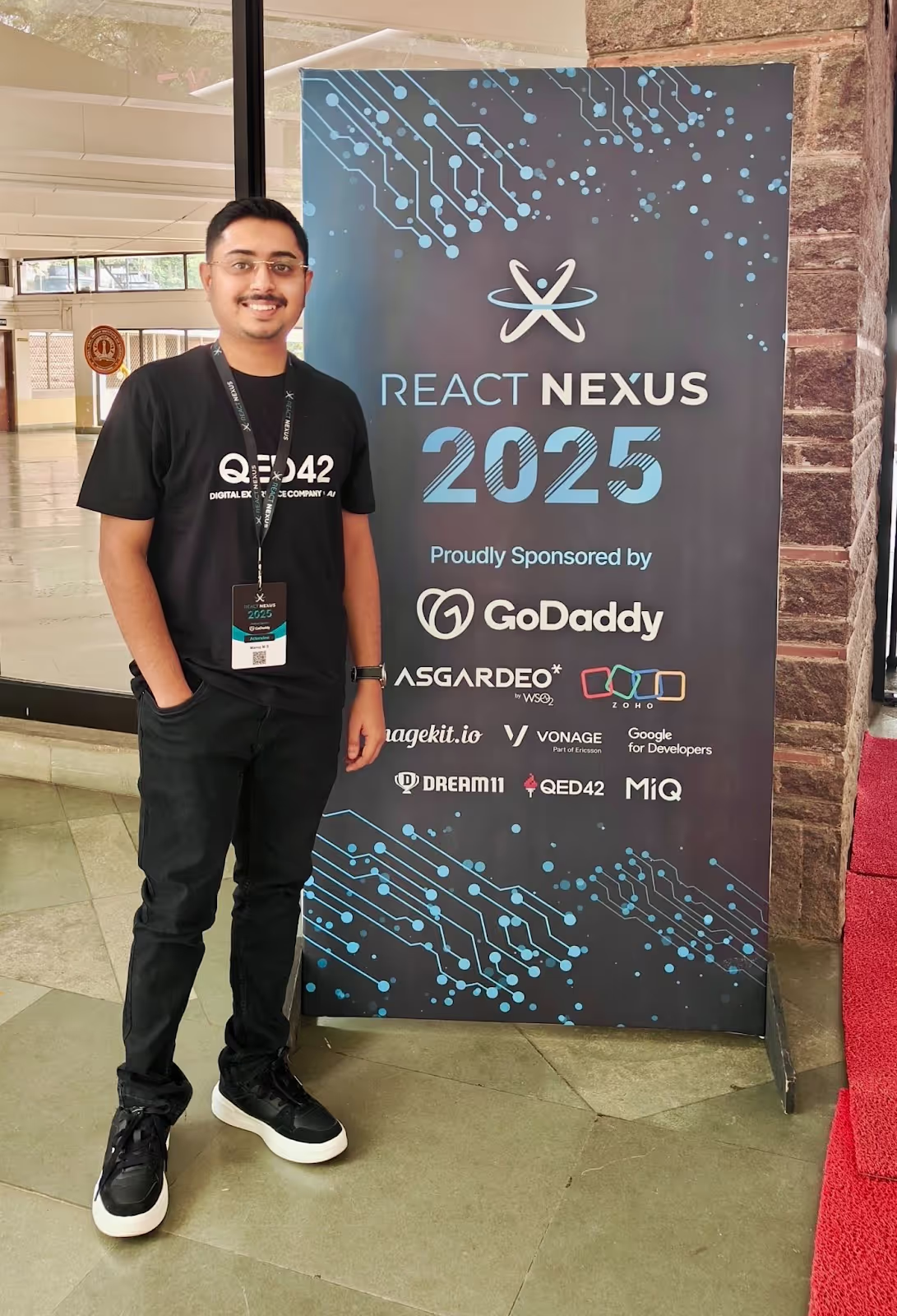
The first day was an incredible opportunity to understand fundamentals that scale. From exploring the React Compiler to understanding Fiber internals, each session was packed with insights you could immediately apply to real-world problems..
The event was run really well. Registration was quick, volunteers were on point, and everything just flowed smoothly.
The breaks for tea and lunch weren’t just a breather; they gave us a perfect chance to network with fellow developers and check out booths from companies like ImageKit, Asgardio, GoDaddy, Vonage, and Zoho Catalyst.
React 19: from boilerplate to beautiful
In her session on building better forms with React 19, Nipuni Paaris demonstrated how React 19 is transforming our approach to forms. With the introduction of new form actions and hooks, the era of tedious form boilerplate may finally be behind us. It's a relief for developers, seamlessly integrated into the framework.
Akash Hamirwasia shared what it’s like to adopt the new React Compiler. If performance tuning has ever taken over your workflow, this will feel like a breath of fresh air. The compiler now takes care of optimisations like memoisation, letting you stay focused on writing clear, expressive code.
Wadad Parker’s session on context was informative and full of personality. While prop drilling can feel like a workout, React 19’s revamped Context API streamlines state sharing, making it more efficient and reliable, with fewer unnecessary re-renders.
Scaling systems: from micro frontends to micro-architecture
Padam Jeet Singh and Shruti Bansal from GoDaddy shared practical strategies for making micro frontends work at scale. Their session focused on building shared infrastructure, setting up strong communication between teams, and putting solid governance in place. With the right structure, micro frontends become a reliable way to grow large applications without losing control.
Alok Kumar Singh from Cashfree Payments gave a clear and thoughtful breakdown of React Fiber internals. He explained how React handles rendering through incremental, interruptible updates and how lane-based prioritisation helps manage what gets rendered and when. It offered a deeper look at the mechanics behind React’s responsiveness and performance.
Performance & observability: build fast, stay fast
Harshit Budhraja from ImageKit.io delivered a session full of practical tips for improving Lighthouse scores, especially for media-heavy applications. He walked through techniques like using responsive images and AI-powered transformations through ImageKit.io. The live demo showed how these optimisations can make a real difference in both speed and quality.
Apurv Khare from Adobe explored the difference between knowing something broke and understanding why it happened. His session on frontend observability covered how to use sampling-based telemetry, real-time profiling, and structured logs to gain deeper insights. The focus was on moving from reactive fixes to proactive improvements that keep systems healthy and predictable.
Supercharging your IDE: the AI coding sidekick
I tested every cursor trick, so you don’t have to!
In her session, Tanisha Sabherwal talked about how the cursor isn’t just an editor; it’s your coding companion, demonstrating how to leverage context-aware prompts and other cursor features to receive AI support that truly understands your project's structure.
Give your code editor real superpowers
In this lightning talk with Apoorv Taneja was incredibly engaging, highlighting how MCPs can transform your editor with amazing new capabilities.
After a full day of learning, we navigated the infamous Bengaluru traffic to enjoy a wonderful team dinner, energised by the ideas we had discussed throughout the day.
Day 2: The rise of the AI-native developer
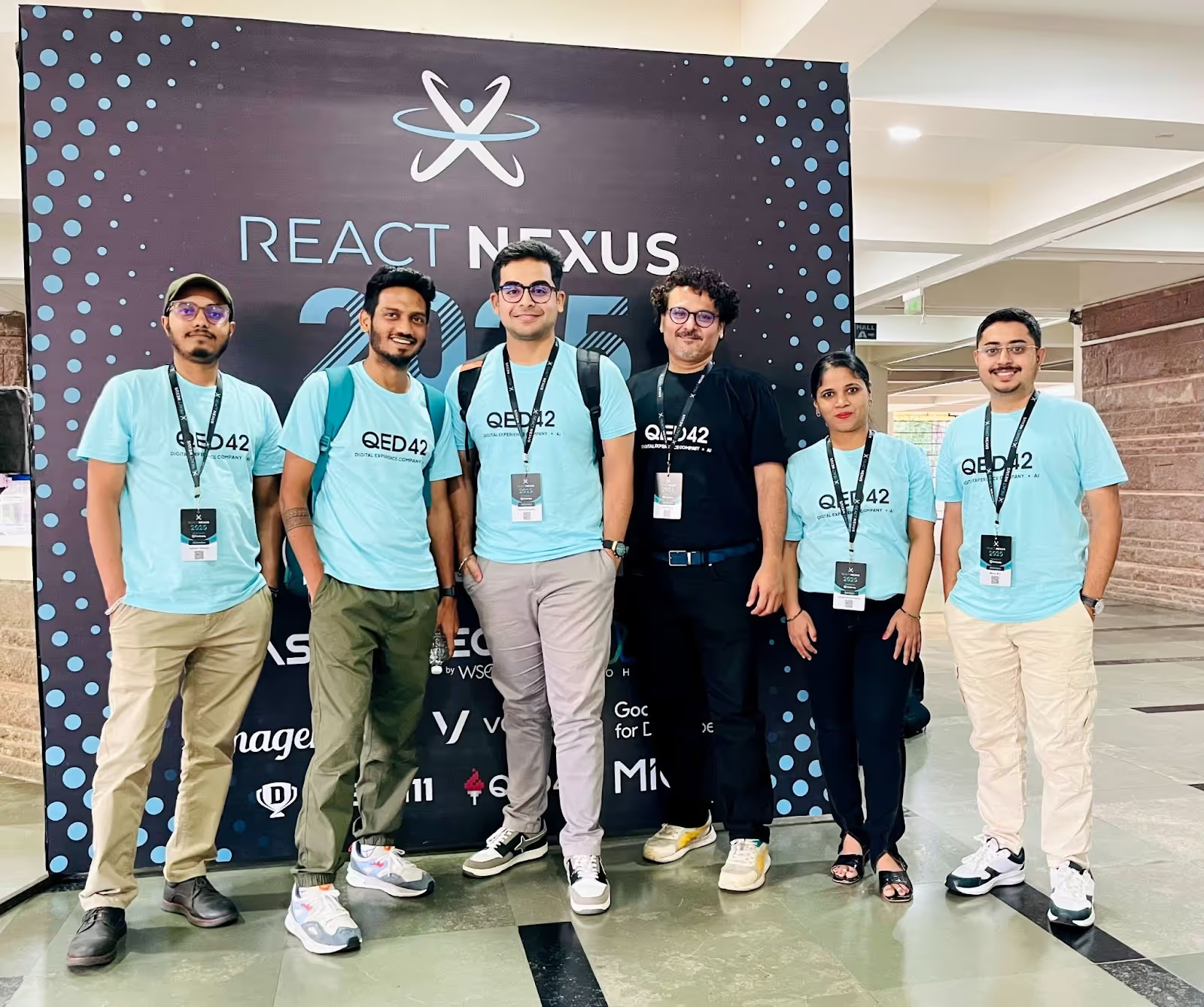
While Day 1 laid the groundwork, Day 2 propelled us into a future where AI is seamlessly integrated into development processes.
AI as co-pilot: from design to code
Chaitanya Deorukhkar from Razorpay showed how their design system, Blaze, works with an MCP server to generate React components directly from Figma. This setup brings design and development much closer, turning design files into production-ready code almost instantly.
Sanket Sahu from GeekyAnts walked us through the evolution of visual builders and introduced ShaperStudio, a new tool designed to connect design environments like Figma with developer tools like VS Code. It’s built to make collaboration between designers and developers smoother and more intuitive. We were so impressed, we caught up with him after the session and managed to get early access to try it out ourselves.
Accessibility as default, not an afterthought
Building accessible UI with copilot – Navya Agarwal
Showed how Copilot can be an accessibility partner if you ask the right way. Copilot can help us address accessibility issues. Concluding with a powerful quote: “Accessibility isn't more work, the work was incomplete.”
Input accessibility deep dive with Shrilakshmi Shastry emphasised the importance of using proper ARIA labels and understanding when and how to apply them. She warned that incorrect use of ARIA can do more harm than good, stating, “No ARIA is better than bad ARIA.” Through clear examples, she demonstrated the proper application of these attributes.
These sessions fundamentally changed how I think about Accessibility and our ethical responsibilities as front-end developers.
A proud moment: framework mastery in action
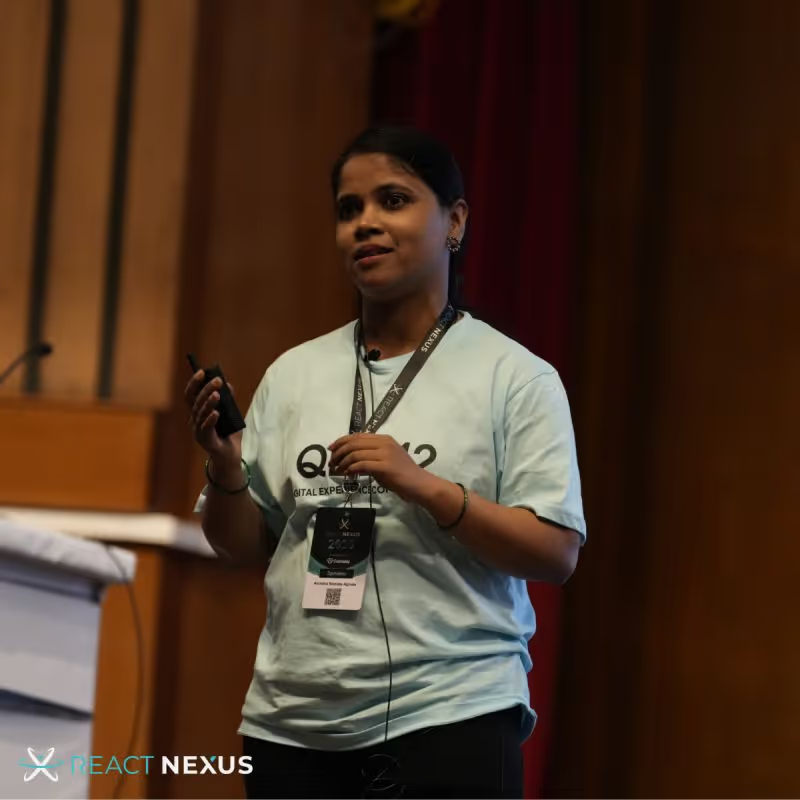
The highlight of Day 2, and perhaps the entire conference for my team, was a moment of immense pride watching our colleague, Archana Agivale, Tech Lead at QED42, take the stage. Her talk, "Static Regeneration: Supercharging Next.js with Strapi Webhooks," was a masterclass in solving a real-world problem we all face.
She presented an elegant strategy for keeping static sites fresh without constant rebuilds by batching updates from Strapi via webhooks and using Next.js's Incremental Static Regeneration (ISR).
The result? Static sites with dynamic superpowers blazingly fast, always up-to-date, and incredibly efficient. It was a brilliant showcase of practical innovation, and seeing her share that expertise with the wider community was a fantastic experience.
Panel discussion on AI was the cherry on top
It was captivating to listen to developers from Razorpay and Adobe discuss how AI is transforming our coding practices. The panel shared honest takes on both the potential and pitfalls of AI. While tools like Cursor, Copilot, and ChatGPT can enhance our productivity, they also require careful oversight and guidelines.
The day rounded out with more framework mastery from Tapas Adhikary on Next.js caching and Soumya Ranjan Mohanty on using Web Workers for smoother UIs, before Akshay Kumar U gave a demonstration of running a language model entirely on the client-side using React and WebLLM, paving the way for innovative, private AI features that operate directly on devices.
Key takeaways
As I look back on my first-ever tech conference, a few core ideas stand out:
- The Developer's role Is Shifting to architecture. With React 19's built-in Compiler now taking care of optimisations and AI assistants generating boilerplate code, our main contribution is shifting higher up the stack. We are transitioning into architects who design scalable, high-performance systems.
- Performance is not a Feature, it's the foundation. From React Fiber internals to image optimisation and frontend observability, the message was clear: building fast and resilient applications is an essential part of our role.
- Accessibility is a moral imperative. The back-to-back sessions on accessibility served as a strong call to action. It's not merely a "nice-to-have" or an afterthought; it's our fundamental duty to create an inclusive web experience for everyone.
- AI is becoming a core layer of the UI. The future isn't just about using AI to write code; it's about building intelligence directly into the user interface itself. On-device WebLLMs are just the beginning of this new frontier.
More than just a conference
As Day 2 came to a close, so did one of the most memorable experiences of my career so far.
After the final session, our team met for dinner before my colleagues returned to Pune. It was the perfect pause to reflect on everything we had learned, discussed, and experienced over the past two days. The energy, the ideas, and the people all came together in a way that felt both inspiring and grounded.
React Nexus 2025 wasn’t just a showcase of what’s possible with React 19 and AI. It was a celebration of how far we’ve come and a glimpse into where we’re heading. More importantly, it was a reminder that the community sits at the heart of everything we do. Behind every new feature or tool is a group of people asking thoughtful questions, sharing what they’ve learned, and helping each other grow.
While i had met them before, this was the first time i truly got to spend meaningful time with them. After three years of remote collaboration, sitting around the same table and sharing stories felt incredibly meaningful.
As we wrapped up and said our goodbyes, I left feeling more connected, more curious, and more excited about what we get to build next.
.avif "How AI is reshaping hiring for opportunity")
How AI is reshaping hiring for opportunity
Artificial Intelligence (AI) is not just a technological advancement; it's a transformative force reshaping the recruitment landscape in the software industry. As we navigate through 2025, AI's integration into hiring processes is revolutionizing how companies identify, evaluate, and onboard talent.
A recent report reveals that 77% of organizations plan to increase their use of AI in hiring, and 39% of recruiters are already leveraging AI for shortlisting candidates.
This shift is driven by the need to streamline recruitment in an increasingly competitive job market, where applications are rising at a rate four times higher than job openings.
AI-powered Applicant Tracking Systems (ATS) have replaced traditional resume screening, analysing applications at lightning speed to identify candidates whose skills and experiences align with job requirements. This automation expedites the hiring process and minimizes human biases, ensuring a more equitable evaluation of applicants.
Beyond screening, AI is also transforming interviews and candidate selection. AI-driven video interviews now assess candidates’ competencies by analysing speech patterns, facial expressions, and emotional cues. While this offers a data-driven approach, balancing AI insights with human judgment remains critical to capturing the nuances of interpersonal interactions.
Additionally, AI excels at parsing vast datasets to match candidates with roles that align with their unique skills and career trajectories, improving the precision of job placements. This ensures that candidates are considered for positions where they can thrive, benefiting both individuals and organizations alike.
Thriving in an AI-driven job market: how candidates can adapt
Some candidates are pushing AI’s capabilities to the limit, using automation tools to apply for hundreds or even thousands of jobs effortlessly. AI-generated resumes and cover letters allow applicants to optimize their chances at scale, increasing their visibility in the hiring process.
However, as AI-driven applications become more widespread, companies are responding with stricter screening measures, such as AI detection tools, targeted skill assessments, and policies against AI-generated content in job applications. Startups like Anthropic are even explicitly warning jobseekers against AI-assisted responses, reinforcing the need for genuine, human-driven applications to ensure fairness and accuracy in hiring.
Rather than relying on automation to cast a wide net, software professionals can take a more strategic approach to stand out in an AI-driven job market. Crafting AI-friendly resumes with relevant keywords, clear formatting, and a strong alignment with job descriptions is now essential to pass AI-powered screening tools.
Additionally, continuous learning plays a vital role, as staying updated on emerging technologies through courses, certifications, and workshops demonstrates adaptability—an attribute highly valued in AI-assisted hiring.
Candidates must also cultivate a robust online presence, as AI tools frequently scour platforms like LinkedIn to assess professional credibility. Keeping an updated profile, engaging in industry discussions, and showcasing projects can significantly enhance visibility to potential employers.
Moreover, AI-assisted assessments are becoming the norm, making it essential for candidates to familiarize themselves with these platforms. Practicing with AI-driven tools can reduce anxiety and improve performance during actual evaluations.
However, despite its advantages, AI-driven recruitment is not without challenges. Concerns over algorithmic biases and transparency remain prevalent, emphasizing the importance of fair and ethical AI applications. Understanding these ethical implications empowers candidates to engage thoughtfully with employers about their AI practices, fostering a recruitment environment that prioritizes both efficiency and fairness.
AI is rewriting the rules of software recruitment—adapt or get left behind. Candidates who embrace AI tools wisely—while focusing on genuine skills, continuous learning, and ethical job applications—will stand out.
The key is to stay updated, build a strong online presence, and approach AI-driven hiring with a balanced mindset. In the end, success won’t come from beating the system, but from proving real value in an evolving job market.


So, we went to a Drupal meetup

After joining QED42, we kept hearing about Drupal meetups—what they were like, who showed up, and what kind of conversations happened there. And then, eventually, we walked into one.
A room full of people who care about this open-source tech at an almost unreasonable level.
Well, we were there for a few reasons. To listen. To learn. To see if Drupal, AI agents, Recipes, and Distributions are as interesting in conversation as they sound in documentation. Spoiler: they are!
First impressions
Walking into our first Drupal Meetup, we stepped into a space filled with developers, designers, and open-source enthusiasts.
Conversations sparked over coffee, ideas flowed, and within minutes, we weren’t just attendees anymore—we were part of the conversations, part of the momentum—loved it.
Drupal — more than a CMS
Yes, AI is a big deal right now and we love everything about it too, but what really stood out at the meetup was the people. The energy, the passion, the way everyone brought something to the table—it’s what makes Drupal and any tech community what it really is.
That’s the real hook that keeps people coming back to these meet ups. Maybe it’s also the modularity, the way Drupal CMS lets you shape content however you want. Maybe it’s the Entity System, which doesn’t just store content but structures it in ways that make scaling easy.
Or maybe it’s the fact that Drupal isn’t just for websites anymore. It powers applications, manages content across platforms, and handles workflows that most CMS platforms can’t or the fact it's always evolving, accepting changes and being relevant with what people really need today.
So that being said, Drupal is more than a CMS. It’s a way of thinking. A way of building. A way of solving problems.
And behind that? Thousands of people. The energy they bring into the room is something you have to experience firsthand.
A focus on discussions

1.AI agents in Drupal: What’s actually happening?
AI is everywhere. But the real question is: how is it being used in Drupal?
The discussion around AI agents wasn’t about hype—it was about real implementation. Things like:
- Chatbots that go beyond basic automation and understand user intent.
- Personalized content that adjusts dynamically based on user behavior.
- Automated moderation that filters content efficiently, reducing manual work.
AI isn’t something that might be useful in the future. It’s already here. The only question is how far teams will take it.
2.Drupal recipes and distributions: Because no one likes starting from scratch
Abishek Mazumdar (Drupal and Mautic Engineer at Dropsolid) walked us through Drupal Recipes and distributions, which, in simple terms, make building a Drupal site feel less like setting one up from scratch.
- Recipes – Prebuilt configurations that developers can drop into a project to speed things up.
- Distributions – Full pre-packaged versions of Drupal with everything set up for specific industries (publishing, community platforms, etc.).
If you’ve ever spent hours setting up Drupal from scratch, you understand why this matters.
Not to be redundant—but the people make all the difference
Drupal has been around for years, and there’s a reason it continues to thrive. It’s not just the software (while that’s great too). It’s the community.
The best part of the meetup wasn’t the talks. It was the conversations in between—people sharing real experiences, problems they’ve solved, things they’re still figuring out.
The kind of knowledge you don’t get from documentation.
Final thoughts
We left with a better understanding of Drupal’s future, AI’s role in content management, and why meetups like this are worth attending.
If you’re working with Drupal, thinking about it, or just curious—go to a meetup. It’s where ideas turn into projects, and where open-source really comes to life.
Thank you for reading!

An internship, a community, and a ticket to DrupalCon
Some moments in life make you pause and think about how it all began. Sitting on my flight home from Singapore, still buzzing from an incredible experience at DrupalCon, I found myself tracing back the steps that led me there.
It’s funny how things unfold.
In 2021, fresh out of college, I joined QED42 as an engineering intern. I had heard of Drupal but barely knew anything about it. If I’m honest, I was a little nervous—new job, new technology, new world. But curiosity has a way of keeping you going. I dived into the work, slowly unravelling the power of this open-source CMS that runs websites across the globe.
And then, I found something even better—the Drupal Pune community.
There’s something special about being surrounded by people who genuinely want to help each other grow. The meetups, the discussions, the encouragement—it all shaped my journey in ways I hadn’t imagined.
It wasn’t just about learning Drupal—it was about being part of something bigger. The support from QED42 and the encouragement from the community set everything in motion.
That journey led me to DrupalCon 2024, a major milestone. The experience, the insights, and the people I connected with made it unforgettable. But getting there wasn’t just luck—here’s how it all came together.
DrupalCon Singapore 2024
This was a surreal experience, packed with everything I love—tech, conversations, food, and the thrill of being in a new city with like-minded people.
Highlights:
- Two days of sessions that left my brain overflowing with technical takeaways.
- A casual chat with Dries about photography—though I might have tested his patience with my enthusiasm.
- The food? Great. The desserts? Even better.
- Wandering through the streets of Singapore with fellow community members, soaking in the city's energy and making memories along the way.
- A major highlight? QED42 won the Splash Award! A moment of pride, excitement, and a sense of being part of something truly remarkable.
- And of course, we wrapped it all up with a short, loud, and unforgettable party.
And if there’s one thing I’ve learned, it’s this—sometimes, all it takes is a bit of curiosity, a great community, and the willingness to take that first step. The rest? It finds its way. Now let me take you through the journey that made this happen.

(Left) Holding the Splash Award won by QED42 for our work with Diabetes.org (Right) QED42 team at DrupalCon Singapore.
Getting started with Drupal Pune
August 2021. I started my internship at QED42, and Drupal was everywhere. Projects, open-source, blogs—it wasn’t just another tech stack; it felt like this whole new culture. People spoke about it with a kind of energy that felt different. At first, I was just going through the motions, trying to keep up. But I could tell there was something more to it.
Then came DrupalCamp Pune, March 2022—my first in-person event.
Walking into that room, I knew this was where things would change. The energy was real. Conversations weren’t just technical; they were passionate. People debated modules like they were life choices, joked about content types, and shared insights like they had been waiting all year for this moment.
One session on Drupal’s caching system hit me hard. It was practical, useful, the kind of thing that makes you rethink how you approach development. By the time it ended, I was thinking differently. That session was a turning point.
After the sessions, I joined conversations about Drupal 10 and the future of open source. And this time, I had something to say.
In the months that followed, I kept showing up. Meetups, discussions, late-night Slack threads. The more I engaged, the more I realized—Drupal is about building, learning, and growing with a community that actually cared.

(Left) Drupal Camp Pune group picture (Right) Presenting a session at the monthly Drupal Pune Meetup.
At first, I was just another face in the crowd—listening, learning, absorbing everything I could. By 2023, I wanted to contribute, to be part of what made this community thrive.
Volunteering at DrupalCamp Pune 2023 was my first real step in that direction. I started at the registration booth, expecting a simple task—handing out badges, directing people, and helping with logistics. But it turned into something more. I found myself in conversations with first-time attendees, answering questions, and sharing my own experiences. In the same way, Drupal Pune had once welcomed me, I was now helping others find their place. That sense of connection—that feeling of belonging—was something I hadn’t expected, but it stuck with me.
Soon after, I took on something that had once felt completely out of reach: presenting at the monthly Drupal Pune meetups.
The first time was overwhelming, standing in front of a room filled with experienced developers, and sharing my own insights, I questioned whether I had anything valuable to say.
But the moment I started speaking, I saw the same curiosity in their eyes that I had felt during my first sessions. The conversations that followed, the questions, the discussions—it made me realize something important.
It was about growing with the community, about sharing what I had learned so someone else could take their next step, just like I had.
Those sessions improved my public speaking. They made me an active part of the space that shaped me—and still does.

Drupal Pune members planning Drupal Camp Pune 2024 at the February meetup.

Presenting a session on Transform API at Drupal Pune’s monthly meetup.
A dream came true – winning a ticket to DrupalCon Singapore!
By 2023, I was part of what made Drupal Pune events happen. Presenting at meetups, volunteering at DrupalCamp Pune 2023, and working on a headless Drupal project—each step deepened my connection with the community.

(Left) Drupal Pune monthly meetup at QED42 office (Right) Presenting a session on Headless Drupal at PHP Camp 2024.
In 2024, I wanted to push further. This time at DrupalCamp Pune, I took on a new role—photographer. Capturing the energy of the event felt different, like seeing the community from a whole new perspective.

(Left) Drupal Pune group photo in March 2023 (Right) As a photographer at Drupal Camp Pune 2024.

Some clicks from Drupal Camp Pune.
During the camp, I joined a community-led contest, thinking it would be fun. I didn’t expect to win. But when my name was announced as the recipient of a ticket to DrupalCon Singapore 2024, it felt like everything I had worked toward had led to this.
It was a celebration of the experiences, contributions, and connections that shaped my journey. And it left me even more excited for what’s ahead.
Attending DrupalCon Singapore 2024
On December 8, 2024, a bunch of us from work hopped on a flight to Singapore.
It was my first international trip, and I could barely contain the excitement. I’d only seen Singapore in movies, and in just a few hours, I was about to experience it for real.
Attending DrupalCon Singapore felt like a dream. – sessions, contributions, and an unforgettable experience
The first two days of DrupalCon Singapore were a whirlwind of sessions, discussions, and some seriously good food.

(Left) At Marina Bay Sands in Singapore (Right) QED42 won the Splash Award for our work with Diabetes.org in the Non-Profit category.
Some of the sessions that stood out for me:
Server-side rendering a Drupal site with Next.js
Since I work extensively with Headless Drupal, this session felt like it was made for me. It covered both core concepts and the latest Next.js features, making it a solid learning experience.
DriesNote – The MAIN event!
Dries Buytaert himself took the stage to present the much-awaited DriesNote, focusing on the recent updates in Drupal CMS (Starshot). Watching it live, I couldn’t help but reflect on how much Drupal has evolved since I first started working with Drupal 9 during my internship.
The CMS has transformed into a smoother, more intuitive experience, making everything feel new again.
After DriesNote, it was time for the legendary group photo—and I was in it!
Other sessions I attended:
Building the Future of Drupal: 11, 12, and Starshot
Level Up Your Impact: Building Socially-Driven Projects with Drupal as a Digital Public Good
What, Why, and When for Recipes & Distributions with Starshot
Day 3: The contribution sprint was a surreal experience. Developers, initiative track leads, and community members gathered to tackle open-source issues, strategic initiatives, and code contributions.
I contributed to the Experience Builder Initiative (XB) and had a great discussion with Lauri, the track lead. I also got to see Jess (xjm) in action as she demonstrated how contributor credits are distributed while solving an active issue.
Sitting in a room full of Drupalers working together on something bigger than themselves was a powerful moment. It reminded me why communities like Drupal Pune and events like DrupalCon matter so much. They go beyond coding—they’re about connection, growth, and collective success.
After the contribution day, we wrapped up the trip with some sightseeing in Singapore—a perfect way to celebrate an unforgettable experience.

(Left) View from the top of Marina Bay Sands (Right) Photo with Drupal community members.

(Left) An evening stroll at Fullerton Pavilion (Right) At Sentosa Island with QED42 folks.
Final thoughts and stepping out of my comfort zone
Well, to sum up, a long story about an internship, a community, and a ticket to DrupalCon—every milestone, from volunteering to presenting and attending, pushed me beyond my comfort zone. I’ve always been more of an introvert, but being part of Drupal Pune changed that.
The support, encouragement, and shared passion helped me embrace new challenges and grow in ways I never expected. Looking back, joining Drupal Pune was one of the best decisions I’ve made. It opened doors I never saw coming, introduced me to incredible people, and helped me recognize my potential.
Whether you’re just starting with Drupal (or any other tech) or have years of experience, being an active part of a community can change everything. For me, it turned a growing interest into an unforgettable journey to one of the biggest Drupal events in the world.
You never know where one little step in the right direction might take you. For me, it led to growth, friendships, a ticket to DrupalCon, and so much more that words can't capture. Truly, if you're on the fence about joining a tech community, I’d say just go for it.

Drupal Developer Days 2023: A Success Story
The Drupal Developer Days 2023 event brought together over 350 passionate individuals from around the world who love, learn, and discuss the open-source CMS, Drupal. Held in Vienna from 19 to 22 July, this year's gathering was a distinct success.

Organized by the Drupal community, this annual event provides a platform for developers to collaborate, contribute, share, and meet like-minded Drupal enthusiasts, uniting minds for open-source progress.
This year's event centered around developer-specific initiatives, featuring dedicated contribution events for GitLab and Mautic. Contributors hosted enlightening sessions covering a diverse array of topics.
There were sessions from renowned Drupal contributors like XJM, providing valuable tips on peer reviews, Gabor discussing the present and future of Drupal initiatives, and Lauri unveiling the exciting innovations in Drupal 10+.
One of the standout sessions was Drupal and Godot, which explored using Drupal as a backend for games with a creative workshop leveraging Legos as an interactive activity.
I had the opportunity to present my session – "An Introvert's Guide to Open Source Communities," which was very well received and opened up doors for some interesting questions from the audience.

The session also led to the opportunity to connect with fellow Drupal contributors and plan some noteworthy future collaborations.
The full session recording is available on YouTube, and it did receive an overwhelming response, making it the most-watched among all the other sessions.
In summary, DDD 2023 offered an uplifting experience for all attendees, making it a highly recommended event for open-source enthusiasts.
The key highlights included networking and collaboration opportunities with prominent figures in the Drupal community, engaging sessions and workshops on the latest Drupal developments, fostering knowledge sharing and active participation, empowering attendees to shape Drupal's future with renewed passion, and strengthening the sense of community among Drupal enthusiasts.
During the event, everyone had the chance to learn about new developments in Drupal and actively contribute to its progress while networking and sharing experiences with other developers. There is no doubt about the event's success when everyone gets to walk away not only with valuable insights and opportunities for future collaborations but also with revered memories of a lifetime.

Rediscovering the Joy of Reading: #AllBookedApril
Welcome to #AllBookedApril, a celebration of World Book Day that transcended the boundaries of a single day and unfolded throughout an entire month.
With a blend of creativity, inspiration, and sheer fun, this month-long activity captured the essence of the written word. It welcomed avid readers, those longing to reconnect with books, and even those who rediscovered the joy of reading amidst their busy lives.

We invite you to immerse yourself in the captivating journey of #AllBookedApril. Get ready to be inspired and entertained as we explore the remarkable events and unforgettable moments that unfolded during this literary extravaganza.
Ignite your imagination: The magic within pages
There's something truly magical about books, isn't there? Books hold immense significance in our lives, offering a multitude of benefits that extend far beyond entertainment. They act as catalysts for creativity, transporting us to realms where our imagination knows no bounds.

As renowned author Jorge Luis Borges once beautifully said, "I have always imagined that Paradise will be a kind of library." This quote captures the essence of the nostalgia and joy that reading brings. It reminds us of the endless possibilities, infinite knowledge, and sheer bliss found within a book's pages.
At QED42, we believe in the transformative power of books. To truly celebrate World Book Day, we recognized that one day wouldn't suffice. Thus, we embarked on a grand journey: #AllBookedApril, a month-long celebration dedicated to reigniting the joy of reading.
At its core, #AllBookedApril was a spirited endeavor to reignite the flames of passion for reading. It sought to remind us of the timeless allure of books, transporting us to far-off lands, unraveling mysteries, and sparking our imagination.
Let's dive into the exhilarating world of #AllBookedApril and unveil the captivating events that made this literary extravaganza an unforgettable adventure.
Unleashing adventure: A sneak peek into #AllBookedApril
Welcome to a vibrant world where literature came alive and ignited the hearts and minds of participants.
Visual Book
Unleashing their creativity to bring books to life, participants selected a book from a slide and transformed its essence into captivating visual summaries. The event showcased a kaleidoscope of imaginative interpretations, celebrating the beauty of storytelling through art.

The Masterful Illustrators
Group 1, led by the creative minds of Jaideep Kandari, Shilpa Lal, Akash Dabhi, and Alphons Jaimon, mesmerized us with their stunning visuals depicting the enchanting world of "The Alchemist." Their artistic expression and interpretation truly captured the essence of the book, earning them a well-deserved victory. Congrats!
Treasure Hunt
Igniting the thrill of discovery, participants were provided with clues and hints, challenging them to uncover the hidden gem—the name of a book. The participants embarked on a captivating quest, putting their literary knowledge to the test.
The Quest Conquerors
Congrats, Team Tagore, comprising Libbna Mathew, Vidit Anjaria, and Siddhi Paliwal, for unraveling the clues and claiming victory in the thrilling Treasure Hunt event with remarkable teamwork.
Trivia - First Week
Diving into the depths of bookish knowledge, participants put their literary wits to the test, answering challenging yes-or-no questions in the MCQ round. In the Guess the Author challenge, they deciphered famous quotes to unravel the brilliant minds behind them. A thrilling battle of book smarts unfolded as 15 participants competed for victory.
The Quiz Maestros
A round of applause to Apoorva Krishnaprasad and Rahul Savaria for their remarkable trivia prowess! Among 15 participants, their knowledge and quick thinking propelled them to the top.
Trivia - Second Week
Ready to test their literary expertise, participants aimed to solve an online crossword puzzle, teasing their brains with clues about beloved books and their authors. Then, they decoded the titles of books using nothing but emoticons, putting their intuition to the test.
The Quiz Titans
Congratulations to Yngesh Raman, Akash Dabhi, and Vidit Anjaria, who emerged victorious among 15 participants, showcasing their quick wit in this enthralling challenge.
Trivia - Third Week
Bracing themselves for a mind-bending challenge in Matching Mission, participants sharpened their wit by pairing book-related terms with their corresponding meanings. In Misfit Mania, they unraveled the odd one out from a lineup of authors, books, and genres.
The Quiz Champions
Kudos to Aastha S and Tarun Lewis for their outstanding win. Among 15 participants, they impressed us with their book knowledge and emerged as the triumphant champions.
Peek-A-Book
Spreading the joy of reading through a heartwarming book gifting activity, participants became literary Santas, exchanging books with one another, kindling a sense of camaraderie, and sharing the magic of storytelling.
Image Contest
Capturing the magic of reading and showcasing their love for books, participants shared photos of themselves immersed in a book or flaunted their personal libraries, competing for the title with the most creative and inspiring image.
Story Writing
Weaving captivating tales in this thrilling event, participants crafted enchanting stories using given prompts and showcasing their storytelling prowess.

The Literary Legends
Group 2, consisting of Pratik Bhadang, Aastha S, Jaideep Kandari, Indu Satheesh, and Yngesh Raman, wove a captivating tale set in a mystical Himalayan village. Their story emphasized the profound value of a majestic banyan tree, showcasing the unity and determination of the villagers to safeguard nature's treasures. Their creativity and heartfelt narrative secured them the win. Well done!
From readers to champions: The enthusiasm that lit up #AllBookedApril
#AllBookedApril swept through QED42 like a tempest, leaving behind a trail of transformed readers. It was a revolution, a resurgence of passion for books.
Pages were devoured, imaginations unleashed, and hearts filled with the sheer joy of literary exploration. It was a month that forever changed us, bonding us through the magic of words.
In the spirit of #AllBookedApril, we discovered the extraordinary power of recognition and appreciation in nurturing a vibrant work culture.
By celebrating the accomplishments of our reading champions, we kindled a sense of belonging and encouragement within our teams. The simple act of acknowledging their literary pursuits became the fuel that propelled us toward greater camaraderie and shared success.

Amidst the heartfelt testimonials and glowing feedback, the resounding impact of #AllBookedApril reverberates. These expressions of gratitude inspire us to not only celebrate books and reading for a month but to embrace the adventure of reading in our lives.
Closing the chapter, opening new worlds: Embrace the adventure of reading

#AllBookedApril is a reminder of the enchantment that lies within the pages of a book. Let us further ignite our imaginations, expand our horizons, and lose ourselves in the mesmerizing narratives that lie ahead. Welcome the pure joy of reading into your life, for it holds the incredible power to whisk us away to unimaginable realms.
As we close this chapter, treasure what the great Dr. Seuss said, "The more that you read, the more things you will know. The more that you learn, the more places you'll go."
May your reading adventures take you on extraordinary journeys, filling your heart and mind with wonder and endless inspiration!

QED42 – Finalist at Acquia Engage Awards 2022
It’s time for the 2022 Acquia Engage Awards. Every year Acquia showcases and celebrates its partners and customers who have gone beyond to deliver the world’s most ambitious digital experiences.
QED42 together with Dr. Reddy's Laboratories have made it into the finalist list for the Regional Excellence – APAC award under the Dreamers category. We, at QED42, have enjoyed a long partnership with Acquia, and are thrilled to earn this recognition at the 2022 Acquia Engage Awards.
The Engage Awards celebrate impressive digital achievements using Acquia’s products. This year’s awards drew more than 120 submissions across a variety of regions and industries under three categories: Doers, Builders, and Dreamers. Check out the full list of finalists under all categories here.
Dreamers
The Dreamers category is for leaders who do not take no for an answer and seek opportunities to do better each day, every day. As per Acquia, the motto of the Dreamers category is “Always learning, always creating, and always searching for what’s next.”
The judges for the 2022 Engage Awards are a panel of distinguished leaders with expertise in Digital Experience Platforms and Digital Marketing. After a careful review of our submission, they have evaluated QED42’s work with Dr. Reddy's Laboratories based on performance, functionality, integration, and user experience to confirm us as finalists for the Regional Excellence award for the Asia Pacific region.
Our work with Dr. Reddy’s Laboratories
Dr. Reddy’s Laboratories is the 4th largest multinational pharmaceutical company in India. Our partnership with Dr. Reddy’s was to help it achieve its mission of delivering good health all around the world. We built an HCP engagement portal for Dr. Reddy’s to connect more meaningfully with healthcare professionals and give them access to high-value medical information.
Our work with Dr. Reddy’s Laboratories involved a custom design system, Drupal 9 architecture, and Acquia Cloud Site Factory to build a multisite portal for two interfaces: MedEnrich (text-based platform) and Docreel (video-based platform). Dr. Reddy’s Laboratories is now fully equipped to deliver unified digital experiences to HCPs.
We aim to build a better tomorrow with Acquia technologies and design a new path forward that makes a difference in the world. This recognition by Acquia is an incredible accomplishment of our innovation and hard work. We look forward to the winner’s announcement and awards ceremony at Acquia Engage in Miami on 25-26th October 2022.
Explore more on how QED42 is Taking Digital Forward with an Imagination.

A Glimpse Inside: Webinar on Future-Proofing Enterprises with an Open DXP!
QED42 is thrilled to announce our first webinar for 2022.
The pandemic clearly highlighted the fact that the market can change in an instant. It is a wake-up call for enterprises to rebuild and redefine their digital ecosystems. With an increasing number of start-ups and unicorns entering the core markets, there is an urgent need for high-growth enterprises to future-proof themselves to adapt.
Wondering why attend this webinar?
The focus for enterprises is not just to survive but also to thrive in the years to come. To do that, enterprise future-proofing is a must! It means modernizing legacy systems and adopting a hybrid IT infrastructure to prioritize customer experiences, personalization, and meeting customer expectations.
Future-proofing enterprises will help to position themselves in the post-pandemic market to remain competitive in an evolving business environment.
Our webinar sheds light on the ‘need-of-the-hour’ strategy of how high-growth enterprises can improve their digital experiences and future-proof themselves with an Open DXP.
You may ask why Open DXPs?
Well, they enable enterprises to reinvent digital customer experiences at scale to deliver consistent and cohesive experiences across all digital touchpoints. Enterprises can customize customer digital journeys by providing hyper-personalized services. They can chart their own Digital Transformation path with a suite of modern and flexible tools. Only an effective digital strategy will ensure the stability and growth of enterprises despite the rising competition.
What will you learn at this webinar?
- How startups and unicorns are shaking the enterprise ecosystem
- What do the post-pandemic customers want
- Why should enterprises future-proof themselves
- How can Open DXPs help enterprises to future-proof
Ashoka.org - Expanding global reach with an Open DXP
Ashoka is a non-profit international organization responsible for promoting social entrepreneurship worldwide. Their website was operational in more than 40 countries, and they wanted to expand it to over 90 countries with a localized version of content and context for each country.
QED42 helped Ashoka re-design its website and upgrade its digital ecosystem with an Open DXP. The Ashoka website is now operational in more than 90 countries with more countries being added every two months. The Open DXP facilitates a 100% independent content marketing team that is empowered to manage, create, and publish customized content for each country seamlessly.
Jayalakshmi Jayanth, the Institutional Strategist at Ashoka, is our guest speaker at the webinar. She will share her experience on how an Open DXP helped to optimize the Ashoka website resulting in a better and broader reach to the global audience.
Our speaker panel
Piyuesh Kumar | Director of Technology at QED42
Piyuesh comes with 11+ years of experience in working on various global B2B projects helping brands like Nestle, Bayer, Novartis, and Stanford GSB to adopt Open DXPs. His expertise in the custom development of Open DXPs will provide a unique perspective in helping the attendees realize the impact and benefit of digital experiences on their business.
Jeffery Lin | Director Solutions Engineering APJ at Acquia
Jeffrey brings in his 20+ years of experience in developing and managing presales efforts and implementing innovative engineering solutions across the Asia Pacific region. His expertise in technical and digital marketing in form of consulting, strategy, and adoption provides an in-depth understanding of Marketing Technology and DXPs.
Jayalakshmi Jayanth | Institutional Strategist at Ashoka
Jayalakshmi is the Institutional Strategist and Build Team Manager at Ashoka. She is responsible to enhance Ashoka’s digital presence and manage all its web properties. Her expertise and leadership have helped Ashoka to bring multiple websites into one ecosystem.
Through this webinar, our speakers aim to highlight and discuss the common challenges businesses face in adopting Digital Transformation. They will elaborate on how an Open DXP will eliminate those challenges to help future-proof enterprises for the post-pandemic customers.
Join QED42 and Acquia as we uncover the power of prioritizing CX with an Open DXP.

Design Workshops at QED42
Design Workshops translate into collaborative sessions that encourage strategic creative problem solving and encourage interdisciplinary ideation from different members of the team.
Design workshops can be customized in terms of duration and location. These workshops might last anywhere from a few hours to a week, depending on the nature of the challenge and the goals and needs of the participants.
They help to come up with viable solutions and foster a culture of innovation within the organisation. The workshops also focus on empathising and reducing the risk of failure during iterations and testing.
Design workshops are an unavoidable step in the process of design and affect the success of a project. Like every design team, we at QED42 also have our way of conducting design Workshops. These design workshops help to get everyone on the page through an inclusive approach, create a live document through the creative summary and determine the accurate problem statement.
Process of Design Workshop at QED42
We usually conduct design workshops in two scenarios -
- To generate fresh ideas, features, and designs for a new project
- For validation of designs already made in an ongoing project (also known as Design Validation Workshops)
Understanding the purpose of the workshop helps to focus on its goal. Whether we are looking to uncover new possibilities, improve an existing product or feature, solve user problems, and the like. Having it well defined in advance helps bring everyone on the same page, right from the start.
Design Workshops usually have an organiser or facilitator who acts as the host of the workshop. This person ensures the whole process is adhered to and members stay engaged throughout. The workshop organisation team also consists of a workshop assistant who ensures the smooth running of the workshop, keeps a track of the timer, helps to set up the FIGJAM board in order, and makes sure that the stakeholders don’t lose track when working on activities.

Workshop agenda
The workshop agenda is of prime importance. It helps us focus on the outcomes of the workshop. It usually consists of a multitude of activities that are put together keeping in mind adequate time planning (mostly on assumption), spontaneity, unlimited discussion, creativity, and sufficient breaks.
Our workshop agenda also includes enough time for reflection and debriefing, once activities are over so that we are aware of any possible flaws that might have occurred during the workshop. This helps us ensure similar slips don’t occur when similar workshops are conducted with external stakeholders and clients.
We prepare introductory slides about the process, what we plan on achieving from the workshop and how we intend on achieving the goals listed in the slides, and so on. This gives stakeholders a clear idea behind the purpose of the workshop, and why their participation will help in designing a product that’ll go focus on user needs and meet business requirements as well.

Empathising with the user
We encourage all the participants in the workshop to put themselves in the shoes of the user. It aids us in assessing the current user personas that team members are using and seeing whether they’re accurate. If not, changes are made accordingly. Activities such as empathy map and role-playing help the participants to understand the wants, needs and goals of the users and get a better understanding of the user needs.
Defining the problem statement
With empathy exercises, participants are able to better know the users’ needs and the problems they face. Based on the understanding of the problems of the user, participants are asked to define the problem statement that we aim to solve over the rest of the workshop.
Based on the problem statement, an outline of activities is decided. We opt for empathy maps, Q/A sessions, card sorting, interviews, and the ‘how might be’ methods to encourage everyone to step into the shoes of the user and consider user wants, needs, and feelings when working on the activities charted out.
Ideation session
During the ideation stage, theoretical solutions are looked into and ideas come in from the problem statement at hand. We use various activities ranging from value proposition mapping to crazy 8’s, empathy mapping, and many such activities which help us understand the business requirements/problems better and to bring as many solutions as possible. If the suggestions seem too divergent, everyone in the team votes for the most suitable solution using sticky voting to help choose the most viable solution.
Along with traditional brainstorming, we also opt for rapid ideation and reverse brainstorming.
- Reverse brainstorming is when you focus on the causes of the problem instead of the solution
- Rapid ideation is when each person writes down multiple ideas within a set time frame
By the end of the ideation session, we’ve all settled on a plausible solution and take to work on it, for the next step.
Mapping out user journeys
The user journey map provides a visual representation of the process that will be followed by the user to accomplish a goal. With a solution in hand, we work on mapping out each step the user will need to take to achieve the final goal.
Design Jam
Designers are encouraged to develop low-fidelity rapid-prototype solutions in the workshop.
For the rapid-prototyping stage, we begin to create a prototype of the most ideal solution. This may entail testing out specific user flows that provide the best usability outcomes for the solution's user journey maps. In this stage, the steps mapped out from the user journey are used to create separate interfaces and screens. These include working on buttons, points of functionality as well as other interaction points.
The solutions that are found to provide the best user experience while keeping usability and accessibility in mind are enhanced with high-fidelity features.
Conclusion
Design Workshops are an interactive way of bringing teams together to work on projects. They help us to stay focussed on the specific challenge at hand. The Design Workshops at QED42 help all designers gain insights to brainstorm on projects, and back that up with facts. It allows for some intensive and engaging ideation sessions that lead to viable solutions using best practices and keeping end-users as the center. We try to create a solid agenda around every design workshop that we host, irrespective of whether it is done with internal teams or with external clients and stakeholders.
Super thanks! to Tarkesh Deva our UX/UI designer for collaborating as a co-author on this blog.
.avif "DrupalCon Europe 2021: Everything we’re excited about!")
DrupalCon Europe 2021: Everything we’re excited about!
Bringing together the greatest Drupal minds from all over the world on one stage, DrupalCon Europe is back again bringing much excitement to the community. Having something in store for all business verticals, the highlight of this year’s DrupalCon are the Drupal Camps which are being organized in 7 cities throughout Europe.
Scheduled to happen from October 4 till October 7, 2021, DrupalCon Europe 2021 is being hosted as a virtual event open for anyone to attend after registration. There are a total of 90 sessions scheduled to take place over the course of four days under five different tracks.
Keynote sessions of DrupalCon Europe 2021
There are a total of four keynote sessions happening on each of the four days of DrupalCon. The most eminent personalities from the tech community are the Keynote speakers of this year’s event.
Here is a list of Keynote events that you should look out for:
- Sound Ideas: Unlocking Creativity - LJ Rich, a world-renowned musician and presenter of BBC’s international technology show called BBC Click will be presenting her session on October 4, 2021. Her session will revolve around the interaction of music and technology in the AI space.
- Build vs Buy - Pfizer and Open Source - This session by Pfizer’s Richard Jones, Dick Olsson, and Jess Romeo is scheduled for October 5 2021. This session will revolve around Pfizer’s opensource journey and will throw light on how Pfizer has used Drupal to its advantage.
- Driesnote - The most awaited keynote session in DrupalCon, Driesnote is the session by the founder of Drupal itself, Dries Buytaert. In his keynote session, Dries will update the audience on the Drupal project and will also talk about the development of Drupal. His session is scheduled for October 6, 2021.
- Drupal Core Initiative Leads - One of the most informative sessions in DrupalCon, this assembly will entail everything that’s happening in and around the Drupal community. This is the third instalment of this keynote and will also have samples of Drupal community leaders and what they’re currently working on. This session is scheduled for October 7, 2021.
Let's hear it for Drupal Camps
Bringing the local Drupal Camps into the ambit of DrupalCon, this year’s convention will witness the forces of this regional and global community joining hands together to make DrupalCon a success.
The camps will benefit from increased visibility of the audience attending DrupalCon, so the participants can cherry-pick which Drupal Camps they want to travel to, next year when DrupalCon won't be virtual anymore. Furthermore, this year, DrupalJam has been made a part of DrupalCon, so the best minds of the industry will share their insights right in DrupalCon itself.
Here is a list of all the Drupal Camps:
- Drupaljam, The Netherlands
- Drupal Mountain Camp, Switzerland
- Drupal Germany
- DrupalCamp Kyiv
- DrupalCamp Finland
- DrupalCamp Belgium - Ghent 2021
- Drupal Wrocław
We’ll be there as well
Not to forget, we too will be presenting sessions at DrupalCon Europe 2021. Here is a full list of our sessions:
- How Drupal internship can help the Drupal project and your organization: Selected as a featured session, this seminar by Jay Kandhari will shed light on QED42’s journey of contributing to the Drupal talent pool. He will also discuss how training the interns with the right approach can be beneficial to your organization, not just the community.
- A Sustainable Approach Drupal Contributions: This session by Mohit Aghera and Piyuesh Kumar will focus on what has helped us plan long-term commitments to the Drupal Projects and helped build an effective contribution culture.
- Always fresh, cacheable content using Cache Tags, Purge and Akamai: This presentation by Hemant Gupta ̣and Graham Arrowsmith will focus on practices to have content that is ‘always cacheable’ using cache variations.
- A better experience for everyone - Accessibility: Bringing you an inside view of Accessibility, Nikita Aswani in her session will take us through what it really means to be accessible. Nikita in her session will also highlight the importance of empath in being accessible and how the two are interlinked to each other.
- How to empower your marketing team with a DIY Layout Builder using Paragraphs: This session by Ruchika Mohite and Abhai Sasidharan will share insights around how we enhanced the Paragraph’s module of Drupal to create a drag and drop user interface to create flexible web pages.
- Introduction to the Bug Smash Initiative: If giving back to the Drupal community is something that is on your task list, then this session is for you. A deep dive into the Bug Smash initiative, this session by Mohit and Frank will take you through the introduction, initiative, and how you can be a part of the initiative.
- Things a professional services firm should do to thrive: In this session, Abhay Kumar will take us through what makes or breaks a service firm. He will also apprise the audience of the strategies that multinationals have deployed to increase brand value, enhance delivery & sales etc.
Why you should attend DrupalCon Europe 2021
If, even after reading through this blog you’re still thinking if you should attend or not, here is one more reason for you. Being a silver sponsor of DrupalCon Europe 2021, we are thrilled to highlight that we will soon be announcing some cool live booth talks, panel discussions and exciting giveaways in our endeavour of making DrupalCon a huge success. Watch this space for more information.
.avif "QED42 named as the #1 Drupal Development Firm in Clutch Leader Matrix 2021")
QED42 named as the #1 Drupal Development Firm in Clutch Leader Matrix 2021
We’re excited to announce that Clutch has named QED42 the Market Leader in their Leader Matrix for Drupal Development Firms in India.
QED42 is recognized for its ability to deliver intelligent, relevant and efficient digital experiences with Drupal. Clutch has ranked us as the #1 Drupal Development firm in India based on our technical capabilities, market presence and direct client reviews.

Clutch Leaders Matrix provides a view of the top-performing companies in a particular industry and considers a company’s client reviews and the level of specialization the company provides in a given service.
The Clutch Leaders Matrix evaluated 15 Drupal vendors across different categories such as the ability to deliver, service focus based on independent customer reviews. This matrix helps businesses to zero in on the Drupal Development partner that is right for their requirements.
The reviews posted on our Clutch profile demonstrate the quality of service provided to our diverse range of clients spanning from non-profit organizations to leading healthcare brands. For more information please visit our Clutch profile here.

With a 4.8/5 rating on customer satisfaction; today 200+ global customers trust us for our thoughtfully designed web and mobile experiences.
Few of our marquee clients include - Nestle, World Bank, HERE Technologies, HP, Sony, Stanford Graduation School of Business, ILAO, SABMiller, Grofers, Scholastic and many more.
Conclusion
Being recognized as the #1 Drupal Development Firm in India has further motivated us to continue co-creating the future through digital transformation. Learn more about our Drupal Development services and offerings here.