All blogs

Revolutionizing Search with AI: RAG for Contextual Response
In this third installment of the 'Revolutionizing Search with AI' series, we further delve into the power of semantic search with RAG to elevate search engine capabilities. In our initial blog, we provided an overview of the complete application, and the second blog delved into the intricacies of semantic search and the backend of our demo application.
Our primary objective has been to enhance the search experience through the introduction of a feature known as 'Ask AI,' which is similar to Google's 'Converse' function in the new Google Search Generative Experience (SGE). This feature goes beyond basic keyword searches. It considers all the relevant results from our previous searches, leveraging data from the Pinecone Vector Database.
This information then acts as the context for our new query and is sent to the OpenAI Chat API to generate a dynamic text response in real time. We call this process RAG or Retrieval Augmented Generation. By weaving these features together, we're confident that the AI-powered search system we're building would transform the search engine landscape.
In this blog, we'll explore RAG and how we've applied its principles to create a more user-friendly search engine experience.
Understanding Retrieval Augmented Generation (RAG)
Back in 2020, Patric Lewis and his team at Meta introduced a concept known as Retrieval Augmented Generation. However, it wasn't until organizations recognized the potential of advanced language models like GPT-4 from OpenAI and Claude 2 from Anthropic, with their ability to handle large amounts of contextual information, that this technique gained widespread adoption.
These models allow us to enhance the quality of generated content by incorporating real-time data. As we started to use ChatGPT and similar large language models, it became evident that while they excel at content generation, they are not without their limitations.
Drawbacks of current LLMs
- Limited to training data: These models, like static textbooks, rely solely on the data they were initially trained on. As a result, they lack knowledge of recent developments not included in their training data.
- Broad but not specialized: Foundational language models like GPT and Claude are built to handle a wide range of tasks effectively. Even so, they may not perform as well when it comes to specialized knowledge and domain-specific tasks.
- Lack of transparency: Since these models are designed to handle a wide range of information from various sources, it can be challenging to trace which specific data they used to generate their responses.
- Cost and expertise barrier: Training or fine-tuning these models can be financially challenging for many organizations. For instance, a cutting-edge model like GPT requires investments in the millions of dollars, making it a costly option, particularly for smaller companies.
- Hallucinations: Because these models are general and don't always have access to reference data, they can sometimes generate responses that may not be entirely accurate.
How does RAG work
RAG begins by retrieving data. In our case, this involves a semantic search using the Pinecone Vector Database API. This search finds relevant information for the user's query.
Next, RAG enhances the initial user query with this data. It then feeds this improved prompt into a Generative AI model, like OpenAI's GPT-4 via their 'Chat Completion API.'
This process results in the final response or answer to the user's query. RAG combines retrieval and generation techniques to provide context-aware and informed responses.

In our system, we employ semantic search within a vector database where our data is stored. This database is designed to understand natural language, such as the user's query or prompt for an LLM.
What sets it apart is its flexibility; it can be updated or modified just like any other database. It solves the challenge of dealing with static or frozen LLMs.
Benefits of RAG
- Offers a dynamic experience, unlike static models.
- Tailored to meet specific business needs by incorporating relevant data.
- Enhances transparency by avoiding the black box issue.
- More cost-effective compared to training or fine-tuning a language model from scratch.
- Simplifies the process by eliminating the need for complex prompts.
- Empowers to create domain-specific chatbots and similar apps in minutes.
Blending Pinecone Vector Store with GPT
In RAG, two key components play a vital role. First, is thevector database, which serves as the repository of updated information. For our purposes, we rely on the Pinecone Vector Database API. Its user-friendly nature and flexibility makes it an ideal choice. The second component is the text generation model, typically an LLM like GPT or Claude.
Combining the Pinecone Vector Store with the power of GPT brings a new dimension to the search experience. We seamlessly integrated these elements to go beyond mere semantic search, delivering a more comprehensive and context-aware solution.
A deeper dive into our backend solution
Here is a glimpse of our solution.

Similar to the ‘q’ route we developed in the previous blog of the series, we are using Rust and a different route namely ‘qa’:
In our demo, we focused on optimizing a specific aspect: latency. To achieve this, we implemented multiple in-memory caches.
Let's explore the custom trimmer we implemented, known as the 'model_selector function'.
Now, let's consider a crucial aspect of the trimming process, the 'document_vec_trimmer function.' We've developed a smart trimmer that doesn't simply remove content to fit within a model's constraints. It takes into account Pinecone scores to trim in a way that respects the document's importance.
Please note that another efficient approach involves breaking down the original data into smaller segments before vectorizing them. This would allow us to include key source data-related information in the metadata of the database entry.
For our demo development, we opted for a more simpler approach.
Take a quick look at the final function within this API, which is the simple 'context_trimmer'.
The remaining components of the streaming solution are managed within the demo React site that we created.

We are using the 'openai-ext' library to handle streaming responses.
It's worth noting that the necessity for a third-party library like 'openai-ext' may no longer be required with the introduction of 'openai-node' v4, which offers built-in streaming capabilities.
Let's get the request ready for OpenAI, which is essentially the message array for the LLM.
Next, let's check the 'openai-ext' configuration for generating streaming responses using the augmented message array we've prepared.
Below is how we managed the interactive button states for actions like Ask AI, Stop Response, and Regenerate.
A glimpse of our demo application
The challenges we faced
Huge text blogs and limited API/model context windows
We explored various approaches to address the issue of dealing with extensive text documents and the constraints of limited API or model context windows. For our experiment, we opted for the simplest solution, which involved "trimming" the content. What set our approach apart is that we considered Pinecone scores before making trimming decisions.
The following is a rough formula of what we did for trimming:
- Normalize scores to [0, 1] range: Normalized Score = (Score - MinScore) / (MaxScore - MinScore)
- Calculate adjusted scores: Adjusted Score = Normalized Score^2
- Calculate the adjusted ratio for each document: Adjusted Ratio = Adjusted Score / Total Adjusted Score
- Calculate the total number of excess tokens across all documents: Excess Tokens = Total Token Count - Target Token Size
- Determine trim ratio based on the excess tokens and total tokens: Trim Ratio = Excess Tokens / Total Token Count
- For each document, calculate the target token count: Target Token Count = max(((1 - Trim Ratio) * Current Token Count), Minimum Tokens in Document)
Another approach we've explored involves an internal application: the division of extensive content or blogs into smaller data segments. This can be done using methods like paragraph splitting or more advanced techniques, such as contextual understanding splits, where we dissect the content based on its context and meaning.
Regardless of the approach chosen for splitting, we then convert these segments into vectors and store them. This ensures that when we create the augmented prompt for the LLM, we minimize data loss during trimming and save costs, especially when the fetched data is limited.
We'll delve into these advanced splitting methods in a future blog.
Writing a steerable prompt for the GPT model
While we aimed to simplify prompt engineering, it remains essential to guide the model in utilizing the provided or augmented context effectively.
We conducted experiments with various prompt styles to arrive at our current approach.
The prompt we employed to develop our AI Lawyer. Please note that this may evolve with user feedback and design updates. For data privacy, we've shortened the organization name using ***.
This prompt will change over time. We are working on a better prompt by referring to the specifics here “What are tokens and how to count them?” by OpenAI.
Streaming response in JS
Streaming responses aren't currently supported by the official OpenAI library (expected in the next version, 4.0, but now available in the v4 beta). We had to explore alternatives, and the most straightforward choice was 'openai-ext,' which also simplifies button state management.
Pinecone API latency
Pinecone mentions that some customers achieve query speeds of less than 100 ms, but we haven't been able to achieve the same level of speed through HTTP requests to the API.
We're still in the process of experimenting with methods to reach this kind of latency, which may involve gRPC implementation in Python or other unexplored approaches.
The OpenAI embedding API performance has shown some slowdown in recent weeks. During our initial testing, we observed response times ranging from approximately 250 to 500 ms. It has now become significantly slower.
While it remains a top-notch solution, its current speed doesn't align with the requirements of a search engine. We are hopeful that OpenAI will upgrade its servers to enable faster embedding generation.
Below is the current latency taken from the demo hosted on a remote server.

We've already experimented with quicker and more efficient methods for generating embeddings and conducting searches. We managed to achieve a response time of approximately 50 ms using open-source alternatives.
What’s next
Next, we plan to continue our exploration by experimenting with more objective-oriented models. Interestingly, some benchmarks have shown that even state-of-the-art models can face challenges in specific domains. Models that might rank below them in general tests excel in particular areas. We'll further delve into open-source variations to uncover new possibilities.
We are soon planning to launch a platform where you can play with all these experiments. In conclusion, our journey to enhance the AI-driven search experience is an ongoing one, marked by experimentation and discovery. We will continue to update our insights in our upcoming blogs.

Decoupled Drupal: Everything you need to know
The scale and scope of web development have exploded exponentially over the last two decades. With 1.8 billion active websites globally, the web development market has gone through transformational changes in this time period.
Traditional web development has a monolithic architecture which despite having some benefits has major drawbacks which become detrimental to the success of an enterprise or a startup alike. Designed on a single block, monolithic web development lacks the scale and flexibility that modern websites require.
The lack of flexibility in a monolithic architecture ultimately became the final nail in its coffin and gave rise to the concept of headless CMSs.
What is a headless or decoupled CMS?
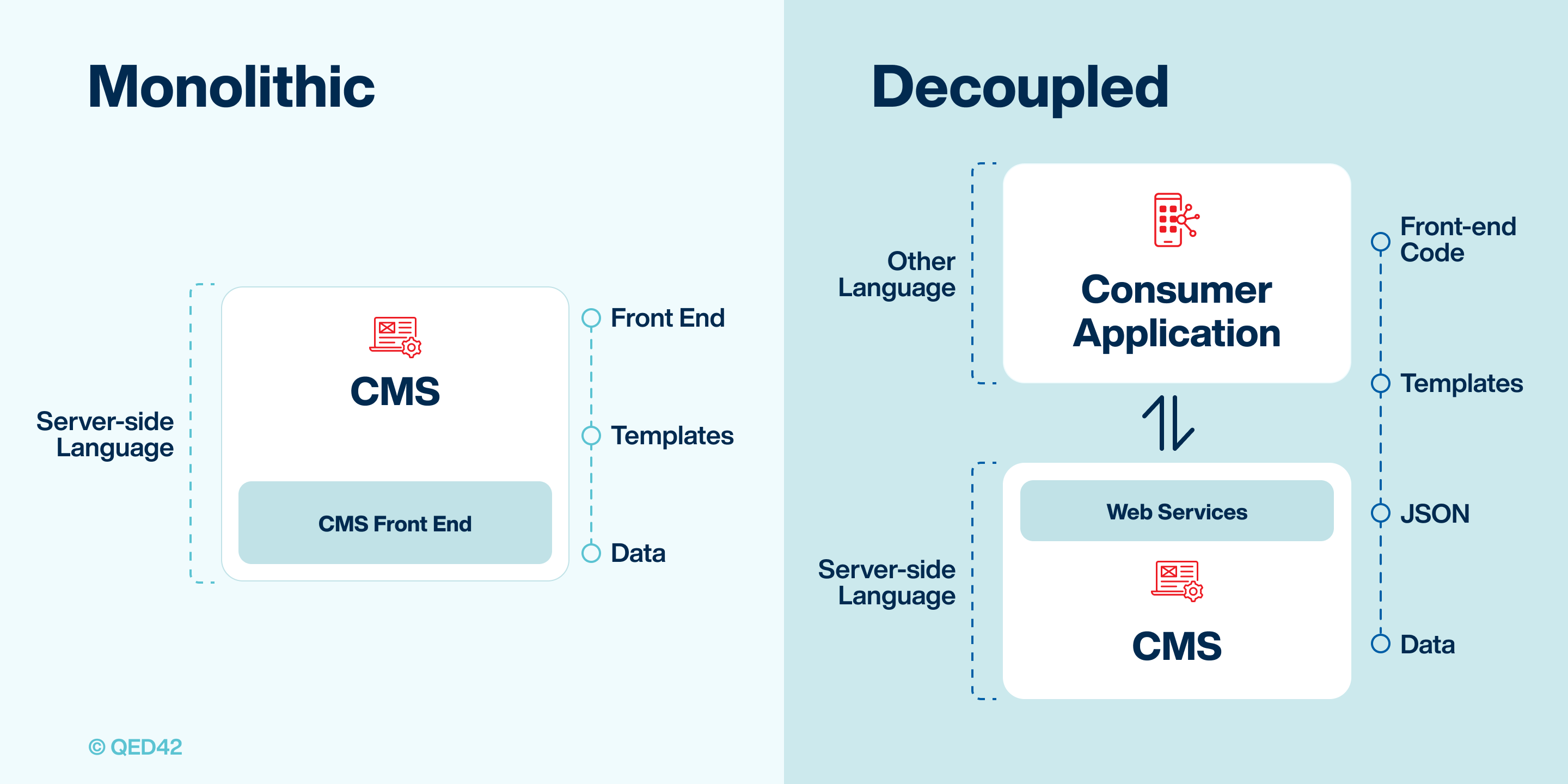
A headless, or decoupled CMS is a modern architecture in software and web development which releases the front-end from the back-end. Designed on different platforms, decoupled architecture presents opportunities that traditional web development can’t even imagine.
Drupal being one of the greatest web development platforms, also presents decoupling options with its hub and spoke model. It integrates all the different spokes (delivery channels) in a single hub (Drupal back-end).
What are the various ways in which you can decouple Drupal?
To be precise about it, there are essentially two ways in which you can decouple Drupal; progressive and fully. Let's talk about them in detail for a bit.
- Progressively Decoupled Drupal: Progressively decoupled architecture adds a JavaScript layer to the front-end delivering some or all the components of the webpage. The back-end CMS remains on Drupal, whereas the front-end uses JavaScript to render interactive web experiences.
In a progressively decoupled Drupal architecture, the developer holds more control over the experience end-users will get. Whereas in the traditional monolithic Drupal framework, it is the editors of the website who control the experience end-users will get.
- Fully Decoupled Drupal: A fully decoupled approach in Drupal, as the name suggests, completely releases the front-end from the back-end. In this complete separation, Drupal serves as the data layer providing content to JavaScript or other front-end layers creating dynamic user experiences.
The front-end of the web experience interacts with the back-end via APIs which connect the two in a seamless and flexible manner. This, although leaves the editors of the website at the whims of the developers, gives end users a captivating and interactive web experience.
So in order for you to decide which approach suits your situation best, think of the editors+content creators and the developers. Who would you want to have more control?
If you want editors to have more control over the end user’s experience, then it would be best to go for a monolithic approach. Whereas, if you want the developers to have more (or complete) control over the digital experience you’re offering, you’d want to go with a decoupled approach.
A progressively decoupled approach gives you best of both worlds as in such an approach, both the editors will have control over the web experience of the end-users.
Front-end defining how content is displayed in the digital application
In any web development, the front-end is responsible for rendering the web pages on the websites. In a monolithic approach, the front-end and the back-end both rely on the same technology, Drupal in this instance.
JavaScript is one of the major languages on which the front-end of decoupled websites are developed. Why, you may ask? Because it helps in delivering an omnichannel experience with elegant user interfaces. It makes websites performant, it also enables fantastic user interactions via chatbots, APIs, real-time data, an intuitive editorial experience, so on and so forth.
This also facilitates the collection of real-time data resulting in much higher personalization of the user experience, as compared to a monolithic or coupled architecture.
Few front-end options to decouple Drupal with
There are some impressive options when it comes to rendering beautiful user experiences on the Drupal back-end. Listed below are some of these technologies.
- Drupal with React: JavaScript offers one of the best front-end solutions in the web development market. React is one such solution which is a JavaScript library that enables the creation of interactive user experiences.
It is a highly powerful front-end technology in the market, and the best part, it is supported and backed by Facebook. With React, the developers have the capability to split the code into corresponding components which can be reused saving developer’s time and effort.
Drupal is perfect in itself, but when decoupled and interlaced with React, it becomes even better. Though it is a bit tough to get the hang of it, but when the two forces combine, a skilled developer can create magical user experiences which leave lasting impressions.
- Drupal with GatsbyJS: Another great tool to render an immersive digital experience is GatsbyJS. GatsbyJS is an open source framework that enables the creation of interactive and performant front-end experience by integrating technologies such as GraphQL. GatsbyJS makes use of pre-configured templates to create static sites with blazing fast speeds.
When it comes to offering exceptional digital experiences at a minimal cost, GatsbyJS and Drupal are great options since both of these frameworks are open source.
GatsbyJS comes with all the components required for a modern website. Performance is enhanced in a framework such as Gatsby because it renders pre-configured pages thus reducing the loading speed drastically.
Essential ingredients to deliver a complete omnichannel digital experience
In a decoupled framework, there are multiple components interacting and working collaboratively to create an immersive digital experience. Listed below are these components.
- Front-end framework: The front-end framework of the website is responsible for delivering the end-user facing component of the website. This is the portion of the system that the end users see and interact with.
- CMS: CMS or the content management system of the website is responsible for holding the data and content repository of a decoupled system that interacts with the front-end via APIs.
- Personalized content delivery: Another important aspect of delivering an omnichannel decoupled experience is the level of personalisation that can be achieved with decoupling. In a decoupled Drupal approach, the user experience can be tailored for each specific user.
- Customer journey mapping: One more essential component of delivering an omnichannel experience is customer journey mapping. When you can see and track how your customers are moving through their journey, it will be easier for you to move them towards conversion.
- Integrations with virtual assistants: Because of its API-first approach, Drupal comes with a lot of APIs out-of-the-box. Drupal serves as the content repository for the front-end delivering content to any virtual assistant, be it on mobile or desktop. Some of the virtual assistants supported with Decoupled Drupal are: Alexa, Cortana, Google Assistant, and Siri.
- API-first approach: In a decoupled system, the front-end, back-end and other layers interact with each other through APIs. This is why Drupal is great for having a decoupled system because of its API-first approach.
Business cases for decoupled Drupal
Decoupled Drupal solves many of the challenges that enterprises face on a daily basis. Some of those challenges are listed below:
- A powerful CMS: Drupal with all of its capabilities, rises to the top as the most powerful content management system out there. Drupal provides immense customisation and personalisation capabilities that modern enterprises require. It also provides state-of-the-art tools to create, manage and analyze content which when coupled with a beautiful front-end, can create digital experiences which are extraordinary.
- Omnichannel support: Drupal is one of the few options out there that can provide content to an unlimited number of front-ends, thus creating an ecosystem of digital experience. Not limited to the parent site, Drupal also has a multi-site approach out of the box which can cater for the content needs of multiple geographies simultaneously.
- Hyperlocalization: Apart from multi-site, Drupal is also multi-lingual which means you can serve up content in the local language as per the needs of the audience. All of this can be presented through the front-end of your choice with the use of decoupled Drupal.
- Enhanced loading speed: With the use of Drupal, one can create static websites with blazing fast speeds. This reduces the bounce rate on a website and increases conversion.
Industries in which Decoupled Drupal outshines every other CMS
- Manufacturing: Manufacturing companies have a plethora of needs when it comes to their websites. With Decoupled Drupal one can fulfill these needs at a fraction of the cost. This saves time and effort and increases sales for businesses.
- Ecommerce: Drupal being a great CMS for building e-commerce websites, it allows the business owners and developers to create intuitive product pages on the front-end of their choice which delivers a great user experience resulting in higher conversions.
- Higher education: Quite often, higher education institutions have to serve content across multiple geographies to attract international students. In such a scenario, a decoupled Drupal architecture gives immense scope and flexibility to serve content, all the while maintaining the institution's brand consistency because all the content is coming from a single Drupal back-end.
- Fintech: With the rise of Fintech companies, has also risen the need for personalising the content across delivery channels to cater to the needs of the audience. Drupal back-end gives enough scope and room for personalising content tailored around the end-user’s requirements.
What decoupled Drupal means for various aspects of your business
- Marketers: For marketers, the Drupal back-end offers a great content authoring experience offering the flexibility to create, publish and edit content for any and every platform simultaneously and seamlessly. It also allows the markets to personalise content according to the needs of the specific user, delivering it all on a beautiful front-end technology.
- Your website: Decoupling your front-end using Drupal at the back-end can result in an exceptional user experience because of the enhanced speed of your website, resulting in better conversion for your business.
- Your budget/site revamps: A decoupled Drupal approach will reduce your total cost of ownership while increasing your return-on-investment. A decoupled approach will also let you build mobile applications and can also be used to provide content to modern interfaces like voice, chatbots etc.
- Your digital experiences: Without a doubt, decoupled Drupal elevates your digital experience by delivering an omnichannel and personalised user experience and gives your end-users something to look forward to.
Reasons for you to use Drupal as decoupled
- Free the developer’s time: Using decoupled Drupal, you can free the developers to focus on innovation. Since developers have the liberty to work on the front-end and the back-end independently, it results in saving the time of the developers.
- Omnichannel delivery: Using Drupal’s ‘create once, publish anywhere’ approach, you can cater to the content needs of various regions, geographies and platforms.
- Improves reliability and performance: Decoupled Drupal becomes the ideal platform for your web experience requirements since it drastically improves performance and makes your site highly reliable.
- Saves time: Using decoupled Drupal, you are not just saving up developer’s time and efforts, but the efforts of the entire organisation. Since you can create once and publish it anywhere, Drupal saves the time of editors, content creators and marketers.
How to decide if Decoupled Drupal is best for you
Here are the scenarios in which decoupled can create magic for your digital experience:
- When your content is to be displayed on multiple different platforms.
- When you have clearly defined the data roles in your organisation and you have a great team to work with.
- When you want multiple websites in multiple local languages.
- When you have the necessary resources and can invest in decoupled development.
QED42 with Decoupled Drupal
We have helped a number of our clients go headless with Drupal. Using headless Commerce, we helped Shop The Area create a multi-vendor e-commerce website that harnesses the power of Drupal to deliver outstanding customer experience.
We used an advanced JavaScript framework to decouple their Drupal website. We used GatsbyJS since it presented an opportunity to solve the business challenges of STA, which was rendering static web pages at blazing fast speeds while also supporting API-enabled e-commerce functions.

Our approach resulted in an increase in the performance score of STA by 96% and the SEO score increasing by 100%. Explore the detailed case study here.
We have immense expertise in going headless with Drupal and can help you as well to decouple. Explore our decoupled Drupal offerings here.

Modern JavaScript delivery in 2025: what really matters
Many businesses still operate on JavaScript-heavy platforms built years ago. They work on the surface, but under the hood, they slow down under load, fail Core Web Vitals checks, and cost more to maintain than they should.
The rules have shifted. Google now uses Interaction to Next Paint (INP) as a ranking factor, flagging any interaction above 200 milliseconds as poor (Google Web.dev). That means slow responsiveness is no longer just a technical issue; it is a visibility and revenue issue. Users expect instant performance across devices and abandon products that cannot keep up.
At the same time, AI is transforming delivery pipelines. Teams that embed it are cutting release cycles by up to 30 per cent and reducing technical debt remediation by 40 to 50 per cent (McKinsey). Security and compliance expectations are stricter than ever (CISA). Budgets are under pressure, and product leaders are asked to deliver more with less.
The framework choice is secondary. The real question is whether JavaScript delivery produces visibility, lowers costs, and reduces risk.
Challenges
Performance is now a business-critical metric
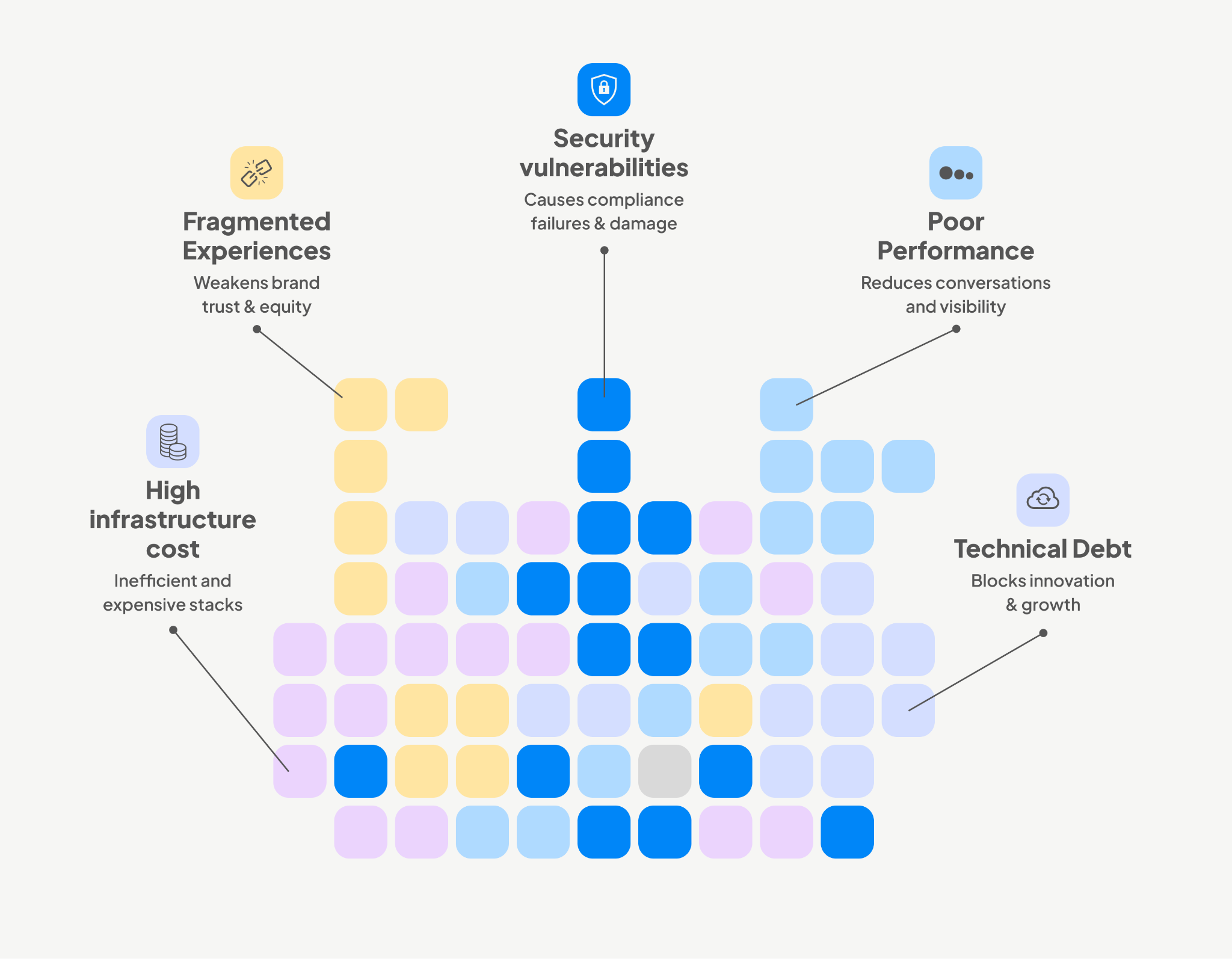
Applications that miss Core Web Vitals lose visibility and customers. Research shows that every 100ms delay in load time can reduce conversions by up to 7 per cent (Akamai). Many older single-page apps, designed for a different era, simply cannot pass INP thresholds. This is not just about faster websites; it is about protecting top-line revenue.
Technical debt has become a growth blocker
A Stripe study revealed that developers spend 42 per cent of their time dealing with technical debt. Every hour spent patching legacy code is an hour not spent on features that drive growth. The compounding effect is brutal: delays in new launches, growing maintenance overhead, and higher developer turnover. Businesses that fail to address this stall their ability to innovate.
Security is no longer optional
High-profile supply chain attacks such as SolarWinds and malicious npm packages show how easily vulnerabilities slip into production. With regulations tightening globally (GDPR, HIPAA, PCI DSS), compliance failures can result in heavy fines and reputational damage. Security must be embedded in pipelines and runtime, not bolted on later.
Infrastructure costs are climbing without control
Running multiple brand websites on separate stacks is expensive and inefficient. Each new launch duplicates effort, inflates hosting bills, and slows expansion. In one case, consolidating 12 fragmented sites into a modular JavaScript platform reduced infrastructure costs by 28 per cent and shortened launch timelines from months to weeks. Businesses that ignore infra optimisation risk ballooning OPEX.
Fragmented experiences weaken brand trust
Without standardised design systems, teams rebuild the same components repeatedly. This leads to inconsistencies across platforms, longer delivery times, and higher costs. Gartner has identified design systems as a key strategy for scaling product delivery effectively (Gartner). For global businesses, fragmented experiences are more than a design issue; they directly impact customer trust and brand equity.
Solutions
Application development tuned for outcomes
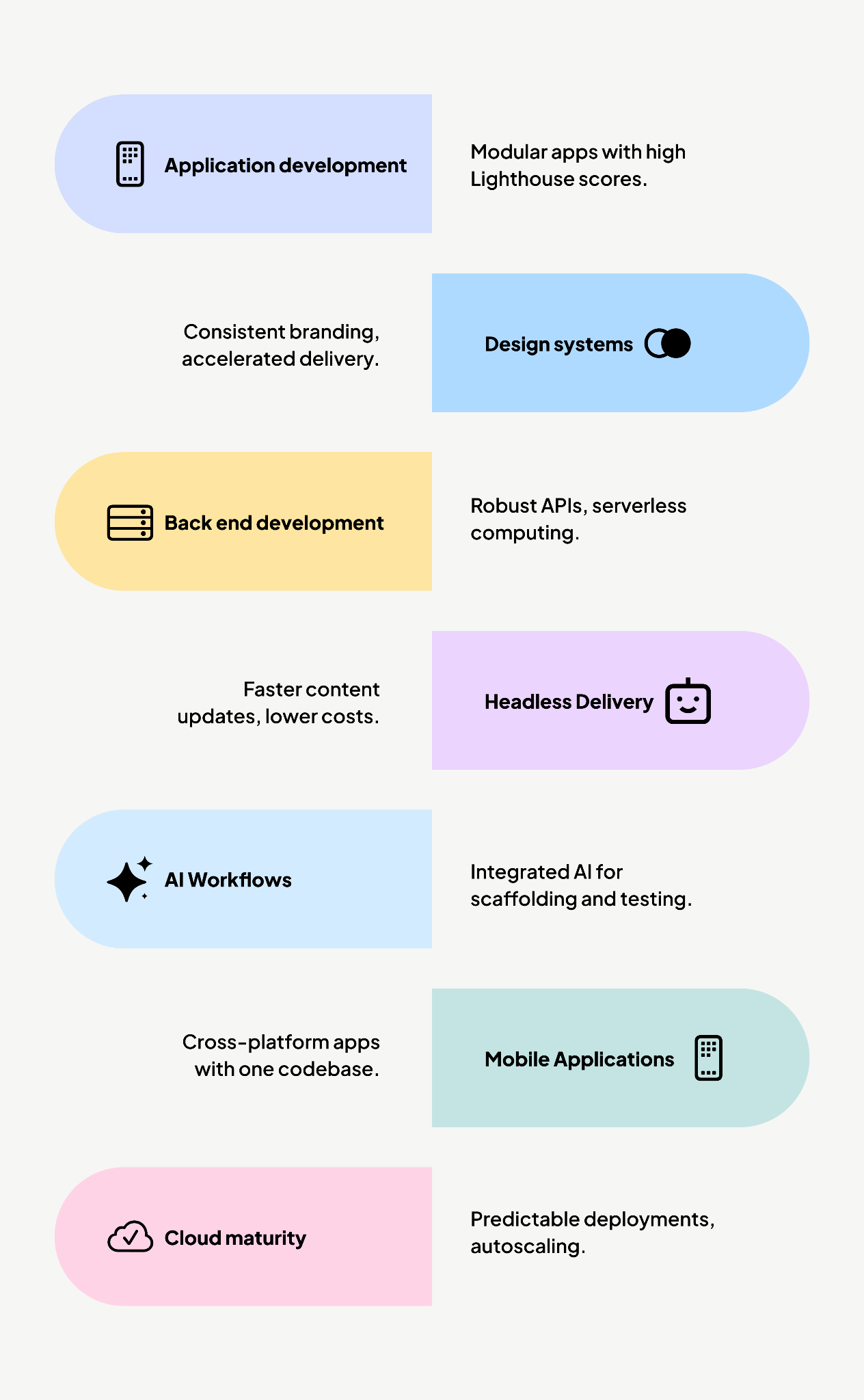
React, Angular, Vue, and Svelte are used to build modular, performant apps. Component-driven architecture and asset budgets deliver 80+ Lighthouse scores on mobile as a baseline.
Example: A financial services platform adopted this approach, combined with AI-assisted testing, and reduced regressions significantly, making releases more predictable and performance stable.
Design systems and component libraries
Storybook, Tailwind, Radix UI, and Atomic Design principles accelerate delivery by 25–40 per cent while ensuring consistent branding across regions and devices.
Example: A hospitality company used this approach to launch three regional websites in half the time, without diluting experience or brand identity.
Back-end and API development
Node.js, NestJS, and Express power robust, secure APIs. Serverless computing reduces infrastructure overhead while ensuring scalability. GraphQL improves developer productivity and system interoperability.
Headless and decoupled delivery
JAMstack approaches with Strapi, Ghost, or Contentful, combined with Next.js, deliver faster content updates and lower infra costs. Example: A global non-profit delivering climate hazard data to governments used headless architecture to serve real-time interactive dashboards with faster performance and easier updates.
AI-enabled workflows
GenAI is integrated directly into delivery: scaffolding, testing, and remediation. Human oversight ensures quality while reducing delivery cycles by 20–30 per cent and cutting technical debt remediation time by 40–50 per cent (Harvard Business Review).
Example: A media company embedded AI into QA workflows, reducing regression issues by half and improving release velocity.
Mobile and cross-platform applications
React Native and Flutter enable mobile apps with one codebase. Feature parity across iOS and Android is faster, with lower maintenance overhead.
Example: A quick-commerce company integrated a headless CMS with React Native, enabling marketers to publish content directly to mobile apps without developer bottlenecks. This reduced turnaround time and increased release cadence.
Cloud and DevOps maturity
CI/CD with GitHub Actions or GitLab CI, observability with Datadog and Prometheus, and Infrastructure as Code ensure predictable, secure deployments. Autoscaling reduces costs by up to 30 per cent while maintaining reliability.
Impact Framework

Why CTOs can’t afford to ignore offshoring
For digital organisations, building fast, staying lean, and delivering reliably are now non-negotiable. Yet with engineering talent in short supply and delivery windows shrinking, traditional hiring approaches can no longer keep pace.
That’s why more CTOs are turning to offshore partnerships. Not as a fallback, but as a way to extend their in-house team and keep delivery on track.
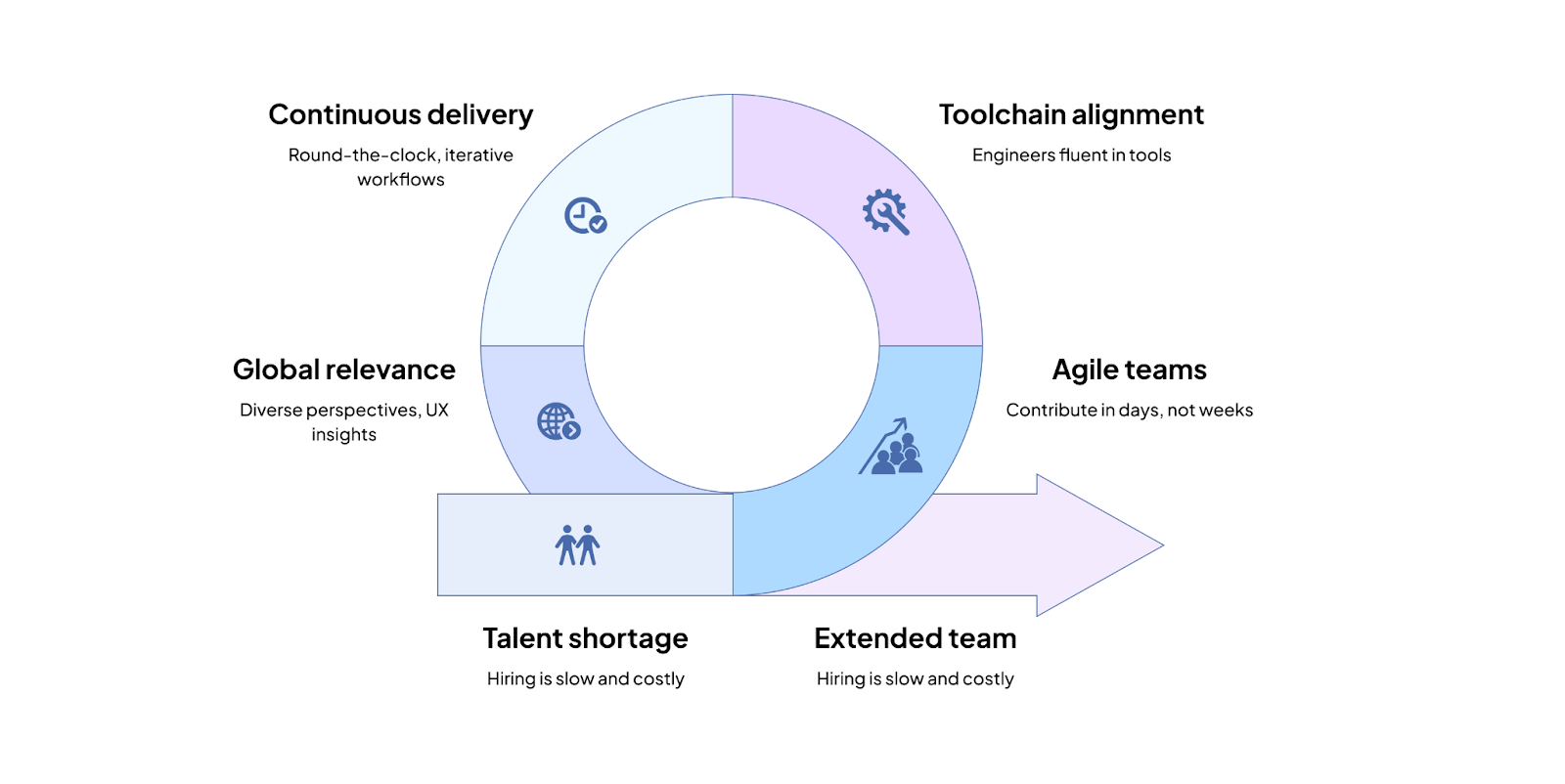
Offshore teams with agile maturity, cloud fluency, and toolchain alignment contribute in days, not weeks, along with taking accountability and being coachable.
What is the value beyond cost
Local hiring cycles are lengthy, and onboarding adds further delays. Offshore delivery reduces that ramp-up by providing engineers already fluent in the tools, workflows, and delivery practices in use.
Whether you're rolling out a headless CMS, improving frontend performance, or adding LLM-powered features, offshore teams make it possible to plug in just the expertise you need, when you need it.
The real value is not in lower rates but in aligning capability to need, while time zone coverage enables continuous delivery.
Round-the-clock, iterative workflows help teams hit tight deadlines while enabling knowledge transfer that strengthens internal teams over time.
What makes integration the difference?
The difference between transactional outsourcing and meaningful offshoring lies in integration. Teams that are aligned with your systems, delivery goals, and culture deliver stronger outcomes. Shared purpose builds trust, collaboration, and ownership.
Offshoring also unlocks relevance in a global marketplace.
Diverse perspectives reveal language, UX, and regional insights that strengthen product-market fit. Forcing one side to over-accommodate the other rarely works.
Balanced teams learn from each other and evolve together, bringing together the most relevant people across geographies, skill sets, and perspectives to engineer systems that serve a global marketplace.
Conclusion
Offshoring is no longer just about cost efficiency. It’s a way for CTOs to bring in the right skills at the right time, keep projects moving across time zones, and reduce delivery risks. When offshore teams are fully integrated into systems and goals, they accelerate execution and strengthen in-house capabilities.
In my view, the biggest shift is that offshoring has become a business advantage. It gives organisations a way to deliver faster, adapt to demand, and stay competitive without being limited by local hiring cycles.

Creating a prescription product site for HCP's
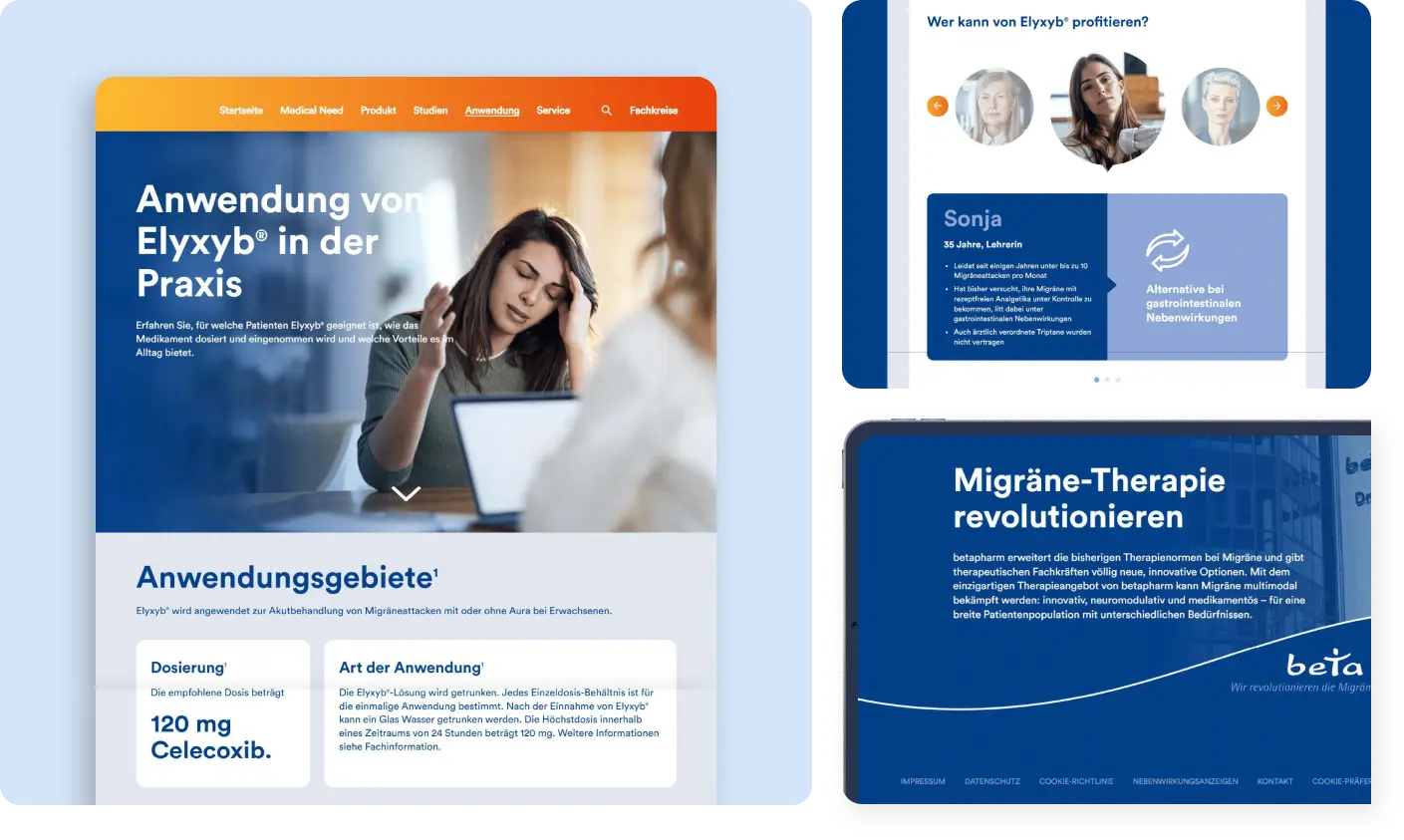
We partnered with a pharmaceutical team to build a secure website for a prescription migraine treatment, restricted to Healthcare Professionals (HCPs) in Germany. The platform had to enforce secure access, meet strict regulations, and let internal teams manage content without developer support.
In pharmaceutical publishing, every update passes through legal and medical review. Teams must ensure compliance at every stage, from layout to accessibility and approval. But traditional CMS setups often limit how quickly teams can respond especially when changes require developer input.
This engagement focused on changing that. We created a gated platform where content teams could structure pages using approved components, update layouts without code, and manage reviews through a system designed for regulatory publishing. DocCheck authentication handled HCP verification, while modular components ensured brand alignment and flexibility across all screens.
The result is a secure, responsive site built for pharmaceutical workflows, where teams can publish with confidence and maintain full control across access, content, and compliance.
Challenges
HCP access restrictions
Prescription product content in Germany must be restricted to verified Healthcare Professionals. The team needed to integrate DocCheck login without interrupting the user journey or creating confusion between public and restricted content.
Modular translation of approved designs
The site had to match detailed Figma designs across all pages. This required translating static visual designs into reusable Drupal components while preserving layout structure, visual accuracy, and brand consistency.
Accessibility compliance across all interactions
The platform had to meet WCAG 2.1 AA standards. Every template and component needed to support keyboard navigation, semantic HTML, and colour contrast requirements across screen sizes.
Content review across legal and medical teams
Content needed to pass legal and medical review, with a CMS that preserved layout fidelity and didn’t require developer involvement.
Visual transitions without performance trade-offs
Designs included interactive elements and transitions. These had to be implemented in a way that preserved responsiveness and fast load times, especially for mobile users.
Fixed delivery timeline and scope
The scope was predefined with a clear feature list and delivery schedule. There was no flexibility for timeline extensions or post-handover adjustments.
Solutions
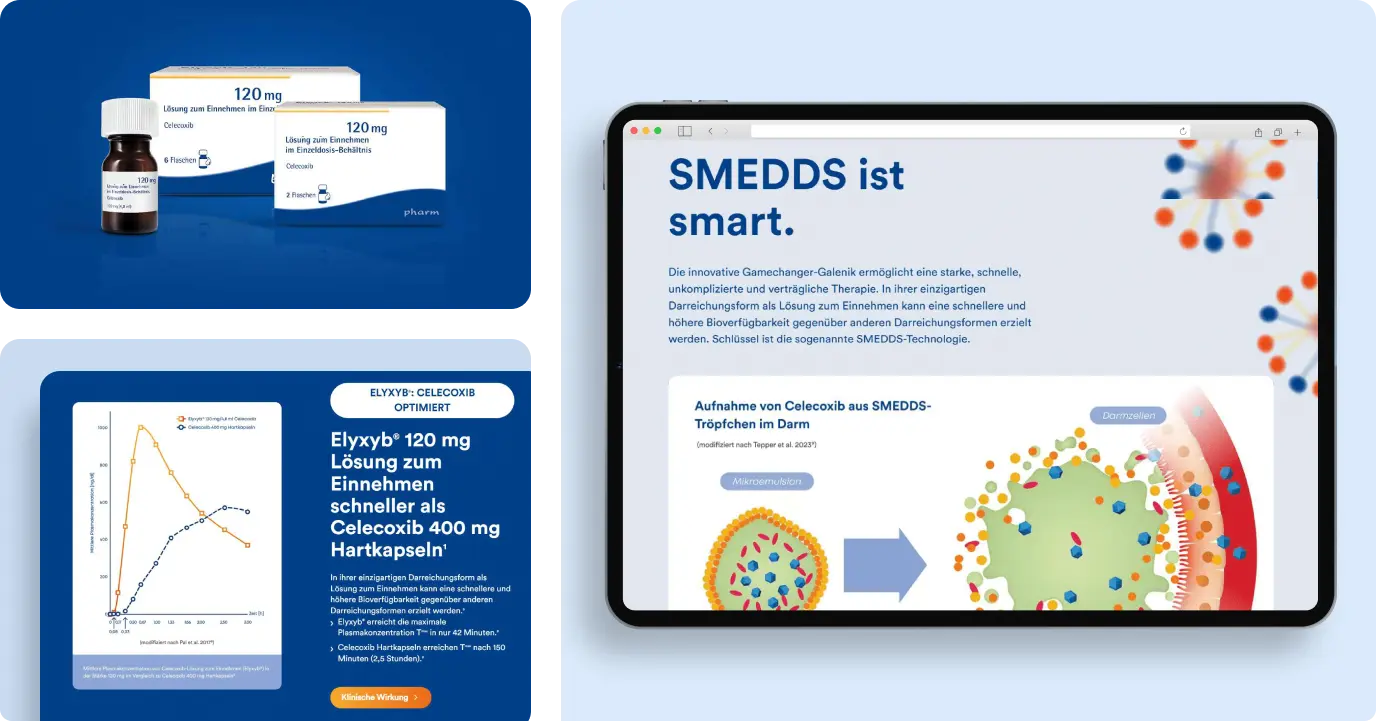
DocCheck authentication
We integrated DocCheck to restrict internal content to verified HCPs. Public pages remained accessible without login. The flow was designed to avoid confusion between public and gated sections and to minimise user drop-offs during login.
Structured CMS with layout flexibility
The site was built on Drupal using Layout Builder and Paragraphs. Editors could create and modify pages using approved layout structures. This reduced the need for developer input and ensured every update followed visual and regulatory standards.
Reusable component library
We developed a library of more than 25 components mapped from the approved design system. These included tabs, carousels, accordions, charts, video modules, and image cards. Each component was responsive and designed for reuse across multiple content types.
Accessibility-first development
Accessibility was applied across all components and templates. We used semantic HTML, validated colour contrast, and added keyboard support to meet WCAG 2.1 AA compliance across devices.
Editor-friendly content controls
CKEditor was configured with utility classes for branded formatting. Editors could apply visual styles directly within the CMS, without relying on code or third-party formatting tools.
Performance-focused frontend
We used mobile-first layouts and optimised CSS to keep page weight low. AOS animation logic was included with fallback support to maintain performance on low-bandwidth or low-power devices.
Knowledge transfer and support
We delivered CMS documentation, a recorded training session, and QA support through internal testing and UAT cycles. The content team was fully trained and ready to manage updates before the handoff.


Results
The site launched with DocCheck authentication, restricting access to prescription product content for verified HCPs. Public users could navigate open pages through a clear and distinct access path.
Editors can now manage structured content and layouts directly in the CMS. Legal and medical reviews happen without layout disruptions or dev bottlenecks.
The reusable component library streamlines publishing by reducing duplication and keeping all content aligned with approved design specifications.
Mobile performance remains stable across devices. Pages load quickly, and transitions run smoothly without affecting responsiveness or layout integrity.
All components meet WCAG 2.1 AA accessibility standards. The platform supports keyboard navigation, semantic structure, and visual contrast requirements across all screens.
Search optimisation is built into the platform through clean URLs, metadata controls, automated sitemaps, and GTM configuration, supporting better visibility and tracking.
Conclusion
Healthcare professionals make decisions that directly affect people’s lives. For prescription treatments, their access to accurate, timely information must be protected, not just provided.
A gated platform ensures that clinical content reaches the people qualified to use it, in the context it was intended for.
This platform was built to support that responsibility, giving HCPs a clear path to critical product information and medical teams the control they need to publish with care.
It keeps the focus where it belongs, on the integrity of the content and the people who rely on it.
.avif "ROI of AI services: how much can you really save?")
ROI of AI services: how much can you really save?
In 2023, the U.S. the Department of Veterans Affairs used AI to process healthcare claims faster, reducing the time from 14 days to under 3 by automating triage and prioritization and thisshift translated into faster reimbursements, better patient service, and significant operational savings.
Businesses across industries are investing in AI to solve real problems, like streamlining operations, reducing overhead, improving customer experience, speeding up the internal decision-making, enhancing compliance workflows, and reducing risk.
From logistics companies optimising delivery routes to banks using AI for fraud detection, the applications are increasingly core to how businesses operate.
But here’s the catch: while the hype around AI is loud, clear conversations about its return on investment (ROI) are rare.
That’s why this blog exists: you’ll discover how to calculate the ROI of AI services, which metrics matter, what costs are often missed, and how to turn smart planning into real business outcomes.
If you're contemplating AI but unsure what it means for your bottom line, you're in the right place. When AI services are pitched, discussions often focus on capabilities. But when it comes to investing, the key question is simple: how much does it return?
How to calculate the ROI of AI services
.avif)
To calculate, the standard formula for return on investment is: ROI = (Net Benefits - Costs) / Costs.
But making this formula useful means being precise about what goes into each side of the equation.
On the benefit side, you account for time savings, accuracy gains, speed of operations, and downstream revenue. These benefits typically come from reducing manual workloads, improving forecasting and personalisation, and speeding up responses.
When it comes to the costs, it's not just about subscription or license fees. You should also factor in the cost of customising models, integrating them into your existing systems, preparing your data, and training your teams. Ongoing costs also matter, such as system maintenance, periodic retraining, and scaling infrastructure.
According to a 2023 McKinsey study, 44% of companies implementing AI underestimated the costs associated with data infrastructure and training. These overlooked costs can often significantly affect the difference between projected ROI and actual performance.
Key ROI metrics for AI services
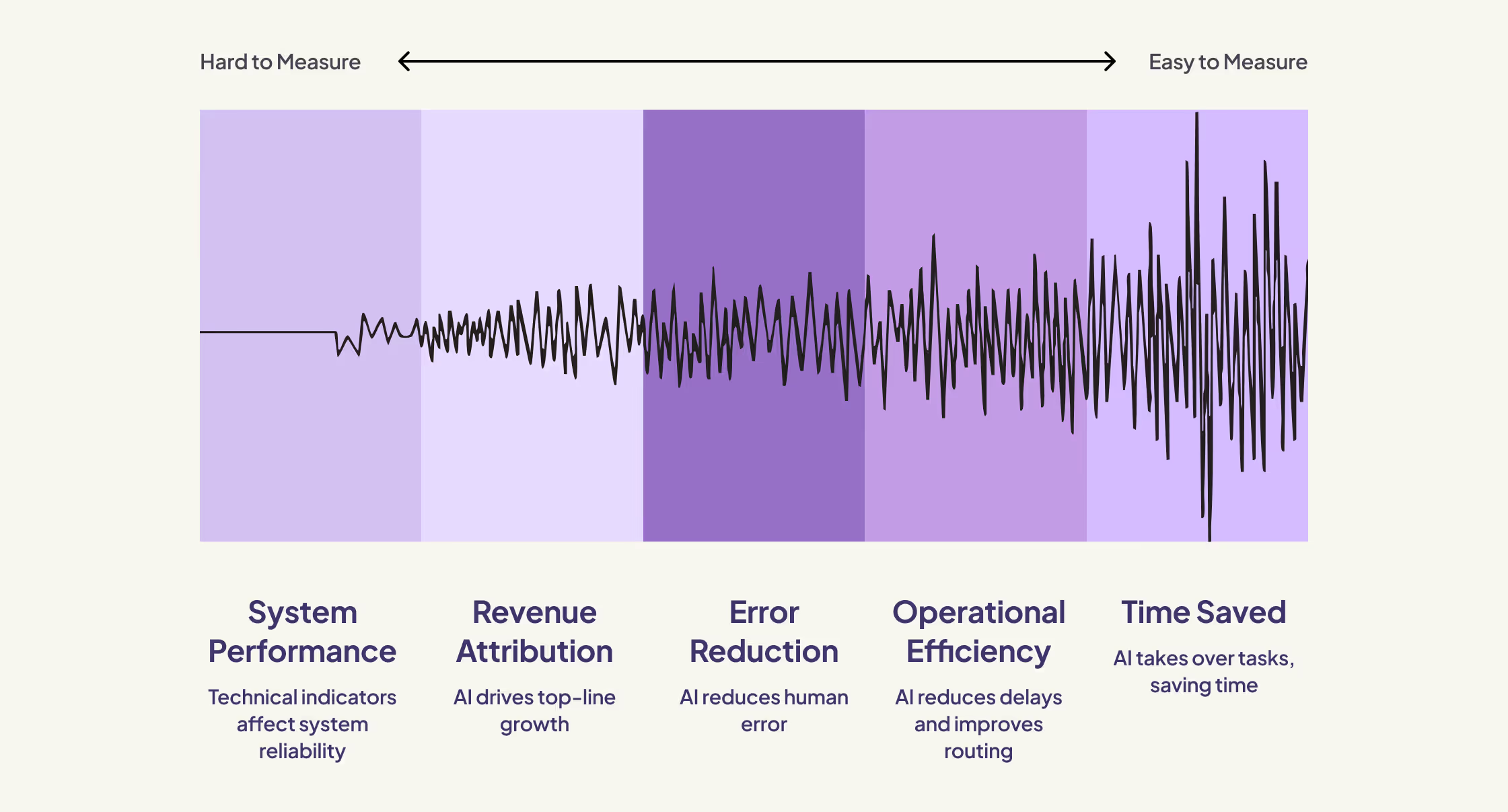
Time saved per task
This is often the easiest and simplest metric to measure. When AI takes over tasks like document classification, ticket triage, or invoice handling, each transaction takes less time.
For instance, if your finance team processes 10,000 invoices a month and automation saves 10 minutes per invoice, you save 100,000 minutes, about 1,667 hours. At an average cost of $30/hour, that equals roughly $50,000 per month.
Operational efficiency
AI can reduce delays, improve routing, and eliminate bottlenecks.
Uber Freight has leveraged AI-powered optimisation to cut down empty miles and improve truck utilisation across its network. By analysing traffic, weather, and load data in real time, the company significantly cut route inefficiencies, boosting delivery reliability and reducing operating costs.
Efficiency metrics often show up in throughput: the number of support tickets resolved, orders processed, or inquiries answered within a given time. Measuring before and after deployment helps isolate the value.
Error reduction
AI reduces human error in repetitive or decision-heavy tasks. Whether it’s data entry, demand forecasting, or product categorisation, accuracy gains can prevent costly mistakes.
A B2B SaaS company deploying an AI triage system for customer tickets saw a 22% drop in SLA violations, reducing the number of escalations and saving team bandwidth, according to this case study summary.
Revenue attribution
AI doesn’t just cut costs, it can also drive top-line growth. Personalised product recommendations, churn prediction models, and dynamic pricing engines can all increase revenue.
Revenue ROI often shows up in increased customer lifetime value, improved conversion rates, or higher average order values. These require controlled testing to isolate results.
System performance
You should also track precision, recall, and latency. These technical indicators affect how reliably a system operates and how users respond to it. Low precision leads to irrelevant results, while long latency can frustrate users.
High-performing systems contribute to adoption and usage. For guidance on evaluation, see our AI testing guide.
Ramp-up time
Some AI systems deliver immediate benefits; others require a learning period. Consider how long it takes to get a model trained, deployed, and effective. The same goes for how long it takes your team to learn and adopt it.
Tracking ramp-up time is key to understanding when returns start and how long the payback period might be.
Factors to consider before investing in AI
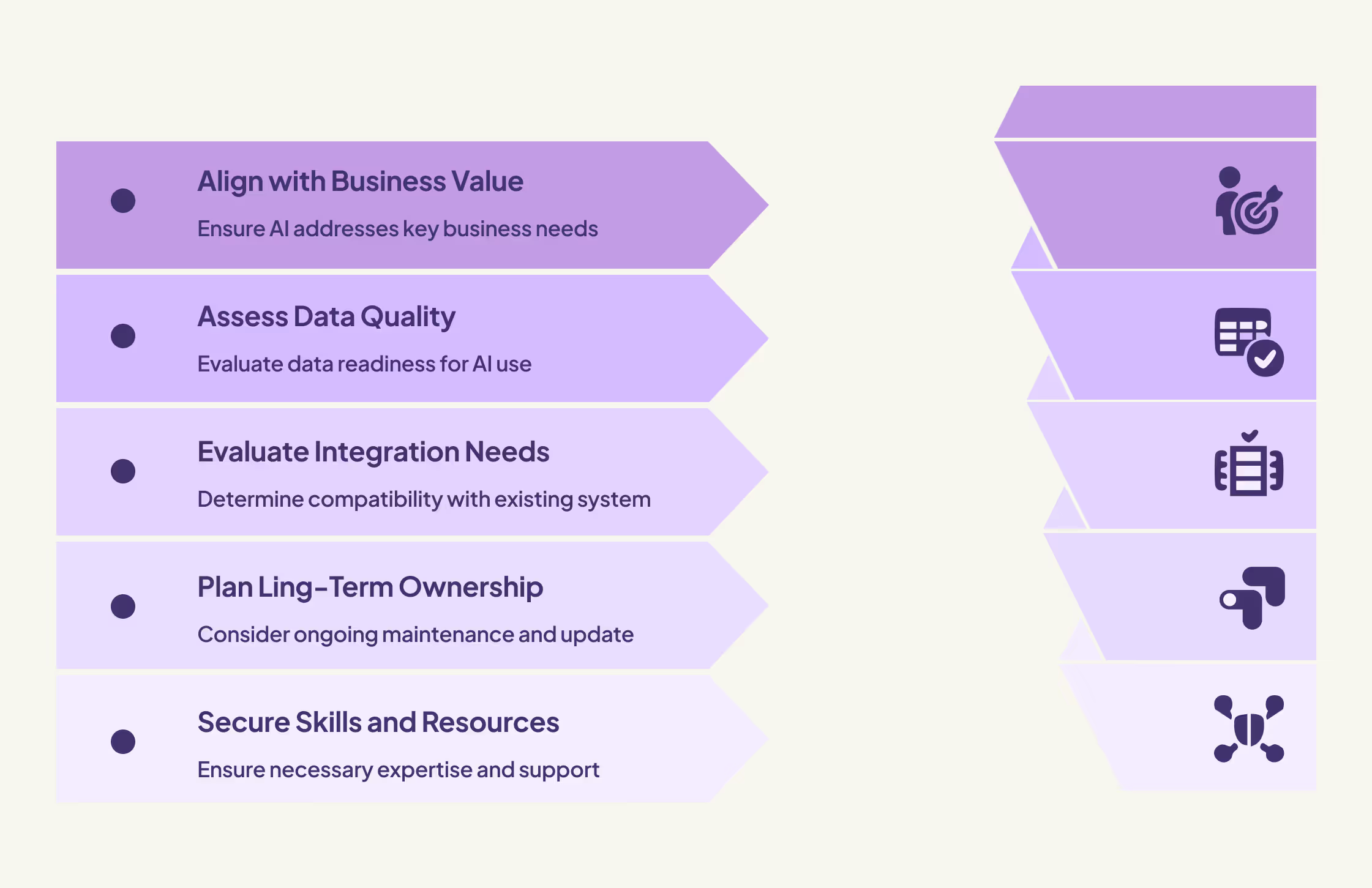
Business value alignment
Start with a problem that affects the bottom line. AI should not be used for experimentation alone. Instead, it should improve processes that matter: reducing cost, increasing revenue, or improving speed.
If your support volume is rising and your ticket backlog is increasing, that’s a clear cost centre. A properly tuned AI assistant might bring measurable improvement here within one quarter.
Data quality
Many AI projects don’t work because of poor input data. Unstructured, inconsistent, or incomplete data limits what AI can do.
Conducting a data readiness audit early can prevent delays and budget overruns later. This includes checking data volume, structure, labelling, and relevance to the task.
Integration needs
Your current tech stack plays a major role. Some AI tools offer plug-and-play connectors; others require API customisation or infrastructure changes.
For organisations running on platforms like Drupal, see how we've approached AI in Drupal implementations.
Long-term ownership
Even after launch, AI systems require monitoring and maintenance. Over time, models may drift, and new edge cases may emerge. Retraining, compliance updates, and UI/UX changes must be factored into total cost of ownership.
After an AI system is launched, it still needs to be monitored and maintained. Over time, models can change, and new edge cases may emerge. When figuring out the total cost of ownership, consider retraining, compliance updates, and UI/UX updates.
Skills and resourcing
Determine whether your internal team can handle the system maintenance or whether vendor support is required. Long-term success is rooted in shared ownership. Our approach to AI services supports capability-building alongside deployment.
Where AI ROI is highest in B2B
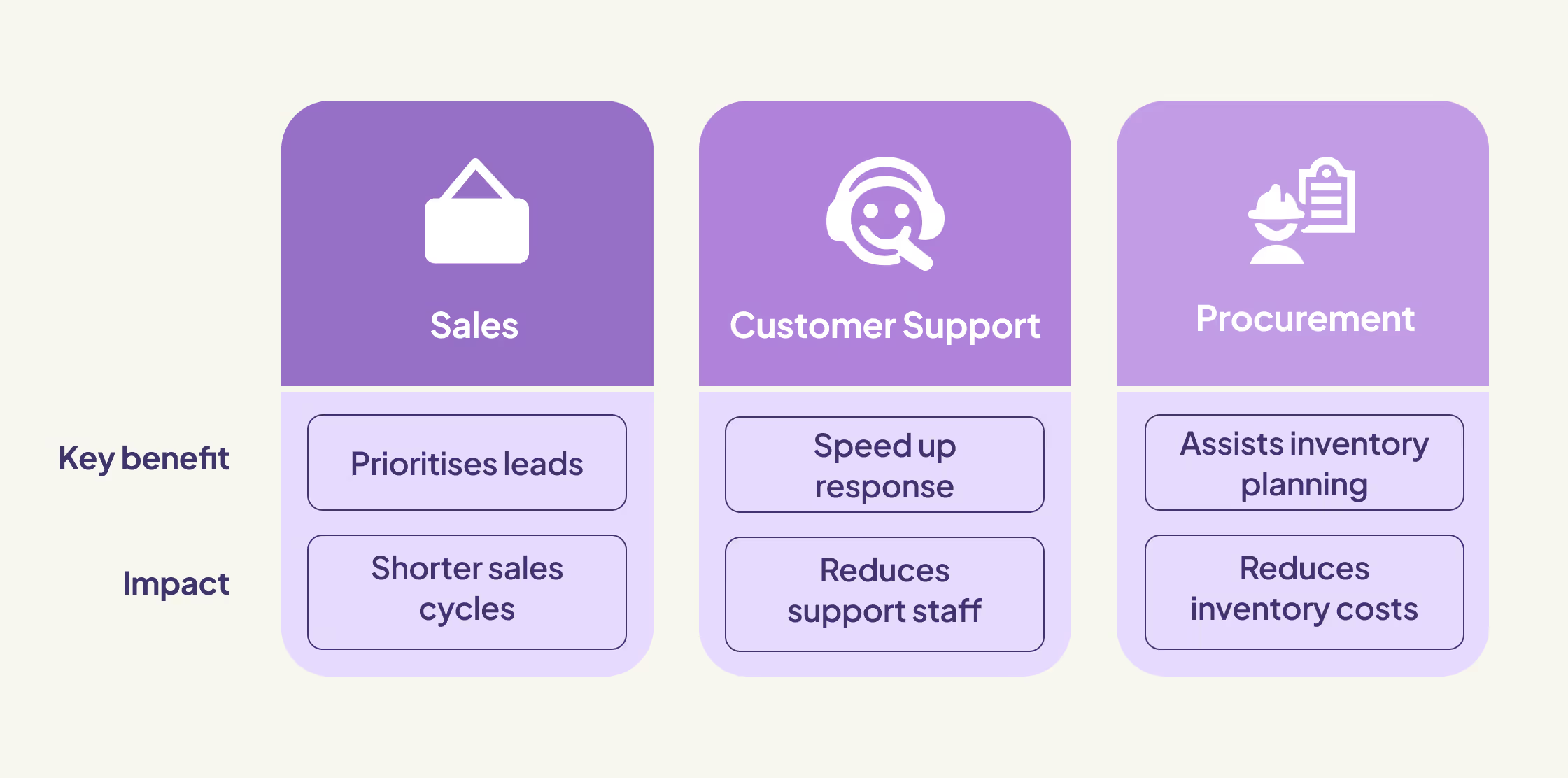
AI is proving to be a game-changer in B2B, especially in areas that require frequent decision-making. In sales, for example, AI can help prioritise leads, suggest follow-ups, and customise email outreach.
HubSpot has found that teams leveraging AI can cut their sales cycles by as much as 12%.
In the realm of customer support, AI tools for ticket triage and classification can significantly speed up response times and decrease the number of tickets agents need to manage. One global SaaS company reported a 15% reduction in support staff needs thanks to AI, saving them $1.3 million each year.
When it comes to procurement, AI assists with inventory planning and forecasting suppliers. Gartner estimates that AI can help reduce inventory costs by up to 10% while still maintaining high service levels.
For more information, explore our AI workflow assistant solutions.
Benefits and tradeoffs of AI systems
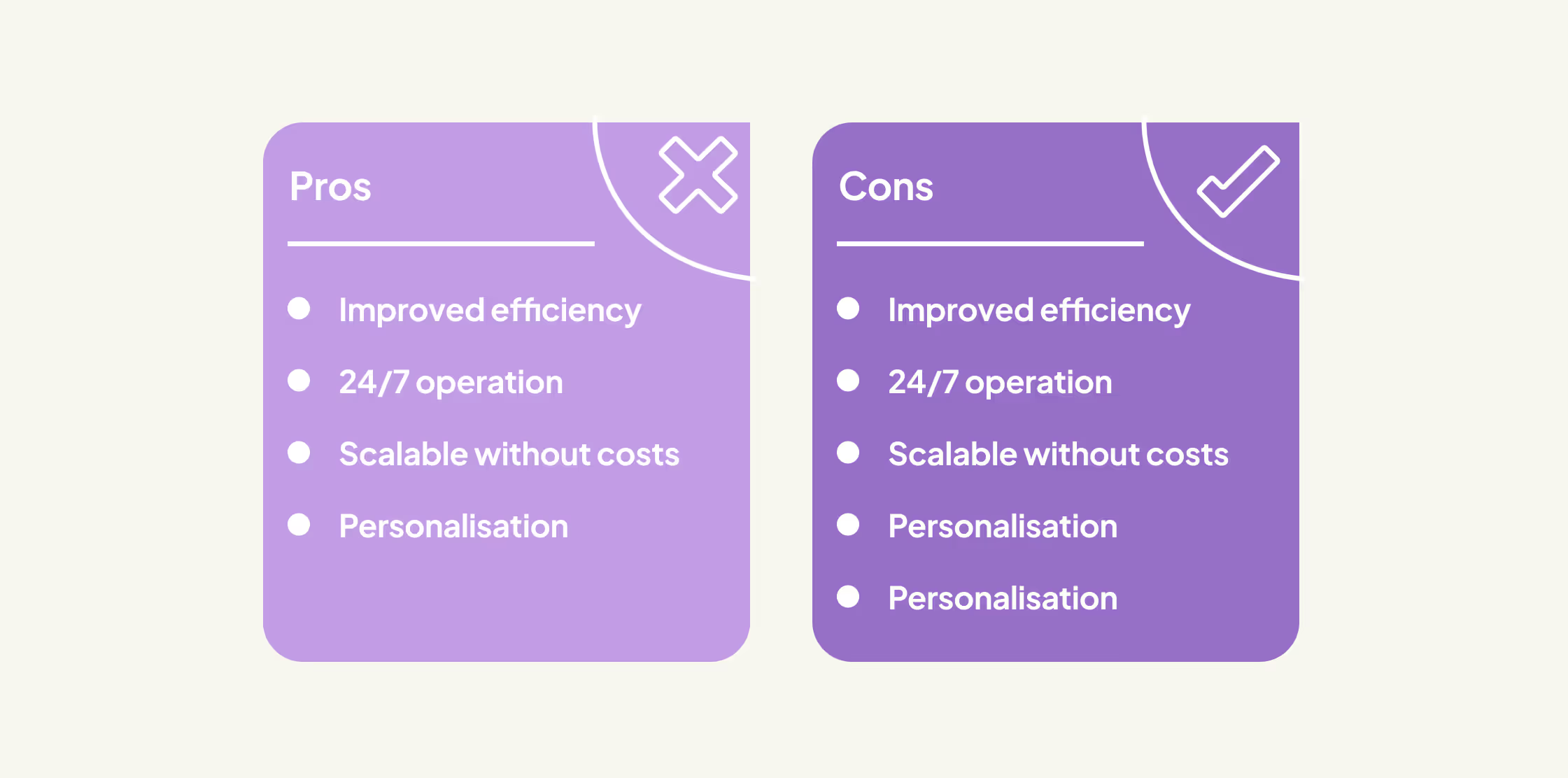
AI brings real advantages, but some tradeoffs are involved.
Benefits
AI systems improve throughput, reduce delays, and surface insights. They operate 24/7 and can be scaled without scaling costs. Personalisation features improve experience and retention.
Tradeoffs
Successful AI adoption requires structured data, systems integration, and training. Predictive systems typically take longer to show ROI than automation systems. Ongoing oversight is also necessary.
Well-scoped implementations help reduce effort. Read our blog on how AIaaS has changed.
Why do some organisations proceed cautiously?
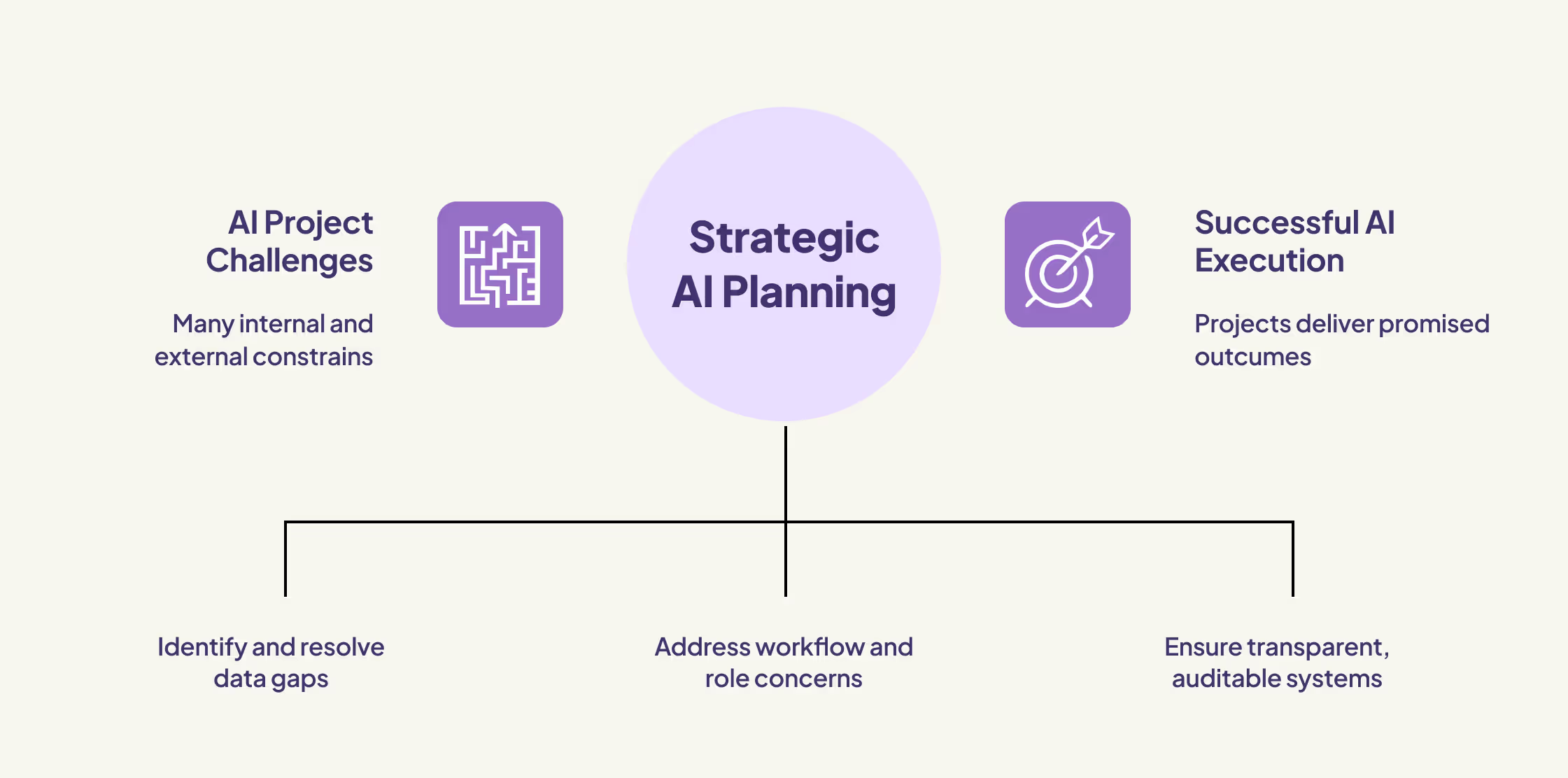
Many companies proceed carefully, often based on past experience or internal constraints.
Some have tried AI projects that overpromised and underdelivered. Others encounter gaps in their data after implementation begins. Internal teams may worry about automation changing workflows or roles.
Compliance requirements can also shape the scope. Finance and healthcare teams need transparent systems that meet audit and reporting standards.
These factors don’t prevent AI projects. They shape planning. Teams that invest time in audits, change management, and compliance reviews tend to execute more successfully.
Hidden value of AI services
There are indirect benefits to AI that are just as real, even if they’re harder to model.
Faster decision-making has compounding value. When you reduce time-to-insight from days to minutes, business leaders can respond more quickly to shifts in the market.
AI also improves morale by taking repetitive work off people’s plates. Employees prefer working on tasks that use judgment, not repetition. This reduces turnover and speeds up onboarding.
Organisations that invest in AI also test and learn faster. They can try more campaigns, pricing experiments, or support approaches in less time.
AI-powered fraud and risk detection systems identify issues earlier. And perceived innovation helps with brand equity. Companies that show AI capability attract more talent, partners, and attention.
Soft ROI: people-first outcomes
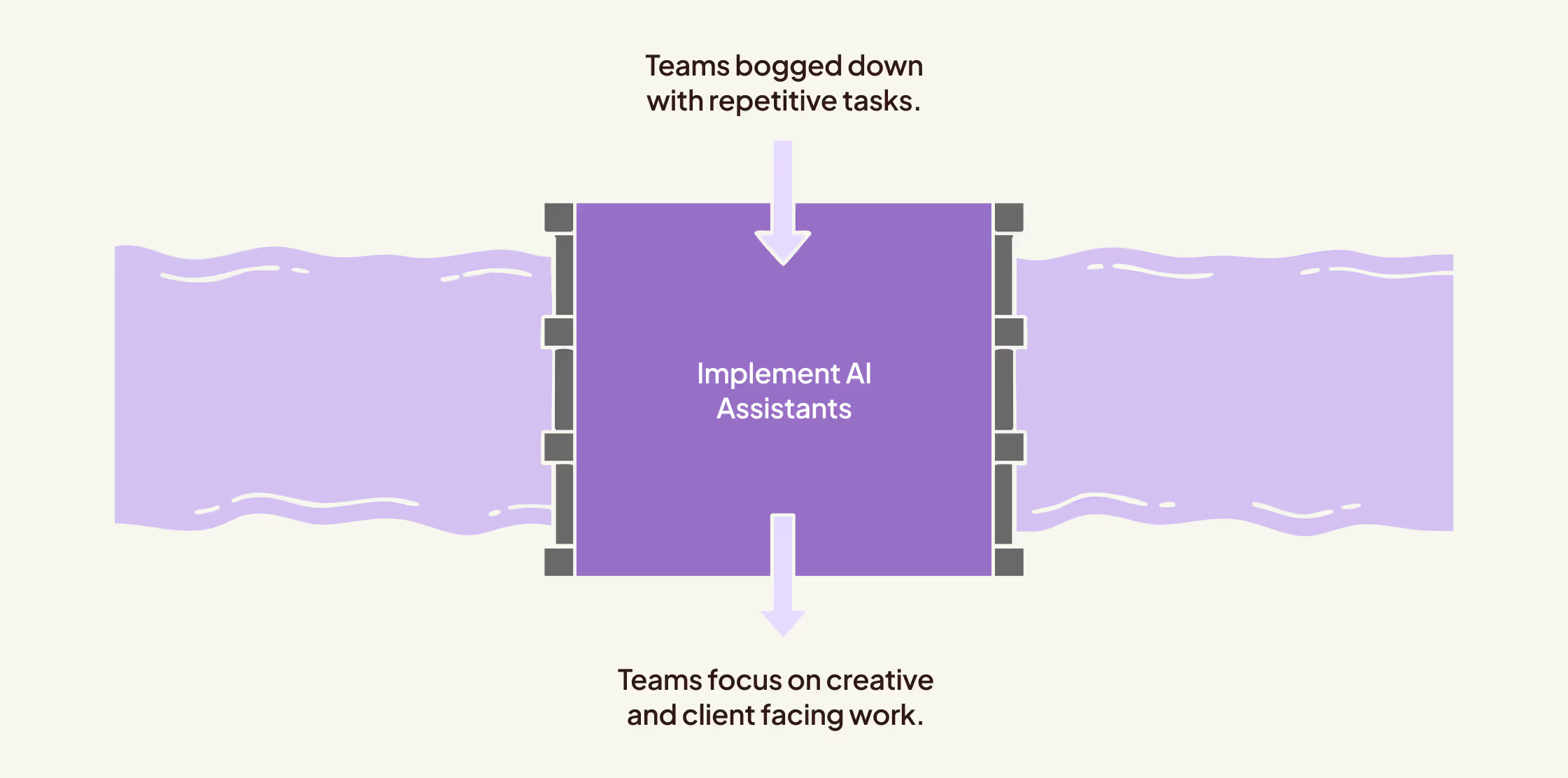
Not all returns show up on a balance sheet. AI frees teams from repetitive work, improves morale, and reduces churn. That’s time and energy reallocated to strategic, creative, or client-facing work.
At QED42, we’ve seen this through AI workflow assistants that cut ticket backlogs, and in platforms like the UNICEF Learning Cabinet, where faster access to insights helps teams focus on outcomes that matter.
With Aeldris, we’re helping legal aid staff spend less time triaging cases and more time with the clients who need them. That shift in attention has operational and emotional payoff.
Soft ROI improves how teams collaborate, how quickly they ramp up, and how well they serve users. It’s a long-term return worth tracking.
What to include when calculating ROI
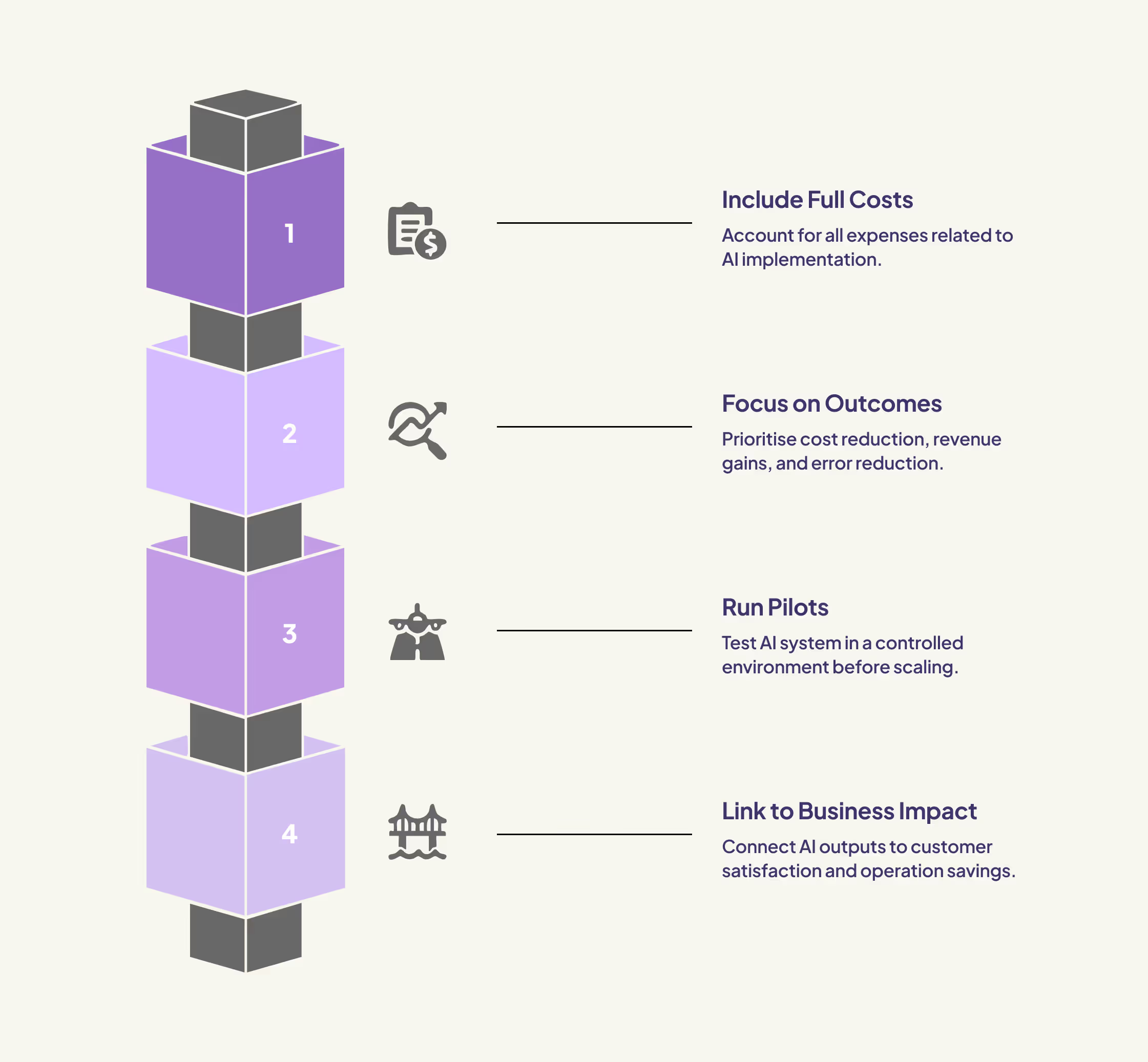
To build an accurate ROI model:
- Include full system costs: setup, training, infrastructure, and updates
- Focus on outcomes: cost reduction, revenue gains, error reductions
- Run pilots before scaling: test against KPIs in a controlled environment
- Link system outputs to business impact: connect response times or accuracy to customer satisfaction or operational savings.
Conclusion
AI ROI is being benchmarked, audited, and tied directly to operations. According to PwC, AI could contribute up to $15.7 trillion to the global economy by 2030, with $6.6 trillion coming from increased productivity. The leading adopters are countries like the United States, China, the United Kingdom, and Germany, where AI is already integrated into sectors such as healthcare, banking, logistics, and public infrastructure.
In the Middle East, governments are investing billions in national AI strategies, including Saudi Arabia’s $40 billion AI investment plan. In India, AI spending across industries such as pharma, finance, and government grew by more than 30 per cent in 2023, according to IDC.
Across industries, AI is embedded in high-impact use cases. Mastercard uses AI to detect fraud in real time. Pfizer accelerates drug discovery with AI. Walmart uses it to forecast demand and optimise inventory. Salesforce has embedded AI into its core CRM to reduce support costs and improve customer experience.
What’s changing is how ROI is tracked. Companies are moving past vanity metrics like total queries or automation rates. They are reporting on time saved per task, reduction in SLA violations, increases in accuracy, operational savings, and revenue impact. In 2024, McKinsey found that leading companies are 3.5 times more likely to measure AI performance using business KPIs, not just technical ones.
The future of AI ROI will be clearer and more connected to real business results. Some Fortune 500 companies are already including AI performance in shareholder updates and quarterly reports. AI is becoming a core part of operations, monitored regularly and expected to deliver consistent outcomes.
No hype, just performance. For practical implementation, see how QED42 approaches AI services.
Frequently asked questions
Why is ROI measurement important?
It removes guesswork and enables confident decisions. Without tracking ROI, it’s difficult to justify continued investment or recognise what works.
What metrics are most useful?Prioritise metrics linked to business outcomes: hours saved, errors reduced, response time improvements, and revenue lift. Precision and accuracy matter, but only in service of those goals.
What challenges affect ROI?The most common ones are weak data pipelines, unclear objectives, and overlooked support costs. Building in early evaluation steps helps reduce risk and clarify expected returns.
.avif "1 product, 6 regions, and the operational drag of fragmented pharma sites")
1 product, 6 regions, and the operational drag of fragmented pharma sites
Healthcare doesn’t move on a clean schedule. People don’t decide to quit smoking or start treatment after scrolling through three pages of brand messaging or watching a campaign video.
It happens in a moment, and that’s when people search for help. Maybe they’re looking for nicotine replacement therapy. Maybe they’re comparing treatment options. Either way, in that moment, they’re overwhelmed and need clarity.
But the confusion isn’t always about wrong or outdated clinical information. It’s baked into the systems behind the scenes, the operational drag that gets in the way of care.
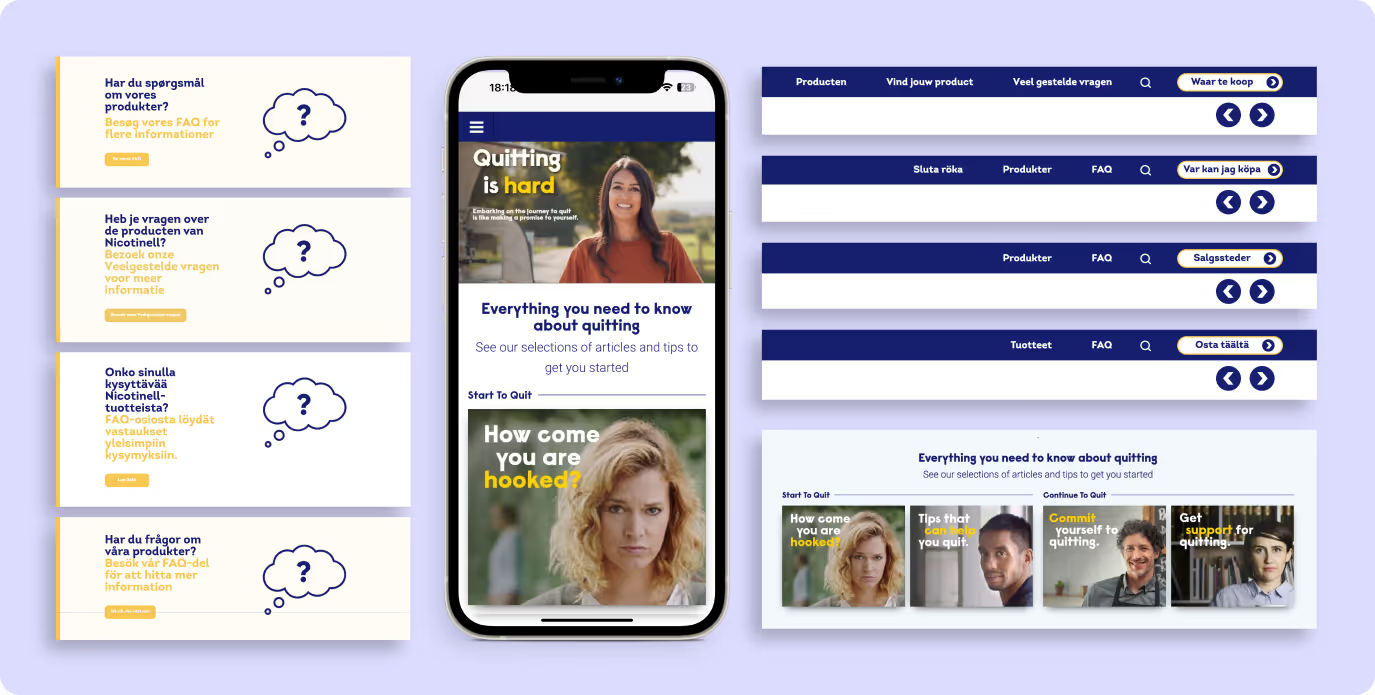
We partnered with a multinational pharma company to solve a similar problem affecting their nicotine replacement therapy (NRT) products. They were managing product websites separately across Denmark, Finland, the Netherlands, Norway, Sweden, and Australia.
Here are the challenges they faced and how the right technology helped fix them.
Challenges
Duplicated systems slow teams down
Each country maintained its publishing platform. That means separate vendor contracts, hosting arrangements, feature development cycles, and support teams. When the same functionality needs to be rebuilt five or six times, it impacts security and performance.
Content management became disconnected
Without a central system, teams are left to copy content between markets. Campaigns were manually adapted, clinical updates had to be re-entered, and translations were handled outside the platform.
User experience became uneven
Users were not able to find the right product for their needs because the guidance or disclaimers differ by region. And if content isn’t in their native language, they’re less likely to take action.
Compliance is harder to track
Approval workflows and documentation standards vary across markets. When content is scattered across platforms, it's difficult to monitor what’s live, what’s approved, and what needs to be reviewed.
In therapeutic categories, this opens the door to regulatory gaps and reputational risk.
What we delivered and why it mattered

A component-based platform to eliminate rebuilds
Each market was rebuilding core features like product finders, dosage tools, and support content from scratch. We replaced that with a shared component library on Drupal. Features could be reused and configured locally. This cut down repetitive development, reduced cost, and ensured consistent functionality across markets. Local teams worked faster, and global teams had better control over platform standards.
A phased rollout based on actual system audits
We audited each market’s setup to understand what needed to be migrated, rebuilt, or removed. Rollouts were done in stages, with testing before launch. This avoided disruption and kept publishing operations running throughout the transition. Teams stayed productive, and adoption was faster because the system was built around their actual needs.
Scoped workflows aligned with local compliance
We created approval workflows and user roles to reflect how each country’s regulatory, medical, and legal processes worked. Teams followed their existing review structures, but with better tooling. This reduced manual tracking, improved turnaround times, and made it easier to stay audit-ready without extra effort.
Built-in localisation and translation tools
Translation workflows were embedded directly into the CMS. Local teams could manage language versions, metadata, and disclaimers without using external tools. This improved accuracy, reduced delays, and kept local content aligned with regulatory requirements.
Faster, more reliable platform performance
The platform was rebuilt to be lightweight, mobile-optimised, and easy to maintain. Load times improved across all regions. Publishing became more efficient, and support tickets dropped as common technical issues were removed at the source.
Shared analytics to track performance at every level
We implemented standard analytics across all markets. Teams could measure what content was published, how it performed, and where updates were needed. Everyone worked from the same data, without needing separate tools or reports.
Every implementation decision focused on reducing operational drag, removing redundant effort, improving time to market, and lowering long-term costs.
The result is a single platform that makes global content operations more efficient, more consistent, and easier to manage.

Conclusion
The right technology, tied to clear outcomes, helped solve key operational issues for the multinational pharma.
Solving the problem of operational drag isn’t unique to one company. It applies across healthcare, where systems should match the urgency of the decisions they support. When people search for help, it shouldn’t be seen as just another interaction or data point on a customer journey map. It’s a turning point, where their decision, mindset, or health outcome might shift direction. They need information they can trust, delivered quickly, in their language, and within their local regulatory context.
In the case of nicotine replacement therapy, smoking cessation, like many life-changing healthcare decisions, happens in minutes. The commitment is quick. People might take weeks to get there, but once they decide, they want to act immediately.
This is where disconnected digital systems fall short. They can’t keep up. People drop off. And the original intent to give people the right information and access to the product at the right time falls apart.
Motivation doesn’t wait. Anything inaccurate or slow became an expensive delay for both the pharma company and the people it’s meant to serve.
A case for building better e-learning platforms in healthcare
Doctors save lives. Nurses, specialists, and frontline health workers carry the weight of care every day. When something changes in treatment protocol, when new research emerges, or when a safety alert goes live, these professionals need to know. And they don’t have time to dig through broken systems or outdated dashboards to find it.
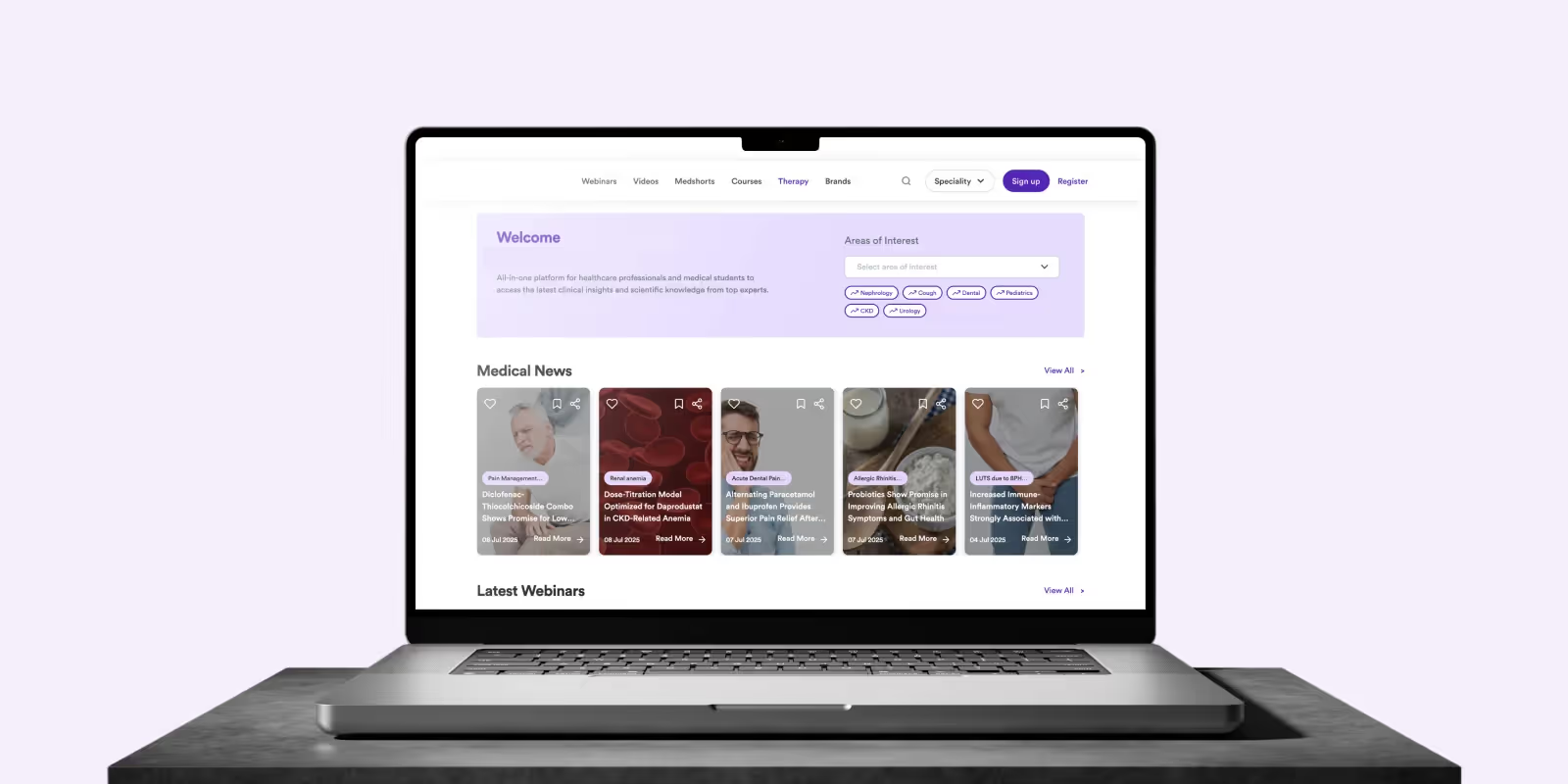
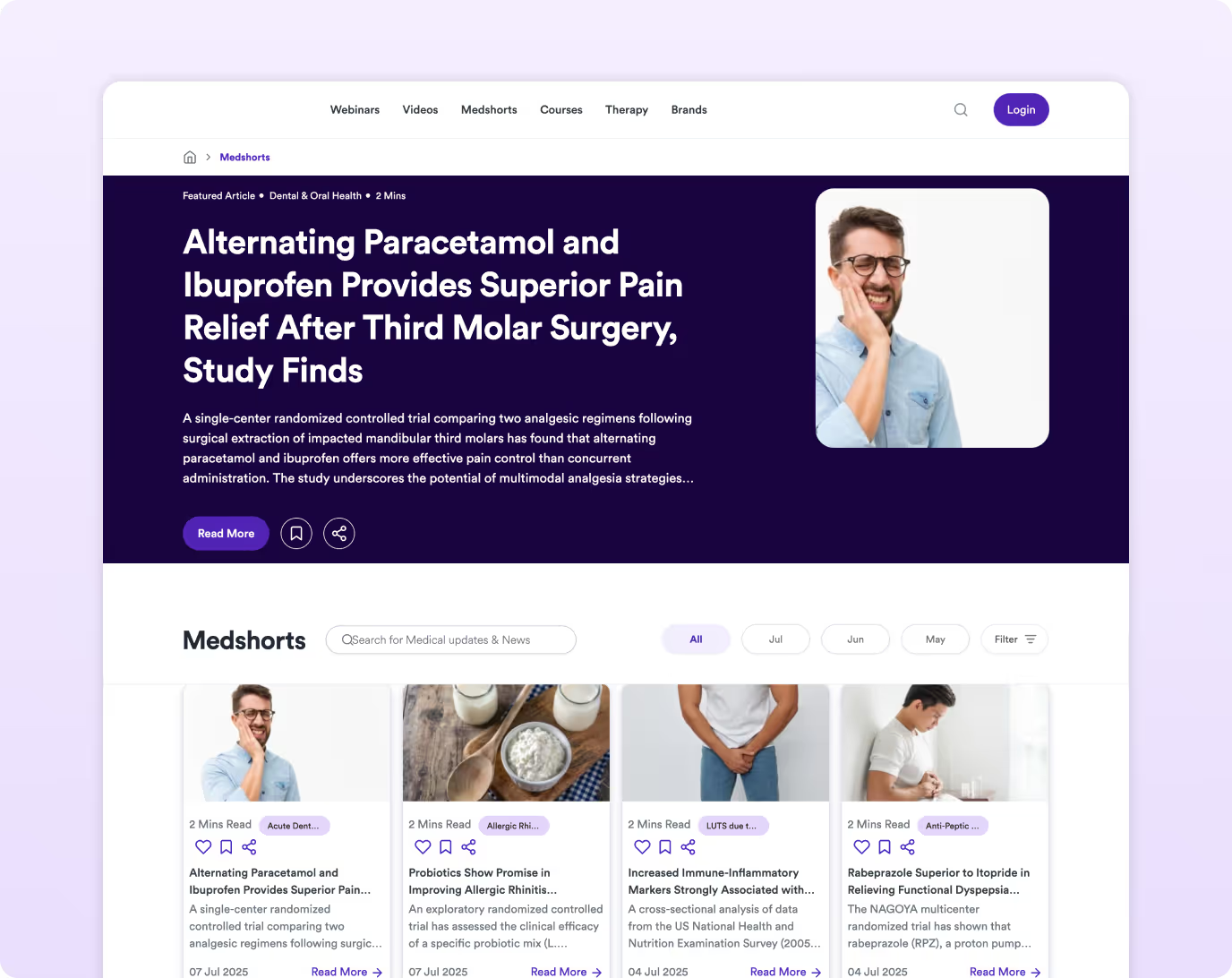
To support this, a multinational pharmaceutical company built a digital learning platform for medical professionals. The goal was clear: provide reliable, easy access to high-quality educational content.
Over time, the platform became difficult to manage, from poor search and scattered content to clunky workflows, manual video handling, and access issues that slowed everyone down.
We partnered with the teams behind the platform to address these issues and reimagine it around clarity, speed, performance, and long-term maintainability. The solution focused on consistent content modelling, streamlined workflows, and a scalable, component-based design system, so the right information could always reach the people who need it, when they need it most.
Why custom e-learning platforms matter in healthcare
Healthcare learning isn't static. Treatment protocols always keep on changing, compliance standards evolve, and new research continuously reshapes how care is delivered. Generic learning platforms struggle to keep pace with this reality.
Custom platforms allow organisations to build compliance directly into how content is created, reviewed, approved, and accessed. Features like version control, audit trails, and role-based permissions help ensure the right information reaches the right professionals at the right time, without introducing risk.
They also make it easier to respond quickly when medical guidance changes. Instead of waiting for platform limitations or manual processes, content teams can publish updates confidently, knowing they will reach the field without delay.
Over time, this reduces dependency on in-person training, lowers operational costs, and creates a learning system that scales across regions while remaining clinically and regulatorily sound.
The challenge: too much content, not enough direction
The organisation’s digital library served a broad set of healthcare professionals across roles and regions. Knowledge content included video explainers, clinical articles, live sessions, and CPD-certified modules.
But the platform was built on a disconnected set of stacks. Key issues included:
- Search delivered inconsistent results
- Editorial teams duplicated work across siloed systems
- There was no shared taxonomy or categorisation logic
- Editorial workflows lacked visibility and version control
These challenges were operational and experience-related. The platform hadn’t been designed for the realities of publishing regulated learning content, or for the way healthcare professionals consume it.
Every moment that outdated content remained live was a moment when a healthcare professional might miss a vital update. And in their world, every detail matters. These are people who show up every day with unwavering commitment to their patients, often under immense pressure and with little time to spare.
The mission was clear: to build a platform that respects their reality. It had to be fast, intuitive, and trustworthy. A space that empowers them with the knowledge they need, exactly when they need it, so they can keep doing what they do best: saving lives and making a difference.
What we implemented
This was a complete rebuild, grounded in workflow clarity, clinical relevance, and system stability- the core issues holding the system back.
We addressed the key failure points and aligned the platform accordingly to reflect how both medical professionals and content teams work.
Structured content, aligned to clinical relevance
We introduced a shared taxonomy, grouping all content by medical domain, format, and target audience. Each content type, like articles, videos, events, and modules, now lives in a unified system and carries a taxonomy reference, making it easier for users to discover what they need and for editors to use the same tags, and users get accurate, predictable results.
To break down silos, we set up two types of content in Drupal and added a "both" tag for videos. This made them show up consistently across formats and cleaned up the URLs.
Reusable components across all content types
We replaced custom pages with a component-based publishing system grounded in Atomic design principles. Editors now use pre-approved templates and building blocks. This ensures consistent layout, faster production, and easier updates. No more visual drift or manual formatting.
One publishing workflow
We connected the backend CMS to the learning front-end through a clean API integration that supports all publishing actions: create, update, approve, publish, and archive.
Content created in Doconnect now flows seamlessly through the system via APIs, enabling cross-platform publishing and synchronisation. User interactions, such as opens and ratings, are tracked to improve engagement and inform ongoing content optimisation.
Centralised video asset management
Video content was migrated to Brightcove and integrated with the CMS through a control module featuring customised sync logic. This ensured seamless video management, prevented duplicates, and eliminated manual embed workarounds. In healthcare education, video plays a critical role. Demonstrations of procedures, device usage, and clinical workflows are often better understood visually than through text alone. By centralising and standardising video delivery, the platform ensures learning remains consistent, accurate, and easy to access for professionals working under time pressure.
Seamless migration for existing users
We integrated the platform with Auth0 and preserved all existing user credentials. Doctors and nurses did not have to re-register or reset passwords. Roles, access levels, and permissions are carried over without friction.
New users complete a simple form, and their data is instantly synchronised between Drupal and Auth0, ensuring a consistent user experience across systems.
What makes an effective healthcare e-learning platform
An effective healthcare learning platform is built for real working conditions. It must be accessible on mobile devices so professionals can learn between shifts or during limited downtime.
It should support interaction through assessments, quizzes, or scenario-based learning so knowledge is reinforced, not just consumed.
Personalisation matters. Learning paths informed by role, speciality, or past engagement help professionals focus only on what is relevant to them.
Security and compliance must be foundational, not added later. Controlled access, audit trails, and content approval workflows protect both the organisation and the people relying on the information.
And finally, strong video integration is essential. For clinical education, seeing is often as important as reading.
Results
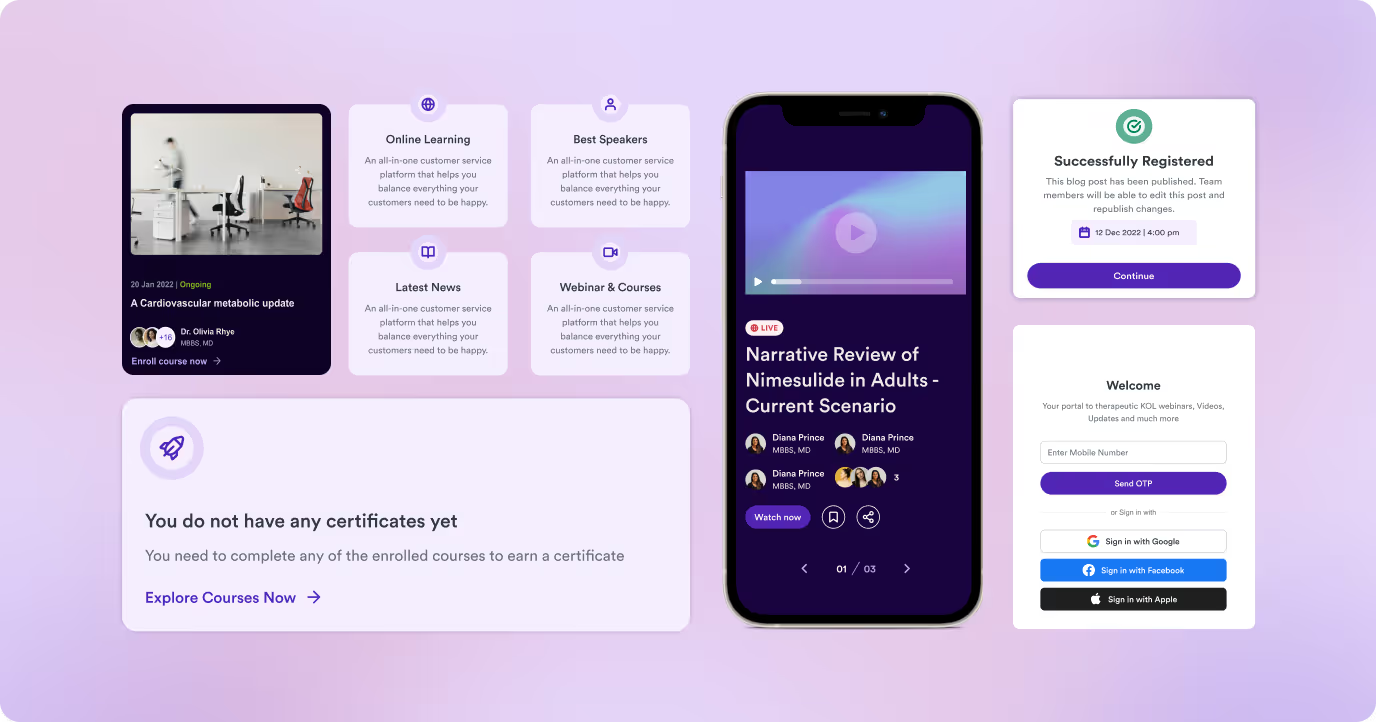
What once took days now happens in hours. Publishing timelines have been streamlined, with no need for engineering support or multi-system coordination. Content teams work independently and release updates quickly. Safety communications, training modules, and clinical content reach the field without delay. In an industry like healthcare, where timing, accuracy, and compliance directly impact patient outcomes and regulatory performance, this speed is a real advantage.
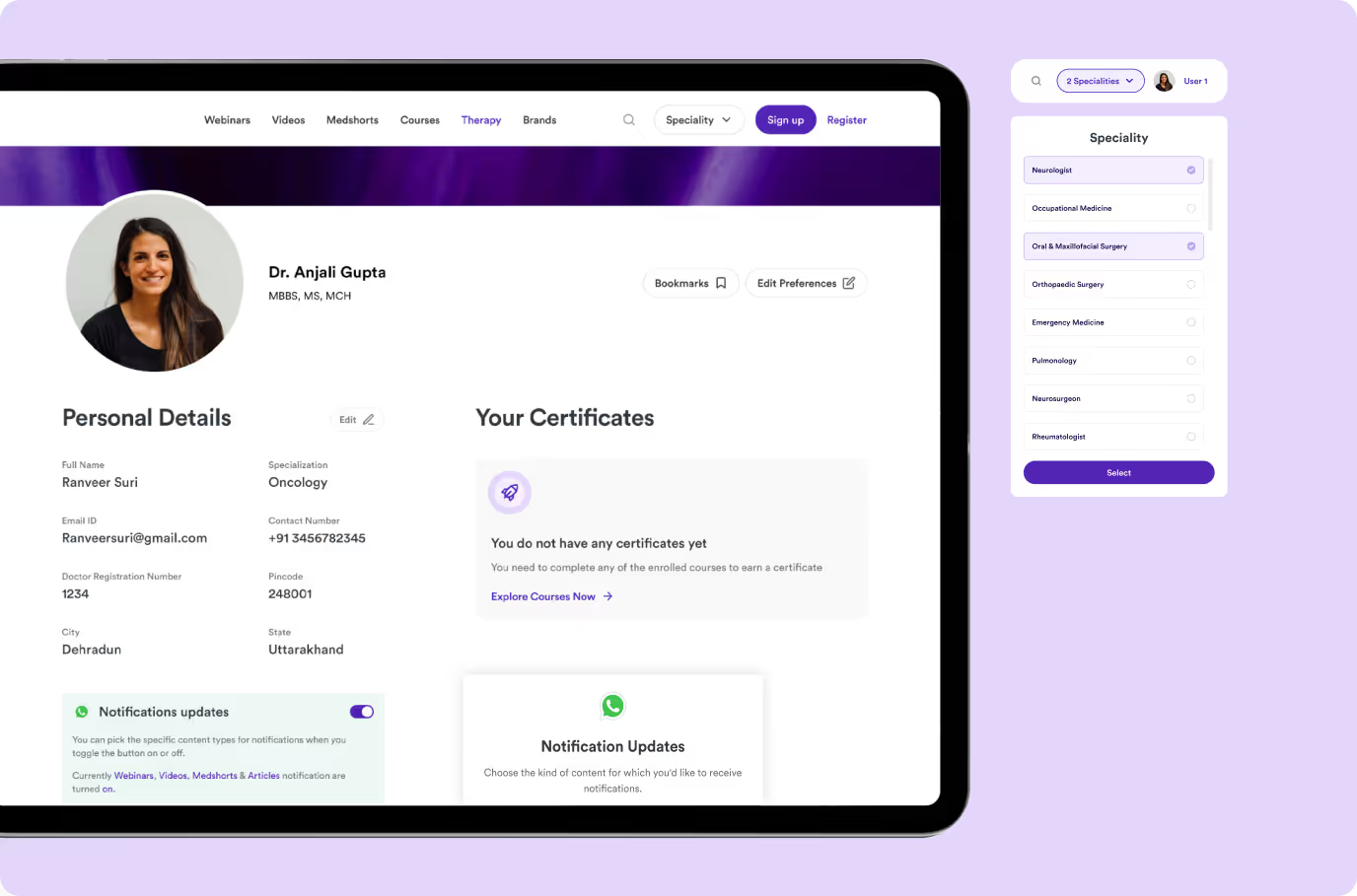
All content is now managed in one place. Search is filtered by speciality and relevance, so healthcare professionals see only what’s current and approved. This improves accuracy and supports regulatory consistency across global markets.
The user experience is straightforward. Returning users keep their preferences and access levels. New users onboard easily and find what they need without extra support. Authentication is simple. That clarity removes friction and increases completion rates. For healthcare professionals, this means better access to critical information without losing clinical time.
On the back end, content teams now follow one publishing workflow with built-in version tracking and transparent approvals. Review cycles are faster. Ownership is clear. Audit readiness is automatic. Editorial and regulatory teams have the visibility they need without slowing things down.
Content is organised, keeping HCP-facing content separate from general or patient materials. That structure supports compliance and reduces risk. The platform also enables personalised learning and real-time engagement tracking, giving teams insights they can act on and helping them focus efforts where it counts.
It is a strategic shift in how regulated content is created, managed, and delivered. It reduces operational risk, accelerates delivery, and ensures critical updates reach the right people at the right time. Most importantly, it gives healthcare providers more time to focus on care, while staying aligned with evolving clinical and regulatory standards.
Conclusion
Accurate information must reach the right people without delay. Even high-quality content becomes ineffective when hidden behind inconsistent systems or fragmented workflows.
We didn’t just improve the look and feel of a learning platform. We rebuilt its foundation.
By removing barriers to access and delivery, we’ve created a system that supports faster learning, smoother operations, and more confident learning and decision-making.
Content reaches the right users faster. Internal teams work efficiently, with greater visibility and control. Every element of the system is designed to support clinical relevance and long-term maintainability.
This is what a healthcare learning platform should deliver as standard. If we expect healthcare professionals to keep up with what matters, we owe them the digital systems that don’t slow them down.
.avif "Product microsites in regulated medical publishing")
Product microsites in regulated medical publishing
Medical and pharmaceutical brands manage multiple and complex portfolios. Each product comes with its claims, market approvals, disclaimers, and regulatory frameworks. Content must pass through legal, medical, and regulatory (MLR) review. Every change must be versioned, timestamped, and audit-ready.
As portfolios expand, shared content systems become harder to maintain. Publishing slows down. Review cycles overlap. Ownership becomes unclear. Microsites address this by assigning each product its own publishing space, review structure, and compliance boundary.
For organizations operating across multiple markets and indications, microsites are a practical, scalable model for regulated publishing.
Content, compliance, and the risks
Different medical products follow different rules. Some products need a prescription, while others can be bought over the counter. Each type has its own rules. Products are also approved at different times in different countries. A product might be ready for launch in one country but still waiting for approval in another. What you’re allowed to say about a product often depends on where it’s being sold.
This means the content has to be customised for each country, not just in language, but also in who the message is for, like patients or healthcare professionals.
Adding to that, the review process is different for each market. It usually involves several teams, including medical, legal, regulatory, and safety (PV) experts, and each team has its role in approving the content.
Regulatory frameworks such as FDA 21 CFR Part 11, the EU Pharmacovigilance Directive, and the ABPI Code of Practice govern how content must be reviewed. When these requirements are managed through a shared CMS without clear boundaries, the risk increases. Promotional material may be shown to the wrong audience. Outdated claims may remain live. Audit logs can become harder to interpret when tracking unrelated products, regions, or approval flows within a shared CMS.
Shared CMS setups break under regulatory pressure
Enterprise CMS platforms can technically support multiple products within a shared system. But the complexity of it increases with scale. As the number of products, regions, and teams grows, so does the friction.
Common issues include:
- Global queues blocking region-specific updates
- Shared components triggering unintended review across products
- No clear separation between promotional and regulatory content
- Audit histories that require manual filtering
- Changes in one product trigger a compliance review for others
In our experience, microsites help to reduce these points of failure. Each product is governed independently. Review cycles are focused. Updates are not delayed by unrelated releases.
More on individual product microsites
Microsites allow each product to operate within a clearly defined environment. This enables regulatory workflows and reduces operational complexity.
1. Review cycles scoped to the product
Medical, legal, and regulatory teams work in focused review tracks. Microsites reduce overlapping cycles by isolating review tracks to specific products, limiting cross-dependencies where possible.
2. Market- and audience-specific access
Microsites allow content to be routed by geography, language, and user type. Healthcare professional content stays gated. Country-specific versions are easy to manage.
3. Version control and audit trails
Each product site maintains its log of changes, approvals, and published content. Regulatory teams can trace review history without filtering through unrelated materials.
4. Campaign velocity
Teams can launch product campaigns, respond to PV updates, and roll out localised assets without cross-team dependencies. Microsites help implement safety-related content updates faster by isolating product-specific workflows, essential for meeting regulatory deadlines for safety communications or black box warnings
5. Scoped permissions
User roles are assigned per site. Different market teams gain clarity on what they can manage, review, or approve, reducing errors and bottlenecks.
This model aligns with how publishing is managed and enforced in regulated environments.
Case study


We partnered with a pharmaceutical company that manages a large portfolio of both consumer-facing and prescription products, spread across multiple regional markets.
One of their top-performing medical product was published within a shared CMS, alongside several unrelated products. Over time, this setup became a bottleneck and introduced risks to compliance and publishing speed.
During the discovery period, several issues became clear. Content for healthcare professionals and the general public was combined without a clean separation, raising concerns about regulatory compliance and audience targeting.
Even small content changes required technical support, which slowed down routine updates. Approval workflows varied between teams, and there was no reliable version history to track. The legacy structure of the site contributed to slow performance.
To address these challenges, we rebuilt the product site as a dedicated microsite.
This new setup enables the creation of product and market-specific editorial workflows that align with medical, legal, and regulatory (MLR) processes. We introduced audience-specific routing so patients and HCPs would see only the content intended for them.
A new component-based design system was created, making it easier to update and reuse components consistently.
We introduced scoped user roles for editorial, legal, and regulatory teams. Each group had clear responsibilities and permissions, reducing confusion and delays during the review process.
The result was a self-contained, compliant publishing environment. Teams now update content faster, reviews are more focused, and the publishing process no longer depends on unrelated product timelines.
The new system mirrors the way regulated content is managed internally and gives teams the flexibility to work at their own pace while staying fully aligned with compliance standards.


Designed for regulated publishing at scale
Microsites work across product categories, regulatory environments, and regions. They support country-specific claims, parallel campaign launches, product-level audit logs, timely pharmacovigilance (PV) updates, and versioned releases tied to local approvals.
Importantly, microsites do not operate in isolation. They integrate easily with your enterprise stack. Microsites can connect to existing systems such as:
- Your DAM (Digital Asset Management) for storing and reusing approved elements.
- CRM platforms for managing customer and HCP engagement
- Single sign-on (SSO) tools for secure access and role management
- Analytics platforms and tag managers for tracking site performance and behaviour
This allows you to maintain brand-level control while giving product teams the flexibility to publish quickly and accurately.
Microsites also support local market ownership. Country teams can manage their versions of a product site while global teams retain oversight of branding and approved claims.
This also simplifies the handling of language, legal, and regulatory differences. Rollouts can be staggered, with one country going live at a time, based on local readiness and market approval.
Shared enterprise CMS platforms still have a place. They can support brand identity, central user access, and global asset libraries. But when it comes to regulated publishing, microsites provide the structure and independence needed to reduce delays, avoid compliance issues, and scale effectively across teams and regions.
Conclusion
The publishing system affects launch timing, regulatory response, review capacity, and cost. When product lines expand, the gaps in shared platforms become harder to manage. Teams wait on each other. Review cycles overlap. Visibility into what’s live and approved becomes harder to maintain.
From our experience developing microsites for medical content, this approach supports scale by allowing each product to run on its track while staying aligned with brand principles and identity. It improves workflow clarity, reduces cross-product risk, and makes regulatory review and launch faster and more controlled across markets.
Wherever a product is launched, the process remains fast, consistent, and compliant, with the site meeting regulatory and market expectations from day one.


AIaaS has changed, here’s why it matters
We always wanted machines that could think. What we got instead were machines that listen. Not perfectly, not like us, but close enough to change everything.
The strange part is how quickly it stopped feeling strange. One year you're typing into a search bar, trying to guess the right keywords. Next, you're in a live conversation with something that doesn’t sleep, doesn’t blink, and doesn’t forget. And it's not just ChatGPT or Claude or Gemini. It's your documents, your calendar, your inbox, your codebase, your CRM. The conversation is happening across all of it. Quiet, constant, and invisible.
People call it agentic AI. It sounds like branding. What it really means is that the machine doesn’t wait for instructions. It takes a prompt and moves. Refund the item. Notify the customer. Update the CRM. Adjust the inventory. Schedule the follow-up. No buttons. No workflow triggers. Just finished tasks, one after another, like falling dominoes. And when something breaks, the AI adjusts. Not always perfectly, but often enough to feel real.
This isn't automation. It's delegation. That’s the shift. And once you see it, it’s hard to unsee.
This is the new AIaaS. Less about models and more about momentum. Built not just to reply, but to carry work from start to finish. Let's read more about it.
AIaaS: how businesses adopt AI without starting from zero
AIaaS lets organisations use artificial intelligence without building everything from the ground up. Instead of training custom models or managing infrastructure, teams can access ready-made tools from platforms like AWS, Google Cloud, Azure, and IBM Watson. These tools offer machine learning, language processing, document analysis, and fraud detection through APIs or simple interfaces.
This approach is already changing how different sectors work. A finance team can flag suspicious transactions using a pre-trained model. Legal departments can sort documents by case type automatically. Healthcare providers can manage appointments using a conversational assistant. These services fit into existing systems without requiring major development or investment.
The real benefit is simplicity. There’s no need to set up infrastructure, wait through long implementation cycles, or build in-house AI expertise. AIaaS is designed to get results quickly, letting teams focus on outcomes instead of the technology behind them.
Types of AI as a service
AI is moving from simple automation; the companies making real progress are investing in solutions that match how they already work.
Retrieval-Augmented Generation (RAG) is one of the most used approaches. It helps AI deliver accurate responses by extracting data from trusted sources.
- Static RAG uses internal content for consistency
- Dynamic RAG pulls from live external sources
- The hybrid RAG does both, switching based on the task, and can be further enhanced by integrating knowledge graphs with RAG for deeper context and accuracy.
This setup supports legal helpdesks, customer portals, and internal tools where accuracy is critical.
Agentic architecture allows different AI agents to plan, act, and verify results in sequence. These modular setups are ideal for workflows that require reasoning, validation, or escalation. Aeldris is an example of a platform that supports this kind of structure.
Multi-Channel Processors (MCPs) let systems receive input through voice, chat, or forms. They support flexibility in how users interact with AI, especially in customer-facing or multilingual environments.
Agent-to-Agent (A2A) communication allows agents to pass tasks to each other. This keeps workflows going without resets, especially in long or multi-step processes.
Voice and text assistants are the layer most users see. These assistants do more than chat; they book appointments, file requests, summarise documents, and complete domain-specific tasks using the logic and data behind the scenes.
Model training and fine-tuning come into play when prebuilt models do not meet the mark. Customising models like LLaMA AGASensures they align with business data, languages, or workflows.
Business consulting for AI integration helps organisations choose the right use cases, map AI to real decision points, and measure impact across speed, accuracy, or cost.
They are working systems already in use, already solving real business problems. The shift is underway. And this is what it looks like.
Why prediction is no longer enough
Most current AI services are reactive. They classify, complete, and summarise while working well for static, one-shot tasks.
But what about:
- Filing an insurance claim that requires multiple checks and steps?
- Drafting a legal response that draws from three different databases?
- Guiding a user through a health decision based on changing symptoms?
In these scenarios, prediction, only systems break down. They lack memory, can’t adapt, and don’t understand what the task is.
To solve this, AIaaS is evolving into agentic infrastructure: systems that plan, use tools, track progress, and adjust when the unexpected happens.
What reasoning agents do differently

Reasoning agents are designed to complete tasks with structure, logic, and memory. Instead of giving a one-time answer, they move through a process step by step, using context and available tools.
Tracking progress
Agents keep track of what’s done and what comes next. This structured reasoning uses internal memory or "scratchpads," like in GPT-4o on ChatGPT and Claude, allowing them to handle complex, multi-turn tasks more reliably.
Evaluating how well RAG systems perform is becoming critical; frameworks like Ragas help measure contextual accuracy, relevance, and completeness.
Using tools mid-task
They don’t rely only on what they’ve seen. Through APIs, databases, and live search, agents can act while working. ChatGPT’s function calling and Perplexity’s web access are strong examples of this in action.
Making decisions step by step
Reasoning agents don’t rush to an answer. They pause, check, and respond based on what’s already known. This is key in areas like onboarding, finance approvals, and legal reviews, where each step depends on the last.
Adapting to change
If something shifts mid-process, agents can adjust. Platforms like Gemini and Claude support longer interactions that allow reasoning across changing inputs.
Reasoning agents work through tasks, with memory, tools, and logic. In AIaaS, this is not a bonus feature. It’s what makes systems reliable, usable, and ready for real business impact.
Why this shift matters beyond the backend
In 2024, a Capgemini survey of 12,000 consumers found that 58% use GenAI tools like ChatGPT, Gemini, and Perplexity for product and service recommendations, up from just 25% the year before.
During the same year’s holiday season, Adobe Analytics reported a 1,300% increase in AI-powered search referrals to U.S. retail sites.
These users are leading indicators of where digital behaviour is heading. They tend to be younger, higher-income, and more engaged, and their journeys now often begin inside a conversation with an LLM:
“What’s the best coffee machine under $200?”
“Plan a weekend trip that’s quiet and close to nature.”
These agents aren’t just model endpoints. They’re becoming decision-making interfaces, and that means your AIaaS strategy now shapes both how internal systems operate and how customers interact with your brand from the very first question.
The rise of SOM: what LLMs think about your brand
To track this new dynamic, marketers and researchers have coined a new metric: Share of Model (SOM).
SOM measures how often and how favourably LLMs recommend your brand, based on real user prompts.
Unlike traditional metrics like Share of Voice (SOV) or Share of Search (SOS), SOM is a model-facing. It reflects what LLMs reason through when they try to solve a user's task.

Jellyfish’s Share of Model (SOM) platform tested prompts across ChatGPT, Gemini, Perplexity, and others, revealing striking differences in how LLMs surface brands.
- Ariel (laundry care) had a 24% SOM on Llama, but less than 1% on Gemini.
- Chanteclair appeared prominently on Perplexity but was absent from Meta’s LLM.
- Lincoln showed strong human brand recall, but did not surface in most LLM responses, likely because its messaging emphasises aspirational qualities, while LLMs prioritise functional relevance and task resolution.
These differences highlight a key shift: LLMs don’t simply index popularity; they select what helps resolve a prompt. That means brands must think beyond attention and start optimising for AI reasoning paths.
LLMs don’t index. They decide. And if your brand doesn't help them resolve a task, you won't be recommended.
LLMs as agents: where AIaaS and brand discovery meet
Here’s the connection: the LLMs behind ChatGPT, Gemini, and Perplexity are fully realised AIaaS platforms.
They work through a few key parts:
- How they understand and respond
- How do they use tools?
- How do they remember things?
- How they learn and improve
These systems are built to reason across context, trigger external actions, and respond to evolving intent. They function as thinking agents, capable of handling multi-step workflows and decision paths.
This highlights what AIaaS now supports: not just predictions, but agents that complete real tasks. Whether they’re guiding a customer to a product or powering internal operations, these agents now sit at the centre of how businesses interact, respond, and deliver outcomes.
Benefits and challenges of AIaas
Instead of building everything from scratch, companies access powerful models and agents through cloud platforms. They connect via APIs, pay as they go, and get instant access to the latest improvements without managing the infrastructure.
The benefits are clear:
- Speed: What once took months to build can now be tested and launched in weeks.
- Flexibility: AI tools can be added to workflows for search, support, automation, or content generation. Real-world implementations like QED42’s machine learning layer on Slack show how AIaaS enhances team communication and internal workflows.
- Cost savings: No need for large internal AI teams or heavy infrastructure.
- Scalability: Services like OpenAI, Google Cloud AI, AWS AI Services, and Azure AI offer powerful, production-ready capabilities.
- Advanced features: Many platforms now support tool use, memory, and step-by-step reasoning, making it possible to build agents that do more than answer; they complete tasks with context.
But AIaaS also comes with real challenges:
- Customisation limits: Out-of-the-box tools often fall short in domain-specific tasks.
- Integration issues: Legacy systems, inconsistent data, and unique workflows still require engineering effort.
- Privacy and compliance: With sensitive data flowing through third-party services, concerns around GDPR and local data laws are rising. See OECD’s AI risk report.
- Vendor lock-in: Once a company builds around a provider, switching can be difficult and expensive.
- Security and oversight: As agents take on more responsibility, the need for transparency, explainability, and monitoring grows. Read more from NIST’s AI risk framework.
AIaaS has opened the door for faster, smarter development. But scaling it responsibly means going beyond easy wins.
Conclusion
A lot of the focus in AI used to be on speed. How fast a model could respond, how cheap it was to run, and how well it could be tuned to answer a question. And sure, that still matters. But what matters more now is what AI actually does. Not just replying, but doing. Slowly, we’re moving toward systems that take initiative.
These agents remember what happened earlier. They plan the next steps. They connect to APIs, trigger CRM workflows, and adapt when something changes. And this isn’t theory anymore. It’s already showing up in production. Platforms like Aeldris are helping companies bring agents into finance approvals, legal work, and internal operations.
Governments in Singapore and the UAE are building agent-driven systems for healthcare and public services. South Korea is putting national investment behind reasoning-based AI programs. Amazon and Shopify are using agents to run support, logistics, and storefronts. Stripe uses agents to power customer service. IKEA is using them behind the scenes to make operations smoother.

A year ago, AIaaS was about responding faster and cutting costs. Now it is about giving systems memory, reasoning, feedback, and the ability to actually carry things out.
The global shift toward cloud and AIaaS increased fast after 2020, as covered in QED42’s piece on post-COVID cloud adoption. That shift laid the groundwork for everything we're seeing now.
In my view, this is one of the most important changes in how we interact with technology. We are not just building smarter tools. We are starting to build systems that work alongside us. That raises new questions about trust and accountability. But it also opens up real opportunities to rethink how work gets done and who does it.
We’re seeing agents that specialise in legal, finance, and business tasks. Agents that work together, passing tasks between them. Agents that reflect a brand’s voice and decision-making style. And a new kind of digital presence, where being inside the model could matter as much as ranking in Google search.
The big question isn’t just what the model can say.
It’s what the agent can figure out and actually do.
And that, to me, is where things start to get interesting
Frequently asked questions
What is AI as a Service (AIaaS)?
AIaaS is a way for businesses to use advanced AI tools without building everything themselves. It offers features like chatbots, language understanding, and image analysis through cloud platforms. You can access these tools through APIs and start using them quickly.
How is AI as a Service (AIaaS) different from SaaS?
SaaS gives you complete software, like email or project management tools. AIaaS gives you specific AI abilities that you can add to your systems. It focuses on things like understanding text, making predictions, or automating tasks.
What are some of the best AI as a Service (AIaaS) platforms?
The most popular platforms in 2025 are OpenAI, Google Cloud Vertex AI, Microsoft Azure AI, AWS Bedrock, and Anthropic. They offer powerful models, easy-to-use tools, and the flexibility to build smart features into your existing workflows.

How AI helps legal aid become the first responder
A woman is handed an eviction notice and told to leave by tomorrow. A teenager receives a court summons without explanation. A single parent loses access to benefits after filling out the wrong form.
None of these situations begins with a request for legal representation. They begin with confusion, urgency, and a need for direction. But legal aid teams — no matter how dedicated — can’t always respond in real time.
The way legal support is delivered still depends on limited capacity, outdated workflows, and rigid hours. Intake doesn’t scale with demand. Urgency isn’t always recognised. Help often arrives too late.
What’s changing now is the infrastructure. Not the mission.
Legal aid remains the responder — the one interpreting, advocating, and showing up.
But with the right systems in place, it can respond faster, smarter, and earlier.
This is where AI fits in. Not as a replacement. As a system that helps legal aid do what it’s meant to do, when it matters most.
Why traditional systems fall short
Legal aid nonprofits were built to fill gaps in access. But those gaps have widened, and existing systems haven’t kept pace.
Severe staff shortages and burnout
Staffing is thin across the sector. Attorneys and support teams are stretched across urgent caseloads, underpaid compared to the private sector, and often managing both client work and internal operations. Burnout is constant, and hiring is slow.
High demand and unmet legal needs
Millions qualify for help but never receive it. Nonprofits are forced to triage: turning away eligible clients, taking fewer cases, or offering only partial support. The need is overwhelming — and growing.
Outdated, disconnected systems
Many legal aid organisations still rely on fragmented technology: paper forms, legacy case management systems, static websites, and unintegrated CRMS. Intake, updates, and documentation take more time than they should, and errors are common.
Poor digital experience for clients
Websites are often inaccessible — not mobile-friendly, not multilingual, not ADA-compliant. Intake forms break. Confirmation messages don’t arrive. Clients, many already facing barriers, find themselves dropped or stuck.
Unequal access across regions
Some regions have no legal aid presence. Others have offices, but limited expertise. Clients in rural or underserved areas face long delays or no help at all.
Complex intake and eligibility processes
Before clients even speak to a person, they’re asked to complete long forms and supply extensive documentation. Many drop off. Staff then spend hours reviewing incomplete data or manually checking eligibility.
Limited access to specialised knowledge
Cases like immigration, elder abuse, or housing discrimination require niche legal skills. Few nonprofits have specialists on staff, meaning generalists handle complex matters, or referrals fall through.
Funding and administrative burden
Grant cycles fluctuate. Reporting requirements are burdensome. Time spent chasing funds often pulls staff away from legal work.
Lack of data visibility
Without integrated systems, organisations struggle to see what’s working — or where they’re falling short. That limits improvement, funding, and impact measurement.
Language and accessibility gaps
Non-English speakers and disabled clients often face even greater barriers. Many legal aid orgs lack translation support or accessible design, leaving already-marginalised communities excluded again.
These challenges aren’t new. But they don’t have to stay unsolved.
.avif)
How AI helps legal aid act faster, smarter, and earlier
Legal aid doesn’t need automation for its own sake. It needs systems that help teams respond with clarity, at scale, and in time to make a difference.
AI can support that shift, not by replacing people, but by removing the friction that slows them down. From intake to research, triage to follow-up, purpose-built AI agents are helping legal aid teams operate with more speed, precision, and confidence.
The result? Faster answers, clearer insight, and more capacity where it matters most.
Smarter search: semantic understanding of legal needs
Legal questions rarely begin with legal terminology. Clients ask:
“Can they make me leave?”
“What does this letter mean?”
“Do I have to go to court?”
Semantic Search agents go beyond keyword matching. They understand intent, follow context, and search across documents, policies, and templates — even when queries are vague or incomplete.
Legal aid teams use these agents to:
- Find relevant precedents and case law
- Quickly access client- or jurisdiction-specific guidance
- Surface the right form or filing rule — without manual digging
Clients get answers faster. Staff spend less time scanning folders.
Conversations that adapt, not collapse
Simple forms can't handle complex questions. And when people drop off mid-intake, follow-up becomes harder and costlier.
Conversational AI enables dynamic, multi-step dialogue. These agents understand nuance, handle follow-up, and maintain context across interactions — all while staying grounded in your real data and governed by built-in safety guardrails.
Legal aid organisations are already using these systems to:
- Triage housing and benefits requests after hours
- Guide users through complex eligibility steps
- Route multilingual clients to the correct next action
They don’t replace human staff — they hold the conversation open until staff are ready to step in.
Reading what others miss
Legal teams often deal with PDFS, scans, handwritten notes, and inconsistent formats. It’s time-consuming and easy to miss critical information.
Document Analyst agents extract, interpret, and contextualise information from structured and unstructured content.
They’re already helping legal aid teams:
- Accelerate contract and case document reviews
- Improve accuracy in eligibility verification
- Reduce human error in data extraction
- Spot patterns across complex or fragmented files
From compliance to intake, these agents turn documents into decisions.
Enhanced research, safer systems, better outcomes
These agents also strengthen what happens behind the scenes:
- Enhanced case research capabilities support lawyers with faster precedent identification and citation
- Efficient contract and document analysis cuts review time and risk
- Confidentiality-preserving access ensures that staff can search and retrieve the right information without compromising privacy
- Everything operates with human-in-loop safeguards — so staff remain in control, while AI handles the heavy lifting
Built for real-world legal operations
Every Aeldris agent runs on a unified, purpose-built AI console with enterprise-grade security, user-level permissions, flexible APIS, and live retraining feedback loops.
From no-code configurations to developer-level integrations, legal aid teams retain full control over how agents behave, respond, and evolve. Audit trails and governance protocols come built-in, ensuring compliance isn’t an afterthought — it’s embedded.
These systems aren’t prototypes. They’re designed for organisations that can’t afford mistakes.
Just as important as performance is transparency. That’s why leading teams are also measuring:
- Response accuracy across topics and formats
- Client feedback on clarity, usefulness, and tone
- Auditable logs that show how decisions were made — and allow teams to improve them
- Bias checks and fairness reviews, ensuring systems reflect real-world diversity, not just statistical averages
In legal aid, trust is earned through care, clarity, and constant review. AI is no exception.

Getting started: precision over scope
Start where the need is highest
Don’t automate everything. Start where volumes are high and rules are clear—evictions, wage claims, family law.
Northwest Justice Project began with a single issue and expanded after field validation.
Share what works
In Chicago, the Lawyers’ Committee for Better Housing developed an eviction-focused AI assistant now used by seven organisations in three states. Shared systems reduce duplication and accelerate progress.
Partner where it matters
Programs like Pro Bono Net’s Legal Empowerment and Technology Fellowship pair legal aid teams with technologists to co-develop AI systems that reflect local needs, not generic templates.

What comes next
Legal professionals aren’t being replaced, and they shouldn’t be. But the systems around them are changing. Not with abstract automation, but with clear, focused upgrades that help legal aid respond before legal problems escalate.
In the coming years, we’ll see AI helping legal aid organisations:
- Triage urgent cases without relying on staff availability
- Recognize risk patterns before escalation
- Understand clients who don’t speak the legal system’s language
- Free up time by eliminating repeat intake and redundant document handling
The next wave of AI in legal aid is about deploying intentionally, where demand is high, timelines are tight, and human judgment remains essential.
That includes paying attention to human-centred design, making sure systems are accessible, multilingual, and usable in low-connectivity environments. Because many of the people who need legal aid the most are also navigating compounding barriers: disability, language exclusion, rural isolation, or digital inexperience.
We’re already seeing what that looks like in practice:
- In Nairobi, legal aid teams using AI-assisted WhatsApp triage saw a 31% increase in follow-through among first-time users
- In British Columbia, AI intake tools helped match more clients with appropriate pro bono support by flagging nuanced eligibility
- In Manila, a child protection helpline used AI to escalate mobile-reported risks in under an hour, preventing intervention delays
- In rural Montana, SMS-based AI intake allowed clients without internet access to start cases for the first time
These aren’t test cases. They’re part of how legal infrastructure is being rebuilt around responsiveness.
AI is not the first responder. But it’s helping legal aid become one.
Conclusion
Legal aid doesn’t need a new mission. It needs systems that keep up with the one it already has.
AI is not the first responder, it never will be, but it is what helps legal aid become the first responder — in every language, every jurisdiction, every format.
Not by making decisions. But by helping people get heard sooner, and helping legal professionals step in better prepared.

AI Agents for smarter business solutions
A self-driving car moves effortlessly through busy streets, noticing traffic lights, pedestrians, and everything around it. It processes all this in real time, deciding when to stop, turn, or speed up, just like a human would.
Similarly, an AI agent taking care of your everyday tasks. Let’s say it’s booking your flights. It looks at your calendar to figure out the dates, remembers your preferences for seats and flight times, finds the best options, handles the payment, and books everything for you, all without you lifting a finger.
This is the essence of an intelligent agent: systems that observe, think, and act independently to achieve goals. From Siri answering questions to Netflix recommending your next favorite show, these agents seamlessly integrate into our daily lives.
Thermostats adjusting room temperature, or robots managing supply chains, intelligent agents bridge the gap between automation and intelligence.
In the business world, AI agents handle repetitive tasks, freeing teams to focus on what truly drives progress, acting as reliable partners, uncovering insights in seconds that humans might miss.
In this blog, we’ll see how they help businesses move faster.

History
The development of AI agents began in the 1950s and 1960s when pioneers like John McCarthy and Alan Newell created systems that could reason and make decisions.
In the 1980s, expert systems emerged, using predefined rules to mimic human decision-making.
By the 1990s, research focused on intelligent agents that could act autonomously, leading to multi-agent systems where agents worked together to achieve shared goals.
From the 2000s onward, advancements in machine learning and increased computing power enabled AI agents to improve their ability to perceive, reason, and learn, allowing them to operate effectively in dynamic and complex environments.
By 2024, AI agents automate complex tasks and enhance workflows with improved reasoning and autonomy. Companies like Google are deploying AI agents to tackle complex problems effectively.
What are AI Agents?
AI agents are intelligent systems designed to operate independently, taking on open-ended tasks that require planning, decision-making, and adaptation.
They can gather information, make choices, and perform actions, all while working towards loosely defined goals and learning over time, as well as adapting to their environment, which makes them capable of solving complex, real-world problems.
This ability to sense, think, act, and learn sets AI agents apart.
They enable businesses to automate complex processes and achieve results with minimal human intervention.

Why are they called Agents and not tools?
The term “agent” reflects their autonomy and decision-making abilities. Tools are passive—they rely on humans to operate and make decisions.
AI agents actively observe their environment, make independent decisions, and act to achieve specific goals which enables continuous operation and adaptability without constant human checks. Calling them agents emphasizes their role as partners in achieving outcomes.
How AI Agents work
AI agents operate in a simple, repeatable cycle to deliver value: they start by understanding their environment, analyze data to decide the best action, carry out that action, and then learn from the results to get better over time.
For instance, they might gather information from customer queries or sensors, use advanced models to predict outcomes, take actions like answering questions or automating workflows, and then improve by learning from what worked and what didn’t.
1. Perception: understanding the environment
AI agents collect information from various sources, such as customer queries, databases, or IoT sensors on factory floors. They interpret this data to understand what’s happening in real time.
2. Decision-making: finding the best next step
With advanced algorithms and models, AI agents analyze patterns, predict outcomes, and determine the best action. For example, a retail AI might forecast demand and adjust stock levels.
3. Action execution: doing the work
Based on their analysis, AI agents step in to act—whether answering a question, automating schedules, or adjusting factory equipment to prevent downtime.
4. Learning: Improving Over Time
AI agents learn from every action and result. They improve their ability to spot patterns, adapt to new challenges, and deliver more accurate outcomes with every cycle.

Why AI Agents matter for growing businesses
The real strength of AI agents lies in their ability to simplify operations, automate workflows, and deliver accurate results.
For growing businesses, this means less time spent troubleshooting and more time innovating. Teams can make smarter decisions faster, solve problems efficiently, and scale operations without added complexity.
Businesses already using AI agents are seeing measurable results: reduced costs, better resource allocation, and improved customer experiences. As systems learn and adapt, their value only increases over time.
Real-world business use cases
AI agents are increasingly utilized across various industries to address specific challenges and drive business growth. Here are some real-world applications:
Customer service
AI-powered chatbots and virtual assistants provide instant responses to customer inquiries, automating routine tasks and allowing human agents to focus on more complex issues.
For example, AI agents can handle tasks such as password resets, order tracking, and basic troubleshooting, enhancing efficiency and customer satisfaction.
Healthcare
In the healthcare sector, AI agents analyze patient data to predict critical conditions, enabling early interventions.
AI-driven diagnostic tools can detect diseases like cancer and cardiovascular conditions by analyzing medical images and patient records, improving patient outcomes.
Finance
Financial institutions employ AI agents for real-time fraud detection by monitoring transactions and identifying suspicious activities.
For instance, AI systems analyze transaction patterns and user behavior to prevent unauthorized transactions, enhance security and reduce financial losses.
Manufacturing
In manufacturing, AI agents utilize predictive maintenance by analyzing sensor data to foresee equipment failures, allowing for timely interventions that reduce downtime and maintenance costs. This proactive approach ensures continuous production and operational efficiency.
Cybersecurity
AI-driven cybersecurity systems continuously monitor network traffic to detect and neutralize threats before they can cause harm.
These systems can identify anomalies and potential security breaches, providing a robust defence against cyberattacks.
Retail
Retailers leverage AI agents to analyze sales data, predict consumer demand, and manage inventory effectively. By forecasting trends, AI helps maintain optimal stock levels, reducing instances of stockouts and lost sales, thereby enhancing customer satisfaction and profitability.
These applications demonstrate the significant impact of AI agents in enhancing efficiency, decision-making, and customer experiences across various sectors.
Future
AI agents are transforming industries in 2024.
Companies like Telstra, Bunnings, and major banks in Australia are using AI solutions to improve customer service, boost productivity, and streamline operations. Telstra’s AI tools, Bunnings' "Ask Lionel," and Macquarie AI Chat are just a few examples of this shift.
Banks like ANZ and NAB are adopting AI to save time and enhance workflows, while resource companies like Rio and BHP are focusing on efficiency and sustainability.
Looking ahead, the global AI agents market is projected to grow significantly. Estimates suggest that the market size will expand from $5.1 billion in 2024 to a remarkable $47.1 billion by 2030, reflecting a Compound Annual Growth Rate (CAGR) of 44.8% from 2024 to 2030.
As AI agents continue to evolve, they are set to become integral to business operations, driving efficiency and growth across various sectors.

Conclusion
For years, the idea of systems working alongside people to handle business tasks seemed out of reach. The real challenge was creating technology that could take on responsibilities independently and reliably.
Today, this is changing. Just as apps revolutionized smartphones, AI Agents are transforming how businesses get things done. With better understanding and memory, they simplify workflows and make processes faster.
They handle repetitive tasks, analyze data quickly, and offer insights to guide decisions. By fitting into existing workflows, they make processes smoother and help teams get more done.
In the future, these agents will do even more like- anticipating needs, suggesting strategies, and working seamlessly across systems. This allows businesses to focus on creativity and big-picture goals while routine tasks run in the background.

AI search assistants—turning complex queries into clear answers
Everyone with a phone in hand, or even just a thought in mind, is always searching for something—whether it’s a recipe, directions to a new café, or the answer to a work question.
Searching has become second nature. But finding the right answer? That’s a different story.
This is where AI search assistants step in.
Instead of scrolling through endless links or sifting through irrelevant results, they interpret intent, adapt to your needs, and deliver answers that are clear, accurate, and actionable.
For years, AI has been part of our lives, recommending videos, optimizing photos, and suggesting replies. But now, AI truly understands. Search is something we all rely on, whether out of curiosity or for everyday tasks.
In this blog, we’ll discuss the need for faster, more accurate, and contextual search assistants, how they improve efficiency and real-world use cases. We’ll also touch on privacy and security concerns and explore what the future holds for AI search technology
What is an AI search assistant?
An AI search assistant is a system powered by artificial intelligence that helps users find accurate and relevant information quickly. By understanding the intent behind your queries, it provides precise, actionable answers without relying on basic keyword matching.
Using natural language processing, AI search assistants can interpret complex questions and deliver responses tailored to your needs, making searches more efficient and intuitive.
This technology streamlines the process of finding information, saving time and helping users access the data they need faster, whether for personal or professional use.
It figures out the meaning behind your questions and finds the most useful answers, like a search that actually gets you.
The importance of AI search assistants in business
Businesses have a clear challenge: getting the right information when they need it most.
Whether it’s a doctor searching for clinical protocols or a lawyer looking up case laws, a lot of time is wasted going through scattered, irrelevant results.
The problem isn’t about having enough data, there’s plenty of that. It’s about making information work smarter.
Search systems need to understand the intent behind a query, recognize the industry-specific language, and deliver answers that are clear, accurate, and useful.
As organizations grow, so does their data, spread across various platforms. What should be a quick search turns into an endless task, draining time and slowing down decisions.
The bottom line?
People need information that finds them, not the other way around.

AI-assisted search solutions
AI search assistants overcome these limitations by offering intelligent, context-aware solutions tailored to specific needs:
Semantic search
Semantic search understands the meaning behind your query. Instead of matching exact keywords, it considers intent and context. For example, searching “treatment options for chronic back pain” identifies therapies, medications, and specialists for long-term pain management.
It works by using natural language processing (NLP) and machine learning to provide accurate and meaningful results.
Image search
Image search uses AI to analyze visual content, shapes, colors, and patterns, to deliver precise results. For instance, searching “green running shoes” brings up images of shoes that match the color and category.
It helps users find products, designs, or references faster by understanding what’s in an image.
Predictive search
Predictive search suggests results as you type by learning from past searches and behaviors. For example, if you often search for “vegan recipes,” typing “vegan b…” might show “vegan brownies” instantly.
This saves time and anticipates what users need.
Personalized search
Personalized search delivers results tailored to your preferences and history. If you’ve been shopping for “winter jackets” on a retail site, it might prioritize jackets in future searches.
By analyzing activity and behavior, it offers a custom, user-centric experience.

Federated search
Federated search gathers results from multiple sources into one organized list. For example, in an enterprise system, searching “quarterly sales report” might pull data from emails, databases, and shared folders, saving time and centralizing information.
Knowledge graph search
Knowledge graph search links related information to uncover deeper insights. Search “Leonardo da Vinci” and you’ll see his works, inventions, contemporaries, and historical context, all connected.
It helps users explore relationships between data points and gain a broader understanding.
Natural language search
Natural language search allows users to search conversationally. For example, asking “Where can I buy affordable hiking gear?” returns relevant stores and products without needing exact keywords.
It works by interpreting intent and understanding human-like queries.
Digital Asset Management (DAM) search
DAM search helps users quickly locate files like images, videos, or documents by analyzing metadata and content. For instance, searching “summer campaign video” in a DAM system surfaces the correct video file by recognizing tags, dates, and descriptions.
It streamlines file management and saves time.
How AI search assistants work
AI search assistants stand out by understanding context and user intent, ensuring every query delivers the most relevant information. Here’s how:
Custom search indexes
Industries can build their search catalogs to meet unique needs. For example, a healthcare company can prioritize clinical guidelines, research papers, and protocols in its search results.
Smart ranking and sorting
AI ranks and organizes results based on what matters most. For instance, a search for “asthma treatment” delivers the latest research and updated guidelines first.
Industry-specific context adaptation
AI understands the relationships between terms in different industries:
- Healthcare: Links symptoms, treatments, and outcomes.
- Legal: Highlights case laws, statutes, and legal documents.
- Education: Focuses on learning materials, curriculum plans, and performance data.
Testing and refining for accuracy
Organizations can test the search system before rolling it out. This ensures results are precise and meet expectations.
Future ready and scalable design
AI search systems evolve with time. They learn from how people use them and can integrate with new tools or platforms as businesses grow.
Industries that can benefit from AI search assistants
AI search assistants work exceptionally well in industries with complex data needs:
- Healthcare
AI search tools enable healthcare professionals to swiftly access clinical research, treatment protocols, and patient care guidelines. The NHS has utilized AI to diagnose COVID-19 from chest imaging and assist in dermatology referrals, streamlining diagnostic processes.
- Legal
Lawyers benefit from AI by quickly retrieving case laws, statutes, and legal references. The legal industry's technology spending is projected to increase from $26.7 billion in 2024 to over $46 billion by 2030, reflecting a significant investment in AI tools to enhance legal research and workflow automation.
- Education
Educators utilize AI to efficiently access curriculum plans, learning materials, and student performance data. AI technologies are increasingly used in clinical education, with 58% of trainee doctors perceiving a positive impact on their training, indicating AI's role in improving educational resources and training efficiency.
- Media management
Content creators leverage AI to locate images, videos, and digital assets effectively. The global AI in media and entertainment market was valued at $14.81 billion in 2022 and is expected to reach $99.48 billion by 2030, growing at a compound annual growth rate (CAGR) of 26%.
AI search assistants are valuable across different industries. In e-commerce, they help users cut through product overload by refining search results based on what they actually need, making it faster and easier to find the desired products.
In nonprofits, AI search assistants simplify the process of finding key information, funding opportunities, or program details, helping users quickly access the resources they need.
In essence, AI search assistants enable businesses—whether large or small—to efficiently access crucial information, such as product details or internal documents. These systems quickly deliver the most relevant results.
Data privacy and security
Keeping data private and secure is essential for businesses using AI search systems, designed to handle sensitive information carefully, ensuring teams can work efficiently without compromising trust.

Here’s how they make data security simple and reliable:
1. Keeping data separate
AI search systems isolate each team's data, meaning no one outside the team can access or view it. This ensures information stays protected within its own space. According to a report by McKinsey, 88% of organizations believe strong data isolation is critical to preventing leaks and maintaining privacy in collaborative environments.
2. Secure system connections
AI safely connects with existing tools and platforms, reducing risks during data transfers. For example, improperly secured integrations are a common target for cyberattacks, which cost businesses an average of $4.45 million per breach in 2023, as reported by IBM’s Cost of a Data Breach Report.
3. Following global privacy rules
AI search systems meet strict industry standards like GDPR (in Europe) and CCPA (in California). These rules ensure businesses protect user data and avoid fines. Under GDPR, businesses that fail to comply can face penalties as high as 4% of their annual revenue.
4. On premise and cloud deployment
AI search systems offer two deployment options to suit different privacy needs:
- On-Premise: Data is stored and managed on a company’s servers. This gives full control over security and ensures sensitive data stays within the organization.
It’s ideal for businesses with strict privacy or compliance requirements.
- Cloud: Data is stored on third-party servers(like AWS or Google Cloud) and accessed via the internet.
Cloud deployment is cost-effective, easy to scale, and managed by trusted providers who follow global security standards.
5. End-to-end encryption
AI search systems use end-to-end encryption to protect data during storage and transfer.
This ensures that even if data is intercepted, it cannot be read or accessed without the proper keys.
According to IBM's Cost of a Data Breach Report 2023, organizations using encryption reduce data breach costs by an average of $220,000 per incident, highlighting its role in safeguarding sensitive information.
The future of AI search assistants

AI search assistants are learning to think the way we search, becoming smarter, sharper, and more human in how they respond.
Soon, searching will feel less like sifting through data and more like having a natural, intuitive conversation, where systems not only understand what we’re asking but anticipate what we need next.
For businesses, this changes everything. The endless hunt for files, scattered information, and missed connections gives way to focus, flow, and clarity.
Teams can work faster, find answers that matter, and spend their time building, creating, and delivering.
What’s exciting isn’t just the speed or accuracy, it’s the shift from searching for information to using it.
These systems are becoming quiet partners in the background, helping us move through decisions and actions with ease.
The right answers, at the right time.

Shaping workflows with AI-driven DXPs
Unfindable and unstructured information becomes a valuable resource when organized and made accessible to the right people at the right time.
AI-assisted solutions, such as semantic search, intuitive chatbots, and intelligent workflow support, enhance operations by making data navigable and actionable, ensuring businesses and users can access important information when needed.
AI DXP simplifies the integration of AI into business processes. It offers pre-configured models for specific tasks and flexible settings to adapt to unique requirements. Businesses can customize AI assistants, save time, and reduce costs by reusing existing data indexes. Built-in security ensures chatbots remain protected from misuse.
Ready-to-use SDKs (software development kit) streamline setup, allowing businesses to focus on delivering better digital experiences without being burdened by technical hurdles
This blog explains how AI DXP streamlines AI integration into business workflows, offering solutions like semantic search and chatbot configuration to handle unstructured data effectively, enhance user experiences, and reduce inefficiencies across industries.
What is AI DXP?
AI DXP, or Artificial Intelligence Digital Experience Platform, helps integrate AI into business workflows. Built for practical implementation, it simplifies setup and ensures seamless integration, accommodating teams across varying technical expertise.
The platform currently supports two main features: Semantic Search, and Chatbot (RAG), both tailored for contextual user interactions. Its future roadmap includes agent-based capabilities to optimize operational workflows and processes, and make them adaptable to evolving business needs and market shifts.
AI DXP offers a practical approach to improving digital workflows. A unified dashboard allows businesses to manage services, configure settings, and test outcomes before deployment, providing clarity and control throughout the process.
Key features and technology
AI DXP is designed for flexibility and easy customization, allowing businesses to align solutions with their unique needs. Through the initial consultancy phase, we provide expert guidance to help teams define their AI assistant goals, configure workflows, and deploy solutions efficiently.
One of its key features is semantic search, which enables users to find relevant information without relying on exact keywords. The team can customize this by adjusting settings like embedding models, and choosing between third-party or QED42-hosted options. The platform also includes advanced contextual chunking—breaking long content into smaller, meaningful parts while preserving the relationship to the overall content. For simpler tasks, cost-effective chunkers are also available, and teams can preview and adjust results before going live.
AI DXP allows teams to create custom-configured AI-powered chatbots that integrate seamlessly with the existing platform. With a curated list of AI models, teams can fine-tune chat prompts and set up security guardrails to ensure bots are reliable. Reusable data indexing helps save time and costs by repurposing existing indexes for chatbots.
The platform’s technology ties everything together. Analytics provide insights into query success and response accuracy, helping businesses refine their solutions.
Use cases
AI DXP provides benefits for industries that handle and harness large amounts of information, extracting and making the best use of data to support teams and other platform users. Here are some use cases:
Legal
AI-assisted solutions can help legal professionals find case files and clauses accurately and faster by searching through large document libraries with natural language processing (NLP). Small law firms can upload case files and use AI to quickly find precedents, saving time and making research easier. Lawyers can ask, “Show me cases where a breach of contract was upheld in New York State.” The platform highlights relevant rulings and key arguments.
Healthcare
Patients can quickly find health information that fits their needs, cutting search time. Hospitals use AI to help medical teams find clinical guidelines faster, making care more efficient. Doctors can ask, “Find me the record of that one patient who had leukaemia last December" and instantly receive accurate, context-aware results. AI DXP’s semantic search interprets queries in natural language, reducing the time spent sifting through documents manually.
Insurance and claims
AI-assisted solutions can help banks, hospitals and insurers quickly search and access reports, policies, or any information they need at the moment. In health insurance, queries like “Does the policy cover pre-existing conditions for diabetes?” retrieve policy-specific insights, reducing manual review time.
Nonprofits
Nonprofits can quickly find reports, grants, and insights, reducing errors. Volunteers also get easy access to training and guidelines when needed. Queries like, “What are the safety protocols for working in disaster zones?” or “How do I log my volunteer hours?” Indexed training manuals provide clear, accurate responses. AI DXP has the potential to help non-profits centralize critical resources, improving efficiency in volunteer onboarding and support.
Looking ahead
As AI DXP evolves, it will make integrating AI into business workflows more practical and reliable, keeping humans at the core as an important ethical principle.
The upcoming updates and new features in the product roadmap will streamline the process of connecting the platform to existing solutions, making them more contextually relevant for a wide range of industries. This will also ensure faster and more efficient deployment.
Offering seamless on-premise implementation as an option, alongside new capabilities like agent-based automation, personalized content delivery, and real-time analytics, thoughtfully designed to address complex business, digital, and workflow challenges. These features will help teams solve complex tasks, deliver relevant content, and save time, enabling them to focus on leveraging their human expertise.
As AI DXP evolves, the shift towards more plug-and-play solutions will allow businesses to quickly implement AI features with minimal setup. Well, looking ahead, AI DXP is designed to be a practical technological asset that grows alongside the needs of businesses, not just in line with trends. Get a closer look—with a scheduled demo.

AI document assistant for modern workflows
Every day, professionals come across an overwhelming amount of information. Reading, analyzing, and reviewing this information is a constant challenge in industries where precision and speed are important.
An AI document assistant addresses these challenges by sifting through diverse content—from text to visuals—identifying key takeaways, integrating with internal systems and platforms like blogs or other content repositories.
This assistant supports teams by harnessing and understanding information based on their precise queries, doubts, and needs of the moment, reducing errors, saving time, and improving the overall operational workflow.
This blog explains how AI Document Assistants help professionals manage complex information by simplifying tasks like retrieving, analyzing, and summarizing content. It also outlines the practical uses and features of QED42's AI document assistant.
Challenges
Modern workflows demand systems that simplify complex information into actionable insights. Professionals simply need fast, accurate access to critical details across diverse industries, from patient records to financial reports
Users operating within many industry systems require fast and accurate access to critical information, whether it’s patient records, legal documents, financial reports, or academic materials. These users need systems that can handle large volumes of information, integrate seamlessly with their existing platforms, and provide relevant insights when needed to support decision-making.
A 2022 report by Coveo found that employees spend an average of 3.6 hours daily. This further proves that the need for advanced AI-assisted solutions is undeniable.
By understanding the problem and researching how professionals and users in specific industries work, we created an AI document assistant that’s simple to use, responds quickly, works well with current workflows could be scaled as needed. It helps save time, reduces mistakes, and supports people, especially those who depend on web-based information.

What is an AI document assistant?
AI document assistants are smart, practical solutions that help people find, understand, and work with information from different types of documents, like PDFs, Word files, and spreadsheets, as well as content like text, tables, and pictures.
They use advanced technologies like natural language processing (NLP) and vision-language models (VLMs) to simplify how questions are asked and answered.
NLP enables systems to process and understand human language by analyzing text or speech. It allows AI to interpret questions, commands, or any form of language input accurately.
VLMs are trained on extensive datasets, enabling them to extract meaning from complex visual and textual elements, even when explicit text is absent. They combine visual and language understanding to handle tasks like interpreting charts, images, or documents with minimal cues.
The AI document assistant, designed and built using these technologies, is for people who deal with large amounts of information, helping them make sense of it quickly and find what they need.
With evaluation systems designed to assess content relevancy, contextual understanding of the language model, and predefined response boundaries with guardrails, they ensure answers are accurate and relevant.
Designed to meet diverse industry needs, these assistants simplify everyday tasks by adapting to varied document formats and user contexts.
While AI Document Assistants can be powerful, their performance depends on how they are designed and where they are applied. For instance, not all assistants can work effectively with tables or images unless they are specifically built for those tasks.
Many systems allow conversational interactions, but the usefulness of their answers often depends on the quality of the source data, how well the system is designed, and the clarity of the user’s questions. Some assistants may not include advanced features like reliable fact-checking or deep contextual understanding, as these safeguards vary across implementations.
It's important to make sure the document assistant is built thoughtfully and its capabilities align with the complexity of the tasks it is meant to handle and the specific needs of the industry it serves.

Implementation and practical use
AI-Doc Assistant is built to address the specific challenges people face when working with extensive and complex content repositories. Its features are designed to make information accessible, actionable, and usable
Enhanced accessibility
For industries like finance, healthcare, legal, and life sciences, where important information is often stored in dense PDFs or unstructured formats, the assistant simplifies the process of finding, extracting, and understanding data. From regulatory filings and clinical trials to legal documents, it helps transform static content into valuable resources.
Tailored industry applications
The assistant’s NLP capabilities are adapted to industry-specific terminology, ensuring it meets the unique needs of professionals in finance (audit reports and compliance), healthcare (clinical guidelines and patient records), or education (research papers and academic material).
Collaborative data insights
When connected to organizational content repositories, the assistant ensures that important information becomes available to teams across functions, supporting cross-functional collaboration and informed decision-making without requiring domain expertise.
The AI document assistant shows its impact across industries—healthcare professionals can retrieve patient records from scanned files, legal teams can locate specific clauses in case files, and financial analysts can identify trends in regulatory filings—all with greater efficiency.
We are running pilots to develop systems that simplify navigating extensive documents, convert static PDF archives into searchable repositories, and extract actionable insights from complex content.
These efforts focus on making important information easily accessible across teams and other users as needed, whether for compliance, reporting, strategic planning, operational execution, or collaboration on shared goals. This ensures organizations can streamline workflows, address bottlenecks, and make better use of their data.

Why it works
As AI document assistants are designed and built to handle complex document tasks with accuracy, adaptability, and speed, their strength lies in providing clear, meaningful results that align with user needs. The main reason why this solution works is:
- Contextual understanding
It processes data in a way that aligns with the meaning and intent behind user queries. This ensures the information provided is relevant and precise, even when working with detailed or unstructured content. - Flexibility
It supports a variety of formats, including PDFs, Word documents, handwritten notes, and scanned images, making them suitable for content of every shape, size and type across industries. - Efficiency
By automating essential tasks like summarizing documents, identifying key details, and organizing information quickly and accurately, these assistants allow users to focus on decisions and actions. Anyone who works with information daily understands the importance of this.
Those who work with information daily understand how much these capabilities—contextual understanding, flexibility, and efficiency—shape their ability to handle diverse tasks and respond to unexpected demands. The time saved can be redirected toward strategic initiatives, creative problem identification and solving, or addressing high-priority challenges.

Potential
The AI Document Assistant and information-harnessing solutions change how people interact with information; here is data from surveys and reports illustrating their impact across industries.
In healthcare, AI Document Assistants can help manage administrative tasks, which often take up to 30% of a professional's time, allowing more focus on patient care and clinical priorities.
In finance, they can assist with the analysis of audit reports and regulatory filings. McKinsey reports that AI solutions may reduce document processing times by 45–50% and improve accuracy by over 30%, helping professionals identify trends, risks, and opportunities more effectively.
In education and research, AI solutions can filter and summarize dense academic materials, with PwC studies indicating productivity gains of up to 25%.
Our research and understanding of the legal industry suggest that AI-assisted solutions can help streamline the review of contracts, compliance documents, and case files, with additional use cases continuing to emerge.
According to the American Bar Association, over 60% of legal professionals spend substantial time on these tasks. AI tools have the potential to improve efficiency by up to 40%, freeing up time for strategic work and client interactions.
The true value of these solutions depends on how thoughtfully they are used.
The real question is not what the technology can do, but how it can be shaped to serve genuine human needs.
A good approach is focused on understanding the specific challenges and workflows in which AI Document Assistants and similar solutions can be applied.
Engaging directly with users to identify pain points, testing solutions in real-world scenarios, and iterating based on feedback are critical steps.
The next steps should prioritize collaboration between technology providers and end users to bridge the gap between potential and practicality.
This ensures the technology is functional, genuinely useful, intuitive, and aligned with the goals of those who rely on the platform and use the solution.
Looking ahead
The changes coming in with artificial intelligence, guided by human imagination, are redefining how we access, harness, and interact with information.
Whether we call them assistants, solutions, or agents, the goal remains the same—to support people (us humans) in navigating complexity with ease and make our lives simpler (professional and personal).
AI Document Assistants, including QED42's solution, help professionals and other users manage information efficiently and adapt to the demands of an information-rich environment.
When thoughtfully implemented, This and other similar solutions have the potential to become our partners—enablers for people to focus on collaborating effectively with clients and colleagues, ensuring precision in tasks that demand human expertise, and dedicating time to priorities efforts that contribute to both personal growth and team success.
.avif "The case for centralized content systems in modern digital strategies")
The case for centralized content systems in modern digital strategies
As businesses grow, so does their digital presence. This often involves launching multiple websites and platforms to support new products and services or address different market segments. Many businesses manage these sites with separate systems, creating a fragmented content management system (CMS).
A fragmented CMS can be defined as a system where content is spread across multiple disconnected platforms that do not work well together. This makes accessing and managing content inefficient, resulting in duplicated efforts, inconsistencies, and increased complexity in workflows.
As a result, collaboration between teams becomes difficult to sustain, often leading to internal challenges that make scaling digital presence and operations more demanding.
These disconnected systems also lead to the creation of content silos—isolated pockets of information that are difficult to share or synchronize. Content silos increase operational costs and demand significant resources to manage multiple systems.
This blog addresses the problems caused by fragmented CMS setups, details the benefits of adopting a centralized content management system, and provides actionable steps for making the transition.
What is Centralised Content Management?
Centralised content management is an approach where content is created, governed, and maintained in a single system and then distributed across multiple digital channels from that one source.
Instead of managing separate copies of content across websites, mobile apps, campaigns, and internal platforms, teams work from a shared content hub. This hub acts as a single source of truth, ensuring that updates, approvals, and governance rules apply consistently everywhere the content appears.
In a centralised model, content is structured and reusable. The same core content can be delivered to different channels without duplication or manual rework. Access controls, workflows, and publishing rules are defined centrally, reducing the risk of inconsistency, outdated information, or compliance issues.
For enterprises managing content at scale, centralised content management is less about a single tool and more about an operating model. It supports consistency, governance, and long-term scalability while allowing teams to move faster without losing control.
The hidden costs of a fragmented CMS
Relying on multiple disconnected content management systems creates challenges that go beyond inconvenience.
Here’s how these issues become tangible obstacles:
Inefficiency and duplicated efforts
Managing multiple CMS platforms demands excessive effort. Routine tasks like content updates, security patches, or maintenance require separate attention for each platform. What should be a simple update becomes a time-consuming and resource-heavy process.

Inconsistent user experience
Visitors navigating between websites may encounter irregularities, leading to confusion and reduced engagement. This fragmented experience diminishes customer satisfaction and impacts overall brand perception.
Escalating operational costs
Each CMS system comes with its own maintenance, licensing fees, and infrastructure requirements. As the number of systems grows, so do the costs, diverting resources from strategic initiatives like innovation and business expansion.
Challenges in scaling
Expanding a digital presence becomes cumbersome. Each new development requires platform-specific customization, slowing growth and increasing expenses, making it harder to meet market demands efficiently.
Missed business opportunities
Fragmentation isolates content and data, leading to missed opportunities. Teams working in silos struggle to respond quickly to market trends, customer feedback, or advertising needs, directly affecting revenue and competitive positioning.

Delayed marketing efforts
Cross-platform marketing campaigns become complex and slow. Lack of coordination between systems and teams leads to delays and missed opportunities, weakening campaign impact and sometimes directly impacting the ROI.
Centralising content management is more than simplifying processes—it is a fundamental requirement for businesses looking to stay competitive and achieve growth.
Centralised vs. Decentralised content management
In a decentralised setup, content is managed across multiple systems or teams. Each platform maintains its own versions, workflows, and updates. This often leads to inconsistent messaging, duplicated work, and slower updates as content needs to be changed in many places.
Centralised content management brings content into a single system where it is created, governed, and maintained. Updates are made once and reused across channels, helping teams stay aligned and reducing manual effort.
Governance is another key difference. Fragmented systems make it difficult to apply consistent approvals, access controls, and content standards. Centralised systems enforce these rules at the source, improving clarity, accountability, and compliance.
As organisations scale, decentralised setups become harder to manage and more costly to maintain. Centralised content management is designed to scale across teams and channels while keeping control, consistency, and security intact.
Benefits of centralising your content
- Improved collaboration across teams
Shared workflows and content models reduce duplication and misalignment between teams. - Stronger content governance and compliance
Centralised access control, approvals, and auditability make it easier to meet regulatory and organisational requirements. - Faster time-to-market
Content updates and launches no longer require repetitive changes across multiple systems. - Omnichannel delivery from a single source
Create content once and publish it consistently across websites, apps, and other digital touchpoints.
Features to Look for in a Centralised CMS
When evaluating a centralised content system, enterprises should look beyond basic publishing capabilities and focus on features that support scale and governance:
- Headless and API-first architecture to deliver content across multiple platforms
- Role-based access control (RBAC) to manage permissions across teams
- Workflow automation for reviews, approvals, and publishing
- Digital Asset Management (DAM) for structured handling of media and files
- Audit trails and governance controls to track changes and ensure accountability
- Integration capabilities to connect with existing systems and tools
These capabilities enable centralised content management to function as a reliable, long-term foundation rather than a short-term consolidation exercise.
How to successfully transition to a centralised CMS
Centralised CMS provides a solution to simplify processes, unify workflows, and prepare for business growth. Successful implementation requires collaboration between technical and business teams to ensure the system aligns with organisational objectives. Here are the steps to approach this effectively:
Conducting a detailed system audit
Begin by analysing your current CMS platforms, workflows, and content assets. This process not only identifies inefficiencies but also reveals alignment gaps between teams using these systems. A thorough understanding of what needs to be migrated, updated, or retired provides the foundation for centralisation.
Defining business-aligned goals
Clearly defined goals should balance business priorities and operational needs. For instance, maintaining a cohesive brand experience might be as critical as enabling faster updates or localizing content for specific markets. Engaging key stakeholders early ensures the CMS serves broader organizational objectives.
Prioritizing scalability from the outset
Scalability isn’t just about technical growth; it’s about creating a platform that adapts to evolving business demands. A system that supports new integrations, content reuse, and seamless expansion will reduce friction as the organization grows.
Establishing a data migration strategy
Data migration requires both technical precision and strategic alignment. While mapping and cleaning data is essential, considering how different teams will interact with the new system ensures a smoother transition. Proper planning for redirects also minimizes disruptions for end-users.

Building for security and governance
A centralized CMS simplifies governance by providing a clear framework for permissions and workflows. Security protocols, like role-based access, ensure teams have access to what they need without creating vulnerabilities.
Testing the system before launch
Testing should include not just technical evaluations but also user testing to align workflows with team requirements. Validating compatibility with existing tools and testing under different conditions ensures the system is ready for real-world demands.
Managing change and training teams
Introducing a centralized CMS requires buy-in from all involved. Training sessions and clear documentation help teams adapt to new workflows while reinforcing collaboration across departments.
Monitoring and optimizing post-migration
Continuous monitoring post-launch allows for refinement based on real usage patterns. Listening to feedback from both internal teams and end-users helps adapt the system to meet ongoing business needs
A case study—ADA’s journey to a centralized CMS
The American Diabetes Association (ADA), committed to improving the lives of people with diabetes, faced operational inefficiencies due to disconnected content management systems (CMS). Their primary website, diabetes.org, operated on Drupal 9, while other platforms relied on outdated systems like Drupal 7 and custom-built solutions. This fragmented setup led to inconsistent branding, slow content updates, and high maintenance costs.
To overcome these challenges, ADA partnered with us to consolidate all their websites onto a single, unified multisite platform powered by Drupal 10. This move streamlined website management ensured design consistency, and enabled faster, more efficient content updates.
By centralizing their CMS, ADA significantly reduced maintenance costs and established a scalable digital infrastructure. This transformation allows the organization to focus on its core mission of supporting people with diabetes, rather than grappling with technological inefficiencies.
Read the full case study for a detailed look at this transformation.

Conclusion
Fragmented CMS is not just a technical problem—it’s a signal of misaligned processes and priorities within a system.
Yes, centralizing content management is a technology upgrade, but more importantly, it’s a solution to align workflows, reduce complexity, and enable teams to focus on meaningful outcomes.
Our association with diabetes.org and other platforms under the management of the American Diabetes Association (ADA) is a testament to how problems can be solved. It also spotlights how businesses can set themselves up for success in the way they envision it.
While the shift requires careful planning, the result is more than worth the effort. It creates a foundation for seamless collaboration, better resource allocation, and a sharper focus on delivering value to users.
The decision is not just about fixing what’s broken—it’s also about building a system that supports and empowers sustainable success.
Frequently Asked Questions
What is centralised content management?
Centralised content management is an approach where content is created, governed, and maintained in one system and then reused across multiple digital channels from a single source.
How is centralised content management different from a traditional CMS?
Traditional CMS setups often manage content per site or platform. Centralised content management focuses on reuse, governance, and consistency across many channels instead of managing content in silos.
When does centralised content management make sense for an organisation?
Centralised content management is most useful when teams manage large volumes of content across multiple platforms, regions, or teams and need consistency, governance, and scalability.
Does centralised content management slow teams down?
No. While governance is centralised, teams often move faster because updates are made once and reused, reducing duplication and manual coordination.
Is centralised content management only for large enterprises?
While it is most common in enterprises, any organisation dealing with multiple platforms, contributors, or compliance requirements can benefit from a centralised approach.

Crafting a digital platform with the power of research to combat gender-based violence with Laaha | UNICEF
Laaha, a UNICEF initiative, is dedicated to enabling girls and women by providing safe and accessible platforms for critical information and services related to sexual and reproductive health and gender-based violence. Their mission aligns perfectly with UNICEF's vision of a world where everyone can live a healthy and dignified life.
In a powerful collaboration, we partnered with Laaha, a beacon of hope for women under UNICEF's umbrella, to redesign and rebuild their digital platform. This project exemplifies our deep commitment to human-centric design.
Guided by extensive research and user insights, we focused on ensuring that girls and women in conflict zones with limited internet connectivity can access crucial information on sexual and reproductive health and resources to combat gender-based violence.
Meeting the client
Our visit to their Geneva office fostered a more cohesive team and significantly improved the project in several ways. Our time there allowed us to leverage UNICEF's resources and delve deeper into user needs. We collaboratively identified pain points and planned a strategy for this impactful social digital platform.
Collaborating with their IT and Tech departments unlocked access to their expertise, significantly enhancing Laaha's development and implementation. This partnership harnessed the collective strength of both organizations, creating a more impactful and effective solution.
.avif)
By interacting closely with the UNICEF team, we gained valuable insights that streamlined our processes, ensured smoother execution, and kept us on track with project timelines. Additionally, their expertise proved instrumental in tackling potential technical hurdles, particularly regarding Laaha's functionality in low-connectivity areas.
The visit also focused on understanding user needs. Through the initial discussions, we gained crucial data on the target audience — women and girls who might benefit from Laaha. This knowledge directly informed the platform's features and functionalities, tailoring them to better meet specific user needs and challenges faced in conflict-ridden areas.
This visit solidified our shared commitment to a meaningful cause. By aligning with UNICEF's vision, we're working together to help women and girls, combat gender-based violence, and make Laaha a beacon of accessible information and support.

Understanding user’s needs
To delve deeper into the challenges faced by Laaha's users, we crafted a comprehensive research strategy. This involved facilitating workshops with stakeholders and users, incorporating a variety of exercises
- User Brainstorming:This session encouraged open discussion and idea generation, allowing users to freely express their needs and frustrations.
- How Might We (HMW) prompts:We posed specific HMW questions to guide the brainstorming process, focusing on potential solutions to user pain points.
- Crazy Eights:This rapid ideation technique helped us generate a large number of potential solutions in a short timeframe.
- Journey Mapping:We collaboratively mapped the user journey to identify key touchpoints and potential areas for improvement.

Through these exercises, we identified
- Goals & Risks for Users:This helped us understand user motivations and the potential barriers they might face when using Laaha.
- Long-term and Short-term Vision:By exploring user aspirations, we could design Laaha to not just meet immediate needs, but also support their long-term goals.
- Essential Features:By prioritizing user needs, we could determine the core functionalities Laaha must offer.
These methodologies, combined with rigorous user testing across various countries, provided a deep understanding of the target audience's nuanced needs and pain points. This rich data informed our design strategy, allowing us to not just meet, but exceed user and client’s expectations by creating a truly impactful platform.

Discovery Report
Building Laaha, a platform for women in conflict zones, hinges on a deep understanding of user needs and potential obstacles. Through various research methodologies, we identified key challenges and risks that guided our design decisions.

Challenges
- Balancing anonymity with session continuity:User research highlighted the importance of user privacy. However, maintaining session continuity for support purposes was also crucial. We knew we had to create innovative solutions to bridge this gap.
- Fostering open dialogue and peer support:Workshops revealed a desire for a safe space where women can connect and share experiences with each other openly. We decided to prioritize features that encourage open communication and peer-to-peer support.
- Prioritizing seamless help access:User interviews emphasized the need for quick and easy access to critical help resources, especially in urgent situations. That guided us focus on an intuitive navigation to ensure these resources are easily and readily accessible to all users.
Risks Identified Through Research
- Sensitive topics:The research confirmed the sensitive nature of Laaha's content. User feedback underscores the importance of handling all information with the utmost care and respect. This guided our thoughts and decisions on content presentation and team Laaha on content creation.
- Prioritizing user privacy and security:User interviews reinforced the absolute need for robust security measures to protect user data. We knew he had to integrate rigorous security protocols into the platform's design and development.
- Ensuring cultural inclusivity:Workshop discussions highlighted the importance of catering to diverse cultures and backgrounds. We conducted further research and involved cultural sensitivity experts to ensure content and features are inclusive for all users.
- Balancing Anonymity with Safety:User research revealed a desire for anonymity alongside concerns about potential safety risks. We're explored innovative solutions to strike a balance between these needs, ensuring user safety without compromising privacy.
By proactively addressing these challenges and risks, we aimed to create the Laaha platform that enables women in conflict zones by providing a safe, secure, and culturally-sensitive space for information access, peer support, and access to critical help resources.
Final thoughts
Our collaborative research with UNICEF for Laaha is complete, and the insights gained are guiding the platform's design and development. Through intensive user studies, strategic workshops, and innovative UX solutions, we've established a clear roadmap for Laaha that is built on an established human-oriented research foundation.
This approach has informed every aspect of the platform, from the user-friendly interface and multilingual support to the integrated forum and chatbot features. Each element prioritizes accessibility, safety, and user-centricity, ensuring Laaha effectively addresses the needs of women and girls in conflict zones.
To learn more about our research methodologies, you can download our discover playbook, with actionable research templates.

Defining UNICEF ShareX with Design
UNICEF, also known as the United Nations International Children's Emergency Fund, is a global organization dedicated to improving the lives of children worldwide. It was established in 1946 to provide emergency aid to children and mothers affected by World War II.
Since then, UNICEF's mission has expanded to encompass a broad range of areas that impact children's lives, making it an essential component of the United Nations system.
Recognizing the crucial role of knowledge, the nonprofit created ShareX, a knowledge management system designed to make its vast information accessible to everyone.To enhance ShareX's user experience, UNICEF partnered with us to conduct extensive research to better understand users' needs and redesign the platform.
Our research process allowed us to identify areas where this KMS could be improved, and we made data-driven changes to make ShareX better for everyone. As a result, we were able to speed up the process of design and make critical improvements, to the platform.
Getting to know the client and the platform
During the initial calls with the client, it became clear that UNICEF was struggling with scattered valuable information across different websites, leading to difficulties in finding what they and their users needed.
The stakeholders shared that — UNICEF faces challenges in making sure that their partners can easily access their technical content and find relevant information. During emergencies, managing a large volume of content becomes a priority. To make it easier to access this information, UNICEF is creating a central place to find technical knowledge about children's issues.
They are also working to make it easier to find products made at the CO/RO level. UNICEF wants to make it easier to find shared materials and reduce the need for multiple sites. Simplifying the content search process across platforms is crucial for improving user experiences and making sure important information can be found quickly.
The kick-off further helped to identify three main problems — information scattered everywhere, lots of repetition, and systems not working together.
With these insights in mind, we created a custom research plan that included fundamental information such as why we chose a specific research methodology and how it would be beneficial.
we started the project by working collaboratively with the client to deliver a simple, centralized, and efficient knowledge management system.
Identifying core problems and user needs
1. Workshops
The Design Workshops were planned carefully to align with the platform's vision and included the Business and On-Field teams from UNICEF. The aim was to empathize with the users, what ShareX should look and feel like, and gain other important insights.
During Workshop 1, we examined business insights and understood users' needs using value proposition mapping. The focus was to strike a balance between what the business aims for and what users expect. Workshop 2 focused on empathy-building exercises, like creating personas and mapping emotional journeys, to gain a deeper understanding of the user experience.
Insights and Outcomes
The workshops helped identify the needs and motivations of primary and secondary users. This led to a better understanding of users' needs in line with the non-profit's goals. Clear statements were created to define Share X's personality, functions, and how it should make people feel.
These statements served as a roadmap for Share X's future, ensuring that it grows in the right direction while adhering to its goals and values.
.avif)
.avif)
Affinity Mapping
Affinity mapping was a highly effective tool that helped us organize and categorize the main ideas by theme. It provided a comprehensive framework for the project, consisting of three axes:
- Functional to Emotional Design
- Fundamental to Distinguishable attributes
- Assumed to Absolute aspects
The first axis, Functional to Emotional design, ranges from practical to emotional design. This axis ensured that the design decisions we made were aligned with the project's overall objectives and priorities while considering the emotional and psychological needs of the users.
The second axis, Fundamental to Distinguishable attributes, spans from basic to unique features. This axis helped us prioritize the key features and elements essential for the success of ShareX and ensured that we focused on the most important aspects of the project.
The third axis, Assumed to Absolute aspects, transitions from things we're guessing about to things we're sure of. This axis helped us gain insights into the project and identify areas that required further research and investigation.
The insights we gained from affinity mapping provided guidance and direction, ensuring that our design decisions were in line with the project's overall objectives and priorities. It also helped us prioritize the key features and elements essential for the success of ShareX.
.avif)
Insights and Outcomes
The insights from the research helped us create a comprehensive UX strategy that was aligned with both the users' expectations and UNICEF's objectives. Our strategy was based on four key actionable insights.
- We aimed to strike a balance between user interest and providing clear and important information.
- We ensured that the platform's purpose and value were easily understandable for everyone.
- We made sure that the platform was accessible to people from all backgrounds.
- We tailored the content based on user's location and needs to make it globally relevant.
We kept in mind these insights while crafting the design that would meet the expectations and goals of the primary and secondary users of the Share X platform. As a result of our efforts, our strategy and design principles were successfully aligned with the objectives of both the users and UNICEF.
.avif)
Shaping solutions
We decided to revamp ShareX and introduce some key features as part of our strategy. These include:
- Advanced Search and Robust Filtering functionality to enable users to navigate multiple sites with ease, using advanced filtering options.
- Customizing the navigation to allow for seamless movement between global and country-level micro-sites, making it more accessible for users.
- To improve content organization, implement a clear and simple labeling system. This was to enable users to differentiate between current and historical content, and we also documented revisions to facilitate this differentiation even further.
Validation and iteration
Throughout the design process, we engaged in a continuous journey of iteration and validation. Collaborative sessions were conducted every week with participation from both developers and stakeholders. Our key priority was to ensure that the designs remained technically feasible, to speed up the delivery process.
Through this collaborative effort, we were able to create an exceptional user experience while remaining aligned with both the user requirements and UNICEF's objectives.
The impact
The key to Share X's success is its user-centered design. This platform prioritizes the user's needs, demonstrating how good design can simplify knowledge management, making it more efficient and effective. The backbone of good design is always good research. By paying attention to users, putting ourselves in their shoes, and making data-driven decisions, we can create purposeful experiences that can help make a real difference in the world.
Download our discovery playbook with actionable research templates!
Dive deeper into our successful collaboration with UNICEF. Read the complete case study — Building Drupal-powered Knowledge Management Platform for UNICEF