All blogs

Redefining digital experiences with an inclusive approach
Designers hold the power to redefine digital experiences that make everyone's life easier. They have the ability to impact design decisions and ensure benefits for users and businesses alike. Designers are always on a quest to show how diverse their teams are and how their designs are not for specific users but for everyone, irrespective of their gender, race, culture, ethnicity, and disability, or impairment. The focus lies in understanding the users and ensuring inclusivity.
Importance of inclusive design
The primary focus of the inclusive design is to ensure that the user experience is for a larger audience. With over 15% of the world population suffering from some form of disability, it bodes heavily on the UX designer to ensure that disabilities don't interfere with the user's ability to access the digital platforms.
An inclusive design approach helps to provide a massive boost to businesses and including inclusive design ensures equal access to everyone. This is something all users are bound to sit up and take notice of.
Most search engines place a greater value on the overall user experience, ensuring inclusivity in their designs. Thus, incorporating alt text for images, having descriptive link texts and closed captions in videos ensure a higher ranking than those pages that don’t incorporate these.
Inclusive design helps to boost sales too since the user experience is diversified enough to include a larger consumer base and users feel empowered to use your design. With the world witnessing a new decade of design, designers are constantly looking to build digital experiences that foster inclusivity.
How to redefine digital experiences through an inclusive approach
In order to ensure inclusivity, it is necessary for the designer to design something that helps increase productivity and usability. Having an inclusive approach throughout the design process enables designers to deliver an optimal user experience. However, along with an understanding of the target user, it is important to follow an organized process to get desirable outcomes.
We bring you 5 ways to redefine digital experience, innovation, and impact change with an inclusive approach.
1. Adequate research
Adequate research is needed to ensure a design isn't created primarily on our own biases. Research ensures more people have access to your design. Now when it comes to human beings, nothing can be termed 'normal' because to each individual, that holds a different meaning. Assuming that every ability and sense is fully enabled causes you to ignore a large proportion of people. Research lets you break down these barriers that lead you to ignore certain groups of people in the first place.
2. Using empathy in design
The first step of empathy is to understand that there are many individuals out there who might not be able to participate in several aspects of society in general. This is why it is necessary to ensure a user doesn't face the same when it comes to the digital experience.
An empathetic approach to design is the root of inclusive innovation. Right from designing audiobooks for the visually impaired to having smart keyboards and apps for the speech impaired, innovators and designers are striving to make the world inclusive and accessible.
3. User involvement in the designing process
The faith of UX is that a user should always be the primary stakeholder, which is why they are supposed to be the focus of all-digital experiences. Connecting with users helps us understand the different groups we are designing for. The idea is to deliver an experience that holds equal value for every user.
4. Ensure accessibility and inclusivity work together
As human beings, we often tend towards being biased. It leads us to believe that others share experiences similar to our own. To completely let go of this bias, it is important to give it time, intention, and adequate exposure to the experiences of people in complete contrast to ours. The only way to ensure this is to make your design both accessible and inclusive because when they work together, the end experience becomes usable to all.
5. Inculcating ethics into your Design Thinking
The idea is to design experiences through experiments with concepts. It is understanding the why before the what and taking into consideration different perspectives before trying to reach a conclusion. Re-structuring based on new insights, ideas, and exclusions helps you consider the users that are missing out on the experiences you're hoping to provide.
Human-led design thinking ensures radical empathy stays at the core. To ensure a long-term impact, empathy must lead the way to all creations. A user needs to be able to experience what the designer is trying to convey through his design. That is how the person will be able to relate to the product and the brand. The power to ensure this experience is both inclusive and accessible solely lies in the designing ethics of the designer.
Using inclusive design to embrace accessibility
By using inclusive design to embrace accessibility we mean – designing a product, service, or device that can be accessed by people having disabilities. While accessibility might not be our only concern, it is an integral component to ensure inclusion.
So, when a design is created, it helps to take into consideration a wide range of users with varying requirements. Working with people who might have certain restrictions to their abilities, allows you to figure out a concrete solution more easily.
Partnering with people for whom you are going to create the product also helps incorporate user feedback. This not just leads to inclusion but provides you with insights into the work you are doing and challenges you might face while doing it. It allows you to stay mindful of all the possible constraints a user might face with your product, thus enabling you to make changes as and where necessary.
Conclusion
Opting for inclusive design can be a great way to ensure your design's user experience takes into consideration a wide range of users from different environments. The primary focus of designers is to improve the overall digital experience and ensure accessibility through a people-centered approach.
To harness the power of an inclusive approach all levels of organizations should come together, collaborate with technology, evaluate with experts and redefine the existing digital experiences with designs that guarantee access to all. Speak with our team of experts about digital experiences that delight users and businesses alike.

Who are we designing for?
Defining user personas through empathy, understanding generations, and storytelling.
A user persona is a fictional portrayal of the ideal person whose goals and characteristics represent the requirements of a larger bunch of people. A persona profile accounts for specific segments of the product's target user base. It mainly narrates demographics, behaviors, motivations, background, and interactions. The process of creating user personas falls within research methodology and if done right it works well for UX design.
Personas work well for UX design because they tell stories, help to see through users, help to understand the interaction between the end-user and end product. They communicate culture, organize and transmit information. More importantly, personas fuel imagination and ignite action that is required to ideate.
A well-defined and descriptive persona successfully explains the needs of users while also spotlighting the importance of features in an interface. The 3 simple points below can help everyone create more descriptive, viable, action-packed, and thought-provoking personas to drive a wholesome product design journey.
1. Empathize like you mean it.
The power of designing for humans lies in empathy. It's impossible to design and build a product without putting in deliberate efforts to understand people's behaviors, frustrations, fears, hopes, motivations, and goals.
User personas can be simplified by creating an empathy map early on in the process. A collaborative focus on this process offers unique insights about people's behavior, helps to understand honest problems and people who are experiencing the problem, creates effective solutions, and eventually helps in creating emotionally resonant user experiences.
2. Understand the ever-changing needs of people and how different generations respond to circumstances.
Alphas are the first generation completely born in the 21st century. They are self-aware, flexible, and have a habitual learning environment. The increased family time is creating a shift in their mindset and values.
The current world scenario has also influenced Alphas’ use of technology to learn, play and interact through FaceTime, Zoom, Skype, WhatsApp, various online games, online school, and e-learning platforms.
So, forget toys this technologically immersed generation demands for gadgets and apps that come with it. Empathizing with their needs can't be avoided as 'gen alphas' are the current and surely the future users of many web products and services.
Gen Z are the ones born after 1996 and fall under the 9-24 age group. They are mainly influenced by social media-born trends and are the main part of social movements amplifying the need for diversity, sustainability, climate health, and mental wellbeing.
When Gen Z are a part of your persona building it's important to empathize with the changes they are experiencing with the current global scenario. They have been put on the spot as they experience a disruption in education and career opportunities. Their behavior is mainly being driven by a sense of protection for the survival of their generation.

Millennials are those who are born after 1981, they are in the 24-40 age group. That means they are completing their education, beginning their career journeys, and also starting families.
They are critics who are driven by deep feelings of wanderlust and an insatiable need for exploration. As they enter middle age their priorities start to change to quality time with their families and chisel out space for themselves.
A Millennial persona can be described as a person who likes to be in control of themselves and question everything he sees and hears. As a skeptic who has high expectations when it comes to apps and websites and needs access to the most functional, usable, self-guided, nuisance-free, efficient user experiences.
Gen X belongs to the 41-56 age group. Gen X is viewed as loyal users and are now seeking effortless digital experiences as they reshuffle the ways to engage with each other, their families, and brands.
They are an extremely busy generation with a sense of courage and resourcefulness. Gen Xers are not afraid of committing to a long-term relationship with one web product that suits their needs and are open to cheerful, playful concepts and that create nostalgic experiences.
Boomers currently belong to the age group 56 to 75. They have either retired or on the precipice of retiring, but don't call them old or expect them to slow down. Between 2012 and 2019, boomers' tech usage grew 59%, which is likely to soar more.
A boomer as a persona is someone who stays at home and as a result, is more exposed to reformative digital tools to connect with people and absorb information. This keeps them entertained and connected, filling the void of in-real-life interaction.

Creating a persona by understanding the ever-changing needs of people and how different generations respond to circumstances helps to tap on the right emotions, trends and provides a real-time reality check to solve their specific problems, remove barriers, or minimize risks for the people you are designing for.
3. Art of Storytelling adds good enough reasons to believe the solution will work out.
Creating a persona needs a great story, this is where the art of storytelling comes in, and who doesn’t like a good story.
To create a story that doesn't fizzle out, here are 5 important folds to connect the unattached dots and convert the personas from mere picture descriptions to an “action figure”.
Establish a goal - Why is the persona using the product? Explain the problem here and the solution that is likely to be achieved with the solution.
Add context - Explain the interaction with the interface and the features that would make this interaction successful?
Let tech stay as human, as compassionate - Avoid adding excessive technical details. Keep the story real and avoid detailed descriptions of the interface that a user wouldn’t interact with.
Add more perspective - Take into consideration all aspects of the users’ way of looking, thinking, and interacting. More perspectives on users’ interaction with the interface help to make more informed design decisions.
End the result like a movie scene - So, what happened to the persona at the end? Was the interaction successful or does your interface require iterations? Describe the result of the interaction here to complete the story of your persona.
Adding the power of storytelling to the persona-building process helps to define interactions based on users' perspectives. A good story gives a good enough reason to believe the concept/solution will work out. Personas bring users into the design team and make them as real and compelling as design concepts and features of an interface.
To Sum Up
Research that comes from the empathy map, an understanding that is derived from real-time circumstances of different generations and efforts put in to create stories create a subtle but extremely important difference between understanding how users would interact with the interface than assuming how users must interact with the interface.
Personas enable decision-making at the highest level. They are highly effective and guide the whole UX design process but at the same time, they can be effectively exercised by different practices like sales, marketing, strategy, planning, human resources, and customer service.
Creating and building personas is teamwork. It is up to the UX researcher to educate the team about personas, UX writers to describe them, and UX designers to illustrate the user dominance it brings to a project and solidify the existence of user personas as a part of the design process.
.avif "Empathetic Approach to UX Design Process")
Empathetic Approach to UX Design Process
Empathy is the ability to understand people and see the world through people's eyes, and it is to step in people's shoes to feel what they feel. It is an intentional attempt to keep aside preconceived notions and uncover the real unspoken needs to truly resonate with the users.
There is a thin line between empathy and sympathy. To not cross that line it is important to understand the differences. Empathy is to feel and share someone's experiences, responses, way of thinking, and way of looking at things. Sympathy is feeling sorrow, pity, and sorry for their troubles.
Empathy in UX design
Empathy plays a critical role in user experience design. If true human needs are not acknowledged, the differences risk compromising design solutions with bias. Research that incorporates observations made in real-life environments, screens, surveys, interviews, and workshops can grasp the several shades of human emotions.
"The better you understand the people who are important for your business, the more you can stand for something fundamentally more important in their eyes”.
— Nigel Hollis, Chief Global Analyst, Kantar Millward Brown.
Different empathy techniques are applied to extract nearly accurate but fair findings, such as storyboarding, what/why/how method, qualitative research methods, ethnography, cultural probe, empathy mapping, and card sorting. Every project has a unique requirement and so it's important to identify which technique/techniques suit the project needs.

Empathy is the first step to build a good design but it is also the outcome. It can be seen in the connection that evolves between the product and the users. For a substantial result — discoveries from empathetic research should be implemented at each phase of the UX design process.
Empathy in the discovery phase — The discovery phase is focused on understanding accurate and mindful information about users to identify the right personas and their stories. Apply the research technique that suits the project needs. Don't rush the discovery phase, findings from this phase are crucial and drive the entire product journey.
Empathy in the strategy Phase — This phase responds to the empathetic findings from the discovery phase with strategies that align with users fluctuating circumstances, needs, and moods to enable businesses and improve user satisfaction with long-term positive impacts such as brand loyalty.
"If we want to be able to retrieve a memory later, you want to build a rich web. It should connect to other memories in multiple ways, so there are many ways for our mind to get back to it."
— Per Sederberg, professor of psychology at Ohio State University.
Empathy in the design Phase — The discoveries from research done from an empathetic point of view drive the need to create immersive and emotionally responsive experiences. Harness the power of findings to get cues for the design concept and solution. If observed carefully these findings also address the right color, layout, type, and content to meet cultural and behavioral needs.

Empathy in the development phase — The objective and the only purpose of technology is not to create economic profit and empower innovation – technology is a way of empowering the people, hence it's important to gain knowledge about people’s behavior, motivations, fears, barriers and empathize with their needs to “tech better” for the future.

Empathy in the delivery phase — Client meetings can be hard and explaining tangible results from time spent empathizing with the users can be harder to explain. Be empathetic towards the needs of the clients to understand how empathy works. Present the results derived from empathic research approaches in each phase when you hand-off the product. It can help them understand the final result in a more meaningful and substantial way.
Thanks to Shelley Evenson, IDEO, Doug Pace, and many more thought leaders, businesses now understand that empathy has the power to heal, understand and solve real problems. It is a part of all the steps that are involved in completing the product design process.
To sum up
Empathy is a really useful tool throughout the UX design process and for making technological progress fair for everyone. The empathetic synergy between designers, developers, agencies and stakeholders/clients can ensure more meaningful, balanced user experiences.
Microsoft, Airbnb, Facebook, Alphabet (Google), Apple, Walt Disney are putting empathy at the forefront to design and build websites, apps, technology solutions, and services. Empathy is also an integral part of their work culture to encourage and support employees. These companies keep users at the center of their decisions, which leads to a better user experience, more productivity, and eventually good business.

Power of Voice Interfaces with Preston So
We are beginning to understand the power of voice interfaces. Power it holds to make our lives easier by creating interfaces that are responsive to things people normally say every day. We are seeing a digital transition from screen to speech dominance. We are moving from interacting with our fingers to the most fundamental human form of contact — "talking" and that's a revolution in making.
In our season one finale, Ep.6 we speak with Preston So, Senior Director, Product Strategy at Oracle about his recently launched book "Voice Content and Usability". Let's listen as he unpacks excerpts from his book, upskilling as voice interface designers, voice interface ethics, and accessibility.
Subscribe to Designwise on Apple Podcast and Spotify.
If you think about Alexa, Siri Cortana, a lot of these devices, you think about who the person is that you're drawing in your mind as you talk to this person. And you're generally thinking about a white woman who is potentially an executive assistant or in a secretarial, which is a very, very sexist way to think about a lot of these voice assistants and really is very, very striking. A very impolite approach or disrespectful approach to treating these voice interfaces that might give lead somebody to think that they can do that in real life as well with somebody who's actually human.
— Preston So
"Voice Content and Usability" is a book that will give you the techniques and insights you need to make voice content tangible—and talkable. Learn from the real-world example of Ask GeorgiaGov, the first-ever Alexa skill for residents of the state of Georgia and one of the earliest content-driven voice interfaces. Get your copy, NOW! Talk to Preston in person and know more about voice interfaces through LinkedIn and Twitter.
Transcript
Priyanka — Hi! Welcome to QED42's podcast designwise. I am Priyanka Jeph and here we are with our 6th episode with Preston so. Preston could be introduced as someone who sits perfectly at the intersection between design and technology. He is a multilingual speaker and can speak more than 8 languages. He is an editor at A List Apart, a columnist at CMSWire, and a contributor to Smashing Magazine. Preston launched and led the Acquia Labs innovation center, directed voice-driven experiences for clients like the State of Georgia and Nestlé. Preston wrote the first and the only comprehensive book which acts as a guide to decoupled Drupal which was launched in 2018. He has also written "Gatsby the definitive guide" which is all set to launch in November 2021, He is currently with Oracle, as Product Strategy Director and today the prime focus of our book will be Preston's recently launched book which is "Voice content and usability". Let's get right to it then. Hi Preston, Welcome to design-wise. How are you?
Preston — Hey Priyanka. I'm doing very well. Thank you so much for having me here today on designwise, it's such a pleasure to speak with you today and talk about some of these amazing things that we've got on the agenda.
Priyanka — Oh! the pleasure is completely ours. So, Preston, the first, uh, and the most important thing that I would like to ask you today is about what we told the audience of designwise, that you've got this perfect balance between design and technology. So how did you get here and what is your story?
Preston — That's a great question, Priyanka and there's a lot of people out there I think that can identify with this sitting in between the worlds of design and technology is something that I think a lot of us have dealt with, especially those of us who work on the web.
I know a lot of people, not only who are part of QED42, but also who listen to 'designwise' are involved in web development and web design. I started out as a web and print designer, which means that I actually began my uh, venture into, uh, web design and graphic design through the print medium and through the web medium, I actually combined my interests in computer programming, which I started when I was very young.
Um, and my experience into beginning to work on web design, and I've really had the opportunity and the privilege to work on all sorts of different sides of the equation when it comes to web architectures, design architecture is especially on the web. Not only have I had my own independent web design studio which is no longer an operation, but I still was going to, I do have a new consultancy today that works on voice interface, design, and things of that nature, but I've also worked for agencies and, uh, consultancy is as well as, uh, the platform side of content-driven architectures as well as software products and SAS products.
So my story is very much an interesting journey because as you can see from the books that you just mentioned Priyanka I've worked on both books that are in the realm of technology directly, really focusing on things like how people build websites with Drupal or with Gatsby, but voice content and usability was just came out last week with a book apart is my first book on design and user experience and specifically voice interface design, which is an area that I've been wanting to write about for a very long time.
And I'm very excited about it not just because it is the first book on voice content, strategy, voice content design. It's also a book apart, my publisher, their first-ever book on voice interfaces in general. So it's a very exciting topic. And I think one of the things that's really difficult obviously is to maintain that equilibrium between the design and technology world. I think we all try our best. However.
Priyanka — So in your book, what is the course of content does it even cover pressing issues like privacy? Siri statistics reveal that it is the most used voice assistant among mobile users. Alexa being a multipurpose assistant has millions of users. Then there is google home, Microsoft Cortana and, according to Microsoft's study which talks about 41% of these voice assistant users are concerned about trust, privacy, and passive listening, so can design help this concern? Is Alexa hearing all our conversations!
Preston — That's a very good question, Priyanka. And let me start by using the case study that really underpins and serves as the foundations for my book, voice content and usability, because this really ties into a lot of the privacy issues that many of us have.
Um, you know, somebody that I follow online, I had the pleasure of sharing the stage with as well. Uh, Sarah and Watson has written extensively and done a lot of work on privacy in voice assistants and conversational interfaces that do operate in voice and, and how it is that we don't pay as much attention to some of these devices.
Um, potentially as much as we do some of the devices that are more visual or have screens. So ASK GeorgiaGov was the very first voice interface for the residents of the state of Georgia here in the United States and it was part of the state of Georgia's efforts to focus on some of the ways in which other people besides web users who might be using voice interfaces like Amazon Alexa or who might be elderly or members of disabled communities want to be able to access content through the georgia.gov website without necessarily incurring the cognitive burden or some of the barriers that come about when you're using a screen reader or you're using a website, um, and would rather use a voice interface that you can have a conversation with.
Now, one of the big issues of course, with these voice assistants is, well, you can certainly imagine situations where it's much more helpful, much more catered and personalized to that user's requirements or their needs at that very given moment based on certain traits you know about the user, for example, knowing their email, their location, their name, um, certain information that might be personally identifiable information or PII could really be useful to helping these, these voice interfaces conduct these transactions on behalf of the user or to serve information or deliver information or content that is relevant to that user.
However, the privacy concerns are very large. And I think, you know, in addition to the really interesting reporting you mentioned Priyanka that there's also the issue of the fact that there have been instances of which, um, Amazon Alexa has been heard to actually be recording conversations that it's not supposed to be privy to, that it's not supposed to have access to.
And one of the decisions that we made at the very beginning of the asked Georgia gov. project for the state of Georgia was to say, okay, we're not going to collect any information it's possible. You know, you certainly could do it. It's feasible, but because of the really big concerns and uncertainty around privacy, the very strong risks that a lot of these voice assistants have when you're potentially handing a lot of this data over to a large corporation, you don't know where it's going.
We opted to not collect location, not collect email addresses, not collect any information that's identifiable about that particular resident or user, even though we could potentially help them much more in a personalized fashion if we had. But I think this really comes into question when you think about all of the privacy regulations that are now coming about, um, not just in Europe and the United States, but also all over the world.
We now have GDPR. We now have HIPAA. We, you know, there's so many new approaches that I think are very important to keep in mind. We've just finished kind of this long process of understanding how privacy really impacts the user experience on a website. Now we're just about to begin the journey of how to understand those things in the context of a voice interface.
Priyanka — So, um, so what I've understand from the whole thing that you've told us that, you know, it's up to a good business, it's up to a designer or a developer to decide how much information they would like to record and, you know in order to be able to help the users. It's something that can be done, it's not that, it's something that can be achieved. So, ya right So the next question is back to basics and something that our audiences of designwise would definitely like to know more from you is what exactly is voice UX and what is the difference between designing for voice UX and on-screen experiences?
Preston — Sure, and you really captured it right there with that last little bit there, Priyanka so the, the thing I will say is that voice user experiences and voice user interfaces and voice interface design in terms of how we think about the universe of user experience today, and the world of design today is a very, very different island. It's really on its own kind of continent over here and one of the reasons for that is exactly, as you mentioned, Priyanka, there's a very big difference between the visual or physical mediums that we work in as designers like screens and mobile devices and wearable technology and televisions nowadays. Um, and the physical interfaces that we use on a daily basis as well, like, uh, computer keyboards and computers and video game controllers. All of these things that mediate our human-computer interaction are primarily tactile or visually rooted interfaces. Of course, voice user interfaces are very different because unlike written conversational interfaces like chatbots or text bots or WhatsApp messenger bots, for example, these voice interfaces, especially the ones that are pure voice interfaces, those that do not have any screen or visual component whatsoever are really unique because as opposed to having something that we can touch or something that we can see or point out or click instead instead It's entirely an interaction that is mediated through the the realm of speech, which means that all of the interactions that we have as users have to take place along the dimension of time and not in a dimension of space as Erica hall notes in her book, conversational design, what are the most important aspects of pure voice interfaces? However, it's also the fact that. Well, context. And what that means is you really don't have the capability to give a user, a visual rendition of a mental model. That is something that's memorable and works for them. For example, I can't give a user, a site map. I can't give a user, a navigation bar. I can't give a user breadcrumb links. I can't give a user even a link itself because there's no way to color, text blue, and underline it in a voice interface. So voice UX is a very, very thrilling, but also very challenging. Uh, area because we have to really remove ourselves as designers and user experience practitioners from the entirety of the world that we've been operating in over the last 50 - 100 years when it comes to these manual and visual interfaces towards more of these kinds of human, organic, and conversational approaches that really distinguish voice interfaces from the others that we work with.
Priyanka — Absolutely. So, um, another thing related to the same topic that our audiences would love to know is, how do you onboard like a new designer from onscreen to voice UX? How do they upskill themselves?
Preston — Absolutely, Priyanka so what I'll say is for those who are looking into getting into voice interface design, especially those who are already operating in web design and user experience design, I actually just had a question yesterday at a talk I gave from somebody saying, oh, should I do XYZ first, is there some kind of foundation I need, but the reality today is that okay, unlike 20 years ago or 30 years ago when designing voice interfaces really required you to have a computational linguistics degree or a very deep understanding of computer science nowadays, there are all sorts of low-code or no-code platforms that are emerging that allow for those who are much more comfortable in tools like photoshop, to be able to use a visual tool that allows you to build the voice interface or a conversational interface. Now, what that means with these, what you see is what you get or wizzy with tools is that nowadays, no designer needs to learn a technology, learn the particularities of standards like voice SSML or SML, um, to really be able to build a chatbot or a voice interface, which really makes this a very compelling new industry for those who are already very well versed in design, or also may not have really gotten into web design and my book, voice content usability actually very much focuses on this later trend that's happening over the past few years for a lot of these conversation design tools to not demand any technical approaches and for them to be more agnostic to some of these approaches, which means that my book doesn't focus on a single technology or a single approach, because all of the principles that I talk about for voice interface, design, like flow diagrams or dialogue writing, or usability testing, apply to all voice interfaces. Regardless of what technology platform you're building So my biggest advice is to find a use case, find something that's interesting to upskill your current toolbox with design and try out some of these tools that are out there, like dialogue flow or bot society, Oracle digital assistant that might give you the ability to design a voice bot or a chatbot that doesn't necessarily require you to write any code whatsoever.
Priyanka — Right. So, uh, this is an in-between question about the book. I mean, uh, comes out of the things that you said that you have all these tools and techniques that designers can practice. So when you were writing the book, I mean, when you thought of this topic that I have to write about this, which was mainly because you worked with this technology for a very long time so how much time did you take to write it and, and what is the process of your research.
Preston — My process when writing books is very unusual and I think this is really one of those things that, um, is a little bit tricky is that I really don't plan out things very far in advance in terms of the actual things I want to talk about the things I want to write. A lot of it is very stream of consciousness. This is how I write all of my articles in my work. I do have usually, some sort of an outline at the beginning, but the book itself really came together, um, through a general sense of what I knew I wanted to talk about in every chapter, you know, basically. Okay. Chapter one is going to be about voice content. Chapter two is going to be about actually taking that voice content into voice chapter three and four are going to be about dialogues and flows respectively chapter five is launching your voice content and chapter six is about the future or the, or the outlook ahead. And, um, you know, I think one of the challenges of course, is that it was during a pandemic and, uh, an ongoing pandemic of course. Um, and I do want to make sure to hold space for everyone that design wise, uh, listeners who are still dealing with this ongoing struggle of ours. But the general approach that I took with the book was just to devote as much time as I could outside of my normal workday to really thinking about these ideas and how I wanted to delve into them. But it's really tough. I think when you're writing a book at the scale of a book of this size to focus on the narrow perspective that an individual chapter has, as opposed to thinking about the big picture and how you want the entire book to go, because you can very quickly lose the forest for the trees or vice versa. Um, sometimes when you write a book and I know that, you know what that's like as a host of a podcast as well.
Priyanka — That's what, like, I think that there are a lot of people out there who have the talent, they want to write. Just that something stops them. It's probably the fear. So this question was really important for them to hear. Right. Um, so what are the things that, um, most people don't know about voice design, something, I mean, are there any unknown insights that you found out why you were working with voice design technology?
Preston — You know, it's really interesting you say that because I definitely think that there are some interesting insights here with voice interface design that are really interesting to keep in mind.Um, the first is that you know, I think that a lot of people think that nowadays, especially with all of these platforms emerging with so many new techniques and so many people getting involved with voice interface, design, that it's kind of a mature landscape that, you know, it's very much as well-developed as the web, but nothing could be further from the truth, uh, in that regard, because voice interface design is still a very, very age fields. And I'll share one example of this from the case study that we did in the book in asked Georgia gov for the state of Georgia. One of the biggest issues that we faced was actually not even the fault of the design that we. And, um, you know, I think one of the things that a lot of people who are web developers or web designers remember is that back in the early two-thousands or mid two thousand, there were a lot of issues with how browsers would use the code that we wrote in order to display certain things. Through CSS. And there were a lot of issues with things like quirks mode, compatibility, uh, box, model hacks, all sorts of things that a lot of us know from working in the web back in those days. Nowadays, of course, the web is so mature that you don't have to worry about any of those things. We're still in those early-stage years when it comes to voice interface design because one example of this is. We worked very hard on the voice interface itself and the application itself that ultimately ended up being an installable Alexa skill for your Amazon Alexa. And there was one result that kept on popping up in the logs and analytics and reports that we built for the Georgia DACA editorial team. And that was a result that kept on coming up over and over again in these 4 0 4 errors.Now, just to give the listeners a sense of what this actually can do is every single time you. With the ask, Georgia gov voice interface. You're really conducting a search across all of the frequently asked questions, content that's available on georgia.gov. So you can ask things like how do I renew my driver's license? How do I get a fishing license? How do I register to become a new. Um, how do I register for a small business loan? How do I register to vote obviously very important topics? Now, one of the results that kept on coming up returned an error, you know, so basically there were no search results returned. The user wasn't able to find any information or content relevant to this topic. Was this particular word, this keyword that kept on coming up in the logs as Lawson's as an L A W S O N apostrophe. Yes. And we had a retrospective about eight months after the. Uh, Alexa skill went live, and people started using it and we found that this really strange word kept on coming up. Why is somebody trying to search for this thing that has absolutely no relationship to anything that is in the state government of Georgia. We thought about it for a long time. And then suddenly one of the native peoples from Georgia in the room, who's lived in Georgia, all her life. If you kind of perked up and she said, oh, you know what? I think that might be somebody who's trying to say. Like driver's license, but it's in a very Southern or Georgia and, uh, dialect or accent. And, and you know, this is not actually the fault of the application. Right? Cause we did usability studies. We did all sorts of research to make sure that it would, uh, go well as soon as we launched it but this is actually an example of where Alexa fell apart or where Amazon fell apart because the underlying. Understanding the natural language understanding mechanism that Alexa was using was not developed enough yet to be able to hear, um, American accents that are not the same as the American accents that it was trained on and if you think about all of the different dialects that people have in English all over the world, you can see how this can become a very big problem very quickly. Now, the other big thing that I will say that, um, didn't really come as a surprise to me, but I think will come as a surprise to a lot of the people in the audience of design-wise and for this book is that I think one of the things that we often forget about. The world of accessibility for voice user interfaces is that voice user interfaces are really intended to accelerate interactions with content or with tasks and transactions that you need to perform. Um, but on the web, one of the big problems and disadvantages of the screen reader, which we use all the time to do this sort of work, is that it is fundamentally a visually worded. Which means that screenwriters rely on the visual structures of websites in order for people who are using screen readers or disabled people, to be able to actually interact with the web a user, you know, the the UI elements or the text that's on a page and so there's a voice interface designer named Chris Miller. Who has written extensively about this and says, you know, I never really understood why it was that people built Sweden meters this way, where it relies on the approach of the web design. In order for content to be delivered in a way that makes sense to the reader user, it should be the other way around. There should be a voice interface that allows for a much more efficient interaction and being a blind person himself. He has a very great, you know, good amount of insight into why it is that people should really think about the fact that. Well, screen readers are kind of the normal or the default way that many of us think about web accessibility, but it's actually still not that optimal or ideal experience for those who really want to be able to have an interaction with a voice interface as disabled users needing to access that content. So I think those two insights were both very interesting to me from the standpoint of, well, you know, voice interfaces are not so ready for prime time, as we think they're not quite ready to beat us at our own game of conversation at the same time. Um, there's also areas where voice interfaces can far outperform some of the things that we already have that are meant for accessibility solutions for disabled communities. So, um I think both of those insights might come as a bit of a surprise, uh, to some of the folks who are going to read my book and also listen to designwise.

Reimagining Typography with Accessibility
Typography is one of the most important design elements of an inclusive digital experience. It is the foundation of an accessible reading experience.
Typography consists of font styles and sizes from different or similar typefaces. It's a part of the design process to place fonts in a way that makes the content clear, readable, legible, aesthetically appealing while conveying the message and emotions as intended.
The wrong choice of typefaces, fonts, hierarchy, and flow etcetera don’t let the users complete the task, or even if they do, it is a “bad user experience". The interface that has been designed to make lives easier turns into a jigsaw jumble of words and why would any designer do that?
Perfect placement of typefaces and fonts in place is not the only solution for people with low vision, cognitive, language, and learning disabilities, aphasia, dyslexia, or low adult literacy. They may still struggle to process the text.
Designing accessible content means more than just making a selection of typefaces, It's about designing with performant fonts that enhance legibility and readability. The below steps are designed to reimagine typography with conscious accessible efforts to make written information as accessible as possible.
- Typeface selection — an accessible typeface is clear, readable, and legible. The trick here is to keep a track of fonts from the initial research, select common typefaces that most people have encountered before, and cast them with the design concept.
- Avoid ornamented typeface families — the fonts that have only been designed with the intent to look good and are difficult to read should be cleared off the list.
- Multiple typeface family and Font selection — if the design concept requires fonts from multiple typefaces, select fonts that complement each other when placed together.
- Prioritize the design — simply saying, hierarchy matters! when it comes to understanding the importance of content in a particular structure, strategize the hierarchy of the content based on their priority and decide the weight of the selected fonts accordingly.
- Use a large enough font size for body text — these steps are relatively close to each other but uniquely important to make sure the body text weight is large enough for people to comfortably read.
- Maintain sizes that promote comfortable reading — again, do it as you prioritized it. If this is messed up you will end up having really small text for the least important copy.
- Maintain space that promotes comfortable reading — Whitespace is important! Clearly define paragraph, sentence, and letter spaces for escalate readability.
- Use headings to communicate the importance — paragraphs after paragraphs are not an internet thing but a novel thing. Understand that headings, bold text, and underlined text at the right place can get your content the attention it needs.
- Ascenders and descenders should be in proportionate height and length — ascenders are lowercase letters like “d, b, or h” who have an upward stroke above the x-height, similarly descenders like “q, p, or j” are the downward strokes below the x-height.
- The ascent should not be taller than the ascender — there should be a visible difference between capital height and ascenders and ideally, lowercase ascenders should not be taller than the capital letter.
- Minimize the occurrence of imposter letter shapes — in some typefaces, some letters are very similar to each other, mainly with characters like “g, q, l, i or 1”. There is nothing wrong with that design unless you use those letters in your design.
- Minimize the occurrence of mirroring letter shapes — its established letters/characters should be easily distinguishable from one another. If a typeface has mirrored letters “it’s time to go back to the first step and change the typeface selection”.
- Avoid symbols — a design that has text that symbols, for example, “Frederick II of Prussia” or “Peter I of Russia” can get easily confusing for people as number “1” or letters like “i or l”.
- Careful use of condensed fonts — condensed typefaces are mostly legible but the thickness of the font doesn’t let the letters have the width they need which makes them difficult to read when they are placed with a small letter weight/height or placed too close to each other.
- Exclamation marks are not friendly to everyone — dyslexic users encounter identification problems with “!” exclamation marks substantially when they are put close to letters like “i, 1, l, or j”.
- Web accessibility guidelines — read the web accessibility guidelines for typography and fonts to ensure that the decision is readable, legible, and clear for all purposes including people and compliance. This step should ideally be followed at the initial and final stages of typography design.
- The aesthetic balance — The overall composition of typefaces, fonts, ornaments, numerals, and symbols should look aesthetically balanced and visually appealing.
The steps in this blog are intended for content clarity, recognition of letters and symbols for everyone. Design processes that include accessibility guidelines and everyone’s needs, other than the only clients’ or designers’ support the needs of people who use the design and ultimately lead to better business.
Accessibility is imperative for building successful, inclusive ethical “user experiences” it includes all aspects of design from - colors, type, layout etcetera.
Accessibility should be a conscious effort from the very beginning and an intentional outcome, not an audit practice. It’s not a separate aspect of design it’s an active part of the design process. Inclusion and accessibility scale design and create a “good user experience” and interfaces that can be used by everyone. As designers, we have to ensure that.

Mindful Design Framework with Devyani M. Lal
Our fifth episode of ‘designwise’ is an honest and raw conversation with Devyani M Lal. Devyani is a design researcher and author of a soon-to-be-launched book ‘Design Thinking, Beyond the Sticky Notes’. In this podcast, we unpack Devyani's attempt to refute a few prejudices we carry when it comes to design, highlight the ‘uncool practices’, and how we as practitioners can improve design practice, design mindfully, and be more responsible towards our decision making while we approach problems penetrating experiences, services, and products. Let's Listen!
Subscribe to Designwise on Apple Podcast and Spotify.
"It doesn't matter which specialization, background, or expertise you have... it's about your ability to work together, tinker together, importantly fail together and get to a common ground and see from there. You build common expertise together. That was an eye-opener at the time...that's when I knew, it's entirely up to me to orient my design practice and hone my skills and even pick up new ones on the way".
— Devyani M. LaL
Design has been treated as a black box; it's been considered to be a closed group only for designers but, today design has traveled to various team members — from engineering, product management, marketing, sales, etc.
Designers should have uncomfortable discussions and face the tough questions about design and the responsibilities of their actions. The role of design amongst practitioners has evolved into the social model of creation that is hardly limited to just design on-screen practice today, through products and services, constantly striving to diversify and co-create with users and stakeholders. This means not only consider users’ needs, age, gender, and profession as primary design considerations but also multiple ranges of human diversity from ethnicity, disability, financial situation, education, sexual orientation, cultural motivations, religious affiliations, etc.
Transcript
Priyanka: Hi and welcome to QED42's podcast, I am Priyanka Jeph and I'm a design writer at QED42. This is our fifth episode and the guest today on the podcast is Devyani M Lal. Devyani is a designer, she's a user researcher and author of a soon-to-be-launched book on design practices. Devyani has conducted many design thinking workshops and has traveled globally to carry out user research for various product and service designs. Today's episode will focus on Devyani's career journey and how she takes us through various notions of design thinking in her soon-to-be-launched book.
Priyanka: Hi, Devyani, welcome to the podcast. How are you?
Devyani: Hi, Priyanka. Thank you so much for having me. It's a pleasure. I'm doing well. How are you doing?
Priyanka: I'm good. I'm good. Um, I'm really excited to have this conversation with you today because, you know, um, I saw you, like, completely immersed in textiles and garments and surrounded with clothes, while we were like in NIFT, and now you're like a well-known user researcher. You've been traveling across the world and identifying user needs. And I mean, your book is getting launched soon. So how did you reach here? What is your story?
Devyani: I was introduced to design back in the late 90s when I was in high school, and design was synonymous to fashion design and all of its grandeur and that initial thought sort of shaped my journey into getting myself into a design school. And I got myself into fashion and textiles. But then out there during the foundation years, we were actually introduced to the origins of design and otherworldly art movements and how design started at Bahouth, even that translation of a basic inspiration into a concept. And that concept is molded into a prototype. That's when the meaning of design sort of changed for me. And when the specialization began, that sort of definition of design became too narrowed and focused. And that aspect of pigeonholing myself as a particular professional designer in textiles, I was not okay with that at the time. And that sort of realization happened very early that this is not my calling, which was very different from my other colleagues who were very certain what they really wanted to do. You know, post graduation like they would see themselves working with some designer or in some design studio. And so, yeah, I already knew that I was not fitting in at that time. So once that happened, I knew that I had to figure that figure my way out. Right. So once I was out there, I was literally like a headless chicken running everywhere. I was open to anything in any project that was coming my way. So I dabbled into graphic design. I dabbled into content development. I even did short films. And so, yeah, like I said, I was doing everything. And that sort of opened my mind at that time, even though they're like there like two schools of thought who do not appreciate this waywardness in a practice, as they appreciate a more focused approach in your practice. So so I didn't know better right at that time. What I felt was that I should just dive in and just see how it goes to figure out what it is I really that I want to do in life. And yeah. So during that experiment phase, I was also pursuing competitive exams for further studies, and that's when National Institute of Design happened, which was like a dream school for me. And it was like a major validation at the time to even get myself a seat there. And that that was that what I would say, that that phase was like a breakthrough in my design journey, because even though I was in a battle, again, like, you know, you would expect, oh, it's in the middle of a master's. She's right there.She would have figured it out. Right. But no, that didn't happen for me even then. So I was again clueless as to what was going to be my design practice. But then the foundation was a very, very, what should I say, mind-opening experience. They didn't just teach us about design foundations. They actually exposed us to the fact that designers really make a difference and they actually have a purpose. It's just not merely built around aesthetics and just functions and how to make things look appealing. It was beyond that we were actually solving problems. And that epiphany sort of built my next series of steps. So even though I was in a misguided specialization of an apparel designer,post that convocation, I again dabbled with some projects, but this time it was more oriented towards research. Because I knew that this is one area that fascinates me and so so so there was this project by my senior, she was heading a research study with Qualcomm and they had designed these series of educational games for children in the age group of four to eight years now, college at first. But at the time we didn't know that then. And she invited me to be part of that is the user study me despite being from an apparel design background. So I was all in I was little. Of course, you are a little nervous, right? But then I got exposed to new research techniques. I got to know more about ethnography, something I just broadly, you know, browse through back at NID. And I got to develop protocols on how to conduct yourself on a field study when you're interacting with such a young age group. So that experience sort of built my core foundation. And that's when the epiphany happened. I do this is something that I can really do and pursue for a long time. And that's how I got myself into user research. And with that experience and and a couple of my research stints, I got I got the opportunity to become a lead at Tata Elxsi. And that was also an interesting experience because I was not only doing broader research that was product or service area, you know, related. It was it was beyond that I was doing research that was targeting public transit systems, research that revolved around healthcare and which was itself a global reserve, which is not just based on an India-focused study. So it took me to China, took me to Egypt, took me to Turkey. That was also an interesting experience in itself. So, yeah, that's where I am today. And this is my design practice, which is design research.
Priyanka: Amazing. I mean, this is such an adventurous journey. And I didn't know all of this. I mean, learning about all of this and realizing the fact that, you know, when you are open to design anything and you understand the true notion of design, the design is for creating solutions and it's not limited to aesthetics. It can actually inspire you to reach levels that you otherwise would not have thought of. So so devyani what I really want to know more about is what is your book about? What's the name of the book firstly?
Devyani: Hmm, my book is Design Thinking Beyond the Sticky Notes,
Devyani: Okay, And it means,
Devyani: it means, So I'll tell you how I came up with the name, so that sort of that's an interesting story to the name sort of came very early to me during this stage of book proposal writing itself, because I was kind of wrapped up with the fact that what it is really that I'm trying to bring on the table that has not been already said on design thinking. And so when I was doing that, being a design practitioner myself who has led and designed many design thinking workshops, I knew that we tend to get attached to the paraphernalia of design thinking. For instance, if you Google design thinking, the first stop image that would pop up is a room full of people surrounded with sticky notes and post its and sharpies, right?
Priyanka: Yes, yes
Devyani: So that's the image I wanted to dissociate my book with. And that's how the name came in, which is design thinking beyond the sticky notes.
Priyanka: Nice that's like, that's like a whole another concept. It actually happens like we've been made to, you know, put sticky notes in everything that we do. Oh, nice. So you were telling me about various workshops that you've done. What kind of workshops? I mean, have you conducted any specific ones that you would like to point out for us?
Devyani: Yeah. So besides design thinking workshops that I would design and conduct for various clients like, let's say Mercedes and Panasonic, who would want to get introduced to the concept of design thinking and how they would be able to apply it during their different stages of their design process or any creative process. So besides that, so I have to tell you about this. So you in the conference, this happened back in 2018. So that sort of began when I met Shaurya Rastogi, he's a UX designer and Meru Vashisht. She used to be my rock star research intern, but now she is a design researcher herself. And I met them when I was a lead designer and researcher at Tata Elxsi. So on a typical coffee session, post work, we were discussing about design and design practices and its aftermath. So Shaurya being a UX designer, would share his thoughts on certain design interventions that have happened in the areas of UX. So, for instance, a more deep diving into human-computer interaction or navigation and interfaces, what really happens and what happens behind the scenes when you're actually designing or coming up with a solution? What is it? What is the idea? So the idea is to basically make life easy for a user, right. To design a solution that is convenient for them. But then but then he gave an example like, for instance, if you're accessing some data on your mobile interface, the idea of just scrolling through is just mind-blowing right. Like it is so easy and it makes you makes the accessible. You can just scroll from one side to the other. And but then he pointed out that over the years there's been a harmful implication of this brilliant design solution. And that sort of put a seed in my head that maybe maybe we can have this open dialogue on where the responsibility of a designer really lies. Does it end after designing a design solution or does it go beyond that? So that conversation triggered something in us, and that's when I pitched the idea of mindful and practices at this conference, so and we designed a workshop around it by developing a series of methods cards on mindful design that we would like to present to certain participants and give them a problem, space or design statement and help them if they can execute these cards in a specific.
Priyanka: So what are these specific mindful design cards? Like, could you give us some examples?
Devyani: Sure , So Post that UX conference thing. I sort of picked these cards up and made them more focused and aligned so that they can actually be utilized not just in a workshop scenario, but even in a workplace setting where you actually are designing and debating on an everyday basis. So I, I developed these cards into basic seven categories, starting with, let's say the context setting, context-setting is is is like a go to right you have to develop a context before you begin anything? So that that category has many prompts that will enable you to have that important dialogue with all your stakeholders, not just you and your design manager or your other teammates. You can actually involve your client to be part of it. So to understand their implicit as well as explicit needs. Right. So now, of course, it has to be beyond the project scope or project brief. So that's what these prompts offer. The next category is called framing. You obviously need to frame your problem space better. It has to you need to know your why?. You need to know your hows. You need to understand all the stakeholders involved. And then comes knowing your audience. Like it says the name, it is about knowing your audience. You need to understand your target group. You need to understand your personas better. You need to understand the current behaviors. You need to, of course, be able to do that journey mapping better. But there is one interesting card that I would like to talk about is called Consider Extreme. So this card prompt allows you to actually consider extreme users in extreme scenarios while you are framing your problems. So it can't be just focused on a specific target group that your client wants. It has to be other extreme users as well. So it basically heightens your sense of empathy. And of course, being a designer, you are somewhat qualified to introduce accessibility in your design solutions. I strongly believe that. So I feel this prompt is really important in your design process.
Priyanka: I am so excited to read the book. I mean. I am sorry to barge in like that this accessibility and the empathy part that we really need to add and the clients also need to understand a part of it you know. So I'm really looking forward to read your book.
Devyani: Absolutely.
Priyanka: So so what are these like? Do you have any live examples of a certain scenario placed like or does it just provide frameworks for different levels and phases of design or there are specific examples of different scenarios that a user is going through?
Devyani: So, for example, when we were mapping this out, so there is another category called impact, so this is where this is an important category because we wanted the role of the designer to go beyond just devising a specific solution or just figuring out areas of design intervention. So this does these categories sort of give you prompts. It gives you triggers. It, in fact, enables more arguments that you can actually have with. So I'll give you the areas that we are talking about. So there is something called. There's a card called Discourse, Debate, Dialogue, so this sort of reloops you back in a conversation. There is also an interesting call, The Conspirator. So, for instance, if you divide it into two and this one is batting for a certain solution or a certain direction and the other one is batting for the other, the conspirator gets the power to play the devil's advocate and sort of take both these solutions through and figured out the alternatives and, you know, discard them. So it's a very powerful card for that person. So, yeah, so if you actually allow designers to play that game. Ok, so the gameplay sort of enables you to deal with these important and tough questions more easily. And that is what I was trying to achieve with certain cards. And there's also another interesting card called the Pro for stigma. So you will know that we are currently going through a very difficult social dynamic Yeah, so so there are issues where dissent has become a problem where so so So what I did was I was tracing how dissent, dissent is happening in creative ways across the world. So I came across an artist who is a French artist. He was actually just on the streets of Paris and he was barking constantly. He was just barking like emulating the sound of a dog or a wolf. And I'm like, literally like who? And more exaggerated. And of course, the audiences didn't know what the purpose was. So his purpose really was at the time, he did not agree with their leaders of their country harping on and on how global warming doesn't exist. So he was equating that with someone who has no idea whatsoever. But then he was giving more. A very interesting twist to the dissent, so I found that very interesting and then I figured, why can't we do that when we are designing? Why can't we ask this tough question whether we are getting any sort of prejudice against a particular race or community or religion or color while we are designing? So we have to revisit our processes with such tough questions so that that was one of the cards that I felt has been applied. And it's being applied these days wherein we are constantly rechecking. And if you like, you are already aware of Black Lives Matter. So that global movement triggered the entire world to rethink its resources. So even at Airbnb, so at Airbnb here in the in the US. So there used to be a hidden racist movement that was going on. Like I'll tell you, for example, if the host figured out that the renters were not white, they would not rent them their house or would not open their homes to these other users. And Airbnb, figured it out when they realized that this discrimination was really happening and that's when they did the intervention of removing that filter of race from that
Priyanka: So, they had the race filter before?
Devyani: Ok, yes, there was a race filter because because you could see the image of the person. Right. So they removed that, that even if you don't put your picture, the host has to give you their apartment based on your ratings and nothing else. So that was a right intervention they did at the time. So it is definitely being applied.
Priyanka: So this is an eye opening sort of a conversation. And it was why I would say again that I'm really looking forward to your book. So is this book any different from are you talking about a specific process? Is it inspired by design thinking or is it any different from these processes that we follow in most of our design projects and everything.
Devyani: So it would be unfair for me to compare all the books with already existing frameworks. So I saw this book sort of compiled a series of different case studies, a series of personal experiences by different practitioners that I have interacted with for this book. They belong to the domains of technology, design, products, services and even education and learning. So I wanted to offer a multifaceted and nuanced discourse on design thinking through this book. And and mind you, it is not a book that presents a specific design theory that could be presented in a room full of academics. No, nor is it a book like a how to guide young practitioners to learn how to apply design thinking. We Know It is a book offering an open discourse on design practices, design, and the complex relationship of design with people. And eventually, after all these simplified arguments and critique, we should be able to arrive at a specific but open ended mindset on design thinking. So that's what this book intends to offer,
Priyanka: Which is really nice. I mean, I've not heard, I read a lot and I've not heard about a book which talks so much openly about so many things that have been hidden for a long time and tapping on so many different things that we really don't realize, you know, because we have submissions to do, we have projects to do and we have deadlines to meet. But this can really change a lot of things for upcoming design projects and for designers as well as for CXO and other people. So you were saying that you had a lot of people involved in the book while writing the book. So So any specific person that you would like to quote, how did that person help you or getting the right or. Getting the right objective for the book.
Devyani: So for this book, I interviewed close to 35 people.
Priyanka: That’s a lot of people.****
Devyani: and like I said, not just yes. So I took this book as an experiment because I didn't want to just harp on my point of view. I wanted to make sure that I get to offer multiple points of views here. And so, yeah, like I said, these were not just practitioners in the field of design. They were also creative thinkers in the field of management, in the field of data, privacy, technology, and, of course, education and learning. So so I should tell you about this so young privacy advocate and privacy expert I met. I met her in San Francisco at some Diwali party at a friend's place. And she she kind of told me about certain aspects, certain big giants. I wouldn't want to name some tech giants that like to indulge in just because they want to sharpen their products and they want to make their lives easier for the user. But there is a lot of privacy infringement that is happening. And so she actually took me through a series of examples as to how these tech giants are sort of taking advantage of their users. And that sort of led us to having this conversation called a panopticon. Yeah. So so what is Panopticon? Panopticon is actually an architecture concept. It basically it is that there is a prison compound and in the middle of that compound, there is a high-rise star, a tower where supposedly the warden of the prison is supposed to stay and he gets a proper panoramic eye view of the entire prison. So the idea was that the warden is sort of keeping an eye on the entire prison and prisoners and their movements. But then the fact was the warden wasn't there all the time. But this was sort of a mind play on the prisoners thinking that they were constantly being watched. OK, so so when you were having this discussion, technically we are living in a digital panopticon society wherein we are equally part of it, we are being watched or we think we are being watched. So that sort of was an eye-opening organization at the time and of course I predated her for her thoughts in the book.
Priyanka: It was really great, you know, getting to know everything that you just told us and so many of these things that I definitely didn't know about. It was a great learning experience for me, this entire recording of the podcast. i really want to thank you for taking time to be with us. Thank you.
Devyani: My pleasure Priyanka. It was lovely talking to you. Thank you for having me.
Priyanka: So that was the conversation with Devyani. Do look out for a book ‘Design Thinking, Beyond the Sticky Notes’. It's going to be launched in July. The book will be available in India, United States, U.K. and obviously on Amazon. You can get in touch with Devyani if you want to know more about her book on LinkedIn and thank you for listening to us. This is Priyanka jeph in DesignWise from QED42.

The Timeless Tale of Design Fundamentals with Tanisha Arora
Our fourth episode of "designwise" is an honest, raw, and real conversation with Tanisha Arora. She is a Senior Creative Strategist at "Purpose, a creative agency, and a social movement incubator". Tanisha designs strategies for under-represented voices and speaks with us about the emerging dynamic of design campaigns and their social and cultural impact. Tune in to hear the untold story of reassessing purpose and the timeless tale of adaptations in her career keeping the fundamentals of design intact. Let's Listen!
Subscribe to Designwise on Apple Podcast and Spotify.
Even during all these transitions in my career, I always kept my fundamentals in a place like there were some things that I would never change. I would never change my approach to working. My output would change. So I would probably be designing a jewelry store, you know, I would be designing a retail store, a window display to eventually designing experiential events, all of it. The output was different, but my approach always remained the same.
— Tanisha Arora
Designers have the natural ability to flip the perspective around problems from obstacles to opportunities, which makes challenges more exciting and proves to be a motivation to improve and grow. Still, career transition is a risk that very few designers make. In "The Timeless Tale of Design Fundamentals" Tanisha tells us about the risks involved when designers choose to change their area of specialization and how that change helps to grow as a designer while also contributing to our personal growth. She also adds that tools can be learned "don't wait" adopt new ideas and new ways to challenge the creative in you and go be that change. Try, process, and believe in yourself while keeping the same fundamentals of design in place.
Transcript
Priyanka: Welcome to QED42's podcast Designwise. I'm your host Priyanka Jeph and I am a design writer at QED42. This is the fourth episode of the podcast and our guest today Tanisha Arora is a Senior Creative strategist at Purpose. Tanisha started her career as a Jewellery Designer with Farah Khan and moved on to do installation art, window displays, and visual merchandising. She has also done art direction, devised Creative strategies for businesses, Experiential marketing, Researched customer journies, and designed for User experience. This episode is focused on Tanisha's very inspirational career journey including a very interesting trip to Antarctica. Let's hear what she has to say to us about the risks involved when designers choose to change their area of specialization and how that change helps to grow as a designer while also contributing to our personal growth. Hi, Tanisha Welcome to the podcast. How are you?
Tanisha: Hi. I'm doing well. How are you?
Priyanka: I am good. You have had a very fascinating career journey and no journey like this is complete without struggle and inspiration along the way. So, What is your story? The story of the challenges you faced and how did you overcome them at each phase of change?
Tanisha: Thank you so much for this lovely introduction. But yes, I would love to share the story of my career transitions that have happened over the years. As you know, when we were in college together in NIFT, I was specializing in jewelry design and that's what I did for the four years when I was there, and post that I basically got an internship with Farah khan, fine jewelry. And I continued to pursue this journey and this profession for another two and a half years while I was with Farah, but yeah, you know, I think throughout college as well as during my time at Farah khan, I, I think I kept questioning whether this is the right thing for me because I don't think my job ever fully made me happy. I just felt like there was probably something else for me. Maybe I'm at the wrong place. And I did continue for two and a half years with Farah khan did that, but then kept questioning. And then that's what I did. At that point. I started, you know, maybe it's time to start exploring different occupations. And I started applying to different companies and different colleges because I was like, maybe education could give me some more direction. So that's what I did. I started applying for colleges. And at some point, I think I realized that even though I have dedicated six years of my life to jewelry, I have to at this point cut off and explore what I actually want to do. And I think, like me, a lot of people felt that at different phases of their careers that maybe this is not it and they should explore something else. So at that point, I was I was working still with Farah and I was doing window displays for a store. And I realized, though, that I absolutely love doing retail spaces and and I love doing art installation. So that's something that made me realize that maybe that's something that I should explore in the future. But while I was doing that as well, I was applying to different colleges. I had been applying for almost a year while still working, and I managed to get admission to a called college. London College of Fashion. It's under the umbrella of the University of Arts. And for me, it was always like a dream to study and do my master's in another country. And that was a dream only because it's the most expensive thing to do. And I personally did not have the funds to fund my education and do my master's. So what I did was that I constantly applied for scholarships or at least in different colleges and different places. But I finally landed getting Tara Nirula Scholarship. It's something that is given to one girl in India to go and pursue their master's degree. And I was just absolutely fortunate and I guess lucky to get that scholarship. And that sort of allowed me to travel to London to finish my master's degree there. And it was an interesting experience that was a different phase of my life because I had left behind jewelry and I was doing my master's in the Fashion business and understanding strategy, understanding business. It's a completely new facet and experience because it it's very different from design, right. Because you're specializing in the thing that's so different from what you're usually used to doing. And I feel like all designers should understand that side of things, too. Like how does the business work and how does the strategy work? Because it's just sometimes not enough to know design. And that that opportunity almost gave me, you know, opened up this avenue when I was studying there. I was also exploring the streets of London, which are so rich in beautiful window displays you have Selfridges there, you have all the inspiration under one roof for a retail space designer. And it sort of solidified my belief then I was in London that maybe I should pursue retail design. Maybe that's something I would love. And I kept doing that. I did like a side project in London where I did a window display on Oxford Street and alongside. I also took up a side job because London is the most expensive city in the world. And to survive in London, you need to get a job, essentially. And so I worked as a bartender alongside. I went to college, I did projects, but I also worked as a bartender and, you know, just surviving the London poverty that they say. So that was my place in London. Soon after that, I came back to India. It was pretty clear that this is this is what I want to do. And I started applying. I got a job in Bangalore and I moved to Bangalore that where I worked with restore design. I worked for almost four years. They're just designing retail space strategies to visual merchandising, to storytelling, to art installations, everything that was. I thought that that's what I would love to do. I got the opportunity to learn that. But most importantly, those four years in Bangalore, it really, really taught me how to work with vendors and how to work with clients. And it's a whole new skill set in itself, right? Like just people management and working with different types of people in the industry. So that was exciting and that was an incredible experience in my life. So that was that was Bangalore for me. I did that for four years. I later moved back to Bombay and instead of doing retail design, I started exploring event design, a very similar profile. But I was just doing more experience design for brands rather than retail stores. And yeah, I mean, it was it was a great job. I was working with a company called seventy EMG where I was designing for the biggest brands such as BMW, Facebook, Nissan, like all the automobile brands, to you know the best brands that you can. And that's what I did, that that was the last job before I moved to Purpose. And I talk about that a little later. But that's been my transformative journey over the last few years.
Priyanka: This is incredible and What i love the most about what you told us is the transition you endured. It's not easy, it's hard right. So, What kept you going during these transitions and do the fundamentals of design change with each transition?
Tanisha: I think I think the hardest one was when I had to move from Farah khan to basically change from jewelry to any other industry because that's the first time you're doing it. And I don't think when you're doing it for the first time, it's not like you're questioning everything. Oh, my God, I've invested six years of my life in jewelry. Will I ever be able to get that amount of experience in any other industry and how hard it would be? So it's really like scary the first time. But when I did it the first time and I realized that I can adapt or into another profile profession and just keep my fundamentals in place, it works beautifully because it is definitely uncomfortable, because you're new to a lot of things that you don't know. So you have to learn a lot. You have to skill up a lot. And but besides that, I that was the first time I realized that it's OK to make that transition. And if your fundamentals are in place, you can mold yourself into a new environment. So for me, I think if I can explain five things, even during all these transitions in my career, I always kept my fundamentals in a place like there were some things that I would never change. I would never change my approach to working. My output would change. So I would probably be designing a jewelry Piece to, you know, I would be designing a retail store, a window display to eventually designing experiential events, all of it. The output was different, but my approach always remained the same. And I mean, if I have to explain what my approach is, I would probably break it down into five pieces. I think the first thing would be that I always, always push myself to think out of the box and think of the craziest ideas as possible. And then you can basically apply that anywhere, whether it's jewelry or space design or like experiences. Just if you can think out of the box, you can apply that anywhere. So it's really important to be bold and brave and not stop yourself there. The other thing would be over the years that I developed was the art of storytelling. I think it's the most powerful tool for telling your stories, telling your audience stories, and making it very relatable to the audience. Right. Tools such as like, you know or you don't illustrator or you don't know the software. That doesn't matter. You can learn that. You can skill up. But these are skills. This is the most beautiful skill. I think if you can learn how to do stories, you can grow in so many different ways in any design industry that you're in. And yeah, another thing would be like I always made sure that I would learn to put myself in the viewer's shoes. So if I make a piece of work, I always want to think about how is the audience perceiving this or how is the audience interpreting it or experiencing it? So these are very important things because you may have a lot of context as a designer when you're making a piece, but the audience may not have that much context. So it's very, very important to always have that filter at the end where you explore that, OK, is it coming across as strongly as you believe it does? So, yeah, that's very, very important. I think the last two points for me are one is that I always, always keep your voice up. Voice your thoughts. I've seen a lot of designers who shy away from saying what they need to do, and that's necessarily not a great way or because it's very, very important to speak up, so to speak out your thoughts, your opinions on design in general and I think the last one would be drawing boundaries, I think over the last ten years I've realized one thing is to learn to maintain your work-life balance. you know As designers, it's extremely hard to cut off from you know your piece of work that you're so, like in love with and you're making it. But it's also important to learn to cut off and like do something else by the end of your day, go for a run, go ride go do something. But like, learn to maintain that point of cut off even when you're working, no matter what job you're working, whether you hate it or love it, just learn to cut off and maintain a good work-life balance. So these are the couple of fundamentals that I keep and that never changes. But my output may change depending on where I am, which company I'm working for. Sorry, that's a very long answer. So that
Priyanka: That was brilliant and this certainly will reach out to a wider audience because what you said was not confined to one particular design specialization it covered to process for most and will inspire and speak to most designers. This also says that risks are there but if you want to move from one specialization to another "DO IT" don't let the tools and other challenges scare you because if your fundamentals are in place and your design process has clarity "you got this". So right now you are working with "Purpose" which is a global social impact organization" as their creative strategist what are your roles and responsibilities.
Tanisha: Yeah. So just a brief introduction to Purpose before I get into what I exactly do. So we are a global social impact organization. We have been in India for since 2015 and we work on various issues from air pollution to mobility, renewable energy to gender, as well as sexual and reproductive rights issues across the country. And what truly makes us different from other design agencies or other organizations is that we truly focus on social impact projects. So we're working with you know different NGOs, foundations, different brands, but we are only working with people who truly want to make a change and create an impact because that's one of our really, really important filters in terms of the kind of people we work with. And yeah, so we are just like a bunch of these incredibly amazing campaigners, strategists, creators, idealists all from all corners of the globe who are just working towards this one mission to make the world a more open, just habitable place. Right. So that's that's truly what we are all working towards. So this is what purpose is all about. What I do at purpose is that I work as a senior creative strategist and essentially I creatively lead on different projects. And like I mentioned about my past, where I've transitioned from many different professions, it's been like in phases of my life. but at purpose, I feel like I'm transitioning my profession every few hours, literally. I mean, it's literally funny because I almost work on three or four different projects at the time. And on one project I'll be probably designing the user journey and interface design of a website. And on the other project, I'll be conceptualizing and curating an activity such as street art or installation art. And I will be like figuring out, OK, who are the right kind of artists to bring on board? What is the bigger vision that we need to achieve, guiding them, working with them to make it happen? At the same time, there are projects where I'm simply making like graphics for social media posts, so there is no small job or big job. Your everything is so important and everything is everything has a purpose to it. It may be a drop in the ocean, but it's it's always contributing towards making an impact. So, yeah, that's what I do. I like doing different roles every few hours and I'm transitioning every day. So it's a very multidisciplinary kind of profile that I have here.
Priyanka: Well, You have invested your time in learning so many new things that handling multiple responsibilities at one time is definitely one of your many strengths. So, moving on How does design or the process of design contribute to a social cause?
Tanisha: And it's really important, right today, you know, you have this whole social sector who is working towards creating change, but now they are realizing how design can make that communication stronger, how it can make the story stronger. So there's this whole realization of how important design can be to make an impact happen. So keeping that in mind, that's what we do. So, for example, giving you one quick example of a project that I'm doing in Bangalore, it's called Bangalore Moving, where we are trying to make or reduce you know pollution and traffic congestion. And we are doing that by making cycling and walking more popular and a more preferred means of transportation and how we are doing that. Is that a very simple example? I can give you that we're working with a bunch of 15 artists, street artists who are doing graffitis across the wall. And and with that, they used art as a medium to uplift the streets of Bangalore. And when you do that, like when you're using art as a medium to uplift streets, you're naturally making it more pedestrian-friendly and cycling-friendly and more approachable and more safe. So that's how we're using art and design to sort of inform our work in the social sector. That's one example of how we do it. But as a as a creative strategy here, I am working with a different type of people and working with artists, musicians, designers, filmmakers, whatever it takes to package the messaging in the most powerful way. So design essentially helps you to do that. It makes it more powerful.
Priyanka: That's Interesting and what are other projects that you have handled at the purpose and how does it feel when you see people experiencing the impact of your designs?
Tanisha: I feel like especially this Bangalore project has been so beautiful because even when it's it's ongoing and it's going to be ending on 15th April, but it's an ongoing activity on the ground. And it's not just impacted in digital numbers that we can capture, but the impact on the ground is beautiful because, you know, you're seeing a lot of the community welcoming these artists and they like, you know, welcoming them home, feeding them. It's like beautiful to see how the communities are realizing the importance of art and design to uplift spaces and how that can sort of make it more or, you know, or walkable and pedestrian-friendly. And we are we're basically this is one example. And another example would be that we recently did an art installation in Bombay, which was which is called a glass station, Mumbai 2.0. It's it's this beautiful piece that's been made by one of our artists. Tyrel And that that art installation essentially captures how, you know, flooding how like, you know, cutting down trees and all these things are just going to add to the flooding and the problem of flooding in Bombay. If you think about it, Bombay is one place which where flooding has happened constantly, like it's been happening year over year. And there needs to be more action that has to take place by the citizens, by the government, by everybody together, collectively, where we need to take action to stop that from happening and we used design. We use art installation. We use different ways to make people realize that, you know, so we created an art installation in collaboration with the "Kala Ghoda" Festival. That's one of the biggest festivals in India, in fact, in terms of art and culture. And we worked with them to curate this piece and the smallest little things, you know, you the other day we saw that a mother and her children were actually standing next to that art installation and she was educating her kids about how you need to plant trees to avoid flooding and how the city needs to be protected. And that in itself is like an achievement. Try to put a piece of art out in the public and it's being acknowledged by the public and it's being like, you know, a constant reminder of what needs to be done and the global action that we need to take.
Priyanka: I am glad that you could share more about your work with us. Work that Involves diverse participants and stimulates change while also collaborating with various communities. So, as we end with a very intriguing conversation I have one final question for you. You probably have a lot of stories to tell from your career journey, which one would you deem as the most special, inspirational, and close to you?
Tanisha: Ya So here is the thing like I, I found out about. Sir Robert Swan, he's he's the person who leads this expedition. I saw his ted talk. It's one of the most inspiring ted talks I've seen in my life. It's highly incredible. And everyone must go watch that ted talk because it's really good. And I saw that I think in 2011, maybe like back in the day when it was launched. And I was so inspired by him and I knew someone who was planning to go for the expedition and they were working in that sector. So that person was working with the renewable energy sector. So it just like it made sense. But like as a designer, I would always say that, oh, why would they take me? I am not the right fit for this. So like five years went by and I kept thinking that, oh, no, they will never take me because I'm a designer. Right. But what I did is this one year I decided, OK, you know what? I'm just going to try it, because the fact that I got my scholarship to study in London sort of made me change my approach to life. I started thinking that if I try, then it's at least I gave it my hundred percent. I may not get it. It's all right. But I always wanted to try. So I ended up applying for it and I actually got accepted to be on the ship. And I was just amazed. And I was I was supposed to be the only designer on board at that point. And this was 2017 when. It was it was very interesting because I got accepted for the expedition in November 2017. And and I think by December 2017, we had like the demonetization and everybody was like nobody wanted to part with their money. Like everybody was so possessive. I like um the biggest point there was that I had to raise funds, i had to raise funds, I had to raise ten lacs rupees to make it happen and go on this expedition. And that was the part that was the most challenging. Right. So the demonetization happened and it was the hardest time to actually ever raise funds for anything. And I basically put up a fundraiser website. I approached 60 brands from my network. I got rejected by most of them. But then I got Farah Khan Fine Jewelry, as well as Pepe jeans London, who agreed to sponsor me three lacs each. And yeah, so they they agreed to fund me. And in a time where India was in a difficult time. Right. It was demonetization. And so they actually backed me, believed in me, supported me. And after that, I could raise some funds from crowdfunding. I broke some of my own savings and and that more than Antarctica. I think it was that whole experience of getting there, like raising funds, believing in myself, and actually trying and applying for that expedition. So that was the biggest learning part. But I think Antarctica in itself is beautiful. It was the best experience of my life. And it was also a transition point for me because after I came back from Antarctica, I realized that I had started questioning what I was doing in design as well, because I kept thinking, OK, I am designing for brands, but I'm feeding into consumerism. And is this it, can I do something better with my skill set of design, and that's how this whole expedition actually was a turning point for me, but I started questioning. I didn't transition immediately, but eventually, I found this job at purpose, which lets me do that like it lets me do meaningful, impactful work with design as a skill set. So yeah!
Priyanka: There hasn't been a part of this conversation where I haven't said to myself "Wow" there is a lot to learn in here and the Antarctica experience inspired through ted talk by Robert Swan is like a powerful message to believe in yourself and try! Thank you, Tanisha, We are really glad that you agreed to record with us on "Designwise"
Tanisha: Thank you so much. Thank you for having me on and good luck with your podcast.
Priyanka: So, that was the conversation with Tanisha Arora Opening up to us about the basic fundamentals of the design process and her experiences of a very bright and true-to-life kind of a career journey. Thank you for listening to us this is Priyanka jeph in designwise from QED42.

Reimagining Colors for Digital Accessibility
Accessibility is more than just a buzzword. Digital accessibility is the democratization of design and the efforts of some good designers can help ensure this design revolution — "Digital accessibility enables people with disabilities to understand, navigate, perceive, contribute to and interact with the web. It is a way to include everyone to use and applaud your designs".
Accessibility recommendations for making web content more accessible come from Web Content Accessibility Guidelines (WCAG) developed by the World Wide Web Consortium (W3C).
The WCAG guidelines are hard to understand and require help from accessibility experts and professionals. Small steps in the right direction can help reach the goal of complete accessible designs. While all accessibility guidelines are vital, the most common of them all is color contrast and visibility.
“Data shows that the most common accessibility issue is color-related."
— Mathias Bynens, a software program engineer at Google
Color accessibility means creating color combinations and palettes that display enough contrast for the content and makes it clearly distinguishable from the surrounding page. Reimagining colors with accessibility guidelines at the beginning of a product's life cycle saves time, effort, and money.
The calculated, conscious, and considerate use of colors that allows each user to have similar digital experiences is spreading empathy. This also reaches out as a brand message to a wider audience as "we care about you".
The 5 points below explain the steps designers can take to learn and understand the use of colors for an accessible user experience.
1. Understand color-related disabilities to empathize with the end-user needs.
Some people are more sensitive to color. They are unable to distinguish certain shades of color and sometimes completely unable to perceive any color. This is known as color vision deficiency or color blindness.
Most people are not actually “color blind” but “color deficient.”
— Pablo Stanley
The decreased ability to see color is not rare, there are an estimated 300 million colors blind/deficient people worldwide, which also includes some public figures like and Mark Twain, Mark Zuckerberg, Pablo Stanley, Christopher Nolan, and Eddie Redmayne.
Color blindness and deficiency affect approximately 1 in 12 men (8%) and 1 in 200 women in the world.
According to an enchroma blog color blindness or color vision deficiency includes a wide range of causes and conditions and is actually quite complex. 98% of those with color blindness have red-green color blindness.

Understanding different types of color blindness and deficiencies are important for the expansion of colorblind-friendly designs. This requires research, patience, and hard work but these efforts help to create designs that are more visible, readable, and fair to all.
2. Use colors and symbols together to make important visual information useful for all.
Colors are important means of conveying information but symbols should be used to make that information more useful. Geometric patterns, lines, text, textures, and labels of different kinds improve readability and visibility for everyone.
Trello, a website and an app that allows users to create actionable tasks and organize them have a colorblind-friendly mode. An easy-to-find function that lets users distinguish between different labels.


A web product is truly aesthetically balanced when the design is also understandable for all. Designers who highlight or complement the already existing design ensure an authentic output that resonates with a wider range of users.
3. Put in efforts to create color combinations that fit all.
The right color combinations help to distinguish one color from another. Understanding different kinds of colors are crucial to effective composition in interface design and having a rational understanding of color helps to create the right color combination.
At the same time, between many different color deficiencies and blindness, it’s hard to create a color palette that fits all. Common forms of color deficiency include difficulty distinguishing between red and green, or confusing blue with green and yellow with violet.
Blue is considered the safest color for most color deficiencies and blindness, as well as all age ranges. Blue is the most accurately distinguishable and can be viewed by most people.
Some very frequently visited websites and apps — Facebook, Microsoft, Safari, Twitter, Shazam, etc. have established that blue is good, but it should not be treated like it's the only color that exists in the world. Although, here are some color combinations that should be avoided to ensure a good user experience.

Selecting colors based on personal preferences is a mistake that no designer should make. Colors don't have the ability to solve all the problems. They are important but they alone don't add to the usability of the user interface. The prime focus of a designer should be to research, learn and create a color palette that meets web accessibility guidelines to help websites provide a more inclusive web experience.
4. Use propitious color contrast for users with low contrast sensitivity.
Color contrast is everything. A good color contrast benefits all users and is mainly beneficial for users with low contrast sensitivity.
Low contrast sensitivity is mostly seen in older people, and people who are colorblind or deficient. They mostly have trouble differentiating between similar colors and understanding digital information which has less contrast between foreground and background.
The WCAG guidelines provide a formula to calculate the amount of contrast between two colors, which results in a perfect contrast ratio.
(L1 + 0.05) / (L2 + 0.05), where
- L1 is the relative luminance of the lighter of the colors, and
- L2 is the relative luminance of the darker colors.
In short, to meet W3C’s minimum AA rating, the background-to-text contrast ratio should be at least 4.5:1. High contrast allows clarity between foreground and background colors and mostly helps text stand out better.
5. Utilise the tools available all over the web.
Each kind of color deficiency and blindness causes inconvenience to the users. Inconsiderate use of colors escalates that stress on them. This stress can be easily avoided by testing the color palette with the available tools.
These tools help to see how users with different forms of color blindness and deficiency view colors and some of them also help to create custom color palettes.
Figma color filter plugins are an easy way to apply grayscale, color deficiency, and other color blind simulation colors to layers and frames.

Color Oracle is a free color blindness simulator that shows in real-time what people with common color vision impairments will see.
WhoCanUse is a tool that helps to understand how color contrast can affect people with different visual abilities.
Google Chrome add-on “I want to see like the color blind” lets everyone simulate color blindness on live websites and testing environments.
Khroma uses AI to learn which colors you like and creates limitless palettes to discover, search, and save.

Unclear information creates confusion, causes avoidable trouble, and affects the overall user experience. The tools mentioned above and many like these help to take into consideration people with different abilities and empathize with their true needs.
An accessible user interface doesn’t require a lot of additional time. We are beginning to realize that digital accessibility can ensure more meaningful, balanced design solutions. The ability to understand the end-user needs is crucial than ever. Designers, as they stay keen on learning, reimagining, and solving problems should use the superpower of empathy combined with accessibility guidelines to reimagine colors for those who see the world differently.

Design Systems for Higher Education - managing design at scale consistently
2020 has sparked the world’s largest-ever remote-learning experiment. This has been a major learning curve for students, parents and educators alike, moving their teaching online. With the need to deliver a cohesive and consistent experience that is customizable, creating a design system seems like a perfect fit! We recently built and deployed a design system for the world’s top business school that not only helped them deliver a consistent experience but also lowered the barrier for non-technical web editors.
With multi-tiered hierarchies, multiple people handling different sub-brands under the umbrella brand, multiple relationships and roles, a higher ed ecosystem is a web of interconnected pieces. Lack of consistency over time is the biggest challenge faced by Higher Ed institutes. It affects their productivity and, more importantly, it affects the user experience. The best alternative for a Higher Ed brand to serve a consistent experience is to get their ducks in a row by building a design system.
So what is a design system anyway?
A design system unites people and teams around a common visual language. It defines the approach to design work. It provides patterns of design elements that can be reused and improved in a controlled way. It makes design decisions easier. It structures creativity. It promotes long-term consistency.
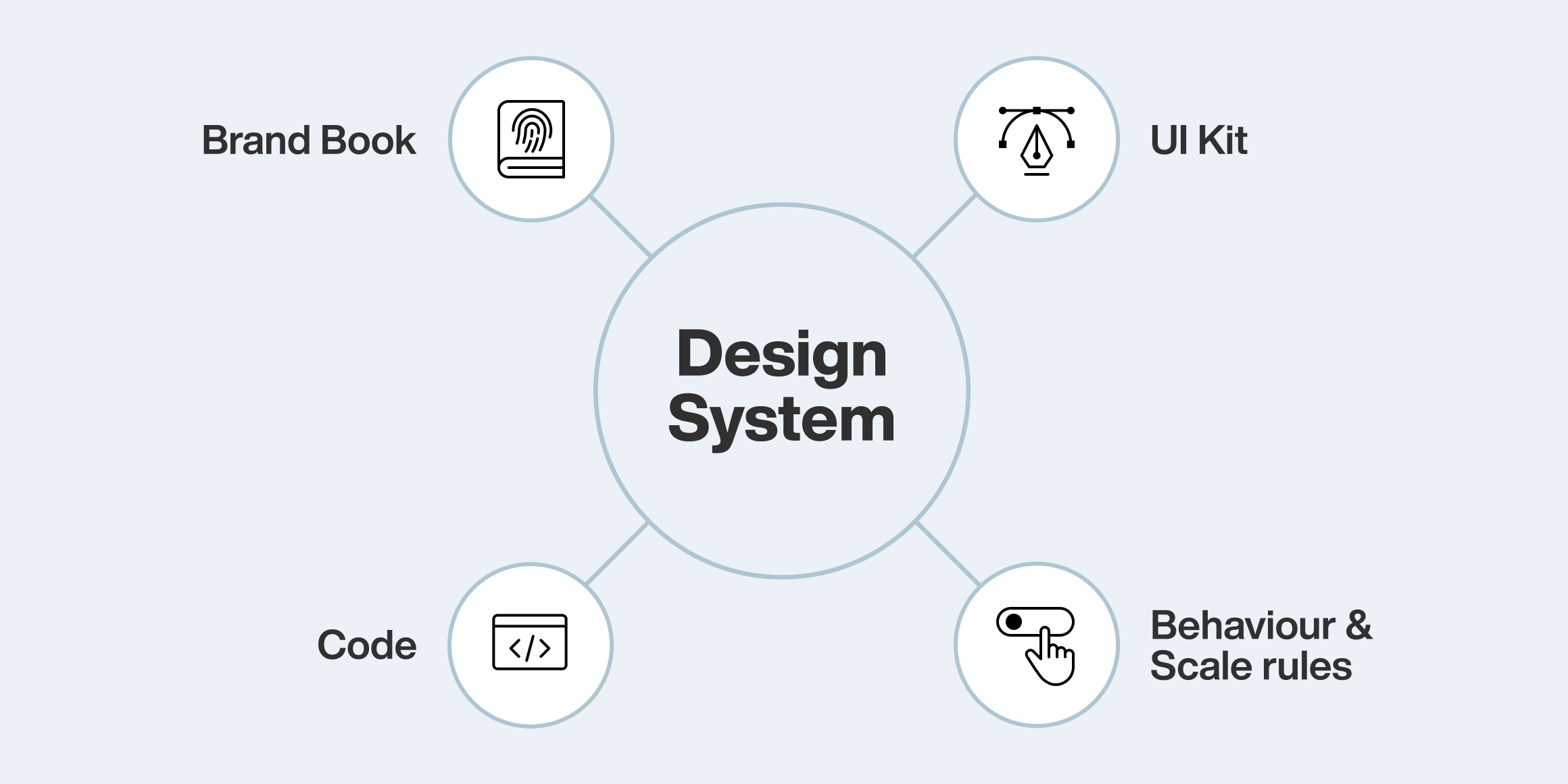
A design system comprises of three components –
- Style guide
A style guide is a set of rules for how a brand should be displayed. It is both visual (design & imagery) as well as written content (voice & tone). It includes the uniformity guidelines of brand consistency across design elements, fonts, etc. The purpose of a style guide is to allow multiple contributors to create content while representing the brand cohesively. Almost every major higher education brand has a style guide. For example, Illinois College has an elaborate style guide menu that caters to the purpose, personality, promise, positioning, and identity of its brand.
- Pattern library
A pattern library is a collection of all reusable elements on your website. These elements usually include carousels, slideshows, social media features, navigation, related links, etc.
- Component library
A component library consists of all the styles and components used in a website, software or app, including buttons, input fields, a UI kit, etc. It is the new and improved code that can be reused for various applications within the brand umbrella.
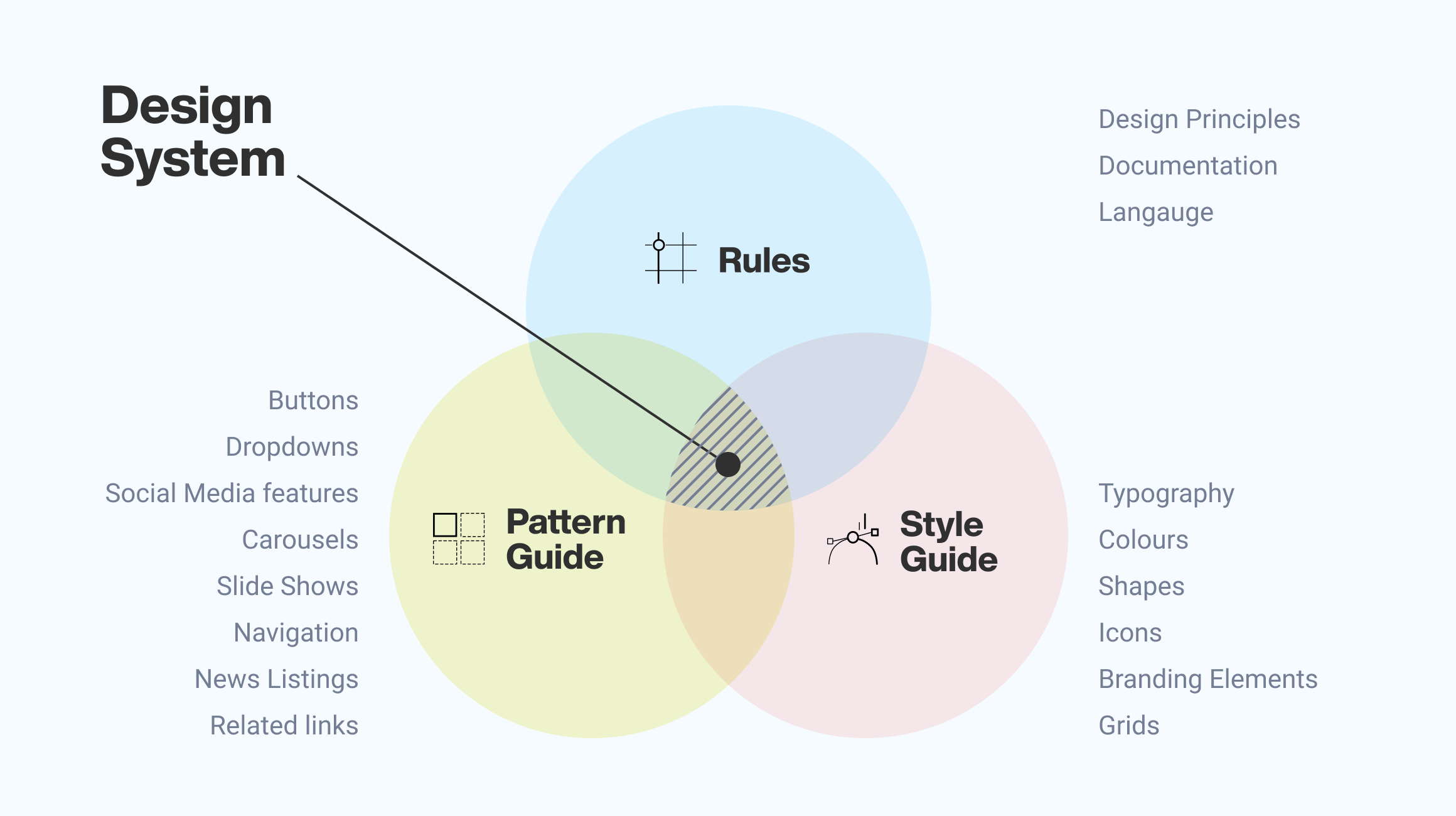
Design Systems for Higher Ed - How the University of Arts, London’s accidentally discovered the design system
The year 2017 was a breakthrough for the University of Arts, London when the User Experience team started focusing on reshaping the core digital experience to be more user-centric as part of their Digital Transformation Program. Before that, every team worked in silos on their site, resulting in a disjointed and inconsistent digital experience. Phase one of the program focused on updating the website, during which the team stumbled upon the concept of having a design system. This is when they collaborated with the University’s brand, content and development teams for the program. Intending to harmonize components across colleges and streamline processes, the teams started working collectively on the design system and the website project. What we see today on UAL’s website is the living version of their brand guidelines that is accessible to all — no matter their device or location.
The teams were finally synchronized around one common system. For the first time, the teams could bridge the gap between developers and designers and effectively communicate with each other.
– Joshua Shindler, Digital Development Manager at UAL
Design Systems - reshaping the educational experience
A design system contributes to setting up a persistent brand both for the website as well as the higher education institute. The major benefits of having a design system for your higher education brand are:
- Brand consistency
A design system creates brand consistency and brand consistency builds trust. Design Systems are extremely helpful in creating consistency across the website. Whether visual or functional, a consistent design does not only make the website look appealing but also makes up for an intuitive and friendly user experience. Enabled by their design system’s amplified user experience, the Georgia Institute of Technology recorded over 10,000 enrollments for their MCS program. The design system creates consistency by providing a unifying influence. It also integrates communication across mediums, creating a consistent brand narrative online.
- Faster turnaround time
With a ready-made design system, you can save up to 70% of the team’s time during the product development process. This increases the quality and quantity of the delivered functionality. The design system reduces development time through prototyping that relies heavily on a set of processes, patterns and documentation for the developers. With established design foundations and reusable components and modules, the design system saves building time for new components and modules.
- Improved team communication
Over 1300 full-time employees of the London School of Hygiene & Tropical Medicine work in tandem with the help of their design system. The uniformity of guidelines encourage collaboration among different teams and help get each individual to work in absolute synchronization. A design system provides each individual with the documentation about everything required to get familiar with the project. Having a design system facilitates the creation of a shared process and governance model within the teams which breaks down design and development silos.
- Encouraged innovation
With a set of processes and guidelines to work on, one must assume that design systems do not leave any room for creativity. Contrary to what it seems, design systems eliminate repetition of tasks, increasing the potential for individuals to add innovative things to the project. Designers and developers prefer solving complex problems which add value. The design system allows more time for exploration and creativity by removing repetitive and low value-adding tasks.
- Enhanced efficiency and clean code
As per a recent study conducted by Figma, having a design system enables resources to work with 34% more efficiency. While a design system promotes consistency, it also focuses on efficiency equally through the reduction of waste or technical debts by promoting the development of generalized or unified elements that are reusable and cater to the long-term goals of the organization. This also helps in maintaining a clean and reliable code-base. Instead of repeatedly building similar components from scratch, Design Systems enable designers & developers to reuse components and thereby increase efficiency.
Here’s how we helped the world’s top business school standardize their design
We collaborated with one of the World’s Top Business Schools for building a design system and standardizing their website’s visual components using Pattern Lab.
- Our team of experts implemented Pattern Lab for design standardization
- We followed component-driven development enabling content managers to easily create pages
- Our designers used low-level components to design high-level ones
- The design system and standardization enabled 100% self-sufficiency of the school’s content team
We standardized the visual styling of elements for the world’s top business school without deviating from their standard component style. Read more about this project here.
Conclusion
Design systems are a higher education institute’s key to amplify their digital landscape and a tool to maintain consistent design, code and brand. Having a design system saves time and improves team communication and collaboration. And is a great way to streamline and simplify the complexity of a higher education digital ecosystem. If you are looking to implement a Design System reach out to us at business@qed42.com.

Accessibility Experience (AX) for Higher Education Websites
Designing a website for users with disabilities improves the digital experience for a wider audience. Accessibility Experience (AX) can help ensure that digital resources are usable by everyone equally, leading to better learning experiences.
Accessibility Experience (AX)
The fact that every good user experience should be an accessible experience ought to be embraced as a challenge. A challenge in which accessibility is not an afterthought with the QA team testing for errors. That's an inefficient model of implementation.
Accessibility has to be embedded as a process within the designers and developers. It is the best way to learn and a progressive approach to design and build websites. It makes sure that responsibilities are diverse as good ownership throughout the organization at every level.
A design based on the principles of AX advocates for involving users in design decisions. This is by far the most important part of designing. It's a powerful approach to making your product more usable.
It's established that research is the best way to start, designing for higher education website mainly has three different kinds of personas.
- Students
- Educators and enablers
- Parents of the students
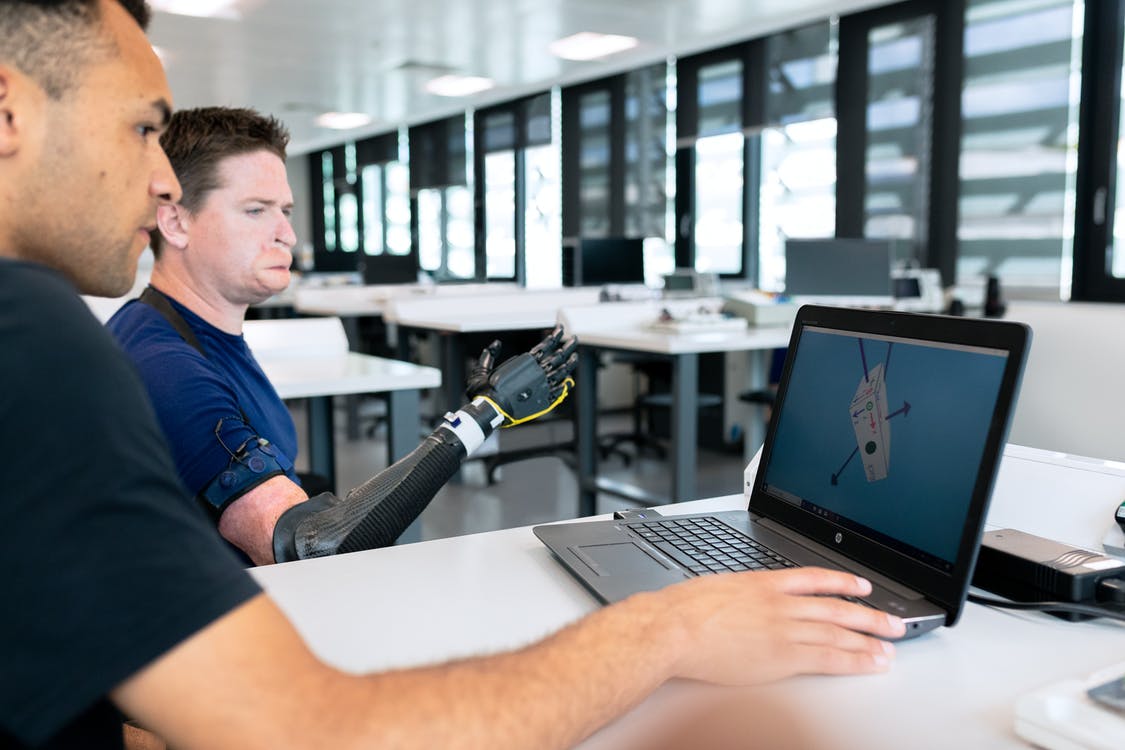
Keeping these three personas in mind here are 5 ways for conducting viable research for a good higher education accessibility experience.
- Research with the team — It's usually the designers or user researchers seen on the desk and the field during research but with a topic as sensitive as accessibility developers, managers, and QA team should be part of it for a shared understanding and a much more viable approach towards the final output.
- Respect the users — Understand the pain points and limitations faced by disabled people every day in their life. A student or a parent of the student may not be comfortable while speaking about their problems. Desk research and an understanding of their problems beforehand can help to not add on to their pain when you speak with them directly.
- Ask fewer questions and be more observant — Understand that your users are going through many fragmented experiences. Instead of creating a long list of questions that may cause them trouble, consider walking in an NGO or the campus to observe their day-to-day tasks while accessing the computer.
- Try the solutions on yourself — How does a blind person navigate only through the keyboard, how does a person with dyslexia view the message on their screen or how does a person with seizure triggers deal with flashing pictures or motion art? Try the tools available online to experience the limitations yourself to fully empathize with your users.
- Tech should be compassionate and not smart always — People use varied technologies and it's impossible for everyone to be backed up by the latest technology. It's a compassionate approach to tech when you consider the needs of the users with different operating systems.
Creating an accessible experience is not hard.
It requires a process in place with a team willing to work on it from the very beginning of the project. The higher education websites as a platform for change have the potential to impact lives across the globe, with that potential also comes a greater responsibility. What is expected of a good higher education website is to continuously progress, efforts to improve and strive to be inclusive in their approach.
Research is how design begins as a process.
It's a step that helps to guide the entire process of design and development. If the research is done right the findings can help to think analytically, make effective observations, ideate rationally, and test and implement feasible and creative approaches. It could be a lot of work and consume time but in the end, all that hard work shows through the accessible digital experience that truly resonates with every user there is.

What is UX Writing?
When UX Writing wasn't even a thing, some fairly, 25 years ago Bill Gates wrote an essay "Content is King", he said, “Content is where I expect much of the real money will be made on the Internet, just as it was in broadcasting". Well, how he perceived the greatness of content at that particular point in time turned out to be true.
There has been a dramatic uptick in awareness across the importance of content and over the past few years, there has come a proliferation of content specialist as UX (User Experience) Writers — the ones who write for the web and follow the process of design to write, the ones who research, strategies and write to resonate with the users.
What is UX Writing?
UX Writing is designing with words to make the conversation between the product and its user meaningful.
Content created for UX Writing is concise but at the same time, it is impactful in terms of communication, accessibility, meaning, and the ability to translate according to the user's linguistic, geographical, and cultural environments.
A UX Writer inspires people to take action and make sure that the message is received as intended. They understand the users through research, empathy and follow the design process to design with words. UX Writing is not just limited to what we read when we interact with a website or an app.
Alexa, Siri, Google Assistant, Cortana and Bixby, all give a seamless experience through the words that are built from the process of UX Writing.
Every word that helps users to communicate with a digital product, spoken or written is a result of a UX Writer's work.
Why is UX Writing Important?
In 2020 there were 2.95 million apps available for download in the Google Play store. There are over 1.8 billion live websites. With the saturated digital market, UX Writing gives a chance to get the right attention from the right user while also helping the users select the right app and website for their work.
Content is everywhere we see, every second that the users spend online they come across a different kind of content. Their attention span is shrinking and at the same time, it is also getting more extreme. That can be explained in a way that, users or we are engaging with things that are both increasingly longer and shorter, anything in the middle tends to feel antiquated. In a complex digital scenario it's critical to break through the clutter by communicating the right message in original, interesting, relatable, clear, and simple words.
Dropbox, Google, Spotify, Apple, and Airbnb incorporate UX Writing as an integral part of designing and UX Writers are considered an important member of their product and design teams.
Spotify UX Writer Marina Posniak simplified their user experience in a clear and simple language.
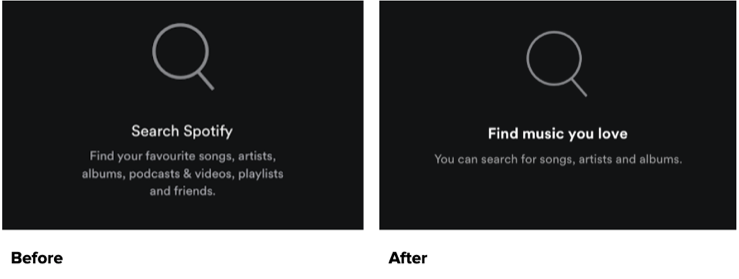
Apple explains the features of its product, AirPods in a simple, fun, and informative way. The process of UX Writing has helped to create a clear, concise, and useful message for the users while also keeping intact the true product character.
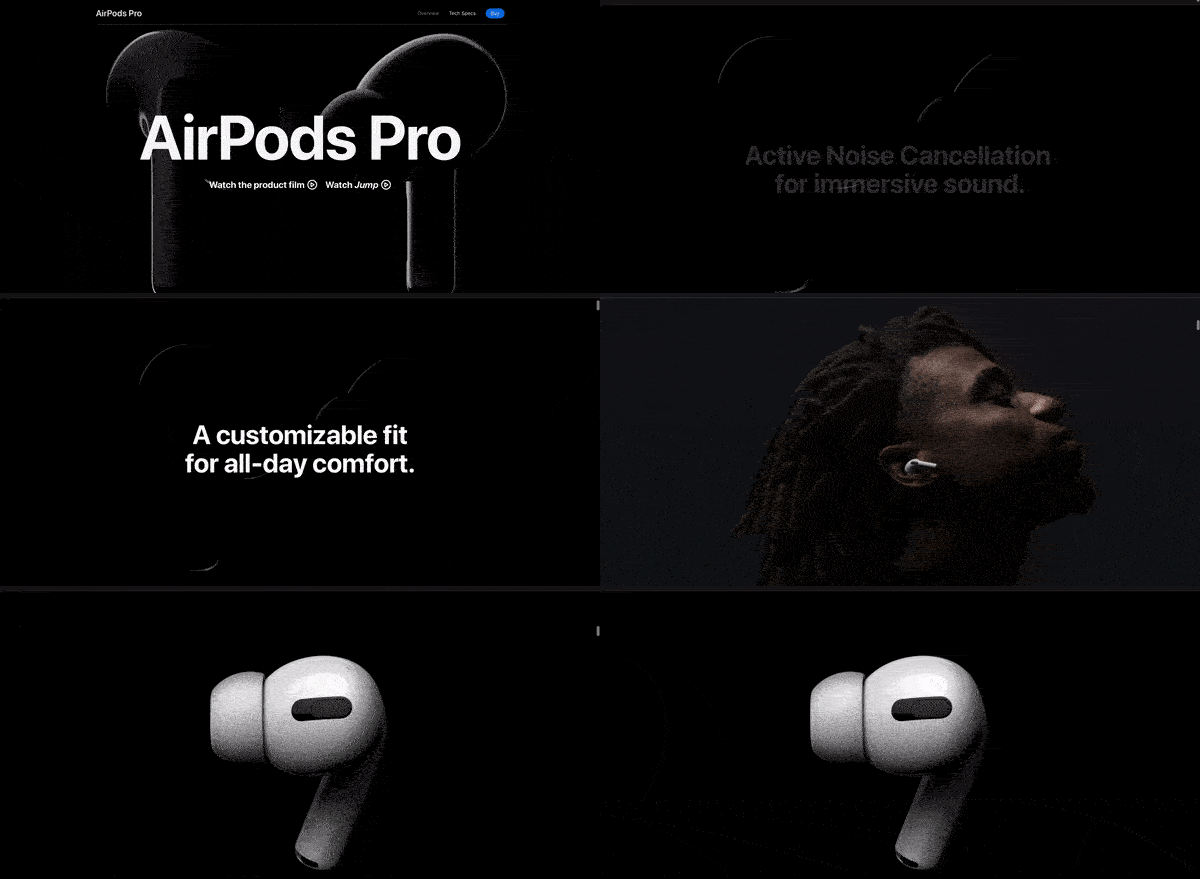
The power of appropriate words creates effective communication that helps users to complete tasks easily. They help to drive the right engagement and build a long-term relationship with the users. The process of UX Writing has proven to make a product stand out from niche to masses and increasingly competitive marketplace.
In Conclusion
UX Writer's entire focus lies on paying attention to interaction and communication of the product with the users. They are involved with designers and developers from the inception till completion of the product design and development process. The result of that work is the microcopy that helps the users to understand and use the product.
Dropbox UX writer John Saito says that language is now a critical part of design and experience. It’s natural to want to have somebody knowledgeable about words, semantics, style, word choice, and tone.
UX Writing is the quintessence of experience design. The words that come out of this process are useful design elements. These design elements help the users interact, communicate and understand the product. It's how people make sense of the product they use. At the end, one could say that UX Writing was invented for the sake of design.

7 Benefits of a Design Thinking Workshop
Design thinking is a methodology from the designer's tool kit to solve complex problems and find solutions. It revolves around understanding the users by the process of questioning the problem, assumptions, and implications.
At its best, design thinking is an iterative and agile process to design and build with a human-centered approach and experimentation by empathizing, ideating, prototyping, testing. By trying out new concepts and ideas design thinking dramatically improves the outcome.
According to the Design Management Institute, companies that are led by design such as Apple, Nike, Pepsi, Proctor & Gamble, and IBM have exceeded the performance of the S&P 500 by over 200%. This is evidence that "thinking like a designer" is crucial to creating successful products and services.
What is a design thinking workshop?
A Design thinking workshop is an ideation session run in groups and teams. It helps everyone get the best of design methodologies. In a workshop, all practices come together to understand users' pain points to create rapid ideas.
Workshop culture fosters empathy and genuine discussion of ideas in a human-centric way.
Design thinking workshop is based on the human-centric framework and build around the design thinking process. It involves steps of creative and collaborative exercises that help a group of people to align on certain pain points to come up with testable solutions and can be applied to all phases of designing a product.
This workshop is conducted at the beginning of the project and during the pre-design phase.
How to run a successful design thinking workshop?
Pre-documenting the workshop course and asking interesting questions can help participants discover more possibilities and ideas. The first step here is to set up a document about the steps involved in the workshop, carefully planning the participates their challenges and the structure of the conversation.
The success of a design thinking workshop also depends on how successfully it is conducted. That success can be measured by three basic parameters —
- How interactive was the session?
- Did all participants have an opportunity to contribute?
- What is the quality of ideas generated?
Each participant should understand the process and benefits of the workshop. Communicating how the workshop incorporates ideas is of utmost importance. Each participant should be enabled by communicating the complete agenda and making aware of the tools to be used during the final workshop.
The complete success of the workshop relies on well-defined questions and facilitation that ensures participation from moderators, stakeholders, and every other participant. The succession ensures that everyone including the stakeholders understands users' on a deeper level.
What are the key benefits of a design thinking workshop?
There are several ways in which a design thinking workshop benefits the process of designing. It is a great way to create an interdisciplinary collaboration. It creates a space for the productive sharing of ideas and the building of innovative solutions.
- Desirable solutions
A design thinking workshop embraces specific attitudes that characterize the design profession and helps people from non-creative backgrounds to use the designer's tool kit. It is a process that translates the users' pain points into a single clear problem statement that everyone can understand to solve complex problems and reach desirable solutions.
- Collaboration and co-creation
Participants share ideas and build on them collaboratively. It helps teams develop much-improved respect and understanding of each other's range of skills and how each of them brings great value by more collaboration and co-creation.
- Reduced risks
Design thinking workshop creates a natural flow of ideas. It emphasizes overcoming preconception and fixation on solutions. It challenges assumptions, discussions around what will or won’t work reducing the risk of repetition of the process.
- Saved costs
Design thinking workshops help to deliver outputs in a reduced amount of time, including — Initial design alignment with the stakeholders and other practices. It helps to create a deeper understanding of the users and effectively reduces the feedback loop, development, and testing time which in the long run saves efforts and costs.
- Foster teamwork
Design thinking workshops are engaging and fun sessions that bring the teams together from different practices and provide an unbiased opportunity for everyone to understand the problem and work together towards common goals.
- Actionable output
The questions and ideas documented during the workshop are documented in a detailed shareable report which helps to understand the users and drive the entire product's design and development journey.
- Serves the true business needs
Design thinking workshop helps to create outcomes based on creative thinking and analytical decision-making. This helps to create user experiences that truly resonate with the users and deliver high business impact.
The workshop created on the principles of design thinking help to approach the problem with a designer's mindset helping everyone unlock everyone's creative potential.
Wrap up
The design thinking workshop lays out the groundwork for the whole journey of product designing. Its organization-wide adoption and stakeholder involvement help in ideal innovation through a linear and structured process. This results in problem finding preceding problem solving, understanding the human needs, idea generation, and experimentation. Design thinking workshop helps participants collaborate in a continuously iterative process that improves and changes with every project's needs.

What is a Design System?
Design systems are everywhere but yet there is no formal or unifying definition for a design system within the web community. The definition of a design system may vary depending upon its users.
For example, if you hear a designer talk about design systems they are most probably talking about its benefits in terms of design which may include:
- Designing at scale
- Delivering a consistent brand experience
- A collection of tried and tested components
- Making sweeping changes with ease
And if you listen to a developer they are most likely talking about:
- Writing less code
- Centralizing the repository of components
- Reducing maintenance
- Scaling the front-end development
So what is a design system?
Design Systems are curated from scratch to suit the specific needs of an organization or product. Almost every organization has its design system aimed at solving peculiar problems and creating a unique and seamless user experience. So any attempt to create a rigid definition to explain a design system would always fail because just like each design is a unique specification of the product. Similarly, each design system is a unique product of its environment.
The technical side of the design system:
Technically at its core, a design system is a collection of content and context agnostic breathing UI components that can be reused across different products/websites.
Essentially a design system contains 3 parts:
1. Pattern/Component Library
As the web has evolved we have moved past designing for pages to designing recurring solutions that solve the common design problems. A Pattern library is basically a collection of related reusable components that address common user objectives with sequences and flows. You think of a Pattern library in terms of Lego blocks. Just like you can use Lego bricks to build multiple structures/shapes, a pattern library lets you build from existing elements; the elements could be anything from buttons, to menus and grids. A Pattern library may include:
- Pattern names
- Visual representation
- Design elements
- Code samples
- Use cases
- Related elements
2. Style Guide
A Style Guide provides information about how things should be done across the website. It represents the styles, patterns, practices, and principles that are implemented globally in all areas of the company/brand. Before the web, style guides were usually implemented in print. The 1976 NASA graphics standards manual is one of the best representations of a style guide. It defined how NASA's design standards will be implemented on billboards, magazines, and anything.
3. Design Language
A design language is a set of guidelines aimed to create a cohesive experience throughout every leg of a user's journey. A design language governs the brain story and the visual expressions/vision that is manifested in the elements like:
- Colour palette
- Typography
- Spacing
- Grid
- Motion
- Content
- Accessibility
- Icons
Do you need a design system?
A fully functional design system’s sole purpose is to unify user experience through a shared design language. A user should not have to wonder whether different words, situations, or actions mean the same thing.
So, it's not a question of whether you need a design system or not, but whether you should be intentional about one or as an organization should you streamline the process of creating a consistent, accessible, collaborative, and globally unified experience for your brand.
Benefits of a Design System
As the website grows in size and complexity the arguments for a design system are overwhelming. So are the benefits. Which includes:
- Coherence and predictability within the products
- Reducing design and development time
- Designing and developing for every user and every edge case
- Centralising the best development practices
- Assists in building easier, faster, and better pages/websites
- Higher quality by focusing more on the product by iterating and improving rather than reinventing
- Future friendly and a promising solution for cohesive work practices
Conclusion
A design system is an approach to build digital experiences, not a result. It is an approach that produces particular artefacts, but these artefacts vary depending on several factors related to the client/product's needs. Building a design system is like building a house, you can think about the architecture of the house, a vision of what the rooms should look like but you won't be able to pen down every single material inside the house.
Rather than creating rigid definitions which are limited to certain fields that end up explaining design systems as some kind of a tool or a language, we should emphasize the need for design systems as a methodology that helps teams work together in a particular way to produce a particular outcome. For example: Think of the Agile methodology, it doesn't dictate what the result should be, it just helps teams work together in a particular way. Lots of teams use agile, but they produce different things in the end.
There is no one-size-fits-all approach. Design systems are always evolving, always changing.

UX Design for Trust, Truth and Transparency
On average 4.66 billion people use the internet globally, which is 60% of the worldwide population. People rely on the internet for learning, education, news, and human connection and associate more with brands that thrive on the principles of trust, transparency, and credibility. UX design for the truth era websites should be a reliable source of knowledge and stand as an epitome of empowerment, and truth.
Over the past year, online education websites have become a stimulant for confidence, and fulfillment, and a source of knowledge, and future career prospects.
News outlets are reimagining a future of the internet centered around trust, transparency, equality, and innovation.
Non-profit organizations (NPOs) are actively contributing positively, from reducing inequalities, driving economic growth, and boosting health outcomes.
The future of these websites and apps lies in systemic innovation and providing honest content to leave a meaningful digital legacy through UX design. In this blog, we explore some strategic UX design solutions to the challenges posed by digital misinformation that can deter people's perception about online education, news outlets, and NPOs.
Online Education
Online education has changed the face of traditional learning, making higher education a more digitally accessible source of optimism through e-learning and various courses. As people are looking for new ways to learn and more importantly learn from home, platforms such as edX, FutureLearn and Coursera have seen a surge in demand for their massive open online courses. Institutions such as Harvard and MIT also running courses on everything from marketing, business, and data science.
Online education is turning architectural education inside out, the options are increasing and more people calling for a change in the way education is consumed online, we foresee more changes in the process of learning and the need to engage with people by creating trust and transparency through some of the UX design features.
- Chat Forums — Faculty members, teachers, and initiators will have to adopt a change management mindset to move beyond intelligence and tap the right emotions in favor of knowing the students through the right communication channels. UX design features such as chat forums, discussion boards, and groups/communities tapped into education websites and apps could serve the GenZ, GenX, and Millenials with the same connection that pulls them to the social media channels.
- Interactive Support Systems— To re-create the interactive playful aura of schools at home content program features like popsicle's virtual recess can be built and designed for educational websites and apps for a well-deserved break or recess periods. This could also help to engage students and also the entire family to support the home learning ecosystem.
- Accessibility Experience for the Students with Attention Issues or Disabilities— Traditional teaching methods are fading away and for real academic success and online effectiveness designers will have to work on accessible UX design features to help teachers teach students with attention issues or disabilities.
News Outlets
Social networking platforms have become a tool for people's growth and passionate debates. They have become a space for entertainment, education, news, and human stories but have also resulted in mistrust and skepticism among people. The mistrust and skepticism due to misinformation had resulted in the reputation of news outlets under scrutiny and fundamental to people's choice.
The general concern is around the contamination of the news and most people stop consuming news from sources of questionable reputation. UX design features can help news outlets regain trust and maintain the authenticity of the news.
- Red Flags — UX design features such as red flag, dislike, not interested, and mute buttons could help people to specify and raise questions around their concerns and at the same time allow their active participation and contribution to the app or website. It will also help the news outlet to recommend and filter stories that fit the people's actual preferences.
- User Communities — Design features such as the community of practice incorporated in news apps and websites can encourage people to have real discussions around global news. This feature can enable human connection and set the core for transparency between the core members and regular visitors while also increasing traffic at the same time.
- Simple and Clear Headlines — Ux writing is a part of a wholesome user experience, a headline accounts for 50% of a news's effectiveness. The goal of content created for news channels should be simple and clear. This could also become a solution for the users to not worry about the authenticity of the news.
Non Profit Organisations
NPOs have a powerful influence on societies and culture. The impact of their good deeds can be felt across all generations, from Alphas and GenZs to Millennials, GenX, and Boomers. NPOs are purpose-driven and personal involvement in their activities can heighten the sense of service, mutual aid, and ethical values for the users. This makes designers responsible for ethical practices, transparency, and truth across their website design.
An NPO website should evoke compassionate emotions and ensure messaging that focuses on being community-driven. The UX features for these websites should be inclined towards understanding users' pain points to build solutions accordingly.
- Purposeful Content— Content is not words alone. Designers can include photographs or images for good visual storytelling. Images are a strong way to convey the mission and show the impact of an organization's work on communities and people. Infographics, interactive charts, fundraising details can also be used in an appealing way to drive the content in a purposeful way to create a deeper emotional connection with the website visitors.
- Impactful Buttons— To ensure consistent donations, volunteers and event sign-ups the call to action buttons require seamless navigation flow, clear visibility, and informative messaging.
- Easy to fill Forms— User-friendly forms are an essential design for NPOs. Designers can contribute here by focusing on reducing the number the fields and creating a responsive form design that fits the screen of all devices.
Conclusion
Some UX design strategies are common to all websites and apps. A design with consistent use of color themes creates a unified voice that the users' can recognize and resonate with in the future. The user experience of websites aiming to sustain in the fair internet era should be clutter-free with seamless navigation.
Distractions can be avoided by limiting the number of items on each page. Steer clear from using any unnecessary text, images, or ads. To avoid misinterpretation write scannable content for the web, stick to simple language, condensed copy, and spaced out sentences with easy-to-understand fonts and font sizes with simple headers and footers.
These UX design strategies make the website welcoming, approachable, and reliable. They evoke a sense of compassion and create a stress/hustle/grind-free culture.
The battle between what's real and what's not in today's world is becoming more pronounced, with misleading information becoming a concern for corporations to run, function, and establish themselves. Through the right UX design features, we can contribute to our share in designing solutions for the level of trust we need to create with today's users. We need to think about design in context to develop a methodology of understanding the needs of the people at the moment.
We need to understand when designs are created for trust, transparency, and truth who does it benefit? It benefits everyone, each one of us.

Design Sprints and Remote Work Lifestyle with Jyotsna Gupta
Designwise Episode 3
Our third episode of "designwise" is an honest, raw, and real conversation with Jyotsna Gupta. She is a Senior Product Designer at ZypTv, San Francisco and she speaks with us about the transformed work dynamics, the key shifts, and value of today's most relevant topics — remote design sprints, work from home lifestyle, and team management. Let's Listen!
Subscribe to Designwise on Apple Podcast or Spotify.
"The strength of the design sprint is the people that are involved in it, right, everyone comes from a different background, somebody is from the operations team, some come from the sales team, somebody is from the data analytics team. They all come with their specialized skills and get involved in understanding the problem from the lenses of their respective skills, it's getting the skills utilized in the best possible way. That's why I feel like having all these skilled people involved in this and the stakeholders involved in this process is key to having a good design sprint".
— Jyotsna Gupta
Design sprints are the fastest way of developing designs and solving problems. The work from home environment is becoming more human-centered to solve the problems faced every day. The work cultures across the globe are shifting. Jyotsna tells us how her team refocuses and emphasizes the importance of communication, collaboration, quality leadership, and flexibility. The conversation here is coupled with the possibilities facilitated by "Agile Design Sprints" for ideation and grooming of human talent and digital products as a reaction to the challenges and opportunities of working from work.
Transcript
Priyanka: Welcome to QED42's podcast Designwise. I'm your host Priyanka Jeph and I am a design writer at QED42. This is the third episode of the podcast and our guest today Jyotsna Gupta is a Senior Product designer with ZypTv. The story of her career gets as interesting as it goes and fits today's transformed dynamics of remote work. Today she will be speaking with us in detail about key shifts and innovations happening in today's most relevant topics, which are working from home, team management, and conducting online design sprints.
Priyanka: Hi, Jyotsna, welcome to the show. How are you?
Jyotsna: Hi, Priyanka. I'm good. How are you? It's been a really long time.
Priyanka: I'm great. Yes, it's been really long. I think the first time we met was in 2005 and definitely around 2009.
Jyotsna: Yes. That's right. Almost 16 years, right? Wow, I'm old.
Priyanka: No, no. The only thing here is we go a long way.
Jyotsna: I know, I know.
Priyanka: Okay. So what have you been up to? Tell us something about yourself.
Jyotsna:Sure. So currently I'm working with ZypTV, which is a startup here in San Francisco. I've been with Zyp for the longest time, I guess four years now. ZypTV recently got acquired by Sinclair Broadcast Group and I'm working here as a senior product designer/design manager. I've been working with the team for a while now. As you know, we started our design career basically together at NIFT so that was the beginning of seed of design and the foundation of it. From there on I went on to work for Export House, did a few freelancing work, did a lot of graphic and print development, and from there on moved on to becoming a design faculty at the university for the bit. And all this previous experience that I gathered really made me think more towards the shift of industry, graphic design, and how it was transitioning towards more of a digital platform and how the products were being used so that's when I decided to pursue my master's at New York University in Digital Media Design and do my specialization in User Experience.
This was the time in New York when I worked on many different projects for different stakeholders, help them in designing different platforms. And I would say this was the time when I really got into the aspect of understanding what a user is, what user research is, how do you conduct these interviews, do usability testing, basically understand the nits and grits of a user experience process, the designing process, but also be able to work with these stakeholders and understand and develop designs from scratch. So that was a great time of learning for me. I worked on different projects for Crozier Finance, Box Butler, did a project for Samsung as well. Also did my internship at the New York Hall of Science and Access Technology in Dallas so there was a lot of smaller projects, bigger projects that I was heavily involved during these three years. And then I worked for Sotheby's Institute of Art as well as a product designer for a while.
All this time I realized that I had a lot of experience with different industries and technologies and so I was happy to do that and learning about different users and different clients and working with different stakeholders. But I also understood that I wanted to focus on one particular technology and also one particular industry and that's when I decided to come to Silicon Valley and moved to Bay Area. And now I've been pretty much with Zyp since then. It's been a pretty exciting journey so far which comes with its own ups and downs but then I would say I've really enjoyed this experience and I'm learning every day as we go. And especially this last year for us, it's all been crazy as we've all never experienced a pandemic before. So this is what is going on in my life. And I've been really happy and really lucky to be working during this time when people have lost their jobs as well so really grateful for that. Also, I got to spend this quality time with my 17-month-old daughter working from home all this while so I've been really happy doing that. So yeah, that's how it's been.
Priyanka: That's been a great journey. I loved hearing the part where you said you're a faculty. So did you enjoy teaching?
Jyotsna: Yes, I enjoyed it immensely. And I never thought that I would get into teaching but at that time I would say it was really interesting because there's something about not just design but there's also the idea of how do you solve a problem and then how do you impart that knowledge of design and concepts to your students and be— It feels like you're a part of something that's really special when you're teaching. And then when they do come up with their different innovations and their own concepts, it's amazing to see that getting through. So yeah, it was a great part of my experience which I think really helped me decide on doing my master's and decide in pursuing what I really wanted to do. So yeah, it was a really important part of my initial years.
Priyanka: Mm-hmm. Sounds about right. So, Jyotsna, you also mentioned about the last year and the pandemic and you working from home with a 17-month-old daughter who's really adorable. I've seen her.
Jyotsna: Thank you. So is your son.
Priyanka: Thank you. So what I would like to know more is that remote working has its own numerous benefits but people are still struggling with the Zoom meetings and there are parenting distractions. So how do you manage working from home when you're a parent or the integration of work and how it inspires you to do better and be better at work?
Jyotsna: Mm-hmm. That's actually a great question. And I feel we should definitely talk more about this everywhere and really normalize these distractions that are caused by babies or pets during your Zoom calls and meetings because really, we are all human beings here trying to do our best with what we have and this pandemic has really thrown that curveball in front of us. And teams are understanding people more, they're empathizing more because they're going through the same emotions, they're going through the same struggles as us. So I think it's something that's changing but obviously, every change takes time. But I definitely think remote work comes with its own challenges. There is no segregation between work and home. It really becomes a thing where you're actually thinking about work 24/7 and then working more than eight hours on a daily basis so it's a challenge for sure.
But I also feel like for me what worked was because I was always working in a remote team since some team members, my team of designers and some engineers sit in Russia and other parts of Europe. So I've always been okay with working remotely and it's worked good for us because we get our work done in a very smooth and in an effective way since we have these difference of time zone. But what works wonders for us is the Russian team works in an MSK time zone but then they work from 2:00 p.m. to 11:00 p.m. That's their schedule. So that works really well with our schedule because we are able to do our first half of the day. We can do those calls and conduct our sessions, Design Sprints, and all of that. And then I get to spend the other half of the day gathering all the feedback from the clients, the stakeholders, and do all of that part. And then the next day we meet again and discuss the session that I had with the findings that I got so that means it really works well for us.
And I feel like there are so many tools right now that we have that makes all this communication and all this a success. I know some parts in the world we have issues with the internet but luckily, our teams don't face that. So in that context, we are lucky enough. We've got great tools to work and communicate to each other. Slack is one form of communication that we use on a daily basis. Anything that we're discussing from vision or any idea or any concept and any comment on a particular design or a feature that we have so we use Slack for that. But then we have Jira that we use that's basically an Agile Sprint that we go through. All our stories and tasks are assigned on Jira so we are tracking that there with all the UI mock-ups and prototypes all attached to it. And Confluence is again Wiki is another place where we do all the documentation that we need to for the particular feature or a product that's going on. And then Nero that we use is for whiteboarding. And then there's InVision and InVision Freehand, which is again, used a lot for our Design Sprints and general activities as well.
So all this remote work works for us because we understand each other, we understand our issues, and we understand the problems one faces, but then we are comfortable and adaptable to all situations. So we know sometimes the team's morales are down or something some person is going through, personal stuff, we give them that leeway and then adjust to meetings, schedule these meetings, if not or reschedule these meetings depending on how everybody is. So we have that kind of freedom to us attached to all this remote culture that we have. So everything has its own challenges but then you got to live with what you have and then make the best of it. So yeah, that's what we're trying to do here.
Priyanka: All right. So what I understood from the whole conversation that we just had is that productivity has actually become a focal point here and there are more and more tools being developed and there is more innovation around technology and it is facilitating more collaborative processes, keeping teams more connected and more engaged in projects. So what I would like to know more from you is what are the processes that you follow? Is there a certain way that you guys come to a conclusion? You mentioned Design Sprint so can you tell us more about that?
Jyotsna: Sure. So as you talked about the tools, we have different tools that we use. For a design team, the basics are there. We use Sketch, there is Figma, there is Zeplin that could be used. So there's a lot of different design tools that we already use. There are the Slack as I mentioned and there are other ways that we communicate with one another. There's also Overflow.io that we use for creating these user flows and any IA or site maps that we need to create. So these are all really helpful tools that we use for our day-to-day basis. Yeah, Design Sprint is something that was developed by Jake Knapp. He wrote a book about it that's basically how to solve big problems and test new ideas. What he suggested was a four to five-day process for multidisciplinary teams. In our company, it's more of sales teams, the ad operations, the product team, analytics, data, and the engineering team. And then for the testing phase, we involve the clients and the customers to that, to the last day for testing all the new ideas that we conducted during these Design Sprints. So in a general basis, it's a four to five-day workshop but since we work heavily towards Agile and Scrum environment, we've cut down the process to a three-day Design Sprint.
So Monday is usually dedicated for understanding the problem and ideating. First half of the day is all about understanding the challenge, defining the problem, and then the long-term goal for the project and mapping exercise to identify all the user pain-points that come along with the journey, and then identify a target area for that particular sprint. The same day, we also do sketch. So once the team has a good understanding of the problem, the top-rated, the top-voted how-might-we questions and then target the focus to that particular area, it is that time to generate the solutions then so we sketch the ideas on paper. So every team member has a different skill, a skill level, so you have to understand that as well. Our sales team or ad operations are not great level designers or doodlers so they might use just pen and paper to come up with a particular idea. Some people are comfortable with using InVision Freehand tool, some people use Miro so there are different ways of how they're sharing their design ideas or solutions or basically their sketches. And then once all of that is done, we usually use which is a very general method that is the Crazy 8 method, which basically means coming up with eight different ideas in eight minutes. So everybody comes up with eight ideas and then everybody gets to share their ideas.
On Tuesdays, because this all takes the whole Monday, on Tuesday everybody presents their ideas and then we decide and vote on the best ones. Once the best idea is decided and voted upon, we do prototyping. That prototyping is more majorly done by designers and heavily on that side. So after Tuesday, Wednesday is the time we spend most of the day testing these ideas with the clients and the customers. So what works really well for us at Zyp is we have our own ad operations team and they have access to other clients as well so we get to share our ideas and prototypes with them. And it's a very iterative process because they're very quick with their feedback. So once we get those feedback, we try to involve that and do a quick iteration of the changes and then finalize on the solution. So this is what we do on a basis of a three-day sprint.
The next two days are then because it's still Wednesday and then Thursday and Friday are more aimed towards grooming and planning because all the idea that was proposed now needs to be put into a story in Jira and then shared with the engineering team. So one day is taken for grooming and the next day is taken for planning those stories and sizing them and then preparing the product backlog and the sprint is ready. So when Design Sprint works together with the Scrum and Agile environment, it brings the design activities into the Scrum development process and it also helps for the whole team to actually think more in a design-driven way and follow that process and also build the feature backlog and solve the right problem within the context of the user. So the user is put on the periphery here. And this Design Sprint can also be done for you know, there are MVP products and then there are your regular legacy products and you can do it for both of them.
For MVP, what we do is you basically start with Sprint Zero to kick off the project to reduce the uncertainties and then the outcome of it provides the team with a shared understanding of the overall project vision and builds a strong alignment within the team and all the relevant stakeholders so there's one common vision that everybody's seeing through. And it also builds the team initial product backlog. So that's how it works. And then every other week that is to maintain the two-week Agile Sprint, these Design Sprints are conducted. So this is for MVP that we do but for ongoing projects or the legacy products that you have, we can use these Design Sprints to discover new features or redesign existing features in between releases or Scrum Sprints. It also helps in reviewing the project vision; renewing it and also reviewing it and making sure that we are working on the roadmap and also make the adjustment to adapt to the change in the market. So we have to be very adaptable and understand that, whatever product because technology is changing every day. And so we have to make sure that what we are doing is at par with the industry. So yeah, that's how we basically work through a Design Sprint.
Priyanka: Okay. Having understood the process, I've got a detailed understanding of how exactly it works and what is the outcome of the whole process of Design Sprint. What I would like to know more is what are the challenges that you face when you're you know, you said that you manage the team, you work as a design manager as well apart from your job as a senior designer? What really bothers people is giving feedback, remote feedback. How do you process that? How do you give feedback in such a way that it is positive, it is nice? And what are the main challenges you face while conducting a Design Sprint?
Jyotsna: Not just as a design manager but as a leader, you have to understand that everybody will have opinion. And especially as a designer, you have to be prepared because everybody thinks that they know design. You put a question in front of a person and then everybody will come up with an idea. And you have to understand not all ideas are great so there has to be a balance. But also, you have to make sure that you hear everyone and we do that. So based on whatever feedbacks we get, we'd always you know, we like to listen. We listen and we understand that this is something that makes sense based on the product roadmap and the vision that we have and also understanding the user's pain points. So when everything is put in context and aligned with and there is feedback that makes sense, we will use it. But if there is feedback that is something that's talking about XYZ stuff that is not relevant to the point that we are trying to focus on or the feature that we're trying to focus on, then those feedback are just skipped. Yeah.
Priyanka: So how do you motivate your team members remotely to align on the same? Is there something special that you were—?
Jyotsna:Yeah. We do a lot of happy hours. What works with us is we have a Russian team, they love their vodka. So we do these happy hours, we try to keep everybody's morales up. That's something that we have to make sure that's happening, making sure that everybody's kept happy. We do a lot of one-on-ones as well. So personally, I have a team of four designers with me so I try to do my bi-weekly one-on-one with them. So that helps to keep that conversation going, understand if they're going through certain problems, or just generally chat with them because everybody wants to be heard. And then having that conversation, even if it's half an hour or 20 minutes, once in two weeks or whatever, that makes them feel heard and that also makes them feel happy that we're always talking to each other and then communicating so that's really helpful. And then sharing pictures with each other like your families, sharing your highs and lows, and so talking through.
We have our own Slack channel. A baby section of Slack is devoted to your babies and then there is a section of pets of ours and stuff like that to keep everybody excited. So you have to do different things. We've also tried a lot of different happy hour sessions. We try to do a Netflix Watch Party as well. So there are things that you would try to do and then work through to keep everyone happy and I think most of it, it will usually work. Sometimes people are not happy so you have to hear them out, listen to their problems and sometimes those are legit problems and you have to work through them.
Priyanka: Okay. So you mentioned you have the specific Slack channel for kids and you have a specific Slack channel for pets which is a really interesting thing. I've not heard about this before. I don't think it's very, very common. So can you tell us about those little moments that you share or while you're in the meeting and Aria is right there next to you? Do you have any positive and negative experiences around that?
Jyotsna: Oh yeah, there are tons. Every day Aria will make some noise behind me so it's become a thing that people know. I have a daughter; I have a 17-month toddler who's running around the house doing her thing so that's become a normal thing. But then sometimes it is a challenge because sometimes there are stakeholders' meetings and you have to be present, your video has to be turned on, things like that. And especially now with Zyp transitioning towards Sinclair Broadcast Channel and we're having this acquisition going on, things are changing as well. For us, it was more of a startup culture that we were so used to, and now we're getting into a bigger company and then that's changing so the rules also change. And then we're trying to figure that out as well and then adapt to that situation as well. So initially, we had our Zoom meetings where we made sure that people can be comfortable in however you want to do these meetings. Even if it's video off, we're fine with that. But now it's changing and now every time we have a call, we want the video to be on so that becomes a challenge.
And me, especially as a mom, I can talk for myself. As a mom, I'm trying to multitask here so sometimes I don't feel like a video-on call is helpful to me. So what do you do in that case? So I can talk about something. Last Friday, I was on a call, a 12:30 p.m. call, and that's the time when actually, Aria sleeps, and she fell asleep on my lap and the call started. So I was like, what do I do now? Should I turn my video on or just keep it off? But then I'm like, why not? So I turned my video on and she was sleeping on my lap. And so there are things that happen on a day-to-day basis and you have to make sure that you are doing what you can the best way but then also make sure that the other person involved also sees that effort. And then, yeah, so nobody had a problem. In fact, they were all appreciative of the thing that I do on a daily basis. So, yeah.
Priyanka: All right. What I would like to know more about is you've shared the entire process of conducting a Design Sprint and you've shared your entire experience and framework working with us, which is really, really valuable information for us and are audience. But what I would like to know more about is on our ending note, more about Design Sprint, the Agile process, and or could you share an experience with us that you faced while conducting a Design Sprint?
Jyotsna: Oh. If you asked me one experience, I think there are so many different experiences with Design Sprint. I can talk about one experience where the sales rep who was involved was not understanding the whole concept so when we gave a little bit of information in the beginning because we always try to make sure that everybody's ready with the tools that they need before the meeting actually starts, he was not prepared. So he came unprepared. He did not have access to Miro. So he did not download the app, he did not do a lot that was needed before the meeting starts. So you have these kinds of experiences. And then, because you don't want to waste the time of others trying to onboard this guy in the system of the workshop, we had another team member help him online but then separately. So while we already started the process of the workshop, he was still getting trained on getting all the tools added to his laptop and getting that fixed. So things like these happen but then it's you have to be quick and adapt to it.
Like okay, think through it and then make sure that nobody's time is wasted because everybody's here as is. A lot of companies are not comfortable devoting a Design Sprint on creating these product features and stuff like that. The idea is still new to them so you have to make sure that everybody and all the stakeholders are kept happy and given the importance that they deserve. And then sometimes you have to make it work. So yeah, you can't be wasting time of everyone because there are like 10 people involved in these meetings and then if one person is not ready, that doesn't mean all the other nine people have to wait for them. So yeah, things like that happen but I would also talk about some good experiences of the Design Sprint. I think these Design Sprints are obviously helpful for understanding of new product features and stuff that we do on a daily basis whenever we are doing an MVP.
So right now we are working on our new product and that's a minimum viable product that we are going through so that's really helpful. But then I also think that Design Sprints are helpful for any new hires that you're having. Any new employee getting onboarded in the HR system also should be going through these sprints because it's more of a workshop where the new person can get involved with the teams. They can talk through, they can understand other people, and they can also understand the product and then also meet everyone. And this process becomes a very light process because it's like they're involved, they're also contributing with their own ideas, and they feel their motivations are up because they're also contributing and then they feel that they were part of something useful. So I think these Design Sprints are very helpful and I have received a couple of feedbacks from our new employees, new hires as well, that these Design Sprints were very helpful for them to just have that as an onboarding process and also getting to know the team as well.
Priyanka: Okay. So I am taking more time than I told you from you. I'm really sorry but it's just getting very interesting. And on a last note of what I would really like to know, what are the key strengths of a Design Sprint if you have to note it down in five points? And why should everyone follow this process? Why would you recommend it?
Jyotsna: The key strength is the people that are involved in it I would say because everybody's coming from a different background. One for us is somebody coming from ad operations team, somebody is coming from sales team, somebody is from data analytics team. So they're all coming with their own specialized skills and all of them involved and understanding of a problem, once they understand the problem and everybody is thinking through their lenses. So once everybody thinks through their lenses, the solutions are going to be legit and all these solutions will solve that problem. So whenever somebody is thinking, they're thinking with their respective skills, and that's why these Design Sprints really work because then you get those ideas actually done. It's getting the skills utilized in the best possible way. And you have to also understand that all these ideas that they come through, they're not designers. So they might come up with an idea which on paper makes sense but then when you have to design it, you need to involve the designers on it. So they can come up with the ideas but then eventually you are the one who's actually creating the solution. So that's why I feel like having all these skilled people involved in this and the stakeholders involved in this process is really key to having a good Design Sprint.
Priyanka: Okay. Thank you, Jyotsna, for your time, and thank you for sharing all this valuable information with us and I've had a great time listening to you. Thank you for taking out time for Designwise.
Jyotsna: Thank you for having me. It's been a pleasure and I hope I was able to give some good insights.
Priyanka: Yeah, Jyotsna. Don't doubt that for a moment. It was amazing knowing everything that you said on the show.
Jyotsna: Thanks, Jeph. Thanks for having me.
Priyanka: So, that was the conversation with Jyotsna Gupta covering key insights about design sprints and a very honest take on working from home. Thank you for listening to us this was Priyanka jeph in designwise from QED42.
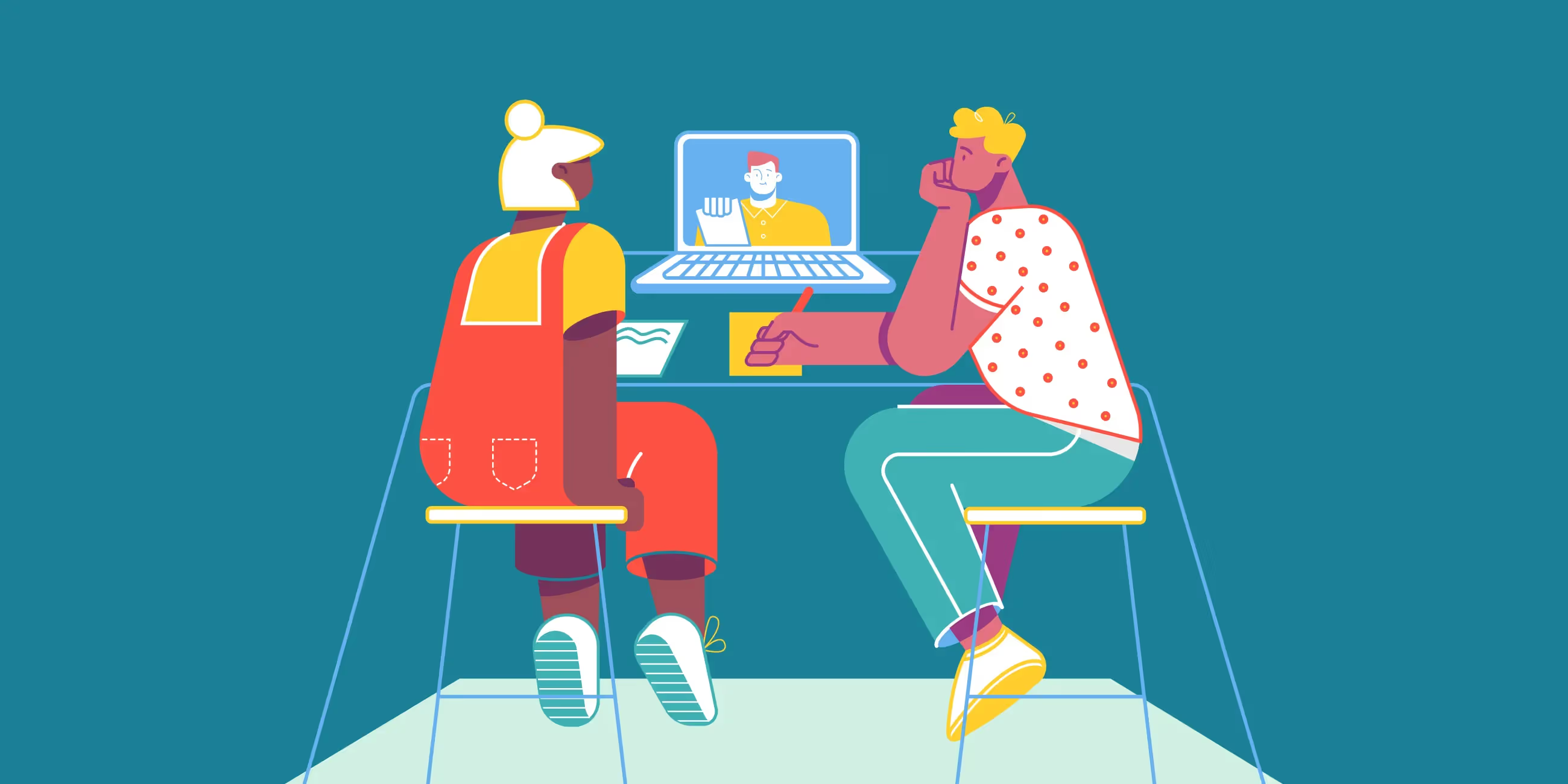
Designing Strategies for Businesses
In the ever-evolving world, people's needs are changing unprecedently across the globe. These changing needs are being led by unpredictability in the economical, social and emotional fronts.
Businesses need to develop new ways of strategizing and planning to find solutions to these unrehearsed problems. Creative strategies through the designer's toolkit can help businesses build resilience, improve, innovate and thrive.
"Design is not about making things pretty, it's not limited to aesthetics and trends. It's about solving problems with a humanitarian approach, also making them appealing at the same time."
Driven by the pandemic, design, and technological innovation the health industry is shifting entirely into the digital world, transforming people's experiences and expectations. The Rise of E-Learning is making education more accessible and providing a new source of optimism in the face of uncertainty.
Looking at some of these examples we understand that change has become fundamental, we need design-based strategies for future-proof businesses. This blog covers some of the most common and relatable problem-solving approaches from the designer's toolkit that can help businesses change, adapt and live up to people's needs in continuously changing business environments.
Problem Solving Approach
The problem-solving approach starts with the identification of the problem, its causes, and environmental factors that contribute to it. In the design process, a systematic analysis of the problem is done to identify what we have to live with and what needs to change. This approach results in the ideation and implementation of the solution. It also involves measuring the solution to justify that problem is solved to an extent.
The following points define different ways to follow a systematic approach to solve problems.
1. People-Centric Approach
All-inclusive research and analysis of the end-user, their surroundings, needs, desires, and environment is a fundamental approach to design, innovate, and build. The insights from this process of design guide the entire product journey.
2. Solving Complex Problems
Complex problems are overwhelming and we can solve them with a more focused approach. Breaking down complex problems into smaller parts enables us to understand and tackle issues without being overwhelmed.
3. Finding Systematic solutions
Thinking in systems can break down silos, encourage creative exchange, and foster progressive collaboration. This approach of creating systemic solutions is particularly effective when businesses face multiple challenges and require one modular solution.
4. Experiment and Play
All work, all play as the design process says, people-centered businesses should create a work culture where experimentation and its play is seen as a constructive tool for progress. This approach is particularly relevant for the ideation and acceptance of ideas in a nonhierarchical manner.
5. Learn from Failures
Design is not easily spooked from failure. Designers usually embrace failure as part of the learning, thinking, and making process. This approach requires removing the taboos around failure and mistakes to transform failures into mapping opportunities to progress and do better.
6. Envision
Designer's way of mapping multiple scenarios can help businesses define the goals and imagine a future based on their perspective and knowledge. Businesses of the new world need new ways to envision their way forward. The approach to imagine, envision, and thinking for the long term helps to construct successful strategies for the future. Imagination allows to push of limits and extract fresh ideas to also accelerate innovation in current work.
7. Speculate
A speculative approach to thinking allows businesses to imagine the future and collect insights into the present circumstances. Solutions derived from speculative thinking are focused on what people would want and demand from the products and services of tomorrow. It’s crucial to be aligned with the needs and desires of the people to ensure an open mind and a flexible approach to strategize careful plans.
8. Embrace Constraints
Every once in a while stepping out of the routine and breaking the rules help creative perspectives flow freely. Research suggests that limited resources and time constraints create an emergency that allows creativity and innovation to flourish. This creative experimentation can provide solutions with new mindsets and innovative processes.
In Conclusion
The problem-solving approach from the designer's toolkit makes the process of creating strategies exciting, motivating, and ambitious. It helps to turn problems into opportunities while also engaging employees in interdisciplinary collaboration.
Businesses that embrace failures and the attitude to experiment, play and adapt, learn from mistakes to strategize, operate and innovate with new ideas and a creative mindset. As Jeff Bezos also explained in his 2018 stakeholders letter, "If the size of your failures isn’t growing, you’re not going to be inventing at a size that can move the needle."
These different problem-solving approaches also help businesses create all-inclusive processes resulting in mutual benefits for all stakeholders while also preserving optimism through designing mindful strategies and creativity.

Inclusive Design: Build for all, By all
When we look at the world around us, from race to gender the identities are changing. As we envision the future, it can't work without inclusive design, and it makes us realize good design is not about visual aesthetics and trends. It's about taking a people-centered approach, creating functional, purposeful digital products that look beautiful and also solve problems while adding value by social inclusion and accessibility experience.
Digital empathy has always sparked innovation, audiobooks were invented for blind people so was the typewriter and the telephone and email were created keeping deaf people in mind. Pushing for more awareness and empowerment, designers and innovators have got accessibility to the fore, making the world equal for all.
Today, we see a rise in inclusive design among designers, brands, and businesses that have been working with the do-good design mindset. A mindset with which you not only improve the digital world for marginalized cultures but also focuses on how inclusive designs can impact the mass market.
In this blog post, we will be highlighting inclusive designs and developments with humanitarian solutions and non-compromising aesthetics.
- Swedish developer Victor Widell released a web code that simulates a scrambled reading experience. Inspired by a dyslexic friend's description of letters "jumping around", the website enables us to feel the extra barrier one might have to face daily.
- A dyslexic student himself, UK designer Daniel Britton created a font called Dyslexia by subtracting half of Helvetica.
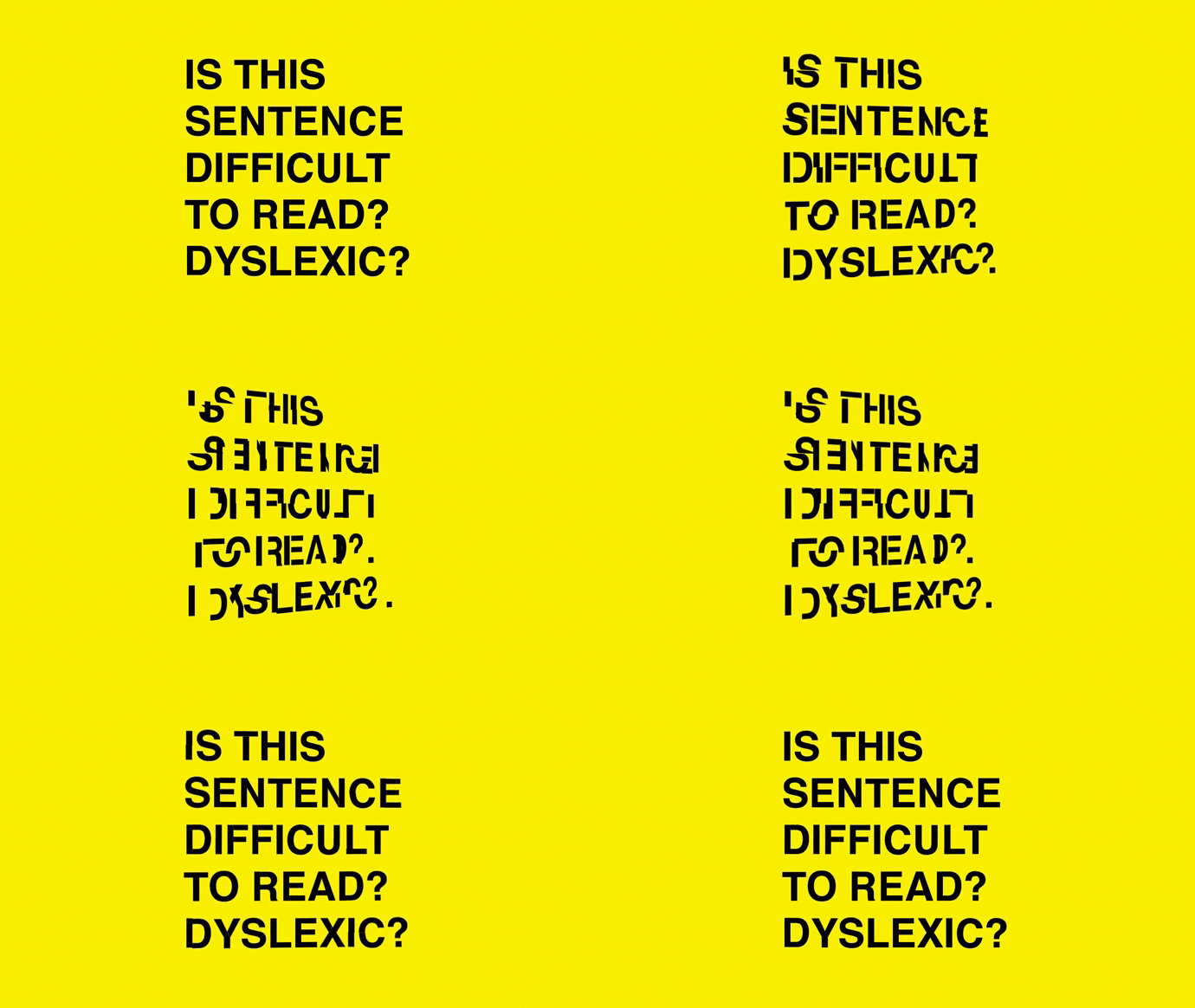
- Israeli design graduate, Yael Weiser's project SIGN offers an easier learning experience by gamification for the 70 million sign-language users who experience inadequate equivalents in digital content.
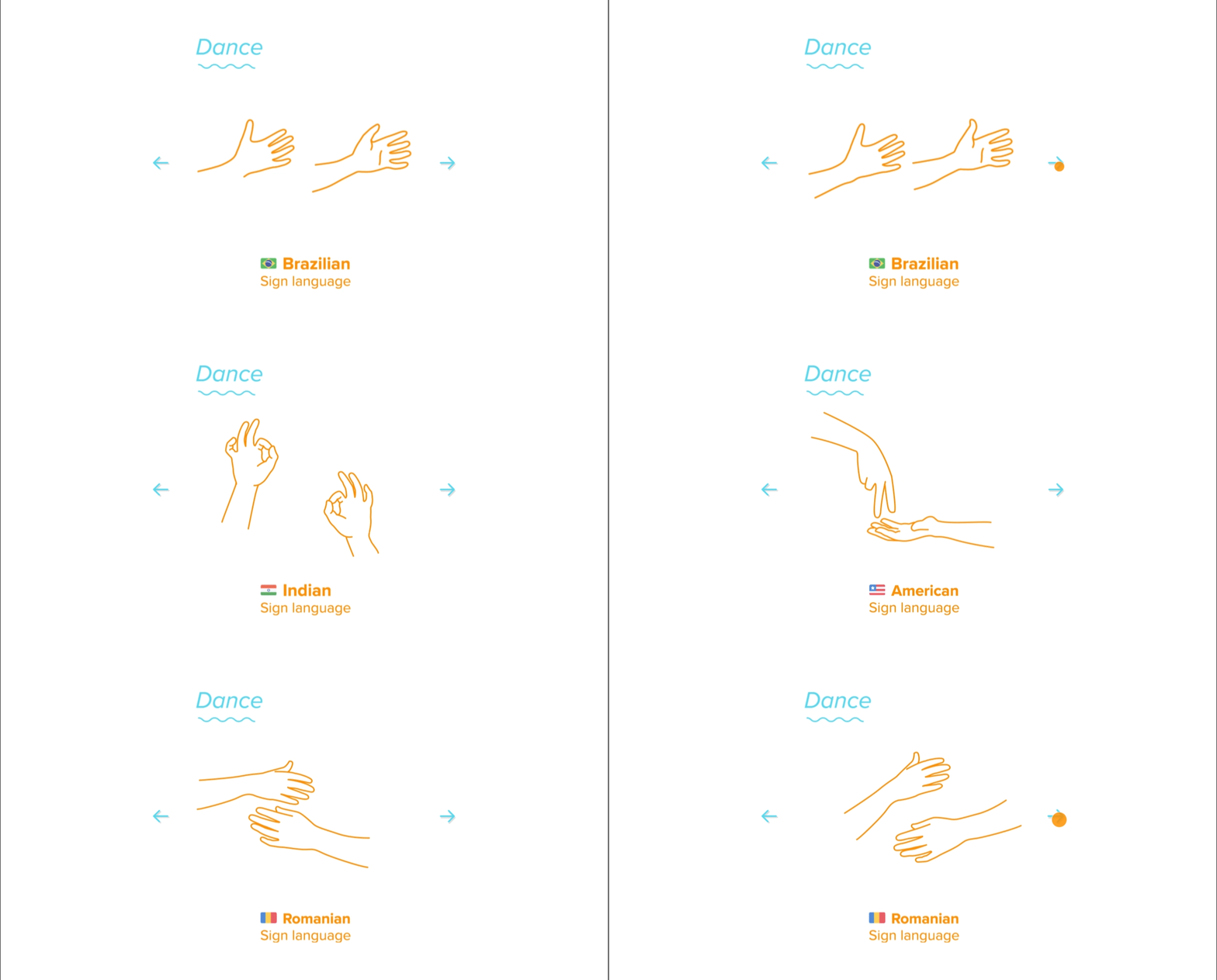
- Non-profit organization ASLized aims to increase web accessibility by releasing a sign-language keyboard app, Signily. Its GIF-based emoji enables lively digital communication among deaf people.
- LookTel launched the Money Reader app, which can identify more than 20 currencies and count bills, enabling a seamless payment experience for the blind.
- 1.8 billion images are uploaded to social media every day. To reduce the level of isolation, Twitter lets users add a text description to an image so that the visually impaired can have a better understanding of the content.
- To make browsing easy apps such as Briago, KNFB Reader, and TapTapSee can analyze and identify images quickly, and then deliver an audible description to the user.
- Matt King, a visually impaired Facebook engineer developed a new Automatic Alternative Text system that deciphers an image with an audible description.
- Action-adventure video game ReCore includes a color-blind mode, as the gameplay is strongly focused on color matching.
- Institute of Digital Fashion, developed imaginative solutions for a broken system to build digital narratives and create inclusive, more accessible experiences for everyone.
Due to large untapped demand, designers, innovators, and businesses are diving deep into accessible features and technology to give alternative experiences to all with the belief that everyone should have an equal and fair digital opportunity.
In Conclusion
Designing for everyone is creating for human diversity, inclusion, and equality. Everything that we design should be accessible and convenient for everyone to use.
Creative visual representation helps and encourages empathy for dyslexia. The gamification of sign language and inclusive designs are a part of a change for people who are deaf or hard of hearing. With tech creating new possibilities for everyone, more and more brands and businesses are investing in innovative designs for a more inclusive internet experience.
Inclusive design shouldn't be a movement we have to make way for, it's always been a part of creating, innovating, and designing. Brands and businesses can use this as a powerful strategy and take a humanitarian approach to design which has the potential to go beyond niche to the mass market.
Driven by new ideas, and the need for inclusive design is the responsibility of each designer and developer to create digital experiences for good, by the good. We call it the democratic approach to design. Designers and developers should lead that change and challenge themselves through functional and thoughtful digital experiences. From our research, understanding we see that the democratization of the digital world has already begun. It's up to us to take the lead and be the change an inclusive world needs.

Design Thinking and Remote Workshops with Prabudha Agnihotri
Powered by innovative thinkers, influential leaders, and creative networking platforms, switching careers is becoming safer via slow and steady progress. This change is not about perfection but realistic progress or slow changes that improve over time. This change is for happiness and contentment and something that we will get to see more with the changing definitions for work integration at home.
The second part of the podcast moves to Design Thinking, a process of change, a process that helps to innovate, strategize and create. Design thinking — a user-centric methodology that uses techniques borrowed from the designer toolbox, such as empathy, to generate innovative solutions and unexpected approaches to particularly difficult problems. Its value stems from its ability to innovate not only at the level of products but also it's capacity to forge new ideas and reimagine business operations and management models.
In this episode, we unpack the key elements behind design thinking and talk about conducting remote workshops and how successful they are in converting concepts into strategic actions for businesses. Let's Listen!
"Design thinking is not something that can be only used by designers, design thinking is there from a long time and all the great innovators in different sectors like literature, art, music and, business have practiced it. The good thing about design thinking is that you can systematically extract information. You can teach things, you can learn and apply human-centered techniques to solve business problems in a very creative and innovative way".
- Prabudha Agnihotri
Subscribe to Designwise on Apple Podcast or Spotify.
Transcript
Priyanka Jeph: Welcome to QED42's podcast designwise. I'm your host, Priyanka Jeph. And I'm a design writer at QED42. This is the second episode of the podcast and our guest today, Prabudha Agnihotri is a NIFT graduate in fashion and lifestyle accessories. He switched his career from designing physical products and entered the digital world of design and landed in microsoft as a UX Designer.
At present, he's working with ServiceNow as a senior UX designer. And we'll be speaking about his interesting journey today. We'll also be getting in details of design thinking, a process of change, a process that helps to innovate, strategize and create. Hello, Prabudha, welcome to the show. We're really happy and equally curious to know more and more about you. How are you?
Prabudha Agnihotri: Thank you for having me here. I'm good. How are you?
Priyanka Jeph: I'm good. Thank you. Um, so Prabudha the first question that comes to my mind when I speak with you is, you know, how did you arrive where you are as a UX designer? Would you like to tell us more about that journey?
Prabudha Agnihotri: Yeah. Um, I started my. Design journey with my bachelor's in NIFT, uh, which was in fashion and lifestyle, accessory design. Uh, initially I was working, uh, in leather accessories and products where I did accessories for some time. And then I got into leather surface treatments where I worked on carpets, uh, leather tiles. Furniture and other and many more leather products.
And it was really interesting because, uh, leather as a material is very interesting, because you can do a lot of things. You can do a lot of surface treatment and you can create a lot of texture onto that you can create a lot of, uh, surface modeling you can do, and you can. Use it in multiple products.
So it was very interesting, uh, where I worked and later on, I shifted into titan industries, uh, where I was working as a watch designer. I also did some of the trophies for some events. So it was really interesting because there, I got to explore different materials. I worked with ergonomics and sketching.
Uh, research was an integral part because I was working in Sonata and it was a low cost. Segment product where, uh, it was very important to know what users want. And we used to go to different parts of the country to understand what our users are actually looking for. What are their ambitions, what is their motivation?
So, um, that was another very interesting thing where I was able to use the knowledge I earned from the college and apply it into the product. And after that I joined Microsoft as a UX designer, and recently I've shifted to service now, and I'm working here as a product designer in UX space.
Priyanka Jeph: This is a very interesting, uh, journey and I would like to know, like know more about it. So how did you make that shift, you know, from the physical to the digital enterprise product?
Prabudha Agnihotri: Oh, yeah, that's, that's really interesting story because when I was working in Titan, I worked on a side project, uh, which was later turned into a startup and the idea was, uh, Disrupting the fine art market, because what is happening in country is that there are a lot of good, fine artists and they make amazing artworks, but they are not able to sell.
And I was thinking that probably I can create a market digitally where they can bring their products and sell them. Idea was really good. Probably I didn't have the right experience and I probably, I was not, uh, ready for that. And, but the good thing happened in that.,thing that I was exposed to UX as a field.
And the reason was that I was creating my own application and website and I met developers. I met a lot of people who were working in the UX field. And when I actually got to know about UX, I realized that this is something which I want to do and I found my fit. And I thought that this is it, this is what I want to do. So that's how I shifted from products to, uh, UX design.
Priyanka Jeph: That's nice. So, uh, what was it like, what was your experience to work with enterprises and how did it help you grow as a designer?
Prabudha Agnihotri: Yeah, and, uh, so when I joined, uh, UX design as a, as a profession and I started working, that was a transition period for me.
And there was a big learning curve as well because, uh, working in UX design is quite different from working in the product design industry, because, uh, you have to first know the product. You have to know the rules, you have to know the tools. So there are many things which I had to learn, which I was aware of, but many of the things you learn when you work on actual projects.
So there was definitely a learning curve, but. Uh, the good thing was that I was working in the service design segment where I was solving the real business problems and in that I got to work with different sectors like healthcare manufacturing, retail, automobiles. I also worked on some of the government projects and the, the type of work we were doing for different sectors was very different.
Although, uh, the process was the same, but. And there were different business problems and there were different solutions required because you cannot do the same things, what you were doing for government projects and for a conglomerate or for a corporate. So every time it was a new challenge, which was really good because every challenge was teaching me something and.
I also got a good exposure in the enterprise world because I attended a lot of seminars. I gave a lot of workshops, attended a lot of UX events. So basically it was a, uh, I would say a 360 degree development for me. And, uh, the benefit, uh, Of working in this service design enterprise industry was that I was applying the design thinking and design thinking was something which I learned in college, but never knew how to apply into a real product.
And this was the time when I was, uh, looking at it, how it was done and how, uh, the P colleagues of mine were doing. And then, uh, slowly, I also picked it up and I applied in multiple projects in solving real business problems, understanding what, uh, Empathy is how design thinking can be used in different types of challenges?
Uh, and there were a lot of mentors on that road who helped me. So, yeah. Uh, that's how I developed this skill.
Priyanka Jeph: So, um, as you said, like you've learned and you think design thinking is one tool that can help you solve a lot of problems. So that's what I want to get into next. Why do you think design thinking solves problems?
Prabudha Agnihotri: Yeah, that's, that's a really interesting one because, uh, Design thinking is something which people think it can be only used by designers, but that's not the truth because design thinking is, is actually there from long time and all the great innovators in different sectors like literature, art, music, um, business have practiced it.
And the good thing about design thinking is that you can systematically extract information. You can teach things, you can learn and apply human centered techniques to solve business problems in a very. Creative and innovative way, uh, clean in business, but also in your life for your country, for your, uh, Organization, you can solve problems.
So, and it's a very hands-on way of working, uh, where you meet people, you understand what their real problems are. You understand, you empathize and you ask questions. Basically, you get to the real problem. Not. Uh, surface level problem. So you go into the root, you understand where the problem is, then you apply the human centered techniques and, um, you apply empathy and that's how you get to a solution.
If you see, there are a lot of big names in the industry who have applied design thinking and they have grown like anything. Like Uber is one of the examples where Uber actually, uh, got in touch with their customers. Understood they are. Basic problems. And, um, one of the examples is that earlier people would have had to struggle a lot to get the change, to pay the drivers.
And then when they applied design thinking to the problem, and then they, uh, brought up the digital payments in their application. So that's how, uh, companies were growing, uh, through design thinking. And those are some of the examples which I can give, um, Although there are different methodologies people use in design thinking.
Uh, some people use UX lean canvas uh, where they have given a canvas based on the book. Uh, their theory is basically based on the book of Eric Rayes, uh, the lean startup and they have come up. Uh, with that lean UX canvas to, uh, solve business problems. Another way to do is, uh, jobs to be done, which was by Clayton Chris Denson.
Uh, he was a Harvard business school professor and, uh, he helped McDonald's to solve their business problem and how they can optimize their business. So that is also one of the ways to do that. Another way of doing it, which was vibrators and in school, uh, where you can. Uh, understand the business problem you diverged, and then you can wish for a problem statement and then you, again, are diverse towards solutions and then, uh, get, uh, converse to, uh, to one or two solutions for a problem.
So there are different ways of doing it. People choose it based on challenge, based on the environment and based on the team. Um, I think, uh, uh, All, all are very important in their own ways and all they are very effective. Uh, it depends what people use. And I personally prefer a double diamond mostly because it is, it works really well for me. Uh, and it helps release all the business problems.
Priyanka Jeph: Okay. Um, so the more I listen about it, the more I want to know. So how do you exactly implement the process of design thinking during a project and also at enterprise level? Like, what is the process of actually implementing it?
Prabudha Agnihotri: Yeah, I can, I can probably take an example of one of the projects which I've worked on, uh, when I was working in Microsoft and, uh, it was with one of the biggest conglomerate in the South Eastern Asian country and the, the problem which they gave us was that they wanted to increase their revenue.
Now, if you ask. Uh, as a designer to me, can you solve this? I will be blank about how I can increase revenue hammer design, where I can design something good on a paper or probably on the screen, but how can I increase your revenue? And this is when, uh, it is important. When I said that understanding business is very important for a designer, because if, as a designer, if I understand what business is, then I can probably solve complex problems and problems, which are not, uh, You know, we'll say directly that design something.
So when, when this problem came to us, uh, increase revenue. So, we thought about how we could do that. And again, the thing which strikes to us was, uh, design thinking is the way to do it. So we had a team of different people. Like I was from the design team. Then there was a project manager and there were people from tech teams, uh, engineering, so that they could help us with what we should actually do.
So we went, uh, to the country and met the people in the organization. And then we realized that first we have to align with the stakeholders. So basically stakeholders are the people who were, uh, giving us this work. And we want to understand from that, that, uh, is it the right problem we are solving or not, or why do they want to do it?
What is their motivation? What is the vision and what, what, what is the purpose they want to do it? Is there just money-making or there are other hidden agendas behind that or what they actually want from us. So I think the stakeholder alignment in the design process as a first part, where you go and understand what your stakeholders want.
Once you understand that, then you go into the process of design thinking. So when I was solving this problem, I used a double diamond where we took this business problem of increasing revenue as well.
Which is what we did. We did a lot of research where desk search was the first, uh, milestone for us, where we researched on cultural trends, we searched on economic trends, external internal trends. Like, if I talk about culture, why culturally, because every country works differently. Things which are working there probably will not work in Russia.
Right. So it is very important to understand the culture, why people do what they do. So. The first thing was that we will do the desk research. We understand we'll get some understanding and then we'll go into the field. So we did the cultural research. We understood the economy because if you're talking about revenue, that means somebody has to pay to increase this revenue.
So it was very important to understand how the economy of the country works, how much people earn, what are their spending habits. So we did a search on that. Then we understood that, uh, what are the technology trends? What other trade trends. And is there any recent event happening in the country or what is history, uh, So we, we decided on all those things and the best practices, who are the competitors, what are the rules and regulations of the country?
Is there any law which, uh, which is coming in the way? So we researched all of those things and we came up with some conclusion that these are the things which can, if you've worked on this weekend improve, but again, our desk research is. A secondary research, not a primary research, probably this was done by someone two years back, three years back and all the scenarios have changed, but this gave us some perspective.
So as a next step, what we did, we did the field research. Uh, in the field research, we actually met real users, uh, around 30 customers. We met and we did the interviews. So in that, the outcome of that field research was to understand the stories, because everyone has a lot of stories. And in those stories, people talk about their pain points.
People talk about their motivations, their ambitions. So that was the. Main thing, which we wanted to get out of that because we also wanted to validate what we learned in the desk research, as well as we wanted to understand what the customer wanted. So field research really helped us. And that was the point where we understood who all our personas, what are the main problems people are facing.
So we made a list of all those problems. Problems, uh, basically the problem statement. And then we, uh, we, we, we basically did an exercise where we thought that, okay, if these are the problems, how much effort will you give and how much, uh, Money. We have to spend so basically effort and money both on those two dimensions.
We understood that there's one problem. If we solve, we will be spending less money and we'll be creating more revenues. So that's how we came up to one particular problem statement. And that was a time when we converged. So that's how, if you see. The double diamond, the first diamond was closed. And then that was the point where we thought, now we have to be diverse again, to understand what solutions we can provide, because from the business problem, which was increasing revenues, we reached a problem statement where we had to improve the sales service. That was the problem statement. We came up with that. If we improve the sales service, we will be able to get more revenues because that's what we learned during the interviews that, uh, the sales people were not good enough. They didn't know about the product. So they were not able to provide the right information, things like that.
So we reached a conclusion that this is the problem we have to solve, and then we did a workshop, a design thinking workshop. Now this is a very important part. I believe in the design thinking process because this is where you get to the solutions and you understand what is important for the users.
So, um, a design thinking workshop is nothing but a workshop where you invite people from, uh, different. Age groups, different, um, sectors of the life, different income groups, basically your personas, you invite them in a small group, like six to 15 is the ideal number. And then, uh, we create this, uh, basically we have to prepare for this workshop because when you are inviting people, you are asking for the investment of their time.
And time is very important. Time is money for people. So. It should be very well planned. And if it is very well planned, then you will get the solution that you're looking for. So what we did, uh, that if I have to explain this, I'll probably go into four different, um, uh, topics. But before I go there, do you have any questions in between?
Priyanka Jeph: Um, I was just all this while wondering that it's like a very intricate process that has been followed in, uh, since, you know, we've, we've shifted completely remote. How are you actually managing these workshops? And, uh, are there any challenges that you're facing? Are you able to conduct them and, you know, get results the way you used to get it before? Uh, how is it happening now?
Prabudha Agnihotri: Yeah, that's, that's a really interesting question because, uh, when this pandemic started, we also had to face this problem because we were very well-trained or doing workshops offline, but then pandemic started, we couldn't move from our places. And then the industry was also, uh, You know, shifts really fast because as soon as it happened, there were few tools were available, but that came into, uh, use a lot because if you see zoom is something which, uh, gained a lot of popularity, uh, teams is getting a lot of popularity because of this.
So similarly there was a tool called Miro which we use for the workshops. And I would say that the ground rules have changed, but, uh, the, the crux is still the same. Earlier, we used to think about how we can, uh, well prepare for four different senses of humans, like smell, what kind of smell should be there in the room, uh, what kind of food we should serve so that people don't sleep in your full day workshop and. Things like that, but when you're working offline, you don't have to worry about that, but there are other challenges that come with that. That, uh, is the internet connection good. Uh, is the room noise proof, um, are people putting their phones on mute or not? Uh, do they understand the, uh, etiquettes of online calls?
Because it was not. common for everybody. Um, probably people who work in it industry, they understand it, but not everybody. So these are some of the things, uh, which we have to deal with. And those were some of the challenges. But, but if I, if I go back to the discussion, which I was having, where I was talking about the design, uh, that double diamond and design thinking.
So, um, whether it is offline or online, I think, uh, crux is the same, the ground rules are different. So. Uh, coming back to the discussion where I was, uh, we were into the create group where, uh, we were looking for solutions. So, uh, whenever we do these kinds of workshops, we basically, uh, first. Plan. And then we prepare for the workshop.
Then we run the workshop and then we close the workshop. Now I will talk about all the four pillars. So what happens when we, uh, plan a workshop? So first we have to understand what the topic is. So, uh, we already had the topic that we have to improve the sales service now, who are the right people for this workshop.
So we invited very carefully the people who can help us, uh, which were the customers of, uh, People who recently got the job, people who were experienced and were buying, uh, another, uh, such product or from different life of, uh, people we were inviting in that workshop. And then what is the size, how many people would you like to invite?
Uh, how much time would you like to give? Will it be three hours, half day, full day. So that is very important to plan. In advance. And what kind of activities will you do? When will you give the breaks? Uh, what is the purpose? What is the presentation style? Will, will it be digital? Will it be, uh, physical, uh, what kind of materials will we use?
So all those things are very important for planning and then comes. Uh, the preparation, uh, one day before, probably, or a week before we had to decide the space, but nowadays it's, uh, either zoom or teams. What channel would you like to use? Um, then you are basically ready with everything and you are over-prepared because in the workshop, there are people who are coming there and giving you your time, their time and.
If you are not prepared, that's not good. So you have to be over prepared, even if it is online or offline, because online also, if your internet connection is not good,probably you will not be able to do it. So what we do is we, we are always ready with two different internet connections so that if one doesn't work, another one is there for backup.
Similarly for the city as well. If something happens with electricity, we have the power backup ready because online, if you lose the connection, you lose the context many times. So that is very important for preparation and. Then, um, earlier we, we, we also used to prepare how far we should go, the washroom so that people don't go and vanish.
So now if you see it, that is also one of the benefits of this, that people don't vanish because they have to come back after five or 10 minutes, they cannot go out anywhere everybody's locked. Uh, so that that's one thing. And then what kind of, uh, material you will need earlier, we had to use. A lot of material, we have to invest a lot of paper, but now I think, uh, it is really nice that digitally, you don't have to waste any paper.
You can do everything on the miro board or on some tool. So that is also one of the benefits of doing it, uh, online. Uh, I also think that, um, When, when you do it digitally, like these days we are doing the good thing is that earlier we were not able to reach all the places. Like if something, some places are too far, or if there are restrictions, we are not able to travel there.
And then we used to ask some other team members to go there and do this workshop. So there was a problem of that sort, but online, you can write to anybody and you can do that workshop. So that is a good thing about running it virtually. So those are some of the things. And, um, we then come to the third part where we run the workshop.
So basically what we do is we set the tone, we set the expectation that what we want from this workshop. And we start with our intro in the agenda, what we are going to do, how the activity, activities, our plan. And at this point, basically we want to know what the journey of this customer is, how they are using the product.
And during that we understand and empathize that, okay, these are the problems. These are the things which we were not doing wrong, or we were doing wrong, or right. So we validate all those things. We ask for solutions from, from customers, if they want, what kind of a way they would like to handle this problem.
And we get a lot of good ideas in that, based on that we ideate and create things. Um, we also time track because again, even if it is. Virtually or physically it is very important to time track that too. It is so that you finish everything in time and entertaining people is very important. So, uh, when, when we run workshops, we make sure that we do some fun activities.
Also from time to time because, um, If it does a job, you will do it because you know what you're doing. But if you are coming for a workshop for you, it can be boring or it can be stressful. So we take care of that. We entertain people, we take pictures, uh, And nowadays we take screenshots and we leave some time for discussions that people can talk about things, what, uh, things they are understanding or what other ideas they have or if they have any conclusions.
So, uh, we always leave some time for discussion and which actually brings up a lot of, uh, insights to us. Uh, in the workshop, the important thing is to use a non verbal communication style. But now again, when we are online, uh, the rules again have changed. So we have to probably interrupt at times and we have to pause.
We have to change tone. We have to comfort some, uh, participants because it can be overwhelming for people. So those are some of the things we are doing and trying to maintain the same level, uh, virtually as well as, uh, When we were doing it offline. Uh, so those are some of the things we take care of. And, uh, so yeah, when, when we did this workshop, we got a lot of insights in this whole process.
And, as the last process, when we're closing up the workshop, uh, participants started summing up what they learned and what the industry, and they again gave us, uh, some. Uh, you know, uh, again, points and things to which they were thinking were not right. So we got a lot of, um, uh, Process related things.
We got a lot of pain points. We had a lot of ambitions, what people had. So those were some of the really good things. And then, um, since we are doing it virtually nowadays, so we don't have to digitize anything earlier. We used to take pictures of all the posters and everything, and we used to sit and write the art to digitize it so that we don't miss out.
So that is again, one of the benefits I think we have doing it virtually. And then we just, uh, send, thank you note and secure next time slot, because what happens is that in this workshop, we got a lot of information from the users and customers. Now, after getting this information, what we will do with the art.
So we, what we do is we take two days and we do some quick mock-ups. And that's what we did in, in this exercise also, where we got a lot of insights. Then we did quick mock ups in two days, and then we invited these people again for two hours. And we showed those mock-ups to these customers and asked, what do you think now?
Because they gave us a lot of information and it was our responsibility now to give them back something and we showed those mock-ups and they were really happy because they could see, uh, those mock-ups were solving their problems. And in return it was increasing the revenue for my customer, because if the problem is solved, they will do it.
Uh, word of mouth, uh, promotion, and they will come back. There will be a return customer. So if more and more people are coming to my shop or obviously my revenues are going to go up. So in this focus group discussion, uh, these customers gave us a lot of, uh, uh, Feedback again, that we can change a few things.
We can add things, we can probably remove a few things. So we did that and then, uh, we sent them back and we sat down again for two weeks and where we, uh, took all the feedback, took all the, uh, insights and created a better version of those mock-ups. And that was a starting point for us where we. Uh, in, in, in this whole process, we came up with one solution that if we do, uh, then probably we can solve the problem that you had earlier.
And then we presented it to our, uh, stakeholders and they were really aligned and happy. And then we also give them a roadmap. Uh, if we want to succeed, we have to do these 10 or 15 things in the first round, and then we can do a few more and a few more. And that's how we will grow as a product and as a, um, you know, conglomerate or as a corporate.
And then we will solve the real problems and we will get more revenues. So if you see, It took a lot of time to explain that, but it was really important to explain because, uh, The problem was a very straightforward business problem. Increase my revenue, but how the design process, and how design thinking helped me get to that solution was really interesting. I believe.
Priyanka Jeph: Yes. Uh, I completely agree. And, you know, after being touched by the pandemic, our ways of working might have changed, but the intent remains the same to understand the users and to grow business. And it is not possible without following a process that has the best design thinking.
Our Listeners are probably. And they for sure have learned a lot through what you had explained, and it was really nice of you to explain the whole process to us. So this is one last thing that I would like to understand . Um, you know, uh, does it also play a process like the design thinking process? Does it also play a major role in innovation and the product development process?
Prabudha Agnihotri: I definitely believe that because in any, uh, development process, you have to go through. Oh, sorry. Then activities and design thinking is one such beautifully crafted, uh, way of doing it because, uh, first you understand.
What the problems of their customers are. And then you try to come up with solutions. So I believe whenever innovation happens, it happens with design thinking and keeping in mind, because either you do it directly or indirectly people go through those steps where they understand, they empathize with the users, they understand their problems, their ambitions, based on that, they come up with a solution and, and, you know, uh, come up with that. So I believe design thinking is the key, uh, to innovation and product development.
Priyanka Jeph: Okay. Uh, thank you for that information. It was really insightful. Everything that you especially mentioned about the workshop, the way you mentioned everything in detail, that was, there were a lot of insights. The key insights that I took and I'm so sure that the listeners. I also took a lot of key insights from this. Uh, we're really glad that you took to time to speak with us and thank you for being on the show.
Prabudha Agnihotri: Thank you so much Priyanka, it was a pleasure for me.
Priyanka Jeph: So that was the conversation with Prabudha, which was nostalgic, expressive and focused on organic experiences about making a switch in career, implementation of design thinking and conducting life and remote workshops. Thank you for listening to us. This was Priyanka Jeph in designwise, from QED42.