All blogs
.avif "How To Optimize Your Website's Performance")
How To Optimize Your Website's Performance
Just like a good performing car is most sought after, in the same way, a performant website leaves a good impression on the users. Web performance is all about making websites fast, including making slow processes seem fast. Web performance is essentially an objective measurement and perceived user experience of a website or application. One can know a lot about a company/product through the website and its user-friendly interface and good performance.
Why does performance matter?
Users expect convenience, functionality, and speed. Delivering optimized website results in increased customer loyalty, higher search rankings, and enhanced user satisfaction. We know that fast-loading websites are preferred by users. But what you may not be aware of is how speed can impact the bottom line. Google-sponsored research shows that AMP leads to an average of a 2X increase in time spent on page (Learn more about AMP here).
Website performance impacts:
- User retention – High-performing sites engage and retain users better than low-performing ones.
- Customer conversions – Slow sites have a negative impact on revenue, whereas fast sites increase conversion rates.
- User experience – Performance is a foundational aspect of good user experiences. Knowing what we know about human behaviour, users will only tolerate low performing applications for so long before abandoning them.
- Users – Poorly performing sites and applications can also pose real costs for the people who use them. It is important to bear in mind that many of these users access the web through mobile LTE, 4G, 3G, and even 2G networks.
Check more about why speed matters here.
How does the browser render a page?
Before we jump on finding the hacks for making a website super fast, let’s try to understand how the browser renders a page. A browser reads the HTML text and builds the DOM Tree. Then it processes the CSS, checks if it is inline or an external CSS, and builds the CSSOM Tree from it. As these trees are built, the browser then starts working on the Render Tree. As the render tree is done. The browser starts painting the elements individually on the screen.
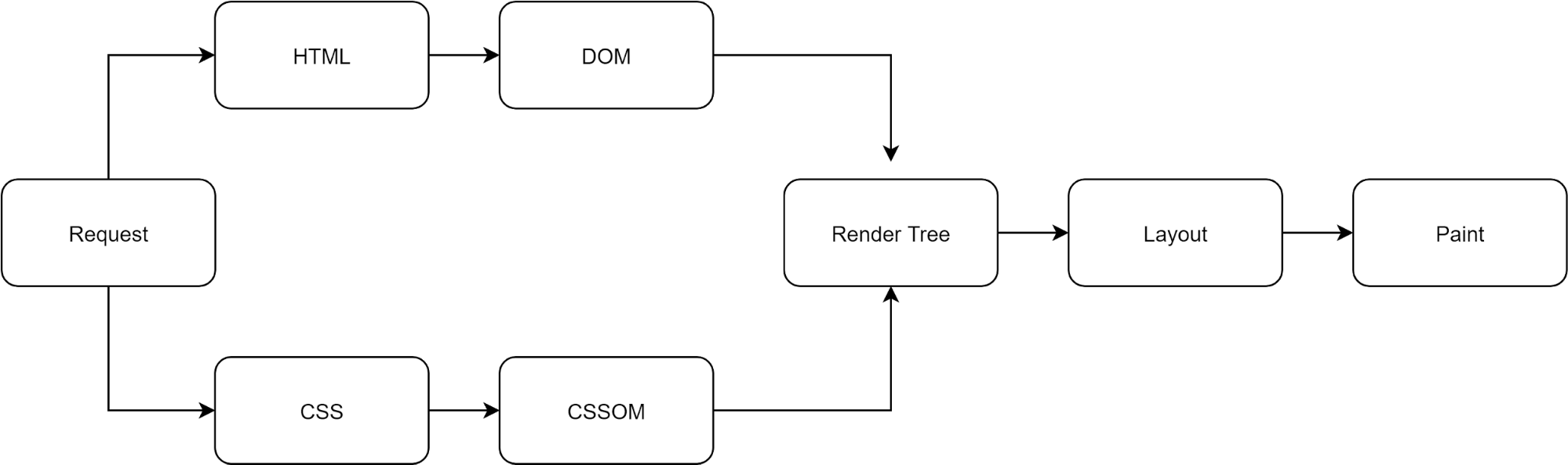
Critical Render Path
How do we measure the performance of a website?
Lighthouse – Tool for Web Developers
Most developers use Lighthouse to identify the improvements needed in their website. In Lighthouse 6 there are 6 matrices under the performance section that make up the score. Each of these metrics has its own weightage for calculating the ultimate performance of your site. The score for a particular website audit report generated by the lighthouse includes the following matrices:
- First Contentful Paint (15% weightage)
- Speed Index (15% weightage)
- Largest Contentful Paint (25% weightage)
- Time to Interactive (15% weightage)
- Total Blocking Time (25% weightage)
- Cumulative Layout Shift (5% weightage)
Note - PageSpeed Insights also uses Lighthouse in the backend.
WebPageTest – Website Performance and Optimization Test
WebpageTest gives you way more insights compared to Pagespeed Insights. This is one of the tools one should use when you need an in-depth report. Here are some other tools that are helpful when performing a performance audit:
- Dareboost: Website Speed Test and Website Analysis – Free test
- SpeedCurve: Monitor front-end performance
SpeedCurve integrates both WebpageTest and Lighthouse. It crunches the data to present in a really simple way. - GTmetrix | Website Performance Testing and Monitoring (GTmatrix also uses Lighthouse)
Responsible checkpoints of performance bottlenecks
There could be various bottlenecks that could make the website less performant. The most common ones are mentioned below:
- More usage of third-party libraries or widgets
- Usage of many non-minified scripts
- Not preloading the scripts
- Using heavy images
- RMiniendering unwanted CSS code
- Slow webfont delivery
How do I optimize my website?
When it comes to optimizing a website performance there are three things which are needed to be kept in mind:
Minimize the Amount of Data To Be Transferred
- We can remove unwanted things like, JS files that are not required for a particular page and which are only required to be added on specific pages.
- Any kind of CSS selectors which will never match any selector or the CSS which is not required in all the pages but for a specific page.
Note - Include only the things which are very much required for a particular page. And avoid including everything on every page.
- Secondly, we can deploy an automatic process for the minification of CSS and JS files. Which will remove comments and every character that bears no additional information (such as whitespace characters in JS). These tips will eventually reduce the size of the page.
Reduce the Total Count of Critical Resources
- After removing unwanted CSS files, there is still some scope for optimization. We will start by telling the browser that a specific CSS file is only needed for a specific device type or screen size. Let’s use the media attributes in this case. This will help the browser identify and reduce the critical resources needed for painting a page.
- Whenever a script is to be parsed, it totally blocks the whole process. Therefore let’s help the browser know that a particular script won’t affect the DOM, so it need not be blocking the process until it’s parsed. Scripts marked with async attributes do not block the DOM construction or CSSOM.
- In the same way, we can use defer attributes which help the browser know that the respective script will be loaded after the document is parsed.
Shorten the Critical Rendering Path Length
- This is something that needs to be kept in check throughout the development process of the site. Although the points mentioned above will eventually improve the Shorten the Critical Rendering Path Length too.
What are the various ways for tuning the performance of the website?
There are several ways to tune the performance of the sites. Below are some basic things which we need to do to make the site more performant:
Minification
Minification reduces the CSS and JS file sizes, which in return reduces the load.
Image optimization
Having all images optimized to their best size help in boosting performance.
Reduce the number of requests
Identify the number of requests from the networking developer tools tab of browsers and try to reduce the number of requests to third-party sites.
Preloading scripts
Another way to not block any DOM paint because of a script is to preload the required scripts.
Limit blocking requests
Still, there can be requests which can’t be preloaded. Identifying such requests and limiting them will help to improve the site loading time.
Intersection observer API
The Intersection Observer API provides a way to asynchronously observe changes in the intersection of a target element with an ancestor element or with a top-level document's viewport.
Conclusion
In this blog, we have covered the basic outline of the web performance from a frontend perspective. Stay tuned with us for a more detailed description of Lighthouse matrices, their importance, what each matrix means and more.

Designing Strategies for Businesses
In the ever-evolving world, people's needs are changing unprecedently across the globe. These changing needs are being led by unpredictability in the economical, social and emotional fronts.
Businesses need to develop new ways of strategizing and planning to find solutions to these unrehearsed problems. Creative strategies through the designer's toolkit can help businesses build resilience, improve, innovate and thrive.
"Design is not about making things pretty, it's not limited to aesthetics and trends. It's about solving problems with a humanitarian approach, also making them appealing at the same time."
Driven by the pandemic, design, and technological innovation the health industry is shifting entirely into the digital world, transforming people's experiences and expectations. The Rise of E-Learning is making education more accessible and providing a new source of optimism in the face of uncertainty.
Looking at some of these examples we understand that change has become fundamental, we need design-based strategies for future-proof businesses. This blog covers some of the most common and relatable problem-solving approaches from the designer's toolkit that can help businesses change, adapt and live up to people's needs in continuously changing business environments.
Problem Solving Approach
The problem-solving approach starts with the identification of the problem, its causes, and environmental factors that contribute to it. In the design process, a systematic analysis of the problem is done to identify what we have to live with and what needs to change. This approach results in the ideation and implementation of the solution. It also involves measuring the solution to justify that problem is solved to an extent.
The following points define different ways to follow a systematic approach to solve problems.
1. People-Centric Approach
All-inclusive research and analysis of the end-user, their surroundings, needs, desires, and environment is a fundamental approach to design, innovate, and build. The insights from this process of design guide the entire product journey.
2. Solving Complex Problems
Complex problems are overwhelming and we can solve them with a more focused approach. Breaking down complex problems into smaller parts enables us to understand and tackle issues without being overwhelmed.
3. Finding Systematic solutions
Thinking in systems can break down silos, encourage creative exchange, and foster progressive collaboration. This approach of creating systemic solutions is particularly effective when businesses face multiple challenges and require one modular solution.
4. Experiment and Play
All work, all play as the design process says, people-centered businesses should create a work culture where experimentation and its play is seen as a constructive tool for progress. This approach is particularly relevant for the ideation and acceptance of ideas in a nonhierarchical manner.
5. Learn from Failures
Design is not easily spooked from failure. Designers usually embrace failure as part of the learning, thinking, and making process. This approach requires removing the taboos around failure and mistakes to transform failures into mapping opportunities to progress and do better.
6. Envision
Designer's way of mapping multiple scenarios can help businesses define the goals and imagine a future based on their perspective and knowledge. Businesses of the new world need new ways to envision their way forward. The approach to imagine, envision, and thinking for the long term helps to construct successful strategies for the future. Imagination allows to push of limits and extract fresh ideas to also accelerate innovation in current work.
7. Speculate
A speculative approach to thinking allows businesses to imagine the future and collect insights into the present circumstances. Solutions derived from speculative thinking are focused on what people would want and demand from the products and services of tomorrow. It’s crucial to be aligned with the needs and desires of the people to ensure an open mind and a flexible approach to strategize careful plans.
8. Embrace Constraints
Every once in a while stepping out of the routine and breaking the rules help creative perspectives flow freely. Research suggests that limited resources and time constraints create an emergency that allows creativity and innovation to flourish. This creative experimentation can provide solutions with new mindsets and innovative processes.
In Conclusion
The problem-solving approach from the designer's toolkit makes the process of creating strategies exciting, motivating, and ambitious. It helps to turn problems into opportunities while also engaging employees in interdisciplinary collaboration.
Businesses that embrace failures and the attitude to experiment, play and adapt, learn from mistakes to strategize, operate and innovate with new ideas and a creative mindset. As Jeff Bezos also explained in his 2018 stakeholders letter, "If the size of your failures isn’t growing, you’re not going to be inventing at a size that can move the needle."
These different problem-solving approaches also help businesses create all-inclusive processes resulting in mutual benefits for all stakeholders while also preserving optimism through designing mindful strategies and creativity.

Is your new UX project getting you worried? Here’s how you can pick the right design partner.
Design is AS important for the success of your business, as the content and functionality. Unfortunately, Design is often an afterthought!
Every $1 invested in UX results in a return of $100
- Forrester
A good UX design will help you keep your customers happy, as well as bring success to your business. If users like using your website or product, they are more likely to come back and use it again. And this will lead to a sale. Without a good user experience, your business will suffer.
There might come many situations when YOU would look for a design company to partner with. Maybe you're launching a new business, or you think you need a brand refresh. You could be planning a strategic marketing campaign, or you probably are a design agency and want to partner with a UX design firm to help offload some extra work that might be pouring in.
Whatever your motive might be, you need some expert help.
But with so many companies competing in the market, choosing the right agency becomes a challenge. And you know you want to pick the most incredible partner from the best of them.
The question is - HOW are you going to take that decision?
Let’s look at a couple of criteria that you might think of when start creating the assessment criteria.
Would you consider LOCATION as one of the criteria?
Due to COVID-19, people are working remotely and almost everyone is open to picking agencies around the world. With teams scattered across the globe, people are managing overlaps in time zones very well. So in the current situation, the location might not be one of the assessment criteria for you.
The next highly sought after criteria are MONEY.
Is it going to be Cost or Budget that influences your decision? In most cases, you are NOT looking to save money when it comes to finding a partner who can play a huge role in making your business work and customers convert!
Money is important but that surely shouldn’t be the decision parameter. You need to be looking for a “reasonable” engagement and not the “cheapest”. You will understand what the reasonable cost is in your given situation when you speak to multiple agencies.
The golden rule of choosing any vendor or partner is -
“All things being equal, people will do business with and refer business to those people they know, like and trust.”
You need to look beyond the conventional or orthodox criteria and emphasize on identifying credible Design partners. The agencies you trust, who can act as a partner, and most importantly who understand your business goals and pain points.
Now, the difficulty lies in figuring out WHO you can trust. Every UX Design firm will have a strong sales process and they will be putting their best people, the best mock-ups, and the chosen designs upfront. They will all make very similar claims about being creative, engaging and having the most flawless communication and design processes. It’s hard to tell who is overplaying, and who's not.
Most companies are used to interviewing potential partners – asking them to deliver a presentation and written proposal. This is a conventional practice when interviewing a partner for technology, or even a Marketing agency. But this process breaks down when it comes to UX Design.
Let’s discuss some things YOU can do to make a worthwhile selection.
Define the business goals you want to achieve with this partnership
Let’s take a step back and think, WHY do you need help from a UX Design partner? If your answer is “because we want to add a visual wow” then we're not considering the root of the problem. Why do you need that visual wow? What do you think it will bring? should be the question.
People often believe that a website redesign or visual refresh is the business goal when in fact the real business goals are better user adoption, customer acquisition, improved support for sales and marketing, etc. The more clarity you have internally on your real business goals and the reason for bringing in a UX Design partner, the easier it is to settle on the type of partner you're looking for and to determine the selection criteria.
What is going to be your evaluation criteria?
Once you have defined the business goals you are looking to achieve from the partnership, it gets easier to list the evaluation criteria for your team internally. These criteria will be subjective to your specific business goals.
You should have your evaluation criteria ready before you go out looking for Design partners. This helps to amplify the differences among vendors and will help you narrow down the list of Design partners on those specific criteria that are important to your business.
- For example, if your company wants to launch a new app in the market and the business goal is to acquire new customers.
- In this case, the key factors you would be looking for could be
- Find similar success stories in their work they have previously done and their outcomes
- Similar industries they have worked with
User Experience Research Capabilities
A good UX Design vendor should be asking you upfront: “What are your business and product goals? How do you think UX Design can help? How will you select your partner?”
Many creative agencies excel in the visual/aesthetic part of UX Design. While the design aesthetic is a key aspect of a product, it is only a small part of the overall design solution.
For example, your company is looking to increase the number of registrations on your website. The insights on what will engage and drive users to register will come from techniques like paper prototyping, user research or contextual inquiry, and many other possible UX research methodologies. When deciding on a UX Design partner, we need to look for firms that include some form of user experience research in their approach.
Cultural Match
It’s no longer enough to choose a design partner solely based on their technical expertise and ability to deliver the project at hand. Since your Design partner will be serving as an extension of your team, cultural compatibility shouldn’t be overlooked.
When the goals and aspirations are highly aligned, the potential for seamless integration increases. This is what you look for when hiring a new employee, and the same diligence and thoughtful approach should be spent when choosing a new Design partner for your company.
Immersion Workshop
The best way to find out whether there is a good cultural fit between the companies is to ask them if they are willing to meet for a design workshop. Most UX Design engagements start with a creative workshop that involves a discussion on business goals and requirements as well as some creative thinking. Find out if they are open to arranging a half-day or full-day workshop to give you real insights into what working together will be like and if your respective cultures ‘fit’.
The best UX firms will embrace this opportunity, and use it to evaluate whether they think you are a cultural fit for them too!
You will be able to get a glimpse of their processes, design approach and methodologies. Good UX companies should be able to accurately describe design processes. You will know if they can reason and have a story backed-up with data behind the design decisions.
References
In addition to the immersion workshop, don’t be afraid to ask for at least a few customer references. If a vendor hesitates, that should raise a red flag.
Impartial references tend to be great sources of insight on how the firm really works, how they deal with conflict and unexpected challenges like time constraints, creative differences, etc.
Then make sure you call those references and ask questions such as:
- Was the Design agency punctual?
- How would you rate the quality of their services?
- If something went wrong, did they make it right?
- Would you work with them again?
Ability to provide Design Consulting
The design agency should be your business partner and not just another outsourced vendor. You need people who have enough knowledge and experience to spot potential UX blockers and identify further optimization opportunities.
It is important to have Designers on board who have the expertise to recommend operational services and professional advice when it comes to improving a design. This will create that clear difference where you will know when you have met an industry thought leader.
One of the signs of an outstanding UX agency lies in its ability to develop a UX that can unlock the potential of your idea and help you gain substantial competitive advantage.
How strongly do they emphasize business outcomes?
Look for business value in their case studies - lookout for how their projects managed to bring in value for the business. After all, there’s no point in a pretty website if it doesn’t help to draw in customers.
A UX team with varied skills
The value proposition of most design agencies revolves solely on their excellent UX design capabilities, but some agencies can offer a much wider variety of skills.
Experienced Design agencies provide more than just UI/UX design services. They also include UX strategy and planning, UX writing, workflow/functional design, workshops, branding, user research, and content strategy services.
When you are already working with a design agency, they are familiar with your brand and totally understand your business objectives. At any point in your engagement, your business might demand design expertise, correlated or not. You wouldn't want to repeat the entire process of discovery with another vendor to fulfil the extra demands in your product. A UX agency that offers varied design services will help you save time, effort and cost, by meeting your requests with their in-house team of experts.
Community Contribution
Community Contribution is a tool for you to gauge passion and stay up-to-date with relevant technology and trends. My contributions to the community, you are assured that the people you are going to work with are not only excellent at their skills but are also passionate about it.
To summarise, here’s the mantra to pick a right design partner for you - explained in three stages:
IDENTIFY - CULTIVATE - ACTIVATE
Identify

The first stage is to IDENTIFY. To identify the right Design vendor you may ask questions like:
- How long have they been in the industry? Ask why
- Why should you partner with them and not consider other agencies?
- What makes their business stand out compared to its competitors?
- Who are their clients?
Such questions will help you filter down to the Design partners who have the 'potential' to take your business to new heights.
Cultivate

At this point, you should have a list of potential vendors and you’d want to start cultivating the relationship with the selected agencies.
The answers you should be looking for in this stage —
- Does your vendor understand your industry?
- Does your vendor understand you, your business and your goals? Even if your vendor works in your industry, it's more important that your vendor understands you.
- Does your vendor know who your customers are? A good vendor not only cares about you but also cares about your customers.
- Does your vendor listen to you? There are some vendors out there who think they know it all. They lecture more than listen. These are not vendors you want to work with. You need someone who listens to you so they understand you.
- Is your vendor reasonably priced compared to the competitors? The key here is "reasonably priced" and not "cheapest"! After interviewing several vendors, you will have a good idea of what is reasonable.
- Is your vendor responsive? During the cultivation process, you should be corresponding with your vendor. From this experience, you know how responsive they are. Hint: If they are not responsive during the sales process, they will not be responsive after you hire them.
Now, how to cultivate? Here are some activities that will help you cultivate your relationship with the identified design vendors:
- Connect with the leadership on LinkedIn
- Engage with their leadership
- Invite them to your webinars and events, and attend their webinars/conferences
- If you like some of their recent work or project launch, set up a time to discuss their work and process
- Follow their top performer’s Dribbble account
- Invite them for guest blogs, write for them or they can write for you, i.e. if it is relevant
- Follow their social media accounts, stay up-to-date about the problems they are solving for their clients
- Add them to your mailing list, keep them informed about your brand and business growth
Make sure they are already learning about your brand and consumers.
Activate

Every interaction you have had while cultivating your relationship, you have taken something from each other, learnt and picked up something from one another, there has been a transaction of ideas.
Now, it’s just like pushing a button - when you have a design ask. By now, they have learnt about your company, your consumers AND are ready to bridge that gap and address your business goals and troubles, as they are truly prepared for it.
Conclusion
Choosing the right UX design partner can be overwhelming for most of us, especially those who aren’t familiar with the design process. But making the effort to translate your business goals and define the assessment criteria, could help you achieve profitable outcomes. Though such successful outcomes are not earned by just hiring a vendor - but it surely needs to start with a conscious engagement. Choose a partner whose skills align with your desired success, and you are certain to follow returns.

Basics of Writing Blogs - The Good Web Content Series
How do you write good web content? Good web content could be useful for some and not of any importance to many. There are many elements to the well-written web content, a well written about page, service page, the meta description, product description, career page descriptions but they are not the limit. An organized page with journal entries, information, stories as a blog page keeps the users consistently connected and engaged.
The good web content series is an attempt to write and create an informative collective of many topics, pages, and different kinds of content and copy that goes on a website. The first post in this series is focused on writing good blog posts.
Well written blogs are a tool for creating a strong web and social media presence. They are written to increase visibility, create a brand image, and show specific areas of expertise to the identified audience.
Before planning, creating, and writing content for the blog posts it is important to understand the three key questions and their explanations.
How do people search for Blogs?
Users mostly have two ways of finding the blog posts and to read content on your web page. First, if you are established as a content and information provider users come to your website directly or it's simple they find you through keywords. It's important to research for searchable and trending keywords before creating content for a blog post. Those keywords should also be a part of your blog title and should be edited and added to existing content.
How do people read Blogs on the websites?
Reading a book is different from how users read and consume content on the web. They take a quick impression while scanning the entire content. They usually read in parts and focus on the content they are interested in and skim the remaining content.
It's important to write content that is minimal, to the point and easy to understand. Another way to increase engagement is to add interesting sub headings and bold the insights and takeaways.
Why is it important to define your writing goals and organizational goals?
We know that the users are important but have you defined your goals, needs, and reasons for writing blog posts? What are the goals of your organization? and what are you attempting to achieve?
Are you blogging for business? Is it to make product sales? or deliver a service or create a brand image? you could be creating blogs for digital marketing campaigns, or to increase your presence. Every organization has different reasons, to begin with, content-based blogs. Defining those goals is important to aim at achieving them strategically. These details make up for your content calendar and help to show your area of expertise to the right audience.
According to the Hubspot blog post, The 4 Most Important Pages on Your Website (& How to Optimize Them) a blog page should be optimized keeping the below points in mind.
- Organize information on your blog clearly — Divide the information on the blog page in different and appropriate categories and sub categories. As design, events, technology, knowledge and learning, compilation, case studies, e-books, downloadable PDFs, newsletters and so on. This makes the search easy for the users once they are on the website and navigating it for information relevant to them. Separate the most recent ones, from the most popular and old content. This helps to makes sure that the right content gets the attention it needs.
- Include CTAs — Add a call to action button for subscriptions and other actions like downloadable files that are valid to the blog posts.
- Provide CTAs in the core design of your blog — Place the CTA intuitively. Read more in detail about the importance of CTA in How Design Influences the Conversion Rate of a Website.
What to do?
Understand your readers
Identify the audience who is going to read your blog before deciding what you want to write. Define the knowledge, information and story that the particularly identified audience would like to read. Write to the needs of the audience. Figure out the possible questions and answer them in a relevant way while providing valuable insights.
Identify the Keywords
The most important part of good blog content to attract new visitors are the keywords. Identify the words visitors are already looking for as this gives information about the keywords used to reach your website. Stay updated about trending words and analyze the keywords on the websites similar to yours. Use the Google Keyword Planner to find out the search volumes of keywords and stay updated about keywords forecast.
Research and search consistently for the keywords according to your planned content calendar and marketing campaigns and make sure to duplicate the most searched keywords to keep the visitors.
Create easy to scan content
Title, headings, subheadings, quotes, bold sentences are integral to creating an easy to scan blog post. Give the reader meaningful, clear, and direct information through bullet points, infographics, numbered lists, summaries, and overviews.
Write simple and easy content
Not everyone knows everything but they could be curious. How do you explain something to a non-expert? Find easy ways to write difficult terminologies, acronyms, and jargon with simple and clear expressions.
More than three to five sentences in a paragraph is writing for fiction. If you want your words to get more attention give them less, keep it short.
As explained in How to Use Short Paragraphs to Strengthen Your Writing short paragraphs are more readable on a screen and less text keeps readers’ attention.
Write authentic content
Authentic content will always keep the readers coming back to you. Keep your facts checked and accurate. Write like you mean it and like you are having a conversation with the reader. Build trust with your writing by providing sincere and straight information, a true insight into a story.
Mention the resource of your information. Mention yourself, let the readers know who are they talking to, and give credits where it's due.
Create a unique tone and voice
But a tone and voice that the readers can relate with.
Almost 2.75 million posts are published each day on WordPress alone. With so much of words being written and millions of blogs being published, how will your blog stand out with unique and different content? How are you supposed to sound? what to do when what you are writing may have or has already been written?
Simple, sound like yourself and your brand values. Combine your research, knowledge, experiences, and learning into a storytelling compelling content with the organizational goals and values.
The tone and voice are what communicates your uniqueness, your way of writing explains how you work, the efforts you put into making reading informative, fun, and knowledgable. This builds a relationship with your readers, they keep coming back for.
Keep it human
Have you ever wondered what makes your blog content more relatable?
People know when you pay attention to them, your readers are no different. Thoughtfully written content gives readers something to relate too and turns the information into a conversation.
Address the reader's problems before answering them. Explain the challenges and goals of solving the problem. Keep yourself inspired and go the extra mile to research for those answers. Infuse more real-life experiences and work examples in knowledge and informative content.
As explained in 17 Blogging Mistakes to Avoid in 2020, According to HubSpot Bloggers People want to feel like they're doing business with real people, not robots. So, get rid of the jargon. Make a pun or two. That's how real people talk -- and that's what real people like to read.
Give attention to what's working
If you have no idea who is reading your content, then why did you write it?
This may sound like it has come from a school teacher's vocabulary but studying blog analysis regularly is an unavoidable mathematics exam that everyone has to take to reach the next class.
Let's look at the statistics below.
- An overwhelming 77% of Internet users regularly read blog posts.
- Once you publish 21-54 blog posts, your traffic can increase by as much as 30%.
- Content marketing is 62% cheaper than traditional marketing.
- Blog posts with 6-13 word long headlines tend to drive more traffic.
Once you have the data available, it gets easier to make decisions and back up those decisions. As defined, analytics uses data and math to answer business questions, discover relationships, predict unknown outcomes, and automate decisions.
When you find something that's working, continue the improvements based on data and readers' responses.
Conclusion
Writing content is a way of telling a story that is informative, engaging, and interesting. A story that could be about any topic including product, service, and business. The story could be created to give insights about design or explain something tech. It could be about work culture, real-life experiences, learnings, and many other things.
When it comes to creating a content calendar and writing for a blog driven by strategy and research — do it with a purpose. Solve a problem, answer some questions, tell the story of your brand, and share your area of expertise by adding value to the readers' life.

How Design Influences the Conversion Rate of a Website
A company's conversion rate and revenue alignment are important for a successful website. The conversion rate is the ratio of total visitors who take desired actions. As a general categorisation, there are two different types of conversion — Macro and Micro.
Macro conversions include visitor's actions aimed at completing tasks which directly influence a company's revenue. Those actions include direct purchases, signing up, taking a trial, being directly contacted, filling out the contact us form and when somebody requests for a quote. Micro conversions are actions that accelerate macro conversions. It includes blog subscription, social media followers, case studies, e-books, reviews and views.
In short, If it doesn’t convert, it's not working. To make a website profitable and worth the hard work -- designers, the marketing team, sales team and business owners should be concerned about both micro and macro conversions.
Design plays the basic and the most important role to influence conversion. The design includes — looks, aesthetics, typography and the first impression of a website but it also includes usability, user engagement, key performance indicators, clear navigation based on data of user research, consumer insights, short term goals, long term achievements, marketing goals, persona profiles and design trend reports. In this post, we are going to cover 8 factors through which design and designers influence the conversion rates of a website.
Know the Goals
First things first, know your goals. Before starting a project, a designer should understand all the objectives of a business. A detailed stakeholder's interview and analysis of the information is the key beginning. Next step is to place the goals in the ladder of priorities — the main objective of the website, secondary and tertiary goals. The website should be designed on the basis of the priorities defined and associate programs and campaigns that serve these goals to make sure that the user sees exactly what needs to convert into leads.

Know your Users
Knowing the users is a comprehensive and multilayered activity. User research aims at collecting information about the potential target audience of the product. To know the users a designer has to turn into a researcher or work in parallel with the research team to get maximum information and it's analysis to create user-friendly design solutions.
The basic understanding of the users and getting deeper into details of the core users is vital for design. These are a few out of many things that define the user research -
- Who are the potential users and audiences?
- Gender segregation.
- What is their age group?
- Understanding the preferences of potential users.
- Understanding the psychological aspects.
- Understanding the demographics and the market.
Many important elements of the website are designed and derived by the analysis of the user research - like colors, style, layouts, emotional aspects and the basic sense of the interaction with the defined group. It makes the website more engaging. The visual outcome has the potential to create an original and recognisable style. It helps to get the website the attention it needs. If the landing page design is a challenge for the users to understand, the website will probably drive the users away.
Understand the Color Theory
Colors are predominant, are a source of information and evoke the right emotions in a website. People make up their minds within 90 seconds of their initial interactions with a website. About 62-90 per cent of the assessment is based on colors alone. Careful use of colors contributes only to differentiating products from competitors, influences moods and feelings and also the attitude towards the brand and its product.
Choosing the right color scheme for a website and creating a sense of aesthetic balance amongst landing page, backgrounds, graphics, headline, typography, buttons, borders, products, popups and more are an extremely important aspect to drive conversion.
The fact that designers should understand color theories is unarguable. Read the details of color theory in our posts about the same in An Understanding of Colors for UI Design. and From Hue to Color Story - A Basic Understanding of Colors.

Readability
A readable website with clarity, high-contrast typography and logical hierarchy of information makes it easier for the user to consume the content and understand the objectives of the website. A designer should make sure that the heading, sub-heading and important content is different from each other and still balanced through different fonts, font sizes and colors to look like a well-synchronised design. Fonts that are consistent on a website helps the user understand the motive behind them naturally.
Another important aspect of readability is the use of appropriate words. As per many surveys, the users have more choices and reduced attention span. This is where a good copy comes into play, good copywriting leads to a better website.
This is how good and appropriate copy influences to create a good design which leads to better user experience.
- An actionable and focused copy helps tell the complete story.
- Copywriting helps the user understand the needs.
- It helps to explain the next steps.
- Copy, voice and tone as an afterthought could misdirect the objectives.
- Copy elevates, directs and influences the success of a website.

Clear Navigation Flow
The simple the better. It's through navigation design that the user explores - enjoys the website and gets access to the important information. Overwhelming the users with many choices and complicated navigation can seriously impede a website's conversion rate.
From the breadcrumb menu to dropdown, tabs to everything on the website should be designed to achieve a simple, time-saving, user-oriented flow. The key to well-designed navigation is to keep the flow simple, easy to use, predictable and consistent.

Focused Call to Action
A well-designed call to action button is meant to be persuasive, intuitive and should motivate the user into the desired action. Call to action buttons are usually given a prime place in the website and are highlighted enough to sign up, downloads or make a purchase etc.
For the right placement of the call to action button, a designer should understand the user's goals and examine how each action progresses towards it. The key is to provide the right visual weight to all buttons and to make the flow intuitive.

Keeping up with the Trends
If the design is inclined towards trends, then trends have to be studied ahead of the season of the launch of the website. Trends go down very well with the design and the always-changing user mindsets.
- trends tend to exponentially increase in the popularity of a website over time.
- Since trends tail off after a specific duration they work best with campaigns, secondary and tertiary goals of the website design.
- Designing with trends facilitates the users with relatable content for that period.
- Trends give websites a conversion mechanism to expand their reach quickly.
- Trending designs have a quick way of becoming famous and increasing discoverability.
Conversion through trends has to be done quickly and should serve the period it is designed for. Trends wear off quickly but moving ahead with consistent trends often result in loyal members and visitors of the website.

Studying Analytics
One design doesn't fit all and can't be universally loved. A designer's goal should be to make the design intuitive, easy to access and well balanced. The analytics come in to understand what works and what does not. This helps a designer to prioritise design needs according to the users and the right metrics.
- Analytics show concrete problems, that design can usually fix.
- Analytics show user behaviours within diverse categories and regions which make design decision easier.
- With the analytics, every design decision has a valid reason and user data to back it up.
- Analytics insights help pay attention to the right details both negative and positive.
- Analytics show how design affects the numbers required.
- It's easy to learn the needs and unlearn the not requires aspects of the website.
- Analytics data answers very specific questions and helps to understand precise needs.
As an example to the above points, analytics show what are the buyers dropping and picking up from the website, it exactly shows how many visitors are converting into sales and which pages get the maximum attention span. It also exactly shows which users are not getting converted into sales or signed-in users and that helps in making the right improvement and enables testing with the real users which is what the while design is centred around.
Analytics should be aligned from the beginning of the project. Designers should not limit the research methods to get analytics. Mix and match the methods and processes, speak with the stakeholders to get the concrete data to solve the issues through design.
As with all the things online, new website designs, technology, devices and trends bring in different challenges with every project. There is no single way of creating a perfect website but an approach to prioritise the objectives, goals, users, aesthetics, usability, functionality, analytics and design trends are likely to yield intuitive and responsive design influencing conversion rate of a website.

Niche Social Networks – Why do they matter?
In the deluge of news about twitter, facebook and other social networks behemoths like MySpace we often fail to take into account the power of domain specific or niche social networks. What are they? – They are social networks which involve people with the same interest and these networks revolve around this interest. They operate on the principle that if you bring people with a similar interest together the selling will take care of itself. Let’s take a look at some of them.
LinkedIn can be put into this category as it’s a social network with the purpose of business networking for professionals. Wayn is a lifestyle and travel social network with a stated aim of uniting travellers all over the world. Then there is classmates.com, probably the first social networking website which helps people keep in touch with long lost friends with whom they once shared a classroom. These are just a few examples of a huge list of niche social networks. Then of course there is Ning which is a collection of more than 1 million social networks in itself.
Niche social networks help in eliminating a lot of noise from the system and help you target a specific audience. Also as a report from the Interactive Advertising Bureau shows that 66% of all internet users would click on online ads if they made sense to them. In traditional social networking sites people tend to block out the ads, only when the ads are personalized or context-driven are people interested. This again is much easier in the context of a niche social network.
So what are the implications? If you want to build a social network targeted to a specific group of people; go ahead build one but make sure it adds enough value for people to justify creating their profile in yet another social network. Be reasonable in the assumption that your user base might not be as huge as facebook. What is important is that you have the right kind of users. Also be mindful of the fact that your backers may not be with very deep pockets so have a sound business plan with ROI in mind. If you are seeking social media marketing for your brand or are a social media strategist, ignore Niche social networks at your own peril. With sites like Ning it’s very easy for you to build your own social network even with limited resources.
One might ask will such networks be deemed redundant in the future by the social networking giants. I don’t think so. They serve their own purpose and will exist side by side with the giants. So what do you think about niche social networks? Are they just more noise? Will they hold their place or will they eventually be blown out by the Facebooks of the world? Do let us know in the comments.