
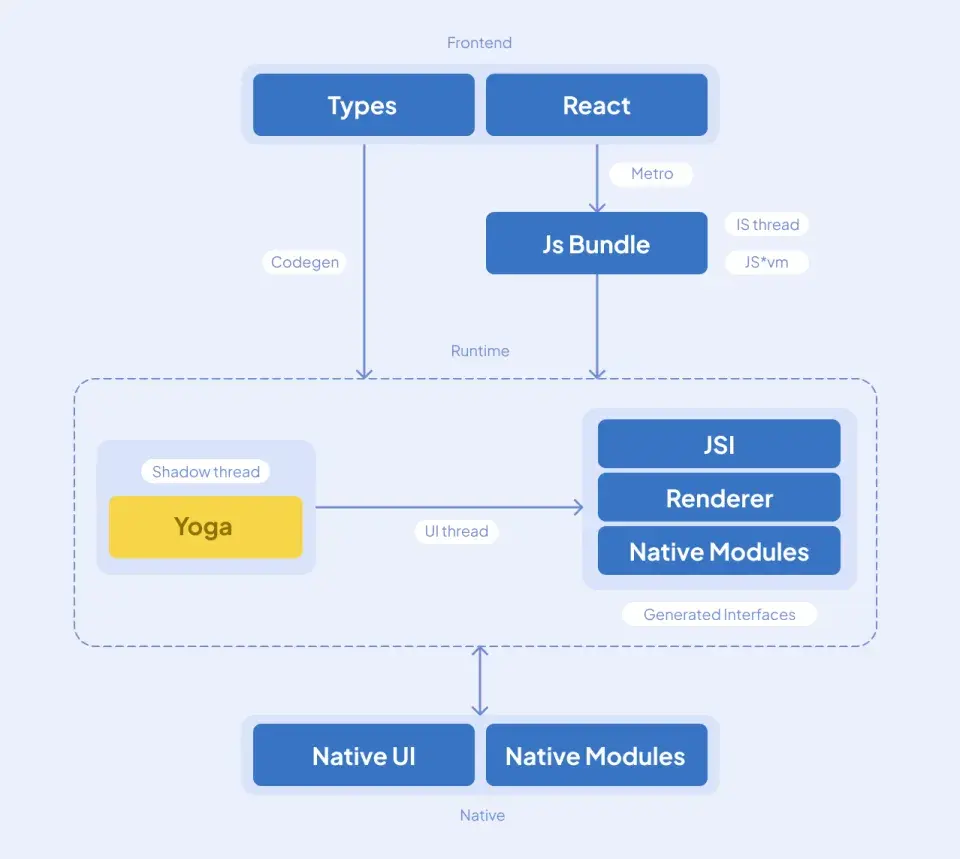
React Native is undergoing one of its most significant transformations since its launch with the adoption of the New Architecture. Built around Fabric, TurboModules, and the JavaScript Interface (JSI), this shift changes how JavaScript communicates with native platforms.
Earlier versions relied on a bridge that serialised data between threads, which often introduced latency in complex applications. The New Architecture removes that limitation by enabling direct communication between JavaScript and native code, resulting in faster rendering, better responsiveness, and lower memory usage.
For production-scale applications, this is more than a technical upgrade. It improves long-term scalability and stability. Fabric brings React Native closer to modern React concurrency, allowing smoother UI updates during heavy processing, while TurboModules improve startup performance by loading native modules only when required.
As businesses increasingly expect native-level performance from cross-platform frameworks, the New Architecture makes React Native more capable of supporting enterprise-grade mobile experiences.
Hermes engine maturity: why JavaScript performance in React Native has improved dramatically
Performance has historically been one of the most discussed concerns in cross-platform development, and React Native’s adoption of the Hermes JavaScript engine marks a decisive step toward solving it. Hermes is optimised specifically for mobile environments, focusing on faster startup times, lower memory usage, and predictable execution performance. Unlike general-purpose JavaScript engines, Hermes precompiles JavaScript into optimised bytecode during build time, reducing runtime processing when the app launches.
This improvement is especially noticeable on mid-range and low-end devices where resource constraints are more visible to users. Faster time-to-interactive metrics and smoother navigation flows directly translate into better user retention and engagement. Beyond performance gains, Hermes also improves debugging and profiling capabilities, giving development teams deeper insight into runtime behaviour. As mobile applications grow more complex, having a JavaScript engine tailored for mobile workloads helps organisations deliver consistent experiences across diverse hardware ecosystems.
React Native and React 18: the shift toward Concurrent Rendering
The alignment between React Native and React 18 introduces a new paradigm in how mobile interfaces handle rendering workloads. Concurrent rendering allows React to prepare UI updates without blocking user interactions, making applications feel significantly more responsive. Instead of freezing the interface during heavy updates, React can prioritise urgent interactions while processing background changes incrementally.
This shift is particularly impactful for applications with dynamic data, such as dashboards, social feeds, and collaborative tools. Users experience smoother scrolling and faster interaction feedback, even when complex state updates occur behind the scenes. For engineering teams, concurrency also encourages better architectural patterns by separating urgent UI updates from non-critical computations. As React Native continues to align closely with the broader React ecosystem, developers benefit from shared innovation across web and mobile platforms, reducing fragmentation and improving long-term maintainability.
Reanimated and the rise of native-level animations in React Native
Modern mobile applications increasingly rely on fluid animations and gesture-driven interactions to deliver premium user experiences. Recent advancements in libraries like React Native Reanimated have significantly changed how animations are executed. By leveraging worklets and running animation logic directly on the UI thread, React Native applications can achieve native-level smoothness without being limited by JavaScript thread performance.
This architectural improvement allows animations to remain responsive even during network requests or heavy computation. Complex transitions, gesture-based navigation, and interactive components now behave consistently across platforms. For product teams, this means design ambitions no longer need to be compromised due to performance constraints. The ability to deliver high-fidelity animations within a cross-platform framework strengthens React Native’s position in industries where user experience directly influences business outcomes.
The evolution of developer experience in React Native
Recent React Native releases have focused heavily on improving developer experience, recognising that productivity directly impacts product delivery timelines. Enhancements to the Metro bundler, faster refresh cycles, and improved error reporting have reduced iteration time during development. Developers now spend less time waiting for builds and more time refining features, which becomes increasingly valuable in large-scale projects.
Tooling modernisation has also improved compatibility with current Android and iOS ecosystems, reducing friction caused by outdated dependencies. Better TypeScript integration has encouraged safer codebases and easier refactoring, particularly in enterprise environments where multiple teams collaborate on shared applications. These improvements collectively signal a maturation phase for React Native, where stability and reliability are prioritised alongside innovation.
Expo’s transformation and its impact on React Native development
Expo has evolved from a beginner-friendly abstraction layer into a production-ready platform capable of supporting complex applications. With the introduction of modern build systems and deeper native integration capabilities, developers can now access advanced features without abandoning Expo’s streamlined workflow. This shift reduces setup complexity while preserving flexibility for custom native development when required.
For organisations seeking faster onboarding and reduced DevOps overhead, Expo’s ecosystem simplifies environment configuration and deployment pipelines. Continuous integration, over-the-air updates, and simplified asset management allow teams to iterate quickly while maintaining production quality. The growing compatibility between Expo and React Native’s New Architecture further strengthens its role as a viable solution for both startups and enterprises.
Why React Native remains strategically relevant in modern mobile development
As the mobile development landscape expands with alternatives like Flutter and Kotlin Multiplatform, React Native continues to maintain strategic relevance due to its ecosystem maturity and alignment with web technologies. Companies already invested in React benefit from shared knowledge, reusable architectural patterns, and easier cross-team collaboration between web and mobile developers.
The framework’s ongoing modernisation demonstrates a commitment to long-term evolution rather than short-term trends. Improvements in performance, architecture, and tooling show that React Native is adapting to industry demands while preserving developer productivity. For organisations balancing development speed with scalability, React Native remains a practical and forward-looking choice capable of supporting both rapid innovation and sustainable growth.